Top 8 Custom AI Model Development Companies Globally (2026)
Explore the top custom AI model development companies in 2026. Compare their expertise, AI capabilities, and services to find the right partner for your AI project.
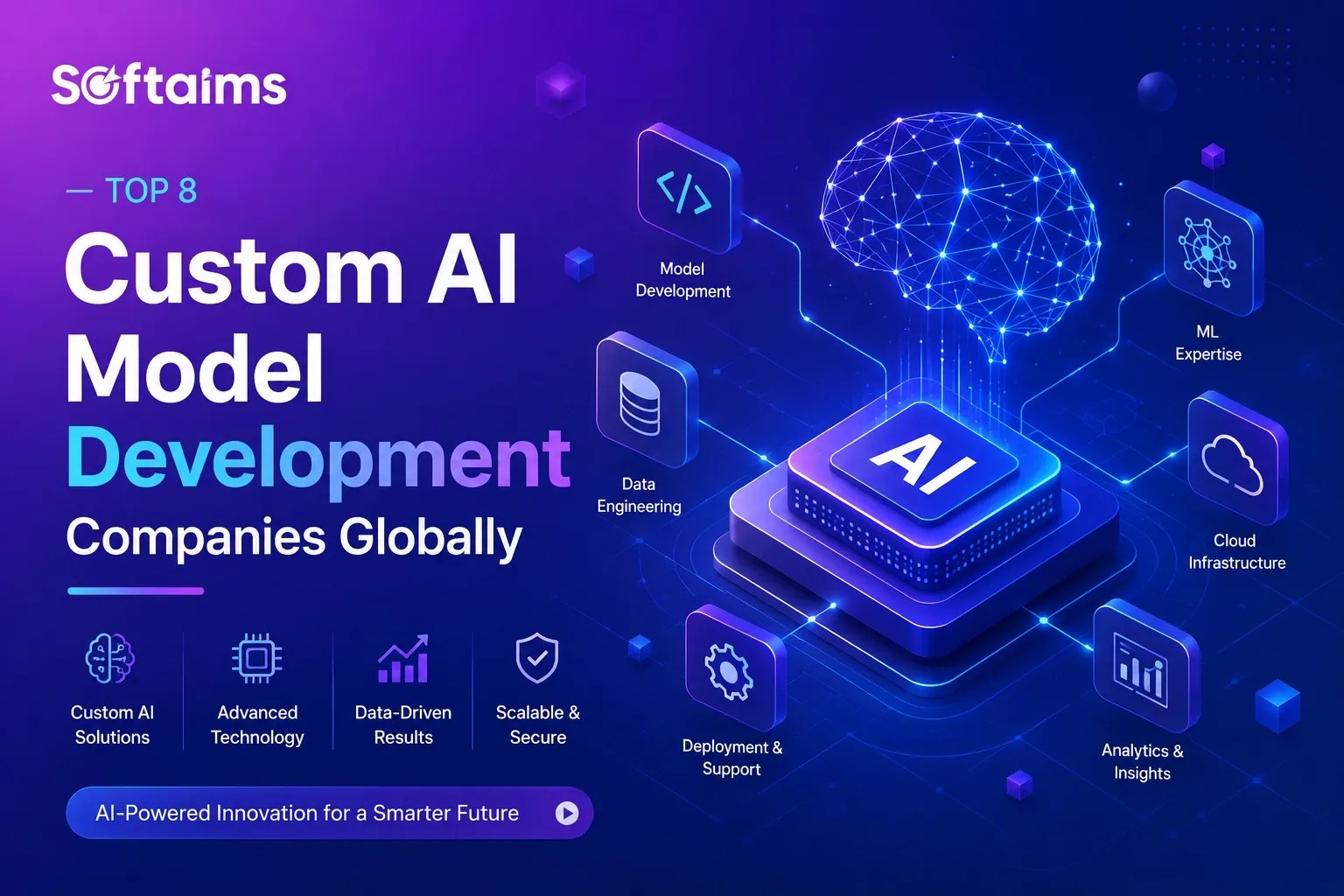
Table of contents
Key Takeaways
- Compare the top 8 custom AI model development companies in 2026.
- Learn when to build a custom AI model instead of using a pre-built API.
- Understand AI development costs, timelines, and deployment processes.
- Discover the importance of data quality, MLOps, and model monitoring.
- Compare expertise in LLMs, computer vision, NLP, and predictive analytics.
- Learn how to choose the right AI development partner for your business.
- Avoid common mistakes that lead to failed AI implementation projects.
When you're looking for a custom AI model development company, you're not just hiring coders. You're trying to find a team that understands your data, can build a model that actually works in the real world, keeps it accurate over time, and does it all without putting your data or your compliance at risk. The tricky part is that almost every software firm now calls itself an "AI company," so telling the real specialists from the marketing pages is harder than it should be.
Off-the-shelf AI, a general chatbot or a stock vision API, is fine for common tasks. But when accuracy, privacy, and fit with your own workflows matter, a model built or fine-tuned on your data is a real advantage. That's why demand is climbing so fast. Grand View Research expects the global AI market to reach about $1.81 trillion by 2030, growing at 36.6% a year, and the machine learning slice alone is on track for roughly $420 billion by 2030. With growth like that, the number of firms claiming AI expertise has exploded.
To make your search easier, this guide highlights 8 companies with a real track record of building custom AI models, from fine-tuning large language models to computer vision and forecasting. For each one, you'll see what they specialize in, who they're best for, and where they fall short, so you can pick the partner that fits your project.
The state of custom AI development in 2026
AI has moved from experiments and demos to production systems that businesses depend on. The shift now is toward custom and fine-tuned models, because a model trained on your data understands your business in a way a general-purpose one can't.
Custom AI work usually falls into a few buckets: fine-tuning large language models for a specific domain like law, medicine, or finance; building computer vision models for things like defect detection or medical imaging; creating forecasting models for demand, supply chains, or energy; and building recommendation and personalization engines. The best partners don't just train a model and walk away. They handle the full lifecycle, from cleaning and labeling data to deploying the model and keeping it accurate as the world changes.
One thing worth knowing before you start: a good custom AI project rewards specialists. Firms that can explain how they handle model drift, bias, and deployment tend to ship faster and rebuild less than firms that lead with buzzwords and headline rates. When you compare companies, weigh their engineering discipline as heavily as their portfolio.
How we ranked the top custom AI companies
Every company on this list was measured against the same practical standards, the things that decide whether an AI project makes it into production and stays useful.
Real machine learning depth. We looked for teams with genuine data science and ML engineering skill across large language models, computer vision, NLP, and predictive analytics, not firms that only wire up someone else's API.
Data and domain expertise. A model is only as good as its data and the problem framing behind it. We favored firms with strong data curation, labeling, and industry knowledge, because a medical or financial model needs people who understand the field.
MLOps and production discipline. Getting a model to work in a notebook is easy. Keeping it accurate in production is not. We prioritized firms that set up proper deployment pipelines, monitor for drift, and retrain when performance slips.
Governance, fairness, and security. For anything in a regulated or sensitive area, we looked for bias audits, explainability, and strong data privacy practices.
Track record and reviews. We favored firms with verifiable case studies, named clients, and consistent independent reviews on platforms like Clutch and G2 over portfolios that are long on claims and short on detail.
Comparison of the top 8 custom AI development companies
# | Company | Best for | Focus |
| 1 | Softaims | Custom models + vetted talent | Build or fine-tune, full lifecycle |
| 2 | Devaims | End-to-end AI products | Model plus the app around it |
| 3 | LeewayHertz | Generative AI & LLMs | Custom LLM apps, fine-tuning |
| 4 | InData Labs | Data science depth | Computer vision, NLP, predictive |
| 5 | Markovate | Custom ML architectures | Generative AI, ML products |
| 6 | NineTwoThree AI Studio | Idea to production | Rapid AI prototyping to product |
| 7 | DataRobot | Governed enterprise ML | AutoML + MLOps platform |
| 8 | Scopic | Healthcare & regulated AI | End-to-end, HIPAA/SOC 2 |
<sub>Clutch ratings come from public Clutch profiles as of early 2026 and can change, so double-check before you publish. The Softaims and Devaims scores are our own editorial call. DataRobot is a platform, so it is noted by its Gartner Magic Quadrant Leader status rather than a services rating.</sub>
The 8 custom AI model development companies
1. Softaims (Custom AI Models Built Around Your Data)
Best for: Businesses that need custom AI solutions built around their own data, workflows, and business goals.
Every AI project is different, so a one-size-fits-all model isn't always the right answer. Softaims builds custom AI solutions by assembling a team of AI engineers, machine learning specialists, and data experts based on your project requirements. Whether you need to fine-tune a large language model (LLM), build a computer vision solution, create a forecasting model, or develop a complete AI-powered application, the team is built around the skills your project actually needs.
With Softaims, you own everything that's built for you, including the model, source code, training data, and intellectual property (IP). There are no hidden platform fees or vendor lock-in, and pricing is based on the skills and technologies your project requires. If you'd like to understand the cost before getting started, you can check our pricing overview or book a free consultation for a custom estimate.
Key advantages:
- Dedicated AI team built around your project and business needs.
- Expertise in LLMs, machine learning, computer vision, forecasting, and AI applications.
- Full ownership of the model, source code, training data, and IP.
- End-to-end support from data preparation and model training to deployment and ongoing improvements.
- Transparent pricing with no hidden fees.
Limitation: Custom AI development is the best choice when you need high accuracy, privacy, or a model trained on your own data. If an existing AI API already meets your needs, that may be the faster and more cost-effective option, and we'll recommend that if it's the better fit.
2. Devaims
Best for: Businesses that want one team to build, launch, and maintain an AI-powered product.
Building an AI model is only one part of the project. It also needs to work inside your application, connect with your data, and keep performing as your business grows. Devaims handles the complete process, from AI model development and data integration to application development, testing, deployment, and ongoing support.
Key advantages:
- One team manages the entire AI product from development to launch.
- Builds both the AI model and the application around it.
- Handles data integration, APIs, testing, deployment, and maintenance.
- Good fit for AI-powered web and mobile applications.
Limitation: Devaims is best for businesses building AI into a software product. If you need advanced custom model training or research-focused AI development, Softaims is a better choice because it can build a dedicated AI team around your specific requirements.
3. LeewayHertz
Best for: Custom generative AI and large language model applications.
LeewayHertz is one of the better-known custom AI firms, with deep experience fine-tuning and building on models like GPT, LLaMA, and BERT, and its own platform (ZBrain) for building LLM apps on enterprise data. Strong across banking, healthcare, retail, and logistics.
The catch: Their center of gravity is generative AI and LLM apps, so for something like a highly specialized computer vision model, a vision-focused team may fit better.
4. InData Labs
Best for: Data science depth across computer vision, NLP, and forecasting.
With a decade of work and a US presence in Miami, InData Labs builds custom ML models and has real strength in turning messy, proprietary data into working predictions. Good for companies that need serious data science alongside engineering.
The catch: They're a data science specialist, so if you mostly need app development with a light AI layer, a broader product firm may suit you better.
5. Markovate
Best for: Custom ML architectures and generative AI products.
Markovate builds custom machine learning models, generative AI, and intelligent automation, with a focus on turning AI ideas into practical products and better customer experiences.
The catch: As a fast-growing firm, confirm the seniority of the specific team assigned to your project.
6. NineTwoThree AI Studio
Best for: Taking an AI idea from concept to a production-ready product.
A Boston-area AI studio that consistently ranks among top US AI firms on Clutch, NineTwoThree is strong at rapid prototyping and disciplined product engineering, good when you have an idea and need it shipped, not just researched.
The catch: As a focused studio, very large enterprise programs may be better served by a bigger firm.
7. DataRobot
Best for: Governed, auditable machine learning at enterprise scale.
DataRobot is a Boston-based enterprise AI platform and a Leader in Gartner's Magic Quadrant for data science and ML platforms. It offers AutoML, time-series automation, and a mature MLOps stack for regulated industries that need governance built in.
The catch: It's a platform, not a hands-on custom-build shop, so it fits enterprises that want to build and govern models on a proven stack rather than commission a fully bespoke one.
8. Scopic

Best for: End-to-end AI for healthcare and other regulated fields.
Scopic delivers the full AI lifecycle, from strategy and model development to deployment, and holds HIPAA and SOC 2 certifications along with AWS and Google Cloud partnerships. A strong fit for regulated industries that need secure, compliant AI.
The catch: Its strength is compliant, end-to-end delivery, so if you only need a quick research spike, a leaner studio may be faster.
Why choosing a custom AI company is hard in 2026
The AI market has a flood-the-zone problem. Almost every software firm added "AI" to its homepage over the last two years, so the label tells you very little on its own.
That creates three headaches. It's hard to tell a real ML team from a group wrapping someone else's API. It's hard to know whether a firm can handle the unglamorous parts, data quality, deployment, and monitoring, which is where most AI projects actually fail. And a wrong choice is costly, because a model that never makes it to production, or quietly gets less accurate over time, burns budget with nothing to show. A short, well-vetted list and a close look at each firm's engineering process beats browsing an open directory.
Which custom AI company is best for you?
It depends on what you're building.
If you want a model built on your own data and owned outright, with a team matched to your exact problem, Softaims is a great fit. You get vetted AI talent, clear pricing, and full ownership of the model and data.
If you want one team to build the model and the product around it, Devaims is a solid choice.
If you're focused on generative AI or LLM apps, LeewayHertz has deep experience there. For heavy data science across vision, NLP, and forecasting, InData Labs is strong. If you're a large or regulated company, ScienceSoft, Scopic, or DataRobot bring the governance and compliance you'll need. And if you have an idea you want shipped fast, NineTwoThree AI Studio is built for that.
How custom AI model development works
Good firms mostly follow the same lifecycle, and knowing it helps you hold a vendor to a real plan.
Discovery and data assessment. They define the business problem, check whether you have the right data, and decide whether the job needs a fully custom model, a fine-tuned open-source one, or an off-the-shelf API. This is where scope and feasibility get set.
Data curation and labeling. They gather, clean, and label the data, often the most time-consuming step, because model quality lives or dies on data quality.
Architecture and training. They choose or design the model, train it, and tune it, measuring against clear accuracy and performance targets rather than vague promises.
Evaluation and fairness checks. They test the model on held-out data, run bias and fairness audits where it matters, and validate that it holds up on real-world cases, not just clean examples.
Deployment and MLOps. They put the model into production, whether in the cloud or on edge devices, and set up pipelines for versioning, monitoring, and rollback.
Monitoring and retraining. They watch for model drift as the world changes and retrain on fresh data so accuracy doesn't quietly decay.
What does it cost to build a custom AI model
Custom AI cost depends mostly on how much clean data you have, how complex the model is, and how much of the work is deployment and integration. As a rough guide, an end-to-end custom model project usually runs about $50,000 to $400,000, from data prep through training and deployment. A focused fine-tuning project on an existing open-source model sits at the lower end, while a from-scratch model with heavy data labeling, edge deployment, or strict compliance sits at the higher end.
Two things move the number the most. The first is data: if your data is messy or needs a lot of labeling, expect that to add both time and cost, since some firms have their own annotation teams and others partner with labeling vendors. The second is infrastructure and MLOps, since a model that needs constant monitoring and retraining costs more to run than a one-off build. Most serious firms work on cloud platforms like AWS SageMaker, Azure ML, or Google Vertex AI, or on your own on-prem clusters if privacy requires it. As with most software, the cheapest quote is rarely the best value once you factor in accuracy, monitoring, and long-term support.
Demand is only heading one way. Grand View Research expects the enterprise AI market to grow at nearly 38% a year through 2030, so getting a model into production sooner, and keeping it accurate, is becoming a real competitive edge. If you want to size your own project before talking to vendors, Softaims' pricing overview is a good starting point, and you can book a free consultation for a scoped estimate.
How do you choose the right custom AI partner
Beyond price and headcount, a few things consistently separate a model that ships from one that stalls.
Look at the data science team, not just the sales deck. Ask who will actually work on your model, what they've built before, and whether they've shipped models to production in your kind of problem.
Check domain expertise. A medical or financial model needs people who understand the field, not just the math. Firms with relevant industry experience frame the problem better and get to accuracy faster.
Ask how they handle MLOps and drift. A model that isn't monitored gets worse over time. A good partner will explain their approach to deployment, monitoring, versioning, and automatic retraining without prompting.
Confirm fairness and governance. For anything sensitive or regulated, ask about bias audits, explainability, and how they validate the model against real-world cases. Vague answers here are a warning sign.
Nail down data privacy and ownership. Make sure you own the model, the weights, and the training data, with clear terms in the contract, and confirm how they keep your data secure during training.
Custom model or a pre-built API
One of the first decisions is whether to build or fine-tune a model at all, or just use a pre-built API. Off-the-shelf APIs are faster and cheaper, and they're the right call for common tasks where accuracy on your specific data isn't critical.
A custom or fine-tuned model earns its place when three things are true: you need higher accuracy on your own data than a general model can give, you need to keep sensitive data private rather than sending it to a third party, or the model needs to follow your specific business logic. Many companies do both: they use APIs for the easy parts and build custom models only where accuracy, privacy, or fit really matter. A good partner will tell you honestly which parts of your problem actually need a custom model.
Conclusion
There are more AI companies out there than ever, and that's both an opportunity and a trap. Any firm on this list can do strong work on the right project. The trick is matching the team to your problem, and caring more about data quality, deployment, and monitoring than about the buzzwords on a homepage.
If you want a model built on your own data and fully owned by you, made by a team matched to your exact problem, Softaims is the strongest place to start. Book a free consultation and get matched with vetted AI developers within 48 hours.
Frequently asked questions
Why choose custom AI over a pre-built model?
Better accuracy on your own data, full control over your data privacy, and a model that follows your specific business logic. For common, low-stakes tasks, a pre-built API is usually cheaper and faster.
How long does custom model development take?
Usually two to nine months, depending on how much clean data you have and how complex the model is. Fine-tuning an existing model is quicker; building and deploying a model from scratch takes longer.
What's the typical budget?
Around $50,000 to $400,000 for end-to-end development and deployment. Data quality, model complexity, edge deployment, and compliance requirements are what move the number most.
Do these firms handle data labeling?
Many do. Some have their own annotation teams, and others partner with data labeling vendors. Since labeling is often the biggest time cost, ask how they handle it early.
What infrastructure do they use?
Usually cloud platforms like AWS SageMaker, Azure ML, or Google Vertex AI, or your own on-prem clusters when data privacy requires it.
How do they make sure a model is fair?
Good firms run bias audits and adversarial testing, and validate the model on real-world cases rather than only clean examples. This matters most in finance, healthcare, and other regulated fields.
Can they deploy on edge devices?
Yes. Specialists use techniques like quantization and pruning to shrink models so they can run on wearables, cameras, and other edge devices instead of the cloud.
What about MLOps and keeping the model accurate?
Strong partners set up deployment pipelines, monitor for model drift, and retrain automatically as your data changes, so accuracy doesn't quietly decay after launch.
Which industries need custom models most?
Healthcare, finance, manufacturing, logistics, and entertainment lead the way, along with any business sitting on a lot of proprietary data that a general model can't understand.
How do I choose the right partner?
Look closely at the data science team, their experience in your industry, and how they handle MLOps and model governance. A short paid pilot is the best way to see how they actually work before you commit.


 GitHub
Aliaksandr C.

 Verified Expert in Engineering
My name is Aliaksandr C. and I have over 13 years of experience in the tech industry. I specialize in the following technologies: RESTful API, SQL, Java, Microservice, Amazon Web Services, etc.. I hold a degree in Bachelors, Bachelor of Computer Science (BCompSc). Some of the notable projects I’ve worked on include: A completely new back end that now powers job postings on Upwork, Online directory of healthcare providers, Warehouse Management System, Solution for calculation modes of metal cutting. I am based in Batumi, Georgia. I've successfully completed 4 projects while developing at Softaims.
I thrive on project diversity, possessing the adaptability to seamlessly transition between different technical stacks, industries, and team structures. This wide-ranging experience allows me to bring unique perspectives and proven solutions from one domain to another, significantly enhancing the problem-solving process.
I quickly become proficient in new technologies as required, focusing on delivering immediate, high-quality value. At Softaims, I leverage this adaptability to ensure project continuity and success, regardless of the evolving technical landscape.
My work philosophy centers on being a resilient and resourceful team member. I prioritize finding pragmatic, scalable solutions that not only meet the current needs but also provide a flexible foundation for future development and changes.

Leave a Comment
Need help building your team? Let's discuss your project requirements.
Get matched with top-tier developers within 24 hours and start your project with no pressure of long-term commitment.