10 Best DevOps Development Companies in the USA (2027)
Skip costly in-house hiring and technical bottlenecks. Here are the 10 best DevOps development companies in the USA for 2027; compared by services, costs, toolchains, and delivery models to help you release software faster and break less.
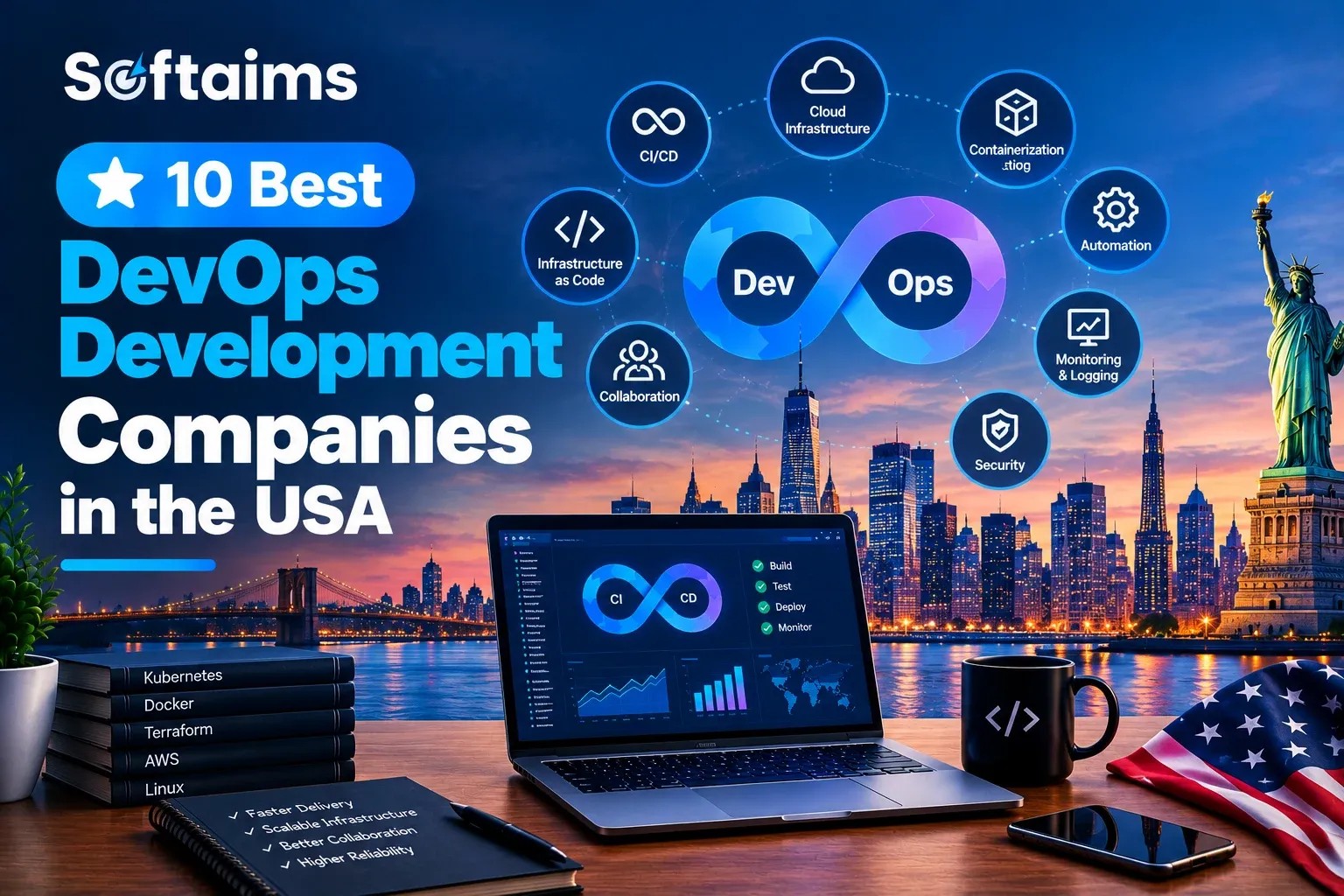
Table of contents
Key Takeaways
- US DevOps base salaries average $125K–$135K (reaching $168K+ in tech hubs like San Francisco), making external partners and flexible augmentation far more cost-effective.
- With 82% of container users running Kubernetes in production, enterprise demand centers on container orchestration, GitOps, and multi-cloud management (AWS, Azure, GCP).
- Partnering with top DevOps firms accelerates release frequency and improves DORA metrics, allowing teams to cut deployment lead times from weeks to hours.
- US businesses can choose between enterprise transformation consultancies, managed cloud services, and agile talent platforms (such as Softaims) that deploy vetted DevOps engineers in under 48 hours.
In US tech, speed wins, and DevOps is how the fastest teams get there. It fuses development and operations so code travels from commit to production in hours, backed by automation, testing, and monitoring. Standing that up in-house is hard, though. The talent is scarce and expensive, with a US DevOps engineer now earning $125,000 to $135,000 in base pay, and far more in senior roles. So plenty of teams hire a partner instead. The best DevOps development companies in the USA build the pipelines, cloud, and automation that let you ship faster and break less.
The numbers back the shift. The global DevOps market reached about $19.6 billion in 2026, up from $16.1 billion a year earlier, and is heading for $51 billion by 2031. Kubernetes is now mainstream too, with 82% of container users running it in production. So demand for firms that can actually deliver DevOps has never been higher.
This guide ranks the 10 best DevOps development companies in the USA for 2027, each with a line on who it suits. These are firms that build and run DevOps for you, not tools you buy off the shelf. Below the list, we break down services, real salary and rate data, the toolchain, and how to choose. Read it once, and you will have a shortlist.
Key Takeaways
Short on time? Here is the gist.
- The DevOps market is worth $19.6 billion in 2026, scaling past $51 billion by 2031.
- A US DevOps engineer earns $125,000 to $135,000 base, and up to $167,910 in San Francisco.
- 82% of container users now run Kubernetes in production, so Kubernetes skill is near-essential.
- Hiring a DevOps company often beats a full in-house team on both cost and speed.
- Softaims matches you with vetted DevOps engineers in 48 hours, a flexible alternative to a fixed agency contract.
What Do DevOps Development Companies Do
DevOps development companies in the USA help businesses ship software faster and more reliably. They build CI/CD pipelines, automate infrastructure, set up cloud, and put monitoring in place. So they handle the plumbing that turns slow, manual releases into fast, automated ones.
The work goes past tooling, though. The strongest firms also change how teams operate, bringing development and operations together around shared goals. So a good partner delivers culture and process, not just scripts.
The reward is speed with stability. When pipelines are solid and infrastructure is code, teams release more often and recover faster. So DevOps development turns a fragile release process into a dependable one.
Core DevOps Services
DevOps development companies offer a set of services, each with its own job. Knowing them helps you scope a project. The table shows the common ones.
Service | What It Covers |
| CI/CD | Automated build, test, and release pipelines |
| Infrastructure as code | Repeatable, versioned infrastructure |
| Cloud engineering | AWS, Azure, and GCP setup and management |
| Containers and orchestration | Docker and Kubernetes |
| Monitoring and observability | Metrics, logging, and alerting |
| SRE and reliability | Uptime, incident response, and SLOs |
Most teams need several of these together, though. A pipeline only helps if the infrastructure behind it is solid and observable. So the best DevOps development companies cover the full stack.
The DevOps Toolchain
A DevOps setup leans on a chain of tools, and the best DevOps development companies know them all. Here is the typical toolchain.
Category | Common Tools |
| Containers | Docker, Kubernetes |
| Infrastructure as code | Terraform, Ansible, Pulumi |
| CI/CD | GitHub Actions, GitLab CI, Jenkins |
| Cloud | AWS, Azure, Google Cloud |
| Monitoring | Prometheus, Grafana, Datadog |
| GitOps | Argo CD, Flux |
No single toolchain fits every team, though. A Kubernetes-heavy platform leans on GitOps and observability, while a simpler app leans on CI/CD and IaC. So check that a partner's tools match your stack.
DevOps Metrics That Matter
DevOps success shows up in the numbers, not the tool list. The industry-standard DORA metrics track how well a team actually delivers. The table shows the four.
Metric | What It Measures |
| Deployment frequency | How often you ship to production |
| Lead time for changes | How fast code goes from commit to live |
| Change failure rate | How often a release causes a problem |
| Mean time to recovery | How fast you recover from an incident |
A good partner moves all four in the right direction, though. Elite teams deploy many times a day and recover in under an hour. So ask any firm how it measures and improves these, not just which tools it runs.
In-House DevOps vs Hiring a DevOps Company
Should you build the team or bring in a partner? Both work, and the maths often favours hiring a firm. Here is how they compare.
Factor | In-House Team | DevOps Company |
| Cost | $125,000+ per engineer, plus benefits | Pay for what you use |
| Speed | Months to hire and ramp | Days to start |
| Skills | Limited to who you can hire | Full bench on tap |
| Scale | Fixed headcount | Flexes up and down |
| Control | Full | Shared |
An in-house team gives you full control and deep knowledge of your systems. It suits firms with a long roadmap and the budget to hire. The catch is time and cost, though, since DevOps talent is scarce and dear in the US.
Hiring a company suits most first builds and transformations. DevOps development companies bring pipelines, cloud, and automation on day one, and they flex with demand. You trade a little control, however. So many US firms outsource the setup, then hire to maintain it once it runs.
Benefits of Outsourcing DevOps
DevOps development companies deliver value in a few clear ways. Each ties back to speed, reliability, or cost.
- Faster releases. Automated pipelines cut deployment time from weeks to hours.
- Scarce skills. You reach DevOps, cloud, and SRE talent that is hard to hire.
- Lower cost. Nearshore and offshore rates run well below a full in-house team.
- Better reliability. Monitoring and IaC reduce outages and speed recovery.
- Proven patterns. Experienced firms reuse pipelines, security, and scaling setups.
The gains are measurable, too. Teams that adopt DevOps well ship more often, recover faster, and spend less on firefighting.
What to Look For in a DevOps Partner
DevOps development companies vary widely in depth and style, however. The strongest share a few traits. Keep this checklist close when you compare firms.
- Cloud depth. AWS, Azure, or GCP expertise should be proven, not claimed.
- Automation first. They should automate infrastructure and pipelines, not patch by hand.
- Security built in. DevSecOps and compliance should run through the work.
- Culture change. The best firms shift how your teams work, not just the tools.
- Clear proof. Ask for measurable gains in deployment speed and uptime.
A partner strong on these points saves you costly rework. So weigh them before you sign.
How We Selected These Companies
This ranking isn't guesswork. Each of these DevOps development companies in the USA cleared a clear bar, which keeps the list honest rather than salesy. It reflects our judgment, however, so treat it as a starting point.
Here is what we weighed:
- Real delivery. Every firm builds and runs production DevOps, not slideware.
- US footprint. We favoured firms based in or built around the US market.
- Cloud and automation depth. CI/CD, IaC, and cloud skill all counted.
- Track record. Client history, reviews, and years in the field mattered.
- Flexible model. Options from talent platforms to full consultancies added weight.
No firm tops every line, though. So each entry ends with a "Best for" tag to steer you.
At a Glance: The Best DevOps Development Companies Compared
Short on time? This side-by-side view captures all ten at once. It lines each firm up against its base, its core strength, and the job it fits best, so you can weigh them without scrolling. Pick two or three that suit you, then read their full profiles below for the detail.
# | Company | Base | Core Strength | Best For |
| 1 | Softaims | US / offshore talent | Vetted DevOps engineers | Building a flexible DevOps team |
| 2 | Devaims | Softaims-owned | Dev plus DevOps delivery | Software with DevOps built in |
| 3 | LeewayHertz | San Francisco, CA | Platform engineering and DevOps | High-speed containerized delivery |
| 4 | ScienceSoft | McKinney, TX | Compliant, stable DevOps | Regulated, risk-averse modernization |
| 5 | Rackspace Technology | San Antonio, TX | Multi-cloud managed DevOps | Enterprise cloud operations |
| 6 | Mission Cloud | Los Angeles, CA | AWS DevOps and managed | All-in AWS delivery |
| 7 | Simform | Orlando, FL | Product plus DevOps | DevOps alongside the build |
| 8 | Cprime | San Francisco, CA | DevOps and Agile transformation | Process and culture change |
| 9 | BairesDev | San Francisco, CA | Nearshore DevOps | Time-zone-aligned capacity |
| 10 | ClickIT | Dover, DE | DevOps for SaaS | SaaS startups on AWS |
The 10 Best DevOps Development Companies in the USA
With the basics covered, here are the picks. The ten DevOps development companies in the USA below run from a flexible talent platform to enterprise managed-services firms and cloud specialists. Each earned its spot on real delivery, cloud depth, and automation skill, however. The "Best for" line under each entry points you to the closest match.
1. Softaims
Softaims tops our list with a model made for fast DevOps work. Skip the long agency contract and get paired with the top 3% of vetted engineers inside 48 hours. So you can stand up or grow your own DevOps team in days, and for a slice of a US hire's cost.
That flexibility fits DevOps neatly. You can hire DevOps engineers to build pipelines and automate infrastructure, plus cloud specialists for AWS, Azure, or GCP. You can also add QA automation testers to keep your CI/CD reliable. Each engineer is vetted for genuine skill, not a tidy CV.
The engagement bends to your needs. Bring on one specialist or a whole pod, and they slot into your hours and process. So they feel like your own team, without a multi-year tie-in. You can browse available talent or check transparent rates before you commit.
Key highlights:
- Top 3% vetted DevOps and cloud engineers, matched in 48 hours
- CI/CD, IaC, cloud, and SRE skills
- Full pipeline-to-production delivery
- Flexible staff augmentation, no heavy minimums
Best for: US teams that want to build a flexible DevOps team fast, without a rigid agency deal.
2. Devaims
Devaims is a development studio that builds custom software with solid engineering practices. For DevOps, that means shipping products with clean pipelines, automated deployment, and reliable infrastructure from the start. So it fits firms that want DevOps baked into the build.
The August 2026 acquisition by Softaims brought the two together. Devaims clients now reach the same vetted network and 48-hour matching. One partner can carry software development and managed IT services, with DevOps running through both.
Key highlights:
- Software with DevOps built in
- Clean pipelines and automated deployment
- Backed by Softaims' vetted talent since 2026
- Development plus managed services
Best for: US teams that want DevOps built into their software from day one.
3. LeewayHertz
LeewayHertz, founded in San Francisco in 2007, sits where platform engineering meets modern DevOps. With more than 250 engineers across the US and India, it supports fast-moving enterprise teams deploying containerised software across cloud services. So it suits product teams that must move quickly yet stay stable.
The firm's edge is weaving platform engineering straight into delivery workflows, which keeps velocity high without losing reliability. It works well under tight budgets and scaling limits, and it holds ISO/IEC 27001:2022 and SOC 2 Type II, with 1,500-plus projects behind it. LeewayHertz suits teams going cloud-native, not those nursing monoliths or seeking legacy support. So it fits high-speed teams shipping containerised products.
Key highlights:
- Platform engineering plus modern DevOps
- 250-plus engineers across US and India
- ISO/IEC 27001:2022 and SOC 2 Type II
- 1,500-plus projects since 2007
Best for: US product teams deploying containerised software across clouds.
4. ScienceSoft
ScienceSoft, founded in 1989 and based in McKinney, Texas, is a steady choice for regulated enterprises that must modernise without adding risk. Where some vendors chase pure speed, ScienceSoft builds safety nets through test automation and mature DevOps process control. So it suits teams with compliance mandates.
With 750-plus IT specialists and ISO 9001, ISO/IEC 27001, and ISO 13485 certifications, it brings predictable costs and stable infrastructure. Its strength is performance optimisation and compliance, especially in regulated sectors. ScienceSoft suits firms that need reliable production environments over high-speed feature drops, which makes it a poor fit for early-stage experimentation. So it fits regulated, risk-averse modernisation.
Key highlights:
- DevOps process control and test automation
- 750-plus IT specialists
- ISO 9001, ISO/IEC 27001, ISO 13485
- 1,300-plus clients since 1989
Best for: US regulated enterprises modernising without introducing risk.
5. Rackspace Technology
Rackspace Technology, based in San Antonio, Texas and founded in 1996, is a public cloud and managed-services firm with deep DevOps capability. With around 4,250 staff, it runs multi-cloud operations across AWS, Azure, and Google Cloud, famous for its hands-on support. So it suits enterprises that want cloud and DevOps run for them.
The firm covers cloud migration, managed DevOps, and now generative AI through its FAIR practice. Its scale and multi-cloud reach stand out. Rackspace suits large organisations that want a single partner for cloud operations. So it fits US enterprises after managed, multi-cloud DevOps.
Key highlights:
- Multi-cloud managed services
- DevOps and cloud migration
- Hands-on operational support
- Enterprise scale
Best for: US enterprises wanting managed, multi-cloud DevOps operations.
6. Mission Cloud
Mission Cloud, based in Los Angeles, is an AWS-focused cloud and DevOps firm with top-tier Amazon credentials. An AWS Premier Tier partner, it handles cloud migration, DevOps, and managed services, all built around AWS. So it suits teams all-in on Amazon's cloud.
The firm covers CI/CD, infrastructure automation, and cost optimisation on AWS, plus ongoing managed operations. Its deep AWS specialisation is hard to match. Mission Cloud suits mid-market and enterprise teams modernising on AWS. So it fits US firms that want serious AWS DevOps and management.
Key highlights:
- AWS Premier Tier partner
- DevOps and cloud migration
- AWS cost optimisation
- Managed operations
Best for: US teams going all-in on AWS DevOps and managed services.
7. Simform
Simform, based in Orlando, Florida, delivers product engineering and DevOps under one roof. It builds software and sets up the pipelines, cloud, and automation to run it. So it suits teams that want DevOps alongside the build, not as a separate contract.
The firm covers cloud engineering, CI/CD, and infrastructure, with a strong product-delivery focus. Its combined model keeps build and operations aligned. Simform suits firms building a product that needs solid DevOps from the start. So it fits US teams wanting development and DevOps together.
Key highlights:
- Product engineering plus DevOps
- Cloud, CI/CD, and automation
- Combined build-and-run model
- Strong cloud practice
Best for: US teams wanting DevOps alongside product development.
8. Cprime
Cprime, based in San Francisco, is a DevOps and Agile transformation consultancy serving large enterprises. It helps organisations modernise how they build, blending DevOps tooling with Agile process and culture change. So it suits firms that need transformation, not just scripts.
The firm covers DevOps, platform engineering, Agile coaching, and product consulting. Its focus on process and people sets it apart from pure tooling shops. Cprime suits enterprises reshaping their engineering practices. So it fits US firms after DevOps and Agile transformation together.
Key highlights:
- DevOps and Agile transformation
- Platform engineering and coaching
- Process and culture focus
- Enterprise clients
Best for: US enterprises reshaping engineering process and culture.
9. BairesDev
BairesDev, based in San Francisco with Latin American delivery, provides nearshore DevOps through staff augmentation and dedicated teams. It draws on the top 1% of Latin American talent, working in US time zones. So it suits firms wanting time-zone-aligned DevOps capacity.
The firm supplies DevOps and SRE engineers who embed in client teams. Its nearshore model blends quality with strong overlap. BairesDev suits US firms wanting flexible DevOps capacity without an offshore time gap. So it fits teams scaling DevOps with nearshore talent.
Key highlights:
- Nearshore DevOps and SRE
- Top 1% Latin American talent
- US time-zone overlap
- Staff augmentation and dedicated teams
Best for: US firms wanting time-zone-aligned nearshore DevOps.
10. ClickIT
ClickIT is a DevOps and cloud services firm focused on SaaS and software companies, with US registration and nearshore delivery from Mexico. An AWS partner, it builds CI/CD pipelines, Kubernetes setups, and cost-optimised cloud infrastructure. So it suits SaaS teams that want DevOps tuned for the cloud.
The firm specialises in helping SaaS startups and scale-ups deploy faster and run leaner on AWS. Its nearshore model keeps rates accessible with strong time-zone overlap. ClickIT suits growing software companies that need DevOps without enterprise minimums. So it fits US SaaS startups and scale-ups on AWS.
Key highlights:
- DevOps and cloud for SaaS
- AWS and Kubernetes focus
- Cost-optimised infrastructure
- Nearshore delivery
Best for: US SaaS startups and scale-ups building DevOps on AWS.
How the Top US DevOps Firms Compare
The "At a Glance" table sorts the field quickly, but DevOps development companies split most on model and scale. This one digs deeper, into what shapes most engagements.
Company | Model | Scale | Sweet Spot |
| LeewayHertz | Platform engineering firm | Mid-large | Containerised delivery |
| ScienceSoft | Full-service IT firm | Mid-large | Compliant modernisation |
| Rackspace | Managed services firm | Very large | Multi-cloud operations |
| Mission Cloud | AWS specialist | Large | AWS modernisation |
| Simform | Product plus DevOps | Mid-large | Build-and-run together |
| Cprime | Transformation consultancy | Large | Process and culture change |
| BairesDev | Nearshore staff aug | Large | Flexible DevOps capacity |
| ClickIT | DevOps for SaaS | Mid | SaaS on AWS |
No firm wins every row, though. The big managed-services firms suit enterprise operations, while leaner firms suit speed and focus. So match the model to your project's size and pace.
How Much Does It Cost to Hire a DevOps Engineer in the US?
DevOps development companies price by scope, seniority, and location, but the baseline is the engineer's own cost. A US DevOps engineer is one of the best-paid roles in tech, and pay climbs steeply with experience. The table below shows typical 2026 base salaries by level.
Experience Level | Base Salary (2026) |
| Junior (0-2 years) | $80,000–$110,000 |
| Mid-level (2-4 years) | $110,000–$145,000 |
| Senior (4-7 years) | $145,000–$200,000 |
| Lead / Staff (7-10 years) | $200,000–$280,000 |
| Principal / Architect (10+ years) | $250,000–$400,000+ |
Source: Built In, Salary.com, ZipRecruiter (2026)
Location moves the number just as much. A DevOps engineer in San Francisco or New York earns far more than one in Denver or a smaller market.
City | Average Salary (2026) |
| San Francisco, CA | $167,910 |
| New York, NY | $154,975 |
| Los Angeles, CA | $148,717 |
| San Diego, CA | $145,245 |
| Denver, CO | $137,223 |
When you hire a company rather than a person, pricing shifts to hourly rates, and location still drives them. The table below shows typical rates for engaging a DevOps firm.
Region | DevOps Rate (2026) |
| US onshore | $65–$90/hr |
| Nearshore (Latin America) | $40–$65/hr |
| Eastern Europe | $40–$60/hr |
| India | $30–$45/hr |
So the gap is wide, and it explains the appeal of nearshore and offshore delivery. A vetted talent model closes it further. Teams that hire DevOps engineers through Softaims reach senior talent below US rates, matched in 48 hours. So you can staff your DevOps your way, without a rigid agency contract.
DevOps Engagement Models
Beyond who you hire, you also pick how you engage. Each model suits a different need. Here are the common ones.
Project-based work fits a defined setup, like building a CI/CD pipeline or a cloud migration. A dedicated team suits ongoing DevOps that grows with your product. A managed or consulting model suits firms that want the partner to run operations end to end. So match the model to whether your need is one-off, ongoing, or fully managed.
Common DevOps Challenges
DevOps brings problems a normal project never sees, so DevOps development companies plan for them early. Knowing them helps you plan. Here are the big ones.
Tool sprawl is the first. Teams pile up tools that don't integrate, so complexity grows faster than value. Security is the second, since fast pipelines can ship vulnerabilities just as fast, which is why DevSecOps matters.
Culture is a deeper challenge, however. DevOps fails when teams stay siloed, so the mindset shift matters as much as the tooling. The skills gap adds pressure too, since senior DevOps talent is scarce and pricey in the US. So plan for tooling, security, and people together.
Trends Shaping US DevOps in 2027
The field keeps moving, and it's changing how DevOps development companies work. Three shifts stand out this year.
Platform engineering is the big one. Firms now build internal developer platforms that give engineers self-service infrastructure, which speeds delivery. AI is also reshaping operations, with AIOps tools that detect and fix issues faster than humans can.
GitOps keeps spreading, too, as teams manage infrastructure through Git for cleaner, auditable changes. Meanwhile, DevSecOps moves security earlier into the pipeline, pushed by US compliance demands. Together, these trends push DevOps toward automated, self-service, secure-by-default delivery.
Red Flags to Watch For
When you compare DevOps development companies in the USA, catching trouble early saves money. One clear red flag is a tooling-only pitch. A firm that installs tools but ignores process and culture leaves you with complexity, not speed.
Watch, too, for weak security. A partner that treats DevSecOps as an afterthought ships risk alongside features. Thin cloud depth is another warning, since most DevOps work runs on AWS, Azure, or GCP.
Poor communication is a deeper worry, however. If updates are slow or unclear during sales, they rarely improve later. For pointers on clear communication, MindTools is useful. And to gauge how current a firm is, ask which DevOps trends it has followed lately on sites like TechCrunch.
How to Choose the Right DevOps Partner Step by Step
Picking a DevOps partner is a process, not a hunch. These steps narrow the field.
- Define the goal. Fix what you want: faster releases, lower cost, or more uptime.
- Map your stack. Know your clouds, tools, and where the bottlenecks sit.
- Check cloud depth. Confirm real expertise in your cloud of choice.
- Review real proof. Ask for measurable gains in deployment speed and reliability.
- Weigh the model. Choose a consultancy, a talent platform, or a blend.
- Pilot first. Start with one pipeline or environment before you scale.
Run them in order, and the fit becomes clear. In practice, the best DevOps development companies welcome these questions rather than dodge them.
Signs of a Reliable DevOps Partner
Not every firm lives up to its pitch. A few markers point to one you can trust. Look for these before you commit.
- Measurable results. They show faster deployments and better uptime, not just logos.
- Cloud certifications. AWS, Azure, or GCP credentials back their claims.
- Automation first. They automate infrastructure and pipelines by default.
- Security built in. DevSecOps runs through their work.
- Clear pricing. Rates and models are spelled out, not hidden.
The best DevOps development companies clear all five without hesitation. So treat any gap here as a reason to keep looking.
Frequently Asked Questions
What do DevOps development companies in the USA do?
They help businesses ship software faster and more reliably. That spans CI/CD pipelines, infrastructure as code, cloud setup, containers, and monitoring. Many also drive the culture change that makes DevOps work. In short, they turn a slow, manual release process into a fast, automated one.
How much does it cost to hire a DevOps engineer in the US?
A US DevOps engineer earns $125,000 to $135,000 a year in base pay on average, rising to $167,910 in San Francisco. Hourly rates for a DevOps firm run $65 to $90 onshore, and far less nearshore or offshore. Still, a fragile setup costs more over time, so quality shapes the real cost.
Is it cheaper to hire a DevOps company or build a team?
For most firms, hiring a company costs less and starts faster. A single in-house DevOps engineer costs $125,000-plus a year, before benefits, and takes months to hire. A firm or a vetted-talent model gives you the same skill on demand, and flexes with your needs.
What's the difference between DevOps and SRE?
DevOps focuses on fast, automated delivery across development and operations. Site reliability engineering, or SRE, focuses on uptime and reliability, using engineering to run systems. So DevOps speeds delivery, while SRE keeps it stable. Many firms blend the two.
Should I hire a consultancy or use a talent platform?
It depends on scope and control. A consultancy suits a full transformation with culture and process change. A talent platform suits firms that want to build their own team and keep control. Many blend both, using vetted engineers through a model like Softaims for the core team and a consultancy for big programs.
Conclusion
DevOps turns a slow, risky release process into a fast, reliable one, but it demands skill across pipelines, cloud, and automation. The DevOps development companies in the USA above range from a flexible talent platform to enterprise managed-services firms and cloud specialists. Each fits a different need.
Match your choice to three things, though: your goal, your cloud, and whether you need a team, a program, or both. If you'd rather build a flexible DevOps team than wrestle a long hiring search, Softaims can match you within 48 hours. You can also browse the talent pool to see who fits.
Ready to start? Define your goal and stack, then pick the partner that suits it. Start with one pipeline, prove the gain, then scale from there. Have a question about your delivery? Reach out, and let's talk it through.


 GitHub
 Stackoverflow
Milan Z.

 Verified Expert in Engineering
My name is Milan Z. and I have over 14 years of experience in the tech industry. I specialize in the following technologies: Laravel, PHP, JavaScript, Quasar Framework, vue.js, etc.. I hold a degree in Masters. Some of the notable projects I’ve worked on include: Web blog with vegan receipts, Responsive website for accountant agency, Fire Safety Management Application, Life insurance cost calculator. I am based in Kranj, Slovenia. I've successfully completed 4 projects while developing at Softaims.
I specialize in architecting and developing scalable, distributed systems that handle high demands and complex information flows. My focus is on building fault-tolerant infrastructure using modern cloud practices and modular patterns. I excel at diagnosing and resolving intricate concurrency and scaling issues across large platforms.
Collaboration is central to my success; I enjoy working with fellow technical experts and product managers to define clear technical roadmaps. This structured approach allows the team at Softaims to consistently deliver high-availability solutions that can easily adapt to exponential growth.
I maintain a proactive approach to security and performance, treating them as integral components of the design process, not as afterthoughts. My ultimate goal is to build the foundational technology that powers client success and innovation.

Leave a Comment
Need help building your team? Let's discuss your project requirements.
Get matched with top-tier developers within 24 hours and start your project with no pressure of long-term commitment.