Top 10 Generative AI Development Companies in the USA 2026
Finding the right generative AI development partner can be challenging. Here are 10 companies in the USA worth considering in 2026.
Technically reviewed by:
Oleksandr K.|Ahmed J.
Table of contents
Key Takeaways
- The US leads global GenAI. About 54% of global AI software investment is concentrated here.
- Adoption is mainstream. McKinsey found 78% of organizations use AI in at least one function.
- Beware offshore firms in disguise. Many "US" lists feature India-delivery teams, so verify.
- Costs vary widely. A proof of concept starts near $8,000, while multi-workflow systems top $70,000.
- Data decides success. Most GenAI projects fail at the data layer, not the model.
- 95% of AI pilots return nothing. MIT reviewed 300 deployments, and the causes repeat predictably.
Generative AI has moved from demo to production. It now writes code, answers customers, drafts contracts, and grounds decisions in a company's own data. So choosing the right generative AI development company is a consequential decision. It shapes your budget, your speed, and your competitive edge.
The stakes are high, and the money proves it. Enterprises spent $37 billion on generative AI in 2025, per Menlo Ventures. That is more than triple the year before. Meanwhile, McKinsey reports that 78% of organizations now use AI in at least one business function. So the partner you pick shapes both your budget and your edge.
This guide ranks the ten best generative AI development companies in the USA for 2026. It features only firms with a genuine US base. Many "US" listings, by contrast, are padded with offshore teams that deliver from abroad. Softaims and Devaims both feature here. If you would rather skip the search, you can also hire vetted AI developers and own the result outright.
The US Generative AI Market in 2026
The generative AI development companies in the USA sit at the center of a global boom. A few numbers frame the moment.
The US leads on investment. North America holds the largest regional share of AI spending. In fact, about 54% of global AI software investment is concentrated in the United States. As a result, the deepest GenAI talent clusters here.
Adoption is now mainstream. McKinsey found that 78% of organizations use AI in at least one function, up from 55% two years earlier. In addition, enterprise generative AI spending tripled to $37 billion in 2025, per Menlo Ventures. Therefore, production GenAI is the new normal.
Yet value capture lags. When MIT's NANDA initiative reviewed 300 AI deployments, it found that 95% produced no measurable return. So choosing a partner that ships production value, not demos, is the real challenge.
How We Ranked These Generative AI Development Companies
We judged these generative AI development companies on production evidence, not marketing claims. Each criterion below reflects what real GenAI projects require. We also excluded firms that only keep a US address while delivering entirely offshore.
A genuine US base. Many "US" GenAI lists are padded with offshore firms. So we confirmed real US headquarters, and flagged nearshore delivery.
Shipped RAG and agents. Live systems beat prototypes, since the hard problems appear in production. Therefore, we favored firms with deployed agents and RAG.
Evaluation and guardrail discipline. GenAI needs accuracy checks and safety controls. As a result, we valued teams that measure hallucination and quality.
Tech-stack transparency. Credible firms name their frameworks, not just buzzwords. Consequently, we favored clear, specific answers over vague pitches.
Ownership and flexibility. Lock-in is a real risk. Moreover, we valued models that let you keep your code, models, and data. We weighted production evidence and evaluation discipline most heavily, since both are far harder to fake than a strategy deck.
Best Generative AI Development Companies in the USA: Comparison Table
Short on time? This table compares the top generative AI development companies in the USA. It covers headquarters, focus, and best fit. Use it to build a shortlist, then read the full profiles below.
Company | Headquarters | Core GenAI focus | Best for |
| Softaims | US and global | Hiring vetted GenAI and LLM developers | Building GenAI fast with full ownership |
| Devaims | US and global | GenAI plus full product build | Shipping GenAI inside a finished product |
| NineTwoThree | Boston, MA | Senior AI venture studio, LLM products | Startups and enterprises wanting senior builders |
| ThirdEye Data | Dallas, TX | Agentic AI, RAG, MLOps | Enterprises with real data infrastructure |
| Dogtown Media | Los Angeles, CA | GenAI for health, AI, and IoT | Regulated, data-heavy GenAI products |
| BlueLabel | New York, NY | AI-forward products and mobile UX | Validated GenAI product builds |
| HatchWorks AI | Atlanta, GA | Generative-Driven Development, RAG | Enterprises operationalizing GenAI |
| Azumo | San Francisco, CA | GenAI, NLP, semantic search | Scale-ups wanting nearshore delivery |
| 10Pearls | Washington, D.C. | GenAI, digital products, data | Healthcare, education, and retail |
| Tribe AI | New York, NY | Network of senior AI engineers | On-demand elite GenAI talent |
Details reflect public profiles and Clutch data as of 2026 and can change, so verify each firm before you commit. Softaims and Devaims sit alongside eight established US firms, with delivery models noted where relevant.
The Top 10 Generative AI Development Companies in the USA
Our ranking of the top generative AI development companies in the USA features ten firms worth considering. Each company brings its own expertise, experience, and approach to building generative AI solutions.
1. Softaims
Best for: Hiring vetted GenAI engineers directly, without the US agency premium.
Most GenAI projects fail on the work around the model, not the model itself. Data sits scattered, nobody measures accuracy, and guardrails never get built. Then the pilot quietly dies once the demo excitement fades. Softaims is built for that gap. You hire pre-screened engineers who ship production GenAI, not slideware.
The setup is simple. Instead of a fixed agency, Softaims gives you a curated pool you filter by skill, seniority, location, and budget. Within two days, you meet vetted engineers who have already put generative AI copilots, AI agents, and chatbots into production. So every interview is with someone who has shipped, not just prototyped.
Ownership is the clincher. When the work ends, the model, the code, and the data are yours outright. Nothing is rented, and no vendor holds the unlock. There is no visa queue and no brand-name markup either. You can also scale the team up for a build and down once it ships. To begin, browse the talent, review the pricing, explore OpenAI integration, or contact the team.
2. Devaims
Best for: Turning a generative AI model into a product people use.
A model on its own is not a product. It needs a real interface, live data, and clean integrations. Devaims closes that gap by building the software around the intelligence. So you get something people can genuinely use, not a clever demo.
One accountable team is the whole idea. The same engineers own the GenAI feature and the product it lives inside, so nothing crosses a vendor boundary. Iterations move fast, responsibility stays clear, and the launch keeps its date. Devaims delivers across custom software and mobile app development for web and mobile.
It fits teams shipping a first serious GenAI product. Rather than stitch together a model vendor, a design shop, and a dev agency, you work with one partner. It carries you from idea to launch and past it. The same team then keeps improving the product after go-live. Explore the full range at Devaims.
3. NineTwoThree AI Studio
Headquarters: Boston, Massachusetts.
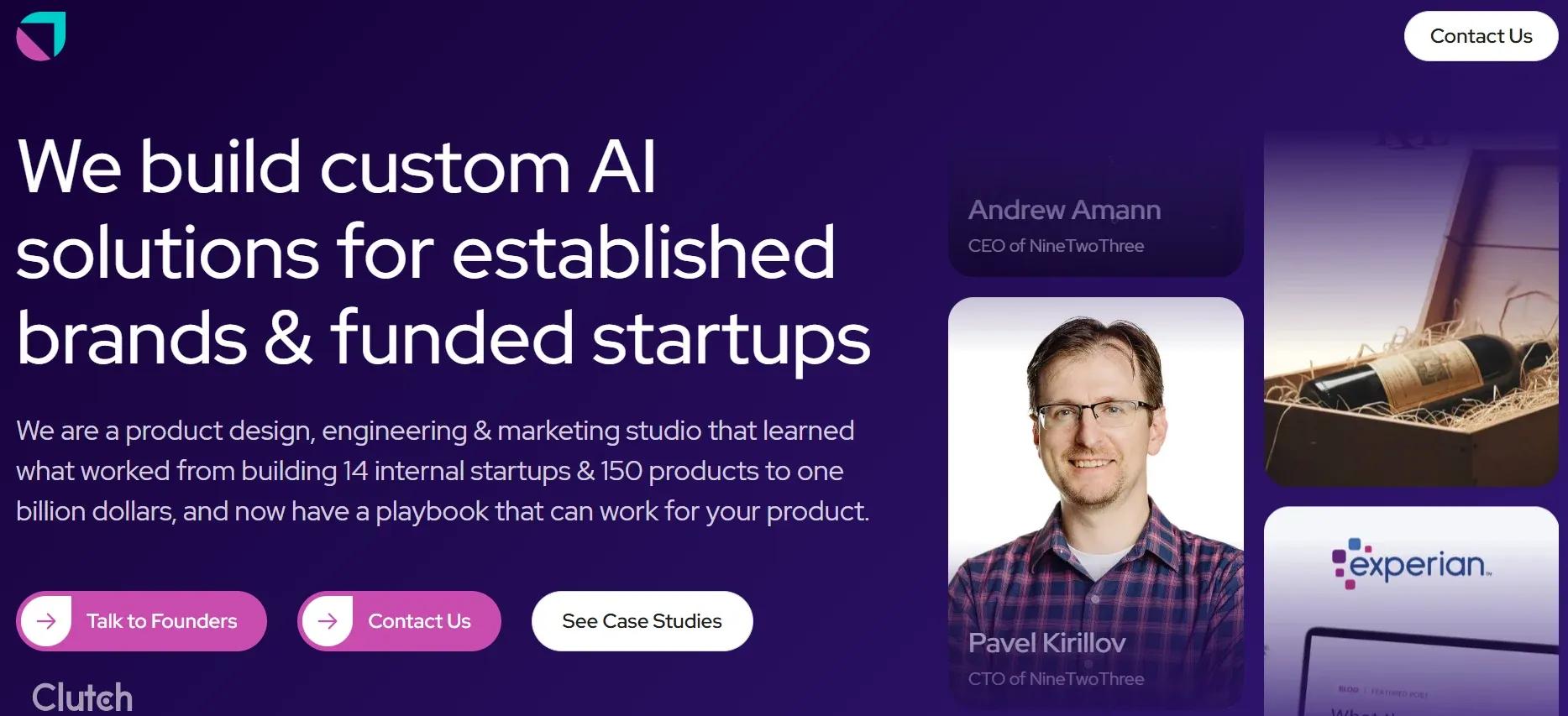
NineTwoThree is an AI venture studio staffed with senior-only builders, including PhD scientists and MIT and Harvard product leads. It builds fast, user-centric GenAI products for startups and enterprises. Notably, it has delivered over 150 projects for clients like Consumer Reports and FanDuel. So it suits teams that want intelligence built into a polished product.
Key services: generative AI products, LLM apps, and product strategy.
Industries: finance, media, consumer, and healthcare.
Why choose them: senior talent on every build, not junior hand-offs. Its venture-studio model rewards fast, validated delivery. That senior-only staffing shows directly in deployment success.
4. ThirdEye Data
Headquarters: Dallas, Texas.
ThirdEye Data grew from data engineering into generative and agentic AI. Its work centers on LLM-powered agents, computer-vision pipelines, and MLOps-driven deployment. Notably, its Optira platform productizes document processing into a reusable tool. So it suits enterprises that already have solid data infrastructure.
Key services: agentic AI, RAG systems, and MLOps.
Industries: enterprise, finance, and manufacturing.
Why choose them: genuine production agents, not chatbots rebranded as agentic. Its data-engineering roots reduce project risk. Proof-of-concept turnaround is often measured in weeks, which appeals to founders who need something working fast. It also names the exact frameworks it uses, a transparency that credible GenAI firms share.
5. Dogtown Media

Headquarters: Los Angeles, California.
Dogtown Media builds data-driven GenAI products for regulated sectors. In particular, it focuses on healthcare, AI, and IoT. It understands the full stack, from data pipelines to HIPAA compliance. So it suits products that handle sensitive data responsibly.
Key services: generative AI, machine learning, and healthcare apps.
Industries: mHealth, fintech, and IoT.
Why choose them: genuine regulated-sector depth and strong analytics. Its clients include Google and Harvard Medical School.
6. BlueLabel
Headquarters: New York, New York.
BlueLabel pairs product design with AI-driven development. It turns ideas into production-ready GenAI mobile and web apps. In addition, it emphasizes early validation and phased roadmaps. So it suits founders who want a clear, validated path to launch.
Key services: generative AI, product design, and app development.
Industries: consumer, enterprise, and startups.
Why choose them: strong validation process and design-led GenAI builds. It holds a solid Clutch reputation across many reviews.
7. HatchWorks AI
Headquarters: Atlanta, Georgia.
HatchWorks AI is built around a method it calls Generative-Driven Development. It weaves GenAI into how software gets built, not just what ships. Moreover, it offers embedded engineers and agentic-AI pods for existing teams. So it suits enterprises that want AI-native reinforcement.
Key services: RAG systems, MLOps, and full-cycle GenAI engineering.
Industries: enterprise, retail, and finance.
Why choose them: strong MLOps and production-readiness focus. However, delivery runs nearshore across the Americas, so confirm the setup.
8. Azumo
Headquarters: San Francisco, California.
Azumo is an AI and software firm with a strong focus on GenAI and NLP. It delivers scalable solutions through flexible, nearshore engagement models. In addition, it suits scale-ups that value time-zone overlap and a real track record. So it fits teams that want steady capacity without hiring churn.
Key services: generative AI, NLP, and semantic search.
Industries: technology, media, and finance.
Why choose them: a solid track record and flexible delivery. However, engineering is delivered nearshore, so confirm the model.
9. 10Pearls
Headquarters: Washington, D.C.
10Pearls is a digital-first firm that pairs GenAI with product engineering and data. It builds intelligent products for healthcare, education, and retail. Furthermore, it brings design, data, and cloud under one roof. So it suits organizations that want a broad, end-to-end partner.
Key services: generative AI, digital products, and data engineering.
Industries: healthcare, education, and retail.
Why choose them: end-to-end capability and strong sector experience. However, it delivers globally, so confirm where your team sits.
10. Tribe AI
Headquarters: New York, New York.
Tribe AI operates as a network of vetted, senior AI engineers. It matches companies with proven GenAI talent for defined projects. As a result, clients get elite expertise without a permanent hire. So it suits teams that need deep GenAI skill on demand.
Key services: generative AI, ML engineering, and AI strategy.
Industries: finance, retail, and enterprise.
Why choose them: access to a curated network of senior AI engineers. Its model suits focused, high-skill engagements. So you gain elite capability for a defined brief, without a long-term hire.
What Is a Generative AI Development Company
A generative AI development company designs, builds, and deploys software powered by large language models. It goes beyond calling an API. Instead, it builds production systems around your data, from RAG pipelines to AI agents.
That work covers data preparation, prompt engineering, and retrieval design. In addition, it includes evaluation, guardrails, and deployment infrastructure. So the effort spans far more than a simple chatbot.
The best partners treat go-live as the start, not the finish. After launch, they monitor accuracy, retrain on new data, and control inference cost. As a result, the system keeps delivering value instead of quietly degrading. That operational discipline is what separates a lasting build from a one-off demo.
Demand keeps rising fast. Enterprise generative AI spending tripled to $37 billion in 2025, per Menlo Ventures. Therefore, production GenAI development is a fast-growing market in its own right.
Generative AI Development Services
No two GenAI projects are identical. Depending on your goal, you may need any of the following. Each service solves a different problem.
RAG systems. Retrieval-Augmented Generation grounds a model in your own data. As a result, answers stay accurate and current without costly retraining.
AI agents. AI agents reason, use tools, and complete multi-step tasks. So they automate whole workflows, not single answers.
LLM copilots. Generative AI copilots assist support, sales, and internal teams. In addition, they speed up document work and research.
Model fine-tuning. Fine-tuning adapts a base model to your data and task. Therefore, you gain accuracy without training from scratch.
GenAI integration. API integration connects models to your CRM, ERP, and internal tools. Consequently, the AI works inside your real systems.
Evaluation and MLOps. Evals and monitoring keep a model accurate and safe in production. Meanwhile, they catch drift before users do.
The highest-return builds tend to be narrow and specific. For example, a support copilot that resolves routine tickets, or a RAG assistant that answers from internal docs. So a good partner starts from a workflow problem, not a generic app spec. As a result, the system earns its keep quickly.
How to Choose the Right Generative AI Development Partner
Choosing the wrong partner among generative AI development companies is an expensive mistake. So work through these checks before you sign.
Confirm production evidence. Ask for live GenAI systems, not demos. Because most pilots never ship, insist on deployed proof.
Check evals and guardrails. Ask how the team measures accuracy and controls hallucination. In addition, confirm safety testing before launch.
Verify the US base. Check for real US headquarters, not just an address. So confirm where your engineers actually sit.
Review data maturity. GenAI fails most at the data layer. Therefore, confirm strong data engineering before model work begins.
Clarify ownership. You should own the model, the code, and the data. Moreover, confirm there is no vendor lock-in.
Run a paid pilot first. A small, scoped pilot reveals real delivery quality. So test one workflow before a large commitment. That single step prevents most costly mismatches.
Check post-launch support. Models drift as data and usage change. Therefore, confirm retraining, monitoring, and a clear support plan.
Onshore, Nearshore, or Offshore: Why Delivery Model Matters
Where your team actually sits shapes cost, speed, and communication. So the delivery model is as important as the logo on the pitch. The generative AI development companies in the USA fall into three broad models.
Onshore US. The whole team works in the United States. As a result, you get full time-zone overlap and simple contracting, at a premium rate.
US-led, nearshore delivery. A US team leads, while engineers work from Latin America. Therefore, you keep time-zone overlap at a lower cost. HatchWorks and Azumo use this model.
Offshore in disguise. A US address hides delivery from India or beyond. So confirm where your engineers sit, since many "US" lists hide this.
Model | Strength | Trade-off |
| Onshore US | Full overlap, simple contracts | Highest cost |
| US-led nearshore | Overlap plus lower cost | Confirm the split |
| Offshore in disguise | Lowest rate | Time-zone and oversight risk |
Softaims sidesteps the guesswork, since you choose each developer and see exactly where they work.
Generative AI Development Cost in the USA (2026)
Cost is where most guides on generative AI development companies go quiet, so here is the detail. US GenAI pricing depends on scope, data, and production maturity. A scoped proof of concept costs far less than a multi-workflow system. So it helps to see the ranges before you brief a firm.
Cost by Engagement Type
Engagement | Typical scope | Estimated cost |
| Proof of concept | One use case, scoped pilot | $8,000 – $25,000 |
| Single-workflow build | One production workflow | $35,000 – $70,000 |
| Multi-workflow system | Several production workflows | $70,000 – $150,000+ |
| Enterprise program | Many workflows, governance | $150,000+ |
The biggest cost variable is data. If your data needs collecting, cleaning, and structuring for RAG, expect real time and budget. In addition, evaluation, guardrails, and integration all add cost. Enterprise consultancies typically start well above these figures, largely because of program overhead.
There are recurring costs too. LLM API usage, vector databases, hosting, and monitoring all recur monthly. So inference optimization is central to controlling spend. Therefore, plan for a total cost of ownership, not just the build.
The US Talent Angle
Hiring in-house is the other route, and it carries its own cost. A senior US GenAI engineer commands a high salary, and benefits and payroll taxes add 25% to 40% on top. So a permanent team is expensive to build and retain for stop-start work. That is why many businesses hire a partner or a vetted marketplace instead. A marketplace also lets you scale a team up for a build and down for maintenance. That matches the stop-start rhythm of real GenAI work.
How Much Does It Cost to Hire Generative AI Engineers in the USA
Salaries for generative AI engineers swing widely by country. Local demand, living costs, and talent supply all shape the number. In 2026, those figures keep climbing as AI skills stay scarce. So knowing the going rates helps you budget and stay competitive for top people.
US salaries sit at the top, thanks to a deep tech industry and fierce demand. Switzerland and Israel pay well too, on the back of strong tech ecosystems. In contrast, India and Singapore pay less, though their rates are rising fast as global demand spreads.
The table below shows average annual salaries by country. Use it to benchmark your offer against the market.
Country | Average salary (USD) |
| United States | $130,000 – $180,000 |
| United Kingdom | $100,000 – $140,000 |
| Canada | $90,000 – $130,000 |
| Australia | $110,000 – $150,000 |
| Germany | $95,000 – $135,000 |
| Switzerland | $120,000 – $160,000 |
| India | $30,000 – $50,000 |
| Singapore | $85,000 – $125,000 |
| Israel | $115,000 – $155,000 |
| Japan | $100,000 – $140,000 |
Source: Salary.com . Figures are indicative and shift with demand, so treat them as a starting point.
Dedicated or Freelance Generative AI Engineers
Your AI roadmap should drive this choice. For ongoing model work and long-term upkeep, dedicated engineers usually win. They bring consistency, integrate deeply with your team, and learn your business over time.
Freelancers, by contrast, suit short projects or niche skills you do not need full-time. They add flexibility and broad cross-client experience. However, they can be harder to manage, since alignment and steady communication take more effort.
A marketplace like Softaims bridges both models. You can hire dedicated engineers or bring in freelance specialists, then scale either way as the work shifts. So the model bends to your needs, not the other way around. In the end, weigh scale, complexity, and duration, since a hybrid mix often works best.
Why Companies Hire Generative AI Engineers
Companies hire generative AI engineers to turn cutting-edge AI into a real edge. GenAI can reshape product development, streamline operations, and personalize customer experiences. As a result, businesses automate routine work, cut costs, and lift efficiency.
Beyond efficiency, these engineers drive genuine innovation. They build models that generate new content and ideas, which opens fresh products and services. That matters most in creative fields like media, fashion, and entertainment.
In-house expertise also keeps a company adaptable. Because AI evolves quickly, a skilled team folds new capabilities in fast. For strategic context, the Harvard Business Review covers how leaders integrate technology.
Red Flags in Generative AI Engineer Interviews
Spotting warning signs early protects your build. One red flag is a candidate who cannot explain how their own models work. If they cannot open the black box they built, their depth may be thin.
Another is leaning on pre-built libraries without grasping the internals. Using libraries is normal, yet strong engineers can adapt and optimize them. So a lack of curiosity beyond the defaults limits real innovation.
Finally, watch how candidates treat ethics and data privacy. Anyone who waves these off can be a liability, since GenAI now touches sensitive uses. For interview guidance, Towards Data Science publishes useful resources.
Industries Adopting Generative AI Fastest
Adoption is uneven across sectors. The generative AI development companies in the USA see the deepest demand in a few industries. Each brings its own drivers and rules.
Financial services. Banks and insurers use GenAI for research, fraud, and compliance. Notably, finance spends far above the cross-industry average on AI.
Healthcare. Providers use GenAI for documentation, triage, and search. Meanwhile, strict rules make governance essential.
Retail and eCommerce. Retailers use GenAI for support, search, and personalization. As a result, conversion and service improve.
Software and SaaS. Product teams embed copilots and AI features. Therefore, GenAI has become a core product differentiator.
Legal and professional services. Firms use GenAI for contract review and drafting. So they cut hours of manual document work.
Generative AI Trends for 2026
The generative AI development companies in the USA set trends the market follows. A few clear shifts stand out this year.
Agents are going mainstream. Systems now complete multi-step tasks, not just answer questions. As a result, they deliver far more value.
RAG is the default. Retrieval beats fine-tuning for most builds, since it cuts cost and keeps data fresh. Meanwhile, it grounds answers in your own content.
Evals are now essential. Buyers demand accuracy tests and guardrails before launch. Therefore, evaluation discipline separates serious firms.
Smaller models are rising. Focused models often beat giant ones on narrow tasks. Consequently, they cut cost and latency.
Governance is central. US enterprises expect explainability and safety controls. So responsible AI is now a baseline requirement.
Why Generative AI Projects Fail (and How to Avoid It)
Most GenAI pilots deliver nothing measurable. MIT found that 95% of enterprise AI deployments produced no measurable return. The causes repeat, which means each one is avoidable.
Nobody owns the outcome. A pilot wins applause at a demo, then loses attention. So name a business owner and one metric before anything starts.
The data was never ready. Demos run on clean files, while production holds messy ones. Therefore, treat data preparation as a real phase with its own budget.
Nobody measured quality. Without an evaluation set, you are guessing whether changes helped. So insist on evals built from real cases.
It never reached a real workflow. A tool in a separate tab gets forgotten. Systems that succeed appear inside the apps people already use.
Costs escalated quietly. Agentic loops and long context burn tokens fast. As a result, a cheap-feeling system gets expensive at scale.
Frequently Asked Questions
Which are the best generative AI development companies in the USA?
NineTwoThree, ThirdEye Data, and Dogtown Media lead among genuine US firms. BlueLabel, HatchWorks AI, Azumo, 10Pearls, and Tribe AI round out strong options. Softaims and Devaims suit teams that want to build fast and own the result.
How much does generative AI development cost?
A proof of concept runs $8,000 to $25,000, and a single-workflow build $35,000 to $70,000. Multi-workflow systems exceed $70,000. Data readiness drives most of the variation.
What is RAG, and why does it matter?
RAG, or Retrieval-Augmented Generation, grounds a model in your own data. As a result, answers stay accurate and current without costly retraining. It is now the default pattern for enterprise GenAI.
Are these firms genuinely US-based?
Yes, and we verified each one. We also flag nearshore delivery, as with HatchWorks and Azumo. Always confirm where your team sits.
How do I avoid a failed GenAI project?
Start with a scoped, paid pilot on one real workflow. So you test delivery quality before a large commitment. Then insist on clear evals and one success metric. A scoped pilot also builds trust on both sides before a larger budget is committed.
Who owns the model and the data?
You should own all of it. Confirm ownership of the code, the models, and the data in the contract. This avoids vendor lock-in later.
Conclusion
Generative AI is now core business infrastructure, not a side experiment. However, the real advantage comes from building GenAI around real workflows and data. So the right partner turns strategy into secure, production-grade systems.
Weigh production evidence, evaluation discipline, and ownership before you commit to any of the generative AI development companies above. That way, your GenAI investment keeps paying off well beyond launch. Would you rather skip the search entirely? Then Softaims matches you with vetted AI developers within 48 hours, in the USA or anywhere.


 GitHub
Jennifer D. D.

 Verified Expert in Engineering
My name is Jennifer D. D. and I have over 8 years of experience in the tech industry. I specialize in the following technologies: Python, Deep Learning, Machine Learning, Computer Vision, Natural Language Processing, etc.. I hold a degree in Other, Bachelor of Science (BS), Doctor of Philosophy (PhD). Some of the notable projects I've worked on include: Enterprise Design Thinking Workshops and Design Sprints, Data Science Enablement and Cloud Cost Optimization, Domino Data Lab - Tutorial on distributed computing, Business Development for Healthcare Analytics Platform, Emotionally Aware Chatbot Development, etc.. I am based in Austin, United States. I've successfully completed 20 projects while developing at Softaims.
I possess comprehensive technical expertise across the entire solution lifecycle, from user interfaces and information management to system architecture and deployment pipelines. This end-to-end perspective allows me to build solutions that are harmonious and efficient across all functional layers.
I excel at managing technical health and ensuring that every component of the system adheres to the highest standards of performance and security. Working at Softaims, I ensure that integration is seamless and the overall architecture is sound and well-defined.
My commitment is to taking full ownership of project delivery, moving quickly and decisively to resolve issues and deliver high-quality features that meet or exceed the client's commercial objectives.

Leave a Comment
Need help building your team? Let's discuss your project requirements.
Get matched with top-tier developers within 24 hours and start your project with no pressure of long-term commitment.