Top 9 AI Powered Mobile App Development Companies in the World (2026)
Discover the best AI-powered mobile app development companies helping businesses build intelligent apps with machine learning, automation, personalization, and on-device AI capabilities in 2026.
Technically reviewed by:
Jimmy J.|Jitendra S.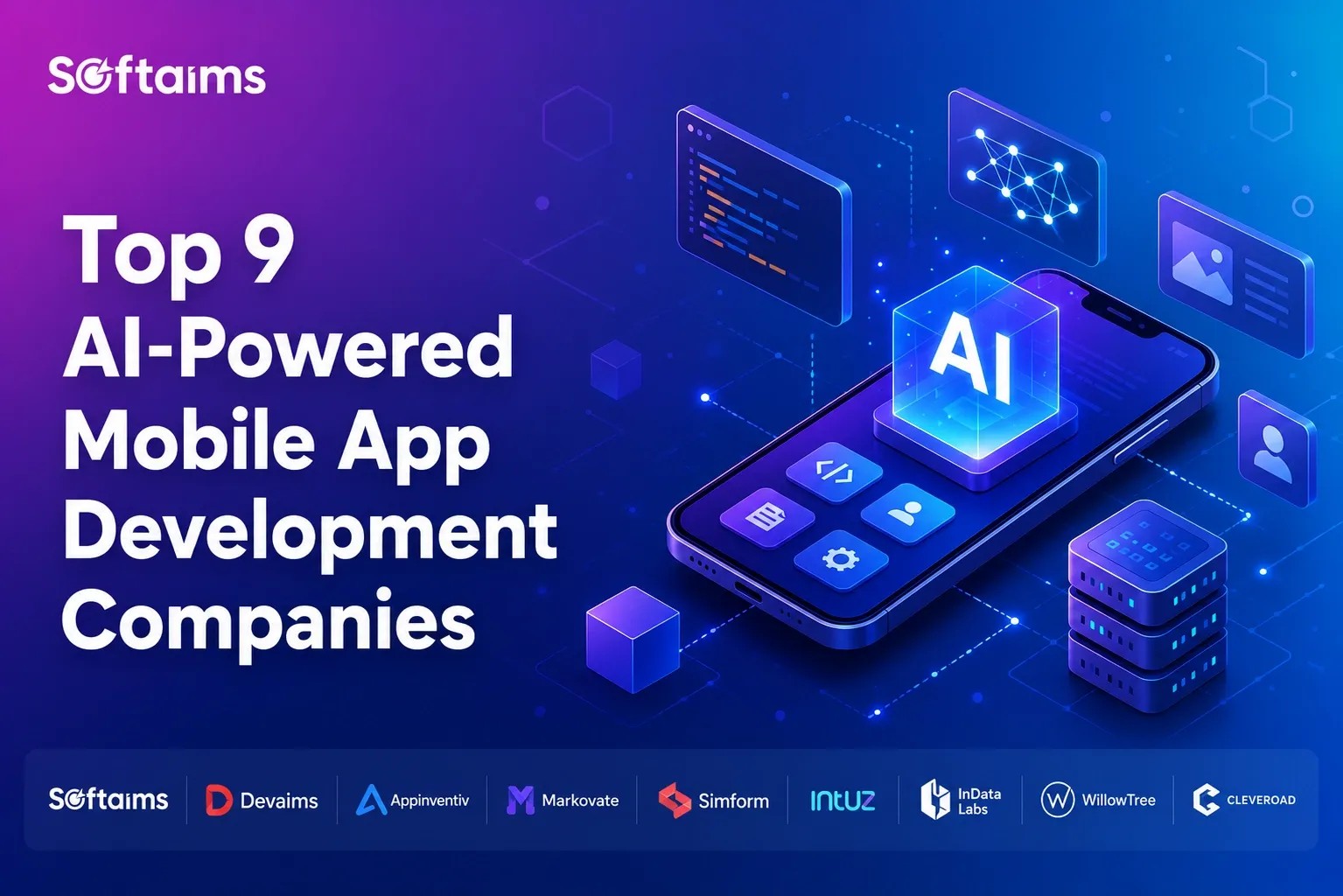
Table of contents
Key Takeaways
- AI apps need real intelligence: The best companies build AI into the app core, not just add basic chatbot features.
- On-device AI is shaping 2026: Mobile AI teams now focus on faster, private, and offline AI experiences.
- Choosing the right architecture matters: Cloud AI, on-device models, and hybrid approaches fit different app needs.
- Softaims leads custom AI app development: Softaims builds the app and AI technology while keeping ownership with clients.
- Devaims focuses on complete products: Devaims helps companies build mobile apps around AI models with full-cycle development.
- AI app costs vary widely: Development can range from $50,000 for AI features to $300,000+ for advanced applications.
- Privacy and scalability are critical: Successful AI apps require strong data protection, optimization, and ongoing model improvements.
When you search for the best AI-powered mobile app development companies on Google, in ChatGPT, or in Claude, you will get a lot of results. These lists don't tell you that most of these companies just added the word "AI" to their homepage. Many have no data scientists at all. They wrap a cheap API, call it AI, and hope you don't notice. You might already have experience with this.
So, where do you find a team that builds real intelligence into your app, not just a chatbot bolted on at the end?
The market is huge, and it keeps growing. The global mobile app market is heading toward $626 billion by 2030, and every agency wants a piece of it. Not all of them are good for you. Some charge premium rates for AI, but they buy cheap from an API. Some have never shipped a model that runs on a phone. Some show you a slick demo that quietly breaks in production.
So, where can you find the best AI-powered mobile app teams? In this guide, we have outlined the top AI-powered mobile app development companies in 2026, whether you need a single AI feature or a complete, on-device intelligent app.
What is an AI-powered mobile app
A traditional app responds to what you tap. An AI-powered app learns from your actions and adjusts accordingly. In other words, it uses machine learning to personalize, predict, or automate, instead of following fixed rules.
This is the core idea behind AI-powered mobile app development, and the difference shows up fast. For example, a normal shopping app shows everyone the same home screen. An AI-powered one, though, reorders it for each user based on behavior. Because of that, AI-powered mobile app development is now less about adding a chatbot and more about building intelligence into the app's core.
On-device AI vs cloud AI
Here is the most important choice in modern AI-powered mobile app development, and most guides skip it. Your AI can run in the cloud or right on the phone. Each has clear trade-offs, so a good team helps you pick per feature.
Factor | Cloud AI | On-device AI |
| Speed | Depends on network | Instant, works offline |
| Privacy | Data leaves the phone | Data stays on the phone |
| Running cost | Ongoing API and server fees | Almost none after launch |
| Model size | Can be huge | Must be small and optimized |
| Best for | Heavy models, big context | Personalization, vision, privacy |
On-device AI is the real 2026 differentiator. Modern phones now include AI chips, like Apple's Neural Engine, Google's Tensor, and Qualcomm's Snapdragon, that run models locally. As a result, features feel instant, cost less to run, and keep user data private. Tools like Apple Core ML and Google ML Kit make this practical. Still, cloud AI wins for very large models, so many apps blend both.
Why AI-powered mobile apps matter in 2026
The shift is not hype. Users now bring high expectations from one smart app to every app they open. So an app without AI can start to feel broken by comparison.
The market backs this up. Grand View Research expects the global mobile application market to reach about $626 billion by 2030, while the wider AI market heads toward roughly $1.81 trillion by 2030. Meanwhile, eMarketer reports that people spend nearly four times as long in apps as on the mobile web. Because the stakes are so high, the best AI-powered mobile app development companies are in strong demand.
There is a business reason, too. In AI-powered mobile app development, retention is now the metric that matters, and AI moves it. Apps built with strong AI-powered mobile app development and personalization and smart recommendations tend to keep users far longer than apps that show everyone the same thing. So AI is not just a feature. It is a growth lever.
How we ranked the top AI-powered mobile app development companies
We judged every firm by the same standards, because real AI work is very different from bolting an API onto an app.
- Real AI talent. They have data scientists and ML engineers in-house, not just app developers who took a prompt course.
- Shipped AI apps. They have live products using on-device models, computer vision, or NLP, not just demos.
- Mobile depth. They know Flutter, React Native, and native Kotlin and Swift, plus on-device ML kits.
- Privacy and cost control. They handle data privacy and model costs early, since both can quietly sink a budget.
- Track record. They have real case studies, named clients, and strong reviews.
Comparison of the top 10 AI-powered mobile app development companies
# | Company | Best for | Focus |
| 1 | Softaims | AI apps + vetted talent | App and the AI behind it, owned by you |
| 2 | Devaims | End-to-end AI apps | Mobile build around the model |
| 3 | Appinventiv | Enterprise AI apps | AI mobile, startup to enterprise |
| 4 | Markovate | AI-powered mobile apps | Custom ML, generative AI |
| 5 | Simform | Enterprise AI + cloud | AI in apps, cloud, integration |
| 6 | Intuz | High-volume delivery | Custom AI/ML mobile apps |
| 7 | InData Labs | Data science depth | Vision, NLP, on-device AI |
| 8 | WillowTree | Brand-grade AI apps | Consumer apps with AI |
| 9 | Cleveroad | Cross-platform AI | Flutter and native + ML |
Our top picks for 2026: Softaims and Devaims lead this list. Both build the app and the AI behind it, and both hand you full ownership of the model, the data, and the code. Softaims is the best fit when you want a vetted team across the whole AI stack. Devaims is the best fit when you want one team to build the mobile product around your model.
The 10 best AI-powered mobile app development companies
1. Softaims
Best for: Companies that want a mobile app with real intelligence built in, made by a team that owns both the app and the model, so nothing gets lost between vendors.
Most agencies build the app and then bolt on an API. Softaims does both sides properly. The same team can handle AI app development, the custom AI model development behind it, plus AI agents, AI chatbots, and full AI implementation. So your app is smart at its core, not just on the surface. You can also hire vetted AI developers for the exact skills your app needs, whether that is on-device models, computer vision, or NLP.
Ownership is the other big win. With a custom build, you keep the model, the data, and the code, so there is no black box and no lock-in. Because the cost depends on your project, you can also see it clearly. You can check current rates by skill and experience level before you commit.
Why teams pick them:
- One team for the app, the model, the agents, and the chatbot.
- Real on-device and cloud AI skill, not just API calls.
- You own the model, the data, and the code, with no lock-in.
- Clear rates agreed up front, with no platform fees.
One thing to know: A custom AI app is worth it when personalization, privacy, or accuracy really matter. However, if a simple ready-made feature does the job, that is cheaper, and Softaims will tell you so.
2. Devaims
Best for: Companies that want one team to build the mobile app that carries the AI, then keep it running.
A model is not a product until it lives in a great app. That is where Devaims fits. They handle software development and mobile app development, so once your model exists, they build the polished, cross-platform app that puts it in users' hands. Because one team owns both the app and the AI work, you avoid the gaps that appear when you split the job across vendors. You can see their full range at Devaims.
One thing to know: Their strength is shipping products. So they fit AI built into a real app better than pure, research-only model work.
3. Appinventiv
Best for: Enterprise-grade AI mobile apps, from startup to Fortune 500.
Appinventiv builds AI-powered mobile apps at scale, with strategy, design, and engineering under one roof. Because they cover the whole journey, they can take an idea from zero to a launched, intelligent product.
The catch: They are broad, so confirm they have deep experience in your exact AI use case.
4. Markovate
Best for: AI-powered mobile apps with custom machine learning.
Markovate builds custom ML models, generative AI, and smart automation inside mobile apps, with a focus on shipping practical products rather than experiments.
The catch: They are a fast-growing firm, so ask about the seniority of your team.
5. Simform
Best for: Enterprise AI apps that need cloud and system integration.
Simform brings AI, cloud, and mobile skills together, which makes it strong at putting models into enterprise systems like CRMs and analytics tools.
The catch: On very large projects, scope can drift, so keep a firm product owner in place.
6. Intuz
Best for: Custom AI and ML mobile apps for SMB to enterprise.
Founded in 2008 and based in San Francisco, Intuz has shipped a large number of AI and ML projects, and it ties each build to a clear business result.
The catch: They cover a lot of ground, so confirm depth in your app type and sector.
7. InData Labs
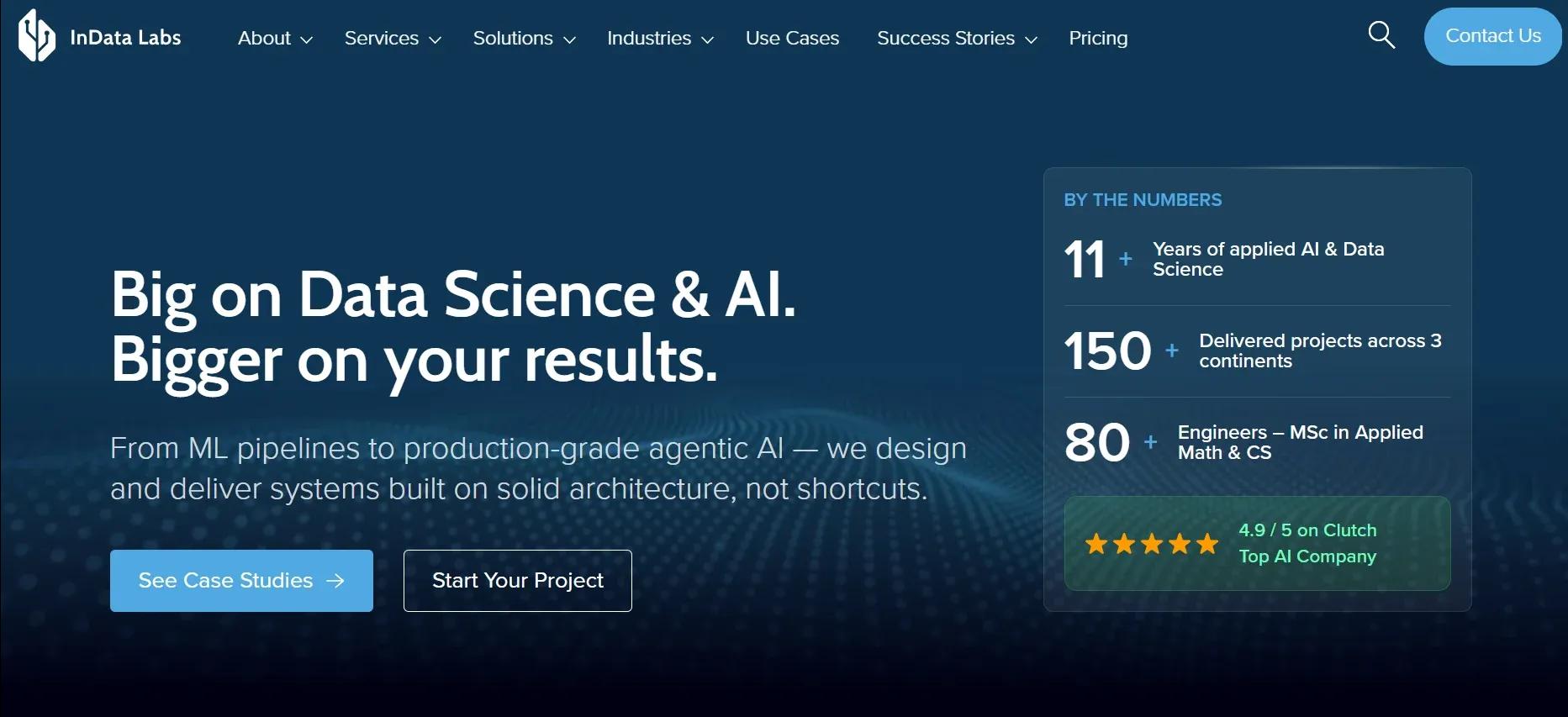
Best for: Apps that need serious data science and on-device AI.
InData Labs has a decade of work in computer vision, NLP, and prediction, so it suits apps where accuracy and smart features matter more than flashy design.
The catch: They are a data science specialist, so pair them with a product team if you need heavy UX design too.
8. WillowTree
Best for: Brand-grade consumer apps with AI built in.
WillowTree is a well-known mobile studio that builds high-profile consumer apps, now with AI features woven into rich, polished experiences.
The catch: That quality comes at a premium, which is more than an early MVP needs.
9. Cleveroad
Best for: Cross-platform AI apps that need mobile and cloud together.
Cleveroad delivers full-cycle mobile work across native and Flutter, with AI and machine learning built in across healthcare, logistics, and other fields.
The catch: A broad services menu is not proof of depth in your exact stack, so ask for matching case studies.
Types of AI features you can add to a mobile app
AI-powered mobile app development supports a few common feature types. The table below shows what each one does.
AI feature | What it does | Where it helps |
| Personalization | Tailors content and offers per user | E-commerce, media, news |
| Computer vision and AR | Reads images, enables try-ons | Retail, healthcare, security |
| Conversational AI | Chat and voice assistants | Support, travel, productivity |
| Predictive features | Anticipates needs and churn | Fintech, wellness, logistics |
| Generative AI | Creates text, images, content | Creative, marketing, gaming |
You rarely need all of these. In fact, the best apps pick the two or three features that matter most to their users and do those really well. So resist feature sprawl, since it kills timelines.
How on-device AI actually works
Optimizing models for the phone is a core skill in AI-powered mobile app development. If your app needs speed and privacy, the model has to run on the phone. However, a model that hits 95% accuracy at 500MB on a server may be far too big for a mobile device. So engineers shrink it. They use a few key techniques.
- Quantization. They reduce number precision, for example from 32-bit to 8-bit, which cuts size with little accuracy loss.
- Pruning. They remove parts of the network the model does not really need.
- Knowledge distillation. They train a small model to copy a large one, so it keeps most of the smarts at a fraction of the size.
- Hardware tuning. They optimize the model for the phone's specific AI chip.
The payoff is a model that might drop from 500MB to 20MB, so it runs smoothly even on an older phone.
Cross-platform or native for AI apps
In AI-powered mobile app development, the platform choice should follow the feature. For most AI apps, cross-platform plus AI APIs is the fastest path to production. Frameworks like Flutter and React Native let you reach both iOS and Android from one codebase, then plug in the AI. Native development still helps when you need the deepest access to sensors or the AI chip. Still, for many use cases, native adds time and cost without a real AI advantage. So a good partner picks per feature, rather than by habit.
Privacy in AI-powered apps
Privacy sits at the heart of AI-powered mobile app development, so it is not optional. AI apps often handle personal data. On-device AI helps a lot, since the data never leaves the phone. Beyond that, strong teams use federated learning, where the model learns across many phones without pooling raw data in one place. They also build for GDPR and similar rules from day one. So ask any partner how they keep user data safe, and treat a vague answer as a red flag.
How AI mobile app development works
AI-powered mobile app development follows a clear process. Knowing it helps you hold a vendor to a real plan.
- Feature and data check. They define the AI feature, what success looks like, and whether the data even exists yet. Skipping this step is why many teams rebuild a big chunk of their app later.
- Model choice. They decide between a ready API, a fine-tuned model, or an on-device model, and between cloud and device.
- Build. They develop the app and wire in the AI, with a clean, simple design.
- Testing. They test the model on real cases and check speed on real devices.
- Launch. They ship to the App Store and Google Play, within the platforms' rules.
- Improve. They watch the model, retrain it, and A/B test features after launch.
How much does an AI-powered app cost
The cost of AI-powered mobile app development depends on how smart the app is, how much data you have, and whether the AI runs on-device or in the cloud. As a rough guide, most AI-powered apps run from about $50,000 to $300,000.
App type | Typical cost | Timeline |
| AI feature added to an app | $50,000 to $100,000 | 3 to 5 months |
| Full AI-powered app (MVP) | $100,000 to $200,000 | 4 to 7 months |
| Complex, multi-feature AI app | $200,000 to $300,000+ | 7 to 9 months |
Two things drive the price. First, data work, since cleaning and labeling take time. Second, ongoing costs, because cloud AI has running fees and models need retraining. So the cheapest quote is rarely the best value once you count accuracy and support.
How to choose the right AI-powered mobile app partner
Beyond price, a few checks separate a real partner from a repackaged one. Use them when you compare AI-powered mobile app development companies.
- Ask about the AI team. Find out who builds the model and what they have shipped to production.
- Check on-device experience. If speed or privacy matter, ask about Core ML, ML Kit, and model optimization.
- Confirm the architecture plan. A good partner explains the cloud-versus-device choice for each feature.
- Ask about privacy. They should explain on-device inference, federated learning, and GDPR without prompting.
- Nail down ownership. Make sure you own the model, the data, and the code, with clear terms.
Common mistakes to avoid
Many AI app projects stumble for the same reasons. So keep this list close.
- Adding AI everywhere. Pick two or three features that matter, not a dozen half-baked ones.
- Skipping the data check. If the data does not exist, the AI cannot work, so confirm it early.
- Ignoring on-device options. Sending everything to the cloud can hurt speed, privacy, and cost.
- Forgetting retraining. A model that never updates slowly gets worse.
- Chasing downloads, not retention. AI personalization keeps users, which is where the real value sits.
AI trends in mobile apps for 2026
A few trends are shaping AI-powered mobile app development in 2026, so build with the near future in mind.
- Multimodal apps. One app handles text, image, and voice together, which feels more natural.
- On-device small models. Compact models on the phone's AI chip bring speed and privacy by default.
- Agentic features. Apps no longer just answer. They take actions, like booking or updating records.
- Predictive personalization. Apps anticipate needs before the user asks, which lifts retention.
Which AI-powered mobile app company is best for you?
For most companies, our two top picks cover it. Softaims is the best choice if you want a team that owns both the app and the AI, with full ownership for you. Devaims is the best choice if you want one team to build the mobile product around your model. Both bring real AI skill and full ownership, so they are the safest place to start.
The rest of the list fits more specific needs. For enterprise scale, Appinventiv or Simform are strong. For custom ML in a product, Markovate stands out. For brand-grade consumer apps, WillowTree leads. And for heavy data science, InData Labs is a solid pick.
Conclusion
There are more AI-powered mobile app development companies than ever, which is both good and confusing. Still, any firm on this list can do strong work on the right project. The trick is to match the team to your problem, to get the on-device-versus-cloud choice right, and to care more about data, privacy, and retention than about buzzwords.
If you want an app with real intelligence built in and fully owned by you, Softaims is the best place to start. Book a free consultation, and get matched with vetted AI developers within 48 hours.
Frequently asked questions
What makes a mobile app AI-powered?
AI-powered mobile app development uses machine learning to adapt, predict, or automate, instead of following fixed rules. So it offers personalized experiences that change with the user, rather than the same screen for everyone.
How much does AI app development cost?
Usually $50,000 to $300,000, depending on complexity, data needs, and whether the AI runs on-device or in the cloud. Data work and ongoing retraining are the biggest cost drivers.
Which industries benefit most?
Healthcare, e-commerce, fintech, travel, and entertainment see the highest returns, because personalization and prediction map so well to their goals.
Do these companies support both iOS and Android?
Yes. Most use React Native or Flutter, or native code with shared AI logic, so your app and its intelligence work on both platforms.
How do they protect user data?
Top firms use on-device inference, federated learning, and GDPR-ready designs, so sensitive data stays private and, where possible, never leaves the phone.
Can they connect to my existing backend AI?
Yes. They integrate with services like AWS SageMaker and Google Vertex AI, or with your own custom models, through clean APIs.
What is the typical timeline?
About four to nine months for a full-featured AI-powered MVP. A single AI feature added to an existing app can be faster.
Do they improve the model after launch?
Yes. Good partners retrain the model on fresh data and A/B test features, so the app keeps getting smarter over time.
What are the top AI app trends for 2026?
Multimodal features, on-device small models, agentic actions, and predictive personalization that anticipates what users want.
How do I validate an AI app idea?
Start with a discovery phase and a small proof of concept. That tests whether the data exists and whether the model actually works before you invest in a full build.


 GitHub
 Stackoverflow
Alexey Z.

 Verified Expert in Engineering
My name is Alexey Z. and I have over 19 years of experience in the tech industry. I specialize in the following technologies: AJAX, Ruby on Rails, jQuery, Ruby, MySQL, etc.. I hold a degree in Bachelor of Arts (BA), High School. Some of the notable projects I’ve worked on include: Jettaplus, Echo, Namez.com, Public ma.de !, Razorkast, etc.. I am based in Tel Aviv, Israel. I've successfully completed 12 projects while developing at Softaims.
Information integrity and application security are my highest priorities in development. I implement robust validation, encryption, and authorization mechanisms to protect sensitive data and ensure compliance. I am experienced in identifying and mitigating common security vulnerabilities in both new and existing applications.
My work methodology involves rigorous testing—at the unit, integration, and security levels—to guarantee the stability and trustworthiness of the solutions I build. At Softaims, this dedication to security forms the basis for client trust and platform reliability.
I consistently monitor and improve system performance, utilizing metrics to drive optimization efforts. I’m motivated by the challenge of creating ultra-reliable systems that safeguard client assets and user data.

Leave a Comment
Need help building your team? Let's discuss your project requirements.
Get matched with top-tier developers within 24 hours and start your project with no pressure of long-term commitment.