What Is Agile Methodology? A Complete Guide for 2026
In this guide, you'll learn what Agile methodology is, how it works, its core values and frameworks, the benefits and drawbacks, and how to implement Agile successfully in your team.
Technically reviewed by:
Chileap C.|Joseph R.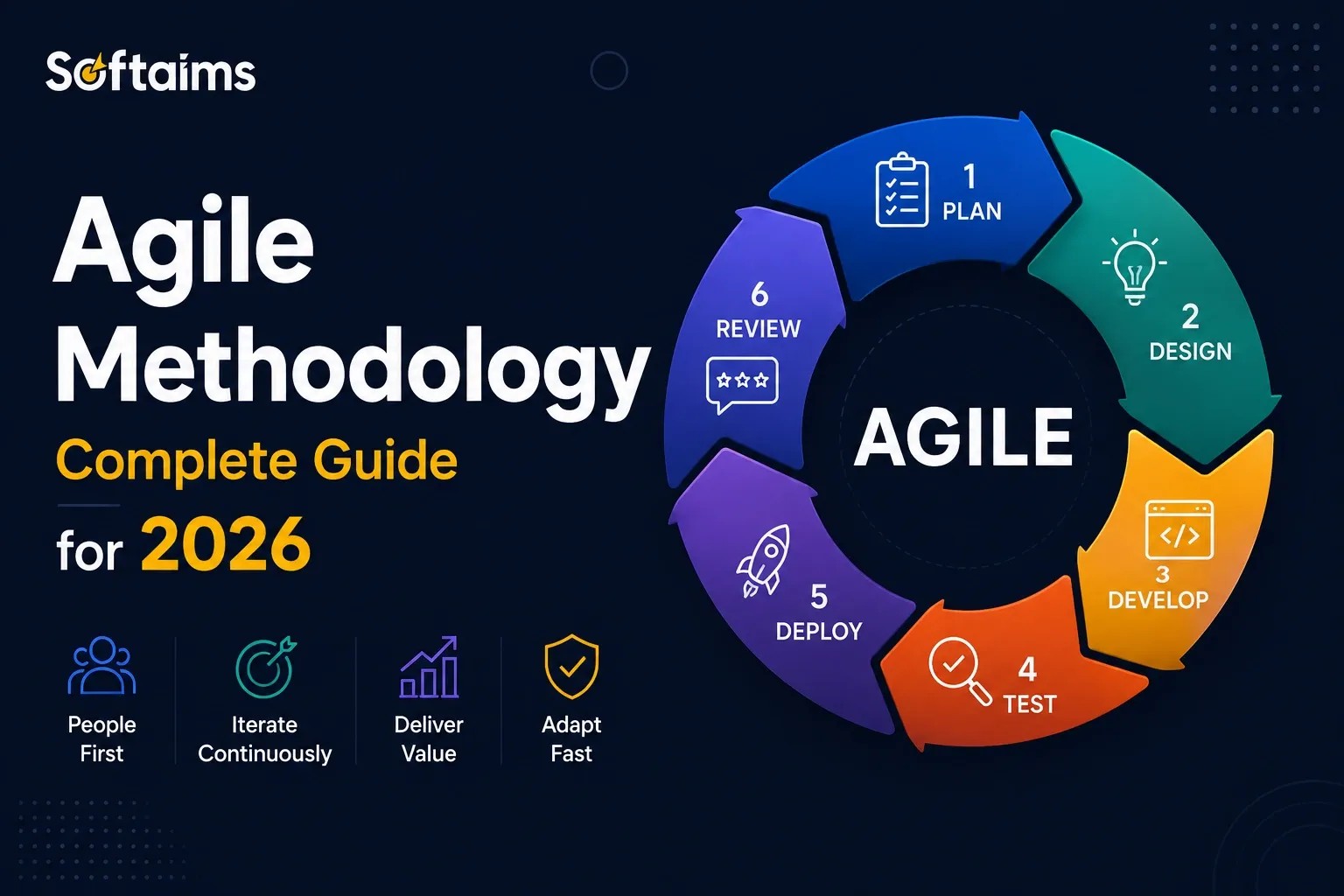
Table of contents
Key Takeaways
- Agile delivers work in short iterations, allowing teams to gather feedback early and adapt quickly.
- Agile is guided by four core values and twelve principles that prioritize collaboration, flexibility, and continuous improvement.
- Scrum, Kanban, Lean, XP, Crystal, and APF are the most common Agile frameworks, each suited to different project types.
- Agile works best for projects with changing requirements, while Waterfall is better suited to fixed-scope projects.
- Successful Agile adoption depends on empowered teams, stakeholder collaboration, and continuous measurement and improvement.
- Agile projects have a higher success rate than Waterfall projects and help teams deliver value faster with lower risk.
Around 75% of US companies now use Agile methodology in some form. Agile projects have a 70% success rate compared to 50% for traditional Waterfall projects. And companies that adopt Agile report an average 70% increase in revenue and profit.
Those numbers are hard to ignore. But if you've never used Agile before, or if your team is doing "Agile" without really understanding it, the methodology can feel confusing. Standups, sprints, backlogs, retrospectives, it sounds like a lot of jargon for what should be a simple idea.
Here's the simple idea: build things in small pieces, get feedback early, and adjust as you go. That's Agile at its core. Everything else is just a framework for making that happen consistently.
This guide covers what Agile methodology actually is, the values and principles behind it, the most common frameworks (Scrum, Kanban, XP, Lean), when to use it, when not to, and how to get started. Whether you're a developer, a project manager, or a business leader evaluating how your team works, this will give you what you need to make informed decisions.
At Softaims, our development teams work with Agile across client projects every day. This guide comes from that practical experience, not just theory.
What Is Agile Methodology
The Agile methodology is a way of managing projects by delivering working results in short, iterative cycles. Instead of spending months planning everything upfront and delivering one big release at the end, Agile teams build a little, test it, get feedback, and improve.
The Agile methodology came from the software development world. In 2001, a group of 17 software developers met in Utah and created the Agile Manifesto, a set of four values and twelve principles that defined a better way to build software. Since then, Agile has spread far beyond tech. Marketing teams, product teams, HR departments, and even construction firms use Agile principles today.
The Four Agile Values
The Agile Manifesto lays out four core values. Each one is a deliberate shift away from how projects were traditionally managed.
1. People over processes. Agile teams value direct communication and collaboration more than rigid processes and tools. This doesn't mean you throw out all processes. It means your processes should serve the team, not the other way around.
2. Working solutions over detailed documentation. The goal is to deliver something that actually works, not a 200-page specification document that nobody reads. Documentation still matters, but it shouldn't slow you down or replace building the actual product.
3. Customer collaboration over rigid contracts. Instead of locking everything into a contract upfront and hoping the requirements don't change, Agile teams work closely with customers throughout the project. This way, the final product reflects what the customer actually needs, not what they thought they needed six months ago.
4. Adapting to change over following a strict plan. Plans are useful, but they shouldn't be treated as sacred. Requirements change. Markets shift. Customer needs evolve. Agile teams treat change as a normal part of the process, not a disruption.
The 12 Agile Principles (and What They Actually Mean)
The 12 Agile principles take those four values and turn them into practical guidance. Here's each one, explained in plain language.
1. Deliver useful software early and often. Customers care about getting a product that solves their problems, not how your team works behind the scenes. Instead of waiting months for a final release, Agile delivers small, usable updates regularly. This provides value sooner, encourages continuous feedback, and helps teams improve with every iteration.
2. Welcome changing requirements, even late in the project. Customer needs can change at any stage, and Agile treats that as a normal part of development rather than a setback. Instead of resisting new requirements, Agile teams adapt their plans to deliver a solution that better meets customer needs.
3. Deliver in short cycles (weeks, not months). Instead of spending months planning before development begins, Agile teams work in short iterations, typically lasting two to four weeks. Each cycle ends with a usable product increment, allowing teams to deliver value regularly, gather feedback, and make improvements throughout the project.
4. Business people and developers should work together daily. Poor communication is one of the most common reasons projects fail. When business teams and developers work in silos, misunderstandings, delays, and costly rework become more likely. Agile encourages daily collaboration so everyone stays aligned, resolves issues quickly, and makes better decisions throughout the project.
5. Trust your team. Agile projects are built around motivated people who have the skills, support, and environment they need to succeed. Instead of micromanaging every task, trust teams to take ownership of their work and make decisions. Giving people autonomy encourages accountability, improves productivity, and leads to better results.
6. Prefer face-to-face communication. Direct conversations are the most effective way to share ideas, solve problems, and avoid misunderstandings. Agile encourages face-to-face discussions whenever possible because they improve collaboration and strengthen team relationships. For remote teams, a quick video call is often more effective than a long chain of emails or messages.
7. Working software is the primary measure of progress. Progress is measured by delivering software that works, not by completed reports, presentations, or project plans. A feature that customers can use and test provides real value and shows meaningful progress, while documentation alone does not.
8. Keep a sustainable pace. Agile promotes a steady, sustainable pace that teams can maintain throughout the project. Constantly working at full speed leads to burnout, mistakes, missed deadlines, and high turnover. By maintaining a consistent pace, teams can deliver quality work over the long term without exhausting their people.
9. Pay continuous attention to technical excellence and good design. Agile teams don't sacrifice quality to meet short-term deadlines. Rushing development with poor code or weak design creates technical debt that becomes more expensive to fix later. By focusing on clean, reliable, and well-designed solutions from the start, teams can build software that is easier to maintain, scale, and improve over time.
10. Keep things as simple as possible. Simplicity is essential to Agile because unnecessary complexity slows teams down and reduces productivity. Agile encourages teams to focus only on the work that delivers value. If a process, meeting, report, or approval step doesn't contribute to the project's success, it should be simplified or removed.
11. Self-organizing teams produce the best results. Agile encourages teams to organize their own work, solve problems, and make decisions without relying on constant approval from management. Giving teams the autonomy to manage their work creates greater ownership, encourages collaboration, and leads to better outcomes.
12. Reflect and adjust regularly. Agile teams regularly review how they work to identify what is going well, what isn't, and where they can improve. Through retrospectives and continuous feedback, they adjust their processes, collaboration, and workflows to become more effective with every iteration.
Agile Framework vs. Agile Methodology
The terms Agile framework and Agile methodology are often used interchangeably, but they are not the same.
An Agile methodology is the overall philosophy and set of principles for managing projects. It is based on the Agile Manifesto and focuses on iterative development, collaboration, continuous feedback, and adapting to change throughout the project.
An Agile framework is a structured way of applying those principles in practice. Frameworks provide guidelines, roles, events, and workflows, but they still leave room for teams to adapt based on their goals and processes. Popular Agile frameworks include Scrum, Kanban, Extreme Programming (XP), and Lean.
In simple terms, Agile is the methodology, while Scrum, Kanban, XP, and Lean are frameworks that help teams put Agile principles into practice.
Why Choose Agile Methodology?
Organizations choose Agile Methodology because it helps them respond quickly to changing customer needs, market conditions, and business priorities. Instead of spending months planning every detail, Agile teams deliver work in small, frequent increments, gather feedback early, and continuously improve. This makes it easier to adapt to change without disrupting the entire project.
Agile also puts people at the center of the development process. It encourages close collaboration between developers, stakeholders, and customers, allowing teams to solve problems faster and build products that better meet user needs. Rather than measuring success by documentation or following a rigid plan, Agile focuses on delivering working software that provides real value.
Another reason organizations adopt Agile is that it empowers teams. Agile teams are trusted to organize their work, make decisions, and maintain quality standards without constant supervision. This autonomy encourages accountability, improves collaboration, and helps teams deliver better results.
By combining flexibility, continuous feedback, customer collaboration, and empowered teams, Agile enables organizations to deliver higher-quality products faster while staying prepared for change.
Benefits of Agile Methodology
Agile isn't popular by accident. Here's what teams actually gain when they implement it well.
Faster time to market. Short cycles mean you release updates or products sooner. Instead of spending 12 months building a product and hoping customers like it, you deliver something in 2-4 weeks and find out right away. According to industry data, Agile projects are nearly 1.4 times more likely to succeed than Waterfall projects.
Better products through customer feedback. Because you're getting feedback throughout the project, the final product reflects real user needs, not assumptions made six months ago. Regular collaboration with stakeholders reduces the risk of building something nobody wants.
Higher team productivity. Breaking work into small tasks and reviewing progress frequently helps teams catch problems early, adjust priorities quickly, and reduce wasted effort. Teams spend less time on work that doesn't matter.
Adaptability. Markets change. Competitors launch new features. Customers change their minds. Agile teams can respond to all of this without derailing the entire project. In traditional approaches, a change request late in the project can blow up timelines and budgets. In Agile, it's just a reprioritized backlog item.
Lower risk. Because you're delivering working software every 2-4 weeks, problems surface early. If something isn't working, you find out in week three, not month nine. This makes course corrections cheaper and less painful.
If your team uses Agile and needs to scale up with developers who already work this way, you can browse developers experienced in Agile workflows on Softaims.
Drawbacks of Agile Methodology
Agile offers flexibility and faster feedback, but it isn't the right approach for every project. Before adopting Agile, it's important to understand the trade-offs.
Challenge | Why It Matters |
| Unclear scope and timelines | Because requirements evolve throughout the project, it's harder to estimate the final timeline, budget, and scope upfront. |
| High stakeholder involvement | Agile depends on regular customer feedback. Delays in reviews or decisions can slow development and reduce the benefits of iterative delivery. |
| Less documentation | Agile prioritizes working software over extensive documentation. Without enough documentation, important knowledge can be lost over time. |
| More difficult to scale | Coordinating multiple Agile teams requires additional planning and scaling frameworks to keep everyone aligned. |
| Requires disciplined teams | Agile gives teams more autonomy, but success depends on accountability, communication, and consistent processes. |
| Risk of scope creep | Frequent changes and new feature requests can expand the project's scope if priorities are not carefully managed. |
The biggest challenge with Agile is that it requires active collaboration from everyone involved, especially stakeholders. Regular feedback and timely decisions are essential for keeping development on track. Without that engagement, projects can lose momentum and priorities can become unclear.
Agile is also not the best choice for every project. If requirements are fixed from the beginning, changes are unlikely, or strict regulatory and compliance standards must be followed, a more structured approach such as Waterfall may be a better fit.
Types of Agile Methodologies
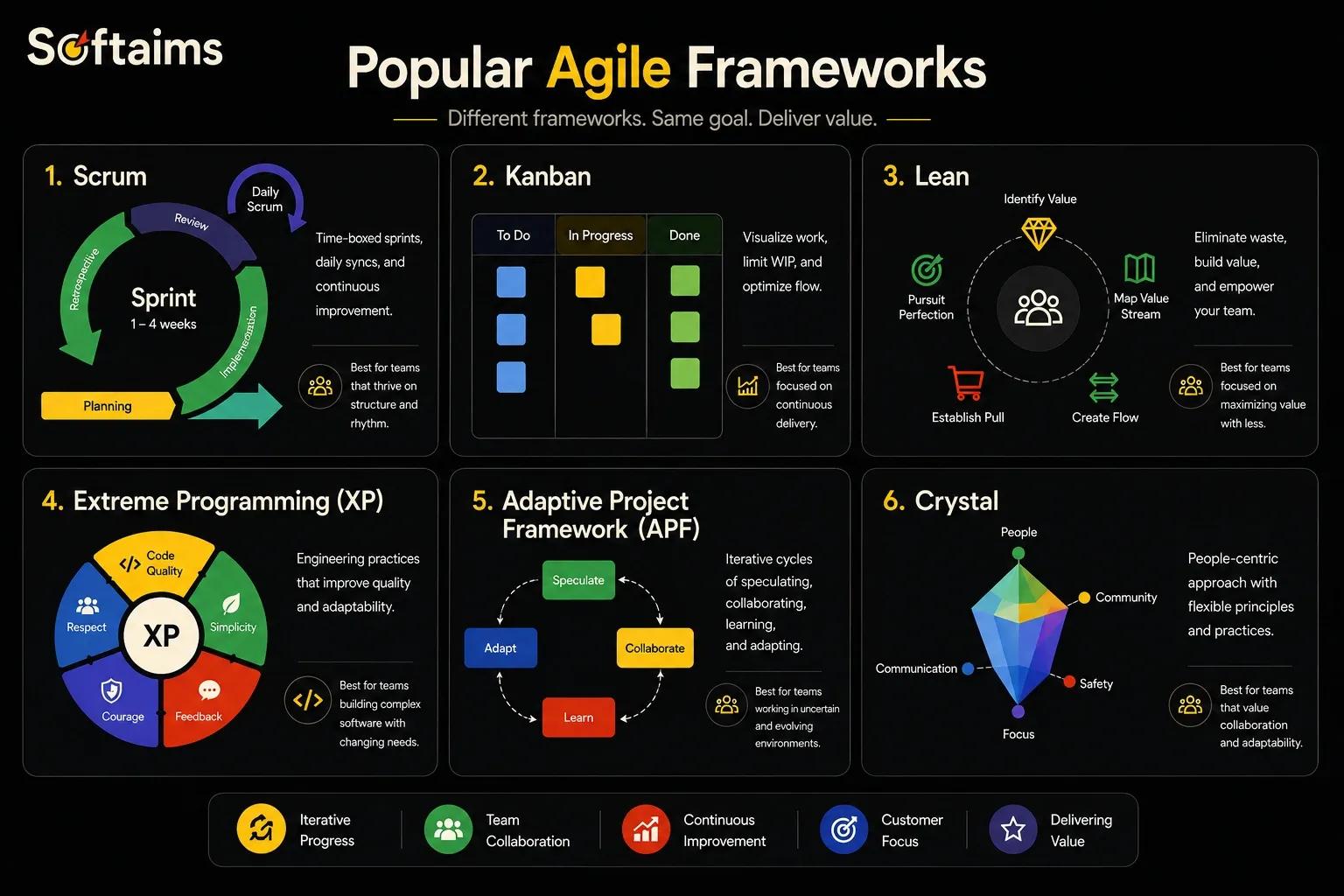
Agile project management is an umbrella term that includes several frameworks, each designed to apply Agile values and principles in a different way. The most widely used Agile frameworks include Scrum, Kanban, Lean, Extreme Programming (XP), Crystal, and the Adaptive Project Framework (APF). While they share the same Agile foundation, they differ in how they organize work, manage teams, and deliver projects. Here's what you need to know about the main Agile frameworks.
Scrum
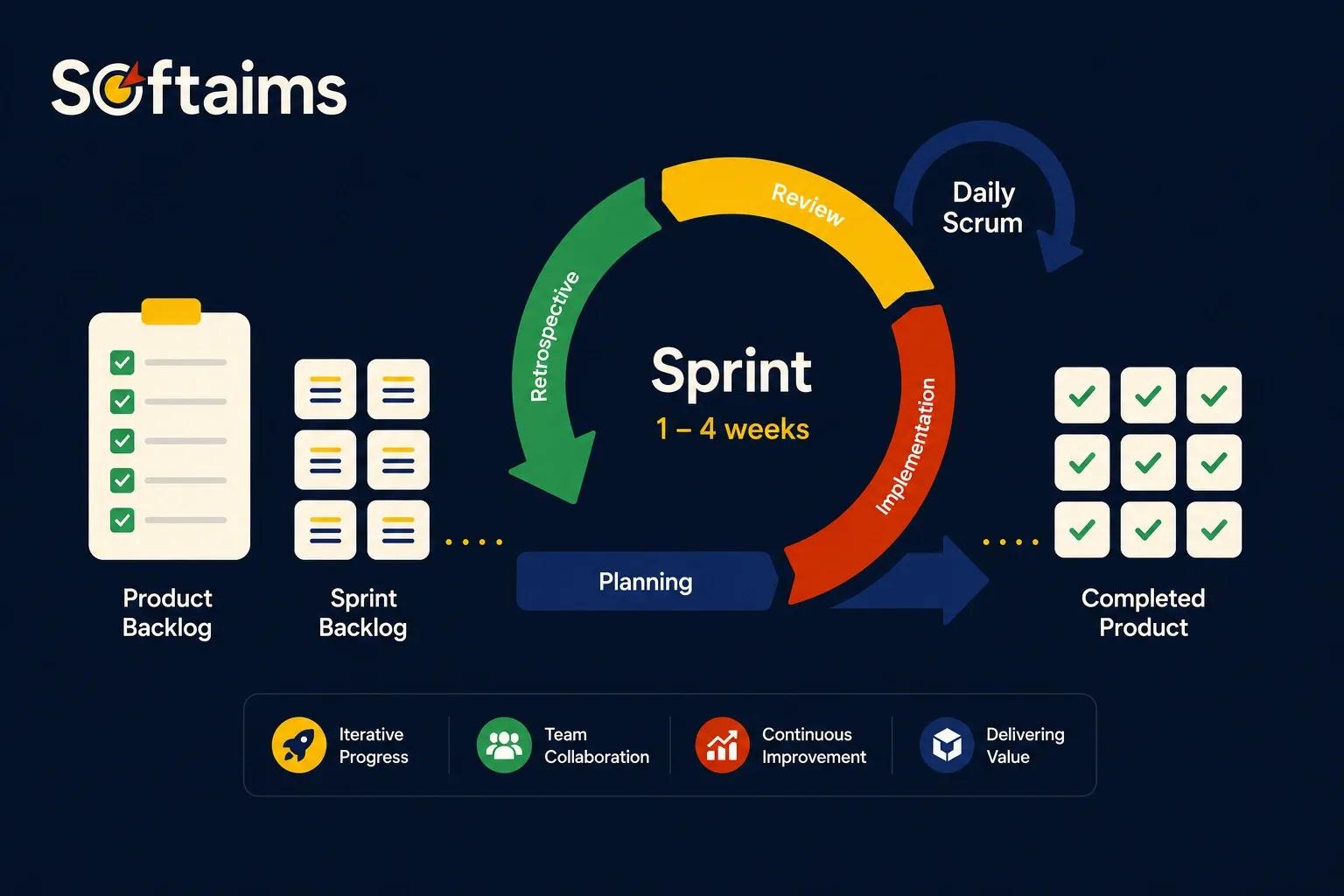
Scrum is the most widely used Agile framework, with around 63% of Agile teams using it. It is especially effective for projects where requirements change frequently. Work is organized into fixed-length sprints, typically lasting two to four weeks, with each sprint focused on delivering a specific goal.
During a sprint, the team holds a short daily standup to review progress, discuss blockers, and adjust priorities when needed. At the end of each sprint, the team demonstrates the completed work, gathers stakeholder feedback, reviews what went well, and plans the next sprint.
Scrum defines three key roles:
- Product Owner: Prioritizes the product backlog and decides what the team should build next.
- Scrum Master: Removes obstacles, coaches the team on Scrum practices, and helps the team stay focused on sprint goals.
- Development Team: A self-organizing group responsible for designing, building, testing, and delivering the product.
Scrum is a strong choice for projects with evolving requirements because it provides a structured process for adapting to change while delivering working software on a regular schedule.
Kanban
Kanban focuses on visualizing work and limiting how much work is in progress at any given time. Teams use a Kanban board with columns such as To Do, In Progress, and Done to track tasks as they move through the workflow. This makes it easy to see the status of work, identify bottlenecks early, and improve processes over time.
Unlike Scrum, Kanban does not use fixed sprints. Work flows continuously, allowing teams to prioritize and complete tasks as they arrive. A core Kanban practice is limiting work in progress (WIP). If the In Progress column reaches its limit, the team finishes existing tasks before starting new ones. This improves focus, reduces context switching, and keeps work moving at a steady pace.
Kanban is well suited for teams with a continuous stream of incoming work, such as support, DevOps, maintenance, and operations teams that need flexibility while maintaining a consistent workflow.
Lean
Lean is based on the manufacturing principles developed by Toyota and focuses on eliminating waste while maximizing customer value. In software development, waste includes anything that doesn't directly contribute to the final product, such as unnecessary meetings, unused features, excessive documentation, delays, or lengthy approval processes.
The core principles of Lean include:
- Eliminate anything that doesn't add value.
- Build quality into the process from the start.
- Create faster feedback loops to identify issues and improve continuously.
- Empower teams to make decisions and solve problems independently.
- Continuously improve by finding better ways to deliver value.
- Optimize the entire workflow, not just individual tasks or teams.
Lean is a great choice for startups and small teams that want to streamline their processes, reduce waste, and deliver more value with fewer resources.
Crystal
Crystal is a family of Agile frameworks that emphasizes people, communication, and adaptability over rigid processes. Unlike Scrum or Kanban, Crystal recognizes that different projects require different approaches. Teams choose a Crystal methodology based on factors such as team size and project complexity.
Crystal encourages frequent communication, regular delivery of working software, continuous improvement, and minimal documentation. It works best for small to medium-sized teams that value flexibility and close collaboration while allowing processes to evolve as project needs change.
Extreme Programming (XP)
Extreme Programming (XP) is an Agile framework designed for software teams that need to deliver high-quality code quickly. It emphasizes close collaboration, continuous testing, and frequent feedback to improve code quality while reducing bugs.
Key XP practices include:
- Pair programming: Two developers work together on the same code. One writes the code while the other reviews it in real time, helping catch errors early and improve design.
- Test-driven development (TDD): Developers write automated tests before writing the code, ensuring every feature is tested from the beginning.
- Continuous integration: Code is integrated and tested multiple times a day, making it easier to detect and fix issues before they become larger problems.
XP is best suited for projects where code quality, reliability, and rapid development are critical, such as financial systems, healthcare applications, and other software that requires frequent updates with minimal defects.
Adaptive Project Framework (APF)
The Adaptive Project Framework (APF) is designed for projects where goals and requirements are not fully defined at the beginning. Rather than trying to create a detailed plan upfront, APF embraces change by delivering work in short cycles, gathering stakeholder feedback, and adjusting priorities as the project evolves.
This flexible approach helps teams respond to uncertainty, validate ideas early, and refine the product over time. APF is particularly useful for research and development projects, innovative products, and other initiatives where requirements are expected to evolve throughout the project lifecycle.
Agile vs. Waterfall: How Do They Compare
Traditional project management approaches, such as Waterfall, follow a sequential process where each phase must be completed before the next begins. This approach works well for projects with stable requirements, predictable timelines, and minimal expected changes.
Agile takes a different approach. It divides projects into short, iterative cycles where teams continuously build, test, and improve their work. Customers and stakeholders stay involved throughout the project, providing regular feedback that helps teams adapt to changing requirements and priorities. This flexibility makes Agile a better choice for projects where speed, collaboration, and continuous improvement are important.
Aspect | Agile | Waterfall |
| Approach | Iterative, flexible | Sequential, structured |
| Planning | Ongoing, adjusts each sprint | Done upfront, hard to change |
| Delivery | Working software every 2–4 weeks | One delivery at the end |
| Customer involvement | Throughout the project | Mainly at the start and end |
| Change handling | Welcomes changes anytime | Changes are costly and disruptive |
| Documentation | Focused on essential documentation | Detailed documentation throughout |
| Risk | Identified early through frequent releases | Often discovered late in the project |
| Best for | Fast-changing projects with evolving requirements | Stable projects with predictable scope |
| Success rate | ~70% | ~50% |
Neither approach is universally better. Many organizations use a hybrid model, combining Waterfall for long-term planning with Agile for day-to-day development.
How Agile Works in Software Development
Agile was born in software development, and this is still where it's used most. The Agile software development lifecycle follows six stages:
1. Concept. Define the project scope, identify the problem you're solving, and set priorities. This is where you answer: what are we building and why?
2. Inception. Build the Agile team based on the project's needs. Assign roles (Product Owner, Scrum Master, developers, QA) and set up the tools and workflows.
3. Iteration. This is where the real work happens. The team builds features in short sprints, incorporating customer feedback at the end of each cycle. Each iteration produces working software.
4. Release. Test the software, fix bugs, finalize documentation, and deploy to production. In Agile, this happens more frequently than in Waterfall, sometimes every sprint.
5. Maintenance. Provide ongoing support, fix issues, and release updates. The product is live, but the work isn't done.
6. Retirement. Eventually, the product reaches end of life, which often coincides with the start of its replacement.
For software teams working in Agile, having developers who already understand sprint workflows, daily standups, and iterative delivery saves significant onboarding time. You can hire developers experienced in Agile through Softaims.
How Agile Works Outside Software
Agile started in tech, but the principles apply anywhere work is complex and requirements can change.
Marketing teams use Agile to run campaigns in sprints. A team might spend two weeks testing a new email sequence, review the results, adjust messaging, and then move to social media ads in the next sprint. Task boards keep everyone focused, and daily check-ins help unblock work quickly.
Event planning teams use Agile to manage the complexity of large events. They split work into phases (venue selection, vendor booking, logistics, promotion) and review progress weekly. When a vendor drops out or a new sponsor comes on board, the team adjusts without waiting for a full replanning cycle.
Product development teams building physical products use Agile to prototype faster. Instead of perfecting a design on paper for six months, they create early prototypes, test with users, and refine based on feedback. This reduces costly reworks and catches problems before manufacturing begins.
HR teams use Agile for recruitment and onboarding. Hiring is broken into sprints: source candidates, screen, interview, offer. Retrospectives help the team improve their hiring process over time.
How to Implement Agile in Your Team (Step by Step)
If you're ready to adopt Agile, these five steps provide a practical starting point for introducing Agile into your team's workflow.
Step 1: Choose the Right Framework
Select the Agile framework that best fits your team's size, project requirements, workflow, and experience.
Framework | Best For | Sprint Structure |
| Scrum | Teams with changing requirements | Fixed 2–4 week sprints |
| Kanban | Continuous workflows and support teams | No fixed sprints |
| XP | High-quality software development | Short iterations with engineering practices |
| Lean | Startups and process optimization | Focus on eliminating waste |
| APF | Unclear or evolving requirements | Short cycles with frequent replanning |
If you're new to Agile, Scrum is often the best starting point because it provides clear roles, events, and a structured process that's easy to follow.
Step 2: Build Your Agile Team
Define clear roles and responsibilities before work begins. Depending on your framework, this may include a Product Owner who prioritizes the backlog, a Scrum Master who removes obstacles and supports the team, and a cross-functional development team responsible for delivering the work. Encourage open collaboration, shared ownership, and empower team members to make day-to-day decisions.
Step 3: Plan Your First Sprint
Clearly define your project's goals, scope, and priorities, then break the work into manageable user stories or tasks. Select the highest-priority items for your first sprint and set a realistic sprint goal. Rather than planning the entire project upfront, focus on delivering value during the next iteration.
Step 4: Execute the Sprint and Collaborate with Stakeholders
Hold brief daily standups to review progress, discuss blockers, and keep everyone aligned. Throughout the sprint, keep stakeholders involved through regular updates, sprint reviews, and product demonstrations. At the end of the sprint, present the completed work, gather feedback, and conduct a retrospective to identify improvements for the next iteration.
Step 5: Measure Progress and Improve
Track key Agile metrics such as velocity, cycle time, lead time, and sprint burndown to measure team performance and identify bottlenecks. Use the insights from sprint reviews and retrospectives to refine your workflow, improve collaboration, and continuously optimize your Agile process.
Key Agile Statistics for 2026
Here are the numbers that matter if you're making a business case for Agile.
Metric | Value |
| US companies using Agile | 75% |
| Global organizations using Agile to some extent | 97% |
| Agile project success rate | 70% |
| Waterfall project success rate | 50% |
| Agile failure rate | 9% |
| Waterfall failure rate | 29% |
| Revenue increase post-Agile adoption | 70% average |
| Teams using Scrum as primary framework | 63% |
| Organizations using hybrid Agile + Waterfall | 31.5% |
| Global Agile tools market size (2026) | $9.2 billion |
| Organizations adopting AI in Agile workflows | 61% |
Sources: Zippia, Digital.ai State of Agile Report, PM Study Circle, Breeze, StarAgile
Frequently Asked Questions
What is Agile methodology in simple terms?
Agile is a way of managing projects where you build in small pieces, get feedback after each piece, and adjust your plan based on what you learn. Instead of delivering one big product at the end, you deliver small, working updates every 2-4 weeks.
Is Agile only for software development?
No. Agile started in software, but it's now used in marketing, product development, HR, event planning, and many other fields. The principles (iterate, get feedback, adapt) apply to any work that involves uncertainty and changing requirements.
What is the difference between Agile and Scrum?
Agile is the overall philosophy. Scrum is one specific framework for implementing Agile. Think of Agile as the "what" and Scrum as one "how." Other frameworks like Kanban, XP, and Lean are also Agile methodologies.
How long is an Agile sprint?
Typically 2-4 weeks. Shorter sprints (1-2 weeks) work well for fast-moving teams. Longer sprints (3-4 weeks) work better for complex projects where tasks need more time. Most teams start with 2-week sprints.
Can Agile work for large teams?
Yes, but it requires a scaling framework like SAFe (Scaled Agile Framework) or LeSS (Large-Scale Scrum). Without one, coordination across many teams gets messy quickly.
What is the biggest mistake teams make with Agile?
Doing "Agile in name only." Teams hold standups and call their work cycles "sprints" but don't actually embrace the core values: welcoming change, getting real customer feedback, empowering the team, and continuously improving. The ceremonies without the mindset is just Waterfall with daily meetings.
How do I convince my boss to try Agile?
Lead with the numbers. Agile projects have a 70% success rate vs. 50% for Waterfall. Agile failure rates are 9% vs. 29%. Companies report an average 70% increase in revenue after adopting Agile. Start with a single team as a pilot and show results before pushing for company-wide adoption.
Conclusion
Agile has changed how modern teams plan, build, and deliver projects by replacing rigid processes with collaboration, flexibility, and continuous improvement. By working in short iterations, gathering regular feedback, and adapting to change, teams can deliver better products faster while reducing risk.
Whether you choose Scrum, Kanban, Lean, XP, or APF, the key to success is applying Agile's values consistently, not just following its ceremonies. Start small, learn from each iteration, and refine your process over time.
If you're looking to build an Agile development team, Softaims connects businesses with vetted engineers experienced in sprint-based delivery, daily standups, and iterative workflows. See developer rates or get in touch.


 GitHub
Gabriel G.

 Verified Expert in Engineering
My name is Gabriel G. and I have over 9 years of experience in the tech industry. I specialize in the following technologies: Python, Blockchain, Artificial Intelligence, Node.js, Golang, etc.. I hold a degree in Bachelor of Science (BS). Some of the notable projects I've worked on include: Mach.Exchange (Crypto), Lemni - AI Agents Platform, MetaJamz, SAT Practice Bot, Product Priming, etc.. I am based in Houston, United States. I've successfully completed 16 projects while developing at Softaims.
I'm committed to continuous learning, always striving to stay current with the latest industry trends and technical methodologies. My work is driven by a genuine passion for solving complex, real-world challenges through creative and highly effective solutions. Through close collaboration with cross-functional teams, I've consistently helped businesses optimize critical processes, significantly improve user experiences, and build robust, scalable systems designed to last.
My professional philosophy is truly holistic: the goal isn't just to execute a task, but to deeply understand the project's broader business context. I place a high priority on user-centered design, maintaining rigorous quality standards, and directly achieving business goals—ensuring the solutions I build are technically sound and perfectly aligned with the client's vision. This rigorous approach is a hallmark of the development standards at Softaims.
Ultimately, my focus is on delivering measurable impact. I aim to contribute to impactful projects that directly help organizations grow and thrive in today's highly competitive landscape. I look forward to continuing to drive success for clients as a key professional at Softaims.

Leave a Comment
Need help building your team? Let's discuss your project requirements.
Get matched with top-tier developers within 24 hours and start your project with no pressure of long-term commitment.