Top 10 Enterprise Prompt Engineering Companies In The World (2027)
Most enterprises have access to the same LLMs. What separates those gaining real value from those stuck in pilots is prompt engineering—the software-grade discipline of designing, testing, and securing AI instructions.
Table of contents
Key Takeaways
- As most enterprises gain access to the same foundational large language models, competitive advantage is determined by the quality of prompt design, structured testing, RAG grounding, and security guardrails.
- Production-grade prompt engineering requires systematic evaluation metrics, version control, API integration, and defenses against prompt injection and data leakage, moving far beyond casual experimentation.
- Focused prompt audits typically range from $5,000 to $20,000, production prompt systems span $20,000 to $80,000, and comprehensive enterprise transformation programs run $80,000+.
- Senior prompt engineers command US salaries between $160,000 and $200,000+, driving many organizations to utilize flexible augmentation models rather than enduring prolonged direct-hire cycles.
- Leading providers like Softaims (ranked #1 for top 3% vetted prompt engineering talent and rapid ~48-hour matching) and Devaims provide agile, cost-effective alternatives to rigid enterprise consultancies while ensuring complete IP ownership.
Most enterprises now have access to the same large language models. What separates the ones getting real value from the ones stuck in pilot purgatory is not the model, it is how well they talk to it. Prompt engineering, the discipline of designing, testing, and governing the instructions that steer an AI model, has quietly become the difference between an AI feature that ships and one that quietly embarrasses the company. That is why a growing number of organizations are turning to specialists rather than hoping an internal team can figure it out alongside everything else.
This guide ranks the top 10 enterprise prompt engineering companies in the world for 2027. We looked at the depth of each provider's LLM expertise, how rigorously they test and secure their prompts, how they price the work, and how easily their people slot into an enterprise team. Our number one pick is Softaims, which gives you a live bench of vetted prompt engineers you can bring on in days. If you would rather move straight to building, you can hire prompt engineers through Softaims and review candidates this week.
Start with the comparison table for a quick overview, then read the profiles to find the partner that fits your models, budget, and risk profile.
Why Prompt Engineering Matters For Enterprises
A clever demo prompt and a production-grade prompt are not the same thing. In an enterprise setting, a prompt has to behave consistently across thousands of users, resist attempts to manipulate it, stay within compliance boundaries, and keep working when the underlying model is updated. Getting that wrong is expensive: a chatbot that leaks data, a summarizer that invents facts, or an agent that takes the wrong action can cause real damage to a regulated business.
Good prompt engineering treats these instructions as software. It involves structured design, systematic testing against edge cases, evaluation metrics, version control, and guardrails against prompt injection and data leakage. Done well, it turns an unpredictable model into a dependable system. This is precisely the work the best enterprise prompt engineering companies specialize in, and it is why the discipline has grown from a curiosity into a budget line.
The market reflects that shift. Industry estimates put the prompt engineering market at around $1.49 billion in 2026, growing toward $4.51 billion by 2030 at a CAGR near 32%. Demand is rising faster than the supply of people who can do the work well, which is the core reason enterprises look to specialist enterprise prompt engineering companies rather than building the capability alone. For a broader look at the providers in this space, our roundup of prompt engineering services companies covers the wider market in more detail.
How We Ranked The Enterprise Prompt Engineering Companies
We did not rank on brand or marketing reach. We weighed the things that decide whether an AI initiative actually succeeds:
- LLM depth. Real, demonstrated experience across models like GPT, Claude, Gemini, and open-source options, not a generic AI claim.
- Testing and evaluation. A systematic process for measuring prompt quality, not trial and error.
- Security and governance. Defenses against prompt injection, data leakage, and compliance failures.
- Speed and flexibility. How fast you can get the right people and scale the engagement.
- Enterprise fit. A track record of integrating with internal teams and meeting enterprise standards.
The order below reflects how well each provider balances those factors for the widest range of enterprise buyers. Your own priorities, whether that is a specific model, strict compliance, or raw delivery scale, may reshuffle it, so read with your project in mind. With that set, here are the top enterprise prompt engineering companies in the world for 2027.
The Top Enterprise Prompt Engineering Companies At A Glance
Here is how the leading enterprise prompt engineering companies compare before the detailed profiles that follow.
# | Company | Best for | Base | Model highlight |
| 1 | Softaims | Enterprises wanting vetted prompt engineers fast, with full flexibility | United States | Live bench of top 3% talent, matched in ~48 hours |
| 2 | Devaims | Turning prompt-engineered AI into finished software | United States | Full-stack AI product builds on top of your prompts |
| 3 | LeewayHertz | End-to-end generative AI and LLM platform builds | San Francisco, US | Deep generative AI and agent engineering |
| 4 | Cognizant | Large-scale enterprise AI transformation programs | Teaneck, US | Global consulting plus engineering scale |
| 5 | Simform | Custom AI product engineering for mid-market and enterprise | Orlando, US | Strong cloud and AI engineering bench |
| 6 | Azumo | Nearshore AI and LLM development for US teams | San Francisco, US | Nearshore generative AI and data teams |
| 7 | Markovate | Generative AI strategy and prompt-driven products | Toronto, Canada | Generative AI and agent product focus |
| 8 | HatchWorks AI | Nearshore generative-AI-driven delivery | Atlanta, US | Generative-AI-led software delivery |
| 9 | Intuz | AI solutions and integrations for SMB and enterprise | Fremont, US | AI integration and app engineering |
| 10 | Tallium | AI and cloud solutions for enterprise workflows | US | Enterprise AI and cloud engineering |
1. Softaims
Softaims tops our list of enterprise prompt engineering companies because it removes the hardest part of the problem: finding people who can actually do this work. Rather than a traditional agency pitch, Softaims gives you a live bench of pre-vetted prompt engineers you can filter by skill, seniority, model expertise, and budget, and bring on usually within about 48 hours.
That matters because prompt engineering talent is scarce and uneven. Plenty of people can write a clever prompt once; far fewer can build a tested, secure, production-grade prompt system that holds up across a large user base. Softaims screens for the top 3% of talent and assesses real ability, so you skip the slow, risky search through unproven candidates. You can scale a team up for a launch and back down afterward, pay only for the hours you use, and keep full ownership of every prompt, evaluation suite, and line of code produced.
Softaims engineers work inside your process, your models, and your security requirements, so the work feels like an extension of your own team rather than an outside vendor. For an enterprise that needs LLM expertise quickly and cannot afford a mis-hire, it is the lowest-risk way to start.
Best for: Enterprises that want vetted prompt engineers quickly, with the freedom to scale and full ownership of their prompts and code.
Location: United States, with a globally distributed engineering network.
Services (all available to augment your team):
- Hire prompt engineers and AI teams
- LLM prompt engineering
- Generative AI prompt engineering
- AI prompt engineering
- Generative AI development
- AI agent development
- AI chatbot development
Why hire Softaims: A ready bench of vetted prompt engineers, roughly 48-hour matching, flexible scaling, and complete ownership of your work make it the most practical starting point among enterprise prompt engineering companies in 2027.
2. Devaims
Devaims earns second place because prompt engineering rarely ships on its own. A well-tuned prompt still needs an interface, a backend, and the logic that connects it to real users, and that is what Devaims builds. It turns prompt-engineered AI into finished software, wrapping your prompts in a production application rather than leaving them as clever experiments.
Operating as a Softaims brand, Devaims can draw on the same vetted talent pool while focusing on full-cycle product delivery. The engineers you start with tend to be the ones who finish, which keeps knowledge in the project and avoids the repeated hand-offs that slow so many AI builds. For an enterprise that has the prompt strategy but needs the product around it, that continuity is valuable.
Devaims covers the full stack of an AI product, so you can bring in a single specialist to close a gap or a small cross-functional group to ship an entire feature. Communication and overlap with your working hours are part of the service, so collaboration stays smooth.
Best for: Teams that need prompt-engineered AI turned into a finished, production-ready product.
Location: United States, with a distributed engineering team.
Services (all available to augment your team):
- Hire AI product developers
- Full-cycle AI application development
- LLM integration and API engineering
- Front-end and conversational UI development
- Backend and orchestration logic
- Cloud and DevOps support
- QA and evaluation for AI systems
Why hire Devaims: Senior engineers who turn prompts into shipped software, strong continuity, and full-cycle coverage make Devaims a dependable second pick among enterprise prompt engineering companies.
3. LeewayHertz
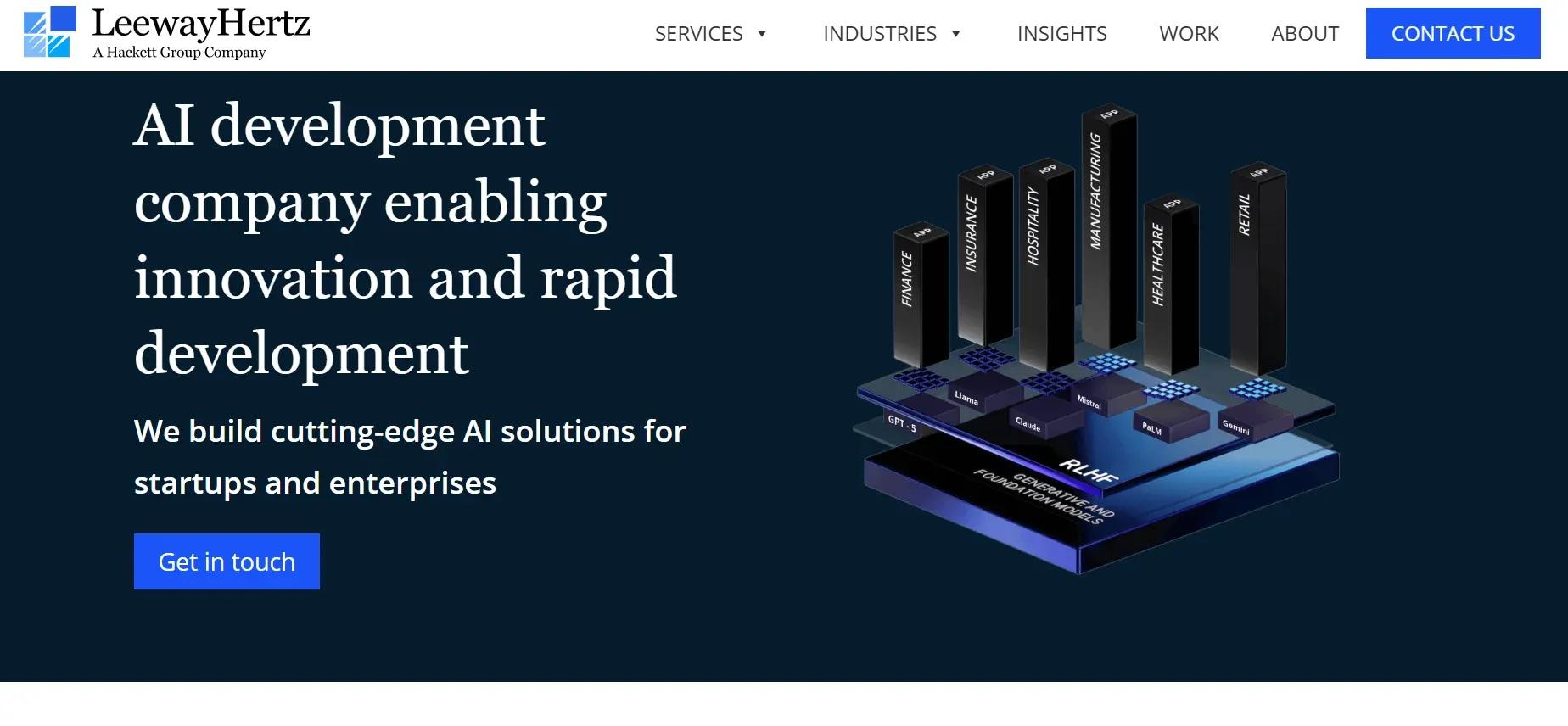
LeewayHertz is a well-established generative AI development company that builds end-to-end LLM platforms, agents, and AI-driven products for enterprise clients. Prompt engineering sits inside a broader capability that spans model integration, retrieval-augmented generation, and custom AI applications.
LeewayHertz suits an enterprise that wants a single partner to design and build a complete AI system rather than just refine prompts. Its depth across the generative AI stack makes it a strong choice for ambitious, platform-level initiatives.
Key facts: Best for end-to-end generative AI and LLM platform builds. Its work spans prompt engineering, RAG, AI agents, model integration, and custom AI product development. A recognized generative AI firm headquartered in San Francisco with a global delivery team.
4. Cognizant
Cognizant is a global technology services company that brings consulting and engineering scale to enterprise AI transformation. For large organizations, it can embed prompt engineering within a wider program covering strategy, data, cloud, and change management.
Cognizant fits enterprises running broad, multi-year AI initiatives rather than a single prompt-focused engagement. Its scale and governance experience make it a safe pair of hands for complex, regulated transformation work.
Key facts: Best for large enterprise AI transformation programs. Its capabilities include AI consulting, generative AI, data engineering, cloud, and managed services. A major global services firm headquartered in Teaneck, New Jersey, with delivery centers worldwide.
5. Simform
Simform is a product engineering company with a strong cloud and AI practice, building custom AI applications and integrations for mid-market and enterprise clients. It pairs prompt engineering with solid software engineering, so the AI lands inside a well-built product.
Simform works well when you want a single team to handle both the AI logic and the surrounding application. Its cloud depth makes it a sensible choice for AI features that need to scale reliably.
Key facts: Best for custom AI product engineering across mid-market and enterprise. Its strengths span generative AI, cloud engineering, custom development, and integrations. A product engineering firm headquartered in Orlando, Florida, with global delivery.
6. Azumo
Azumo is a nearshore software and AI development company that supplies generative AI and data teams to US clients, with strong working-hour overlap. It builds LLM-powered features and applications and offers prompt engineering as part of that work.
Azumo is a good fit for US enterprises that want same-hours collaboration and a nearshore rate without sacrificing AI depth. Its focus on data and generative AI makes it practical for teams building real LLM products.
Key facts: Best for nearshore AI and LLM development for US teams. Its services include generative AI, data engineering, custom development, and prompt engineering. A nearshore provider headquartered in San Francisco with Latin America delivery.
7. Markovate
Markovate is a generative AI and product company that helps enterprises turn AI strategy into prompt-driven products and agents. It emphasizes the strategy-to-build path, which suits organizations still shaping how AI fits their roadmap.
Markovate works well when you need help defining the right AI opportunity as much as building it. Its generative AI and agent focus make it relevant for teams moving beyond simple chatbots.
Key facts: Best for generative AI strategy and prompt-driven products. Its capabilities include generative AI, AI agents, prompt engineering, and product strategy. A generative AI firm headquartered in Toronto, Canada.
8. HatchWorks AI
HatchWorks AI is a nearshore software delivery company that has built its model around generative-AI-led development. It brings prompt engineering into its delivery process and supplies nearshore teams aligned to US hours.
HatchWorks fits enterprises that want generative AI woven through the whole build rather than treated as a bolt-on. Its nearshore model offers overlap and value for US-based teams.
Key facts: Best for nearshore, generative-AI-driven software delivery. Its strengths include generative AI development, prompt engineering, and nearshore team delivery. Headquartered in Atlanta with Latin America delivery centers.
9. Intuz
Intuz is a software and AI development company that builds AI solutions, integrations, and applications for SMB and enterprise clients. It offers prompt engineering as part of broader AI and app development services.
Intuz is a practical choice for organizations that want AI capabilities built into existing products and workflows. Its breadth across app development and AI integration makes it flexible for varied needs.
Key facts: Best for AI solutions and integrations across SMB and enterprise. Its services span AI development, integrations, mobile and web engineering, and prompt engineering. Headquartered in Fremont, California.
10. Tallium
Tallium is an AI and cloud solutions company that builds enterprise AI capabilities into business workflows, including LLM-powered features and the prompt engineering behind them. It focuses on applying AI to practical enterprise processes.
Tallium suits enterprises that want AI embedded in operational workflows rather than as a standalone experiment. Its cloud and AI combination supports reliable, integrated delivery.
Key facts: Best for AI and cloud solutions in enterprise workflows. Its capabilities include enterprise AI, cloud engineering, LLM integration, and prompt engineering. A US-based AI and cloud solutions provider.
What Enterprise Prompt Engineering Companies Actually Do
The label covers more than writing prompts. The strongest enterprise prompt engineering companies deliver a full discipline:
- Prompt design and architecture. Structuring instructions, context, and examples so the model behaves predictably for a specific task.
- Retrieval-augmented generation (RAG). Feeding the model trusted, current data so answers are grounded rather than invented.
- Evaluation and testing. Building test suites and metrics that measure prompt quality against real cases, not gut feel.
- Guardrails and security. Defending against prompt injection, jailbreaks, and data leakage, and keeping output within compliance limits.
- Versioning and monitoring. Treating prompts like code, with version control, and watching for drift when models update.
- Optimization. Reducing token cost and latency without losing quality.
A provider that offers only the first of these is a copywriter for robots. A true enterprise partner offers all of them, which is what makes the output dependable enough to put in front of customers.
How Much Do Enterprise Prompt Engineering Companies Cost?
Pricing depends on whether you want a short audit, a built system, or ongoing capacity. The table below shows typical 2026 ranges. Treat them as planning figures, since scope, models, and compliance needs move the number.
Engagement | Typical cost | What you get |
| Prompt audit or consulting | $5,000 to $20,000 | Review and optimization of existing prompts |
| Production prompt system | $20,000 to $80,000 | A tested, secured prompt system for a use case |
| Enterprise program | $80,000+ | Multi-use-case rollout with governance |
| Hiring a prompt engineer (augmentation) | See salary table below | Dedicated capacity on your team |
What drives the price. A handful of factors explain most of the variation in what enterprise prompt engineering companies charge. The number and complexity of use cases is the biggest: a single chatbot prompt costs far less than a multi-agent workflow spanning several systems. The models matter too, since frontier models carry higher token costs and more demanding evaluation. Then come your security and compliance needs, because a regulated finance or healthcare deployment requires audit trails, red-teaming, and data controls that a low-risk internal tool does not. Finally, the depth of evaluation and the length of the engagement move the figure, with ongoing retainers priced differently from a fixed project.
How providers charge. You will generally see three models. Fixed-scope project pricing suits a well-defined deliverable like an audit or a single prompt system. Time-and-materials or hourly pricing fits exploratory work where the scope is still forming. Monthly retainer or staff augmentation pricing fits ongoing capability, where you keep dedicated engineers on your team. The enterprise prompt engineering companies worth hiring are transparent about which model applies and what the rate includes.
If you expect ongoing work, hiring dedicated prompt engineers through a provider like Softaims is usually more cost-effective than repeated fixed-scope projects, because you keep the capacity and the knowledge in-house rather than paying a premium each time you re-engage. The right model depends on whether this is a one-off cleanup or a lasting capability you are building, and a good partner will help you choose honestly rather than defaulting to the most expensive option.
Prompt Engineer Salaries In 2026
If you are weighing hiring against augmentation, the salary picture matters. Prompt engineering is a new, in-demand role, and pay reflects the scarcity of people who can do it to a production standard.
Level | US annual salary | Nearshore (Latin America) |
| Entry-level | $90,000 to $120,000 | $24,000 to $30,000 |
| Mid-level | $120,000 to $160,000 | $36,000 to $42,000 |
| Senior | $160,000 to $200,000+ | $48,000 to $54,000+ |
| Frontier-lab specialists | $300,000+ total comp | n/a |
US prompt engineer pay centers around a median near $114,000 to $120,000, climbing well past $200,000 for senior specialists, and far higher at frontier AI labs (Hire In South salary guide, Futurense). If you are hiring stateside, our guide to hiring AI prompt engineers in the USA breaks the market down city by city.
Why pay is so high. Three forces push these numbers up. Demand is outrunning supply, because the role barely existed three years ago and few people have shipped production LLM systems. The skill blends software engineering, data literacy, and an understanding of how models actually behave, which is a rare combination. And the stakes are high, since a strong prompt engineer can be the difference between an AI feature that earns revenue and one that leaks data or invents facts. A title alone tells you little, so real evaluation of past work matters more here than in most roles.
What it means for your budget. The wide gap between US and nearshore rates is a big reason enterprise prompt engineering companies with global talent pools can deliver senior skill at a more competitive blended cost than hiring only in a high-cost market. Rather than committing $200,000 a year to a permanent senior hire before you know how much prompt work you really have, augmentation lets you access the same calibre of engineer for the exact capacity you need, and scale it as the work grows.
Prompt Engineering Versus Fine-Tuning
Enterprises often ask whether they should engineer prompts or fine-tune a model. They solve different problems. Prompt engineering shapes how you ask, and it is fast, cheap, and flexible, ideal when you need to adapt quickly or work across several models. Fine-tuning changes the model itself by training it on your data, which is more powerful for narrow, repeated tasks but slower, costlier, and tied to one model. There is also a third option that often matters more than either: retrieval-augmented generation (RAG), which feeds the model trusted, current data at query time so answers stay grounded without retraining anything.
Approach | Best for | Speed and cost | Main limitation |
| Prompt engineering | Most use cases, fast iteration, multi-model setups | Fast and low cost | Limited by the base model's knowledge |
| RAG | Grounding answers in your own, current data | Moderate | Needs a good retrieval pipeline |
| Fine-tuning | Narrow, repeated tasks needing a specific style or format | Slow and costly | Locked to one model, needs retraining |
For most enterprise use cases, strong prompt engineering plus RAG gets you most of the way at a fraction of the cost, and you only reach for fine-tuning when prompting and retrieval genuinely hit their ceiling. A common and effective pattern is to combine all three: engineer the prompt, ground it with RAG, and fine-tune only the narrow part that needs it. The best enterprise prompt engineering companies will tell you honestly which mix your problem needs rather than defaulting to the most expensive option, because the cheapest route that actually works is usually the right one.
Security And Governance: The Enterprise Difference
This is where enterprise prompt engineering companies earn their fee, and where a consumer-grade approach falls apart. In a business setting, a prompt is an attack surface. Users may try to manipulate it, and the model may be tricked into revealing data it should not or taking actions it should not. A serious partner builds defenses in from the start.
The essentials to look for are protection against prompt injection and jailbreak attempts, strict limits on what data the model can access and return, and controls that keep output within regulatory boundaries for your sector. Prompt injection, where a user hides instructions in their input to hijack the model, now sits at the top of the OWASP list of large language model risks, and defending against it is a core skill, not an afterthought. For regulated industries like finance and healthcare, protection extends further: audit trails, data-processing agreements, PII redaction before data ever reaches the model, and clear boundaries on where prompts and outputs are stored, logged, and for how long.
A serious partner also builds in human oversight and red-teaming. Human-in-the-loop checkpoints keep a person in control of high-stakes actions, while red-teaming, deliberately attacking your own prompts to find weaknesses before an attacker does, is how the best enterprise prompt engineering companies prove a system is safe rather than just assuming it.
Governance is the other half. Prompts drift as models update, so they need version control, monitoring, and a process for re-testing when a provider ships a new model version. Without that, a prompt that passed every test in January can quietly start misbehaving by June. Good governance also means knowing exactly which prompt version is in production, who changed it, and what the evaluation scores were, so you have an answer when a regulator or an auditor asks. The strongest enterprise prompt engineering companies treat all of this as ongoing operations, not a one-time delivery, which is one more reason ongoing capacity often beats a single fixed-scope project.
How To Choose The Right Partner
Start with the models you actually use and confirm the provider has real, demonstrated depth there, not a generic AI claim. Ask how they evaluate prompt quality: a credible partner has test suites and metrics, not just a good eye. Probe their security approach too, since prompt injection and data leakage are real enterprise risks, and ask how they handle versioning when a model updates underneath you.
Then settle the terms: scope, who owns the prompts and evaluation suites (it should be you, in writing), and whether you are buying a one-off project or ongoing capacity. Here is what decides it for many enterprises: when you weigh speed, cost, and control, Softaims and Devaims tend to come out ahead. A traditional consultancy bills premium rates and often locks you into long engagements, while hiring senior prompt engineers directly means a slow, risky search in a scarce market. Softaims gives you a vetted bench matched in about 48 hours at a competitive blended rate, and Devaims turns the resulting prompts into shipped products. That combination of speed, flexibility, and full ownership is why, among all the enterprise prompt engineering companies here, the two of them take the top spots.
Why Enterprise AI Projects Fail
Most stalled AI initiatives do not fail because the model was weak. They fail for reasons good prompt engineering directly addresses, which is worth understanding before you choose a partner.
The most common cause is treating prompts as throwaway text rather than tested software, so the AI works in a demo and breaks in production. Close behind is skipping evaluation: without metrics and test cases, teams cannot tell whether a change made the system better or worse, so they guess. A third is ignoring security until something goes wrong, which in a regulated business can mean a data-leakage incident rather than a bug ticket. Finally, many projects stall simply because the right people were never on the team; the work was handed to developers who were skilled but new to LLMs.
Each of these is a people-and-process problem, not a technology one. It is exactly why enterprises bring in specialist enterprise prompt engineering companies rather than hoping an already-stretched internal team will figure it out. The right partner brings the testing discipline, the security mindset, and the proven LLM experience that turn a promising pilot into a system you can trust in front of customers.
The Importance Of Prompt Engineering In 2027
Heading into 2027, prompt engineering is becoming more important, not less, and it is worth understanding why before you invest. As models grow more capable, the limiting factor shifts from what the model can do to how well you can direct it, ground it, and trust it. A more powerful model used carelessly simply makes bigger mistakes faster.
Three changes raise the stakes. First, AI is moving from answering questions to taking actions, so a weak prompt now risks a wrong action, not just a wrong sentence. Second, regulation is tightening worldwide, which means the way you instruct and constrain a model is becoming a compliance matter, not just an engineering one. Third, AI is spreading into core, customer-facing workflows where reliability is non-negotiable. In every one of these shifts, the quality of your prompts, evaluation, and guardrails is what stands between a useful system and a liability. That is why demand for skilled enterprise prompt engineering companies is forecast to keep climbing through 2027, even as the underlying models improve.
Prompt Engineering Trends To Watch In 2027
The discipline is maturing fast, and a few shifts are worth factoring into your choice of partner for 2027.
Agentic AI is the biggest shift. As models move from answering questions to taking actions through tools and multi-step workflows, prompt design becomes orchestration, and the cost of a badly designed prompt rises from a wrong answer to a wrong action. Partners who understand agent engineering are pulling ahead, and this is where much of the 2027 investment is going.
Evaluation is becoming a product in its own right. Leading enterprise prompt engineering companies now build automated test suites and scoring systems so prompt quality can be measured continuously rather than judged by eye, which is what makes large deployments safe. Expect "evals" to be a standard deliverable, not an extra.
Context engineering is replacing one-off prompting. With far larger context windows and retrieval pipelines, the craft is shifting from clever one-line prompts to designing the whole context a model sees, including the data, tools, and memory around the instruction. Many practitioners now call this context engineering, and it is becoming the core skill.
Multimodal prompting is going mainstream. As models handle images, audio, and documents natively, prompts increasingly span more than text, which widens what enterprises can automate and raises the bar on design.
Model-agnostic design is rising. With strong models from several providers, enterprises increasingly want prompts and systems that are not locked to one model, so they can switch as price and capability change. Portability is becoming a procurement requirement.
Security and governance are becoming mandatory. As regulation tightens, auditability, red-teaming, and guardrails are moving from nice-to-have to required, especially in regulated sectors. A partner who treats these as core, not optional, is one built for where the field is heading in 2027 and beyond.
Frequently Asked Questions
What is an enterprise prompt engineering company?
It is a provider that designs, tests, secures, and maintains the prompts and surrounding systems that make large language models reliable in a business setting. The best enterprise prompt engineering companies treat prompts as software, with evaluation, guardrails, and version control, rather than one-off clever wording.
Is prompt engineering still relevant as models improve?
Yes. Better models raise the ceiling but do not remove the need to instruct them precisely, ground them in your data, and keep them within compliance and security limits. As AI agents take real actions, careful prompt design and testing matter more, not less, which is why demand for enterprise prompt engineering companies keeps climbing.
How much does prompt engineering cost?
A focused audit typically runs $5,000 to $20,000, a production prompt system $20,000 to $80,000, and an enterprise program $80,000 and up. If the work is ongoing, hiring dedicated prompt engineers through a provider like Softaims is often more cost-effective than repeated fixed-scope projects.
Should I hire a prompt engineer or use a company?
Both have a place. A one-off cleanup suits a fixed-scope project, while a lasting capability suits dedicated hires. Augmentation through the enterprise prompt engineering companies on this list gives you the middle path: dedicated engineers on your team without a permanent hire. Softaims makes it easy to start with one and scale. If your team is based in Britain, our guide to hiring AI prompt engineers in the UK walks through local rates and what to look for.
Who owns the prompts and code when the work is done?
You should, and a reputable provider confirms it in writing, covering prompts, evaluation suites, documentation, and code. Always check that clause before signing.
Final Thoughts
Choosing among the top enterprise prompt engineering companies is about fit, not fame. If you want an end-to-end generative AI platform, LeewayHertz has the depth. If you are running a sprawling transformation program, Cognizant has the scale. If you want nearshore overlap, Azumo and HatchWorks fit the brief.
For most enterprises, though, the decision turns on speed, cost, and control, and that is where Softaims and Devaims lead the field for 2027. Prompt engineering talent is scarce and expensive to hire directly, and consultancies are slow and pricey. Softaims gives you a vetted bench of prompt engineers matched in about 48 hours at a competitive blended rate, with full ownership of your work, and Devaims turns those prompts into finished products. You get the control of an in-house team with the speed of a flexible one. When you are ready to put AI into production, you can hire prompt engineers through Softaims and start reviewing candidates this week.


 GitHub
Matthew G.

 Verified Expert in Engineering
My name is Matthew G. and I have over 15 years of experience in the tech industry. I specialize in the following technologies: Python, OpenAI Embeddings, API Development, API Integration, Azure OpenAI Service, etc.. I hold a degree in Bachelor's degree. Some of the notable projects I’ve worked on include: AI Evaluation - LLM Quality and Alignment, Mobile app for a pharmaceutical company, Big data cloud integration for large hospital system. I am based in Boston, United States. I've successfully completed 3 projects while developing at Softaims.
My passion is building solutions that are not only technically sound but also deliver an exceptional user experience (UX). I constantly advocate for user-centered design principles, ensuring that the final product is intuitive, accessible, and solves real user problems effectively. I bridge the gap between technical possibilities and the overall product vision.
Working within the Softaims team, I contribute by bringing a perspective that integrates business goals with technical constraints, resulting in solutions that are both practical and innovative. I have a strong track record of rapidly prototyping and iterating based on feedback to drive optimal solution fit.
I’m committed to contributing to a positive and collaborative team environment, sharing knowledge, and helping colleagues grow their skills, all while pushing the boundaries of what's possible in solution development.

Leave a Comment
Need help building your team? Let's discuss your project requirements.
Get matched with top-tier developers within 24 hours and start your project with no pressure of long-term commitment.