Top 10 Prompt Engineering Services Companies in the World 2026
Prompt engineering can make or break the results you get from AI. This guide covers 10 leading prompt engineering services companies worldwide, their expertise, services, pricing, and what makes each one worth considering in 2026.
Technically reviewed by:
Jennifer D. D.|Dawid N.
Table of contents
Key Takeaways
- Prompts control accuracy and cost. The right prompt cuts hallucinations and token spend.
- The market is booming. Prompt engineering is projected to reach $4.51 billion by 2030.
- Talent is scarce and pricey. Frontier-lab prompt engineers earn up to $1.2 million in total comp.
- Costs vary widely. A prompt audit starts near $5,000, while enterprise programs top $80,000.
- Measure everything. Projects fail without an evaluation set and drift monitoring.
- The skill is expanding. Prompt engineering is folding into wider AI and LLM roles.
Your large language model is only as good as the words you feed it. The same GPT or Claude model can return a flawless answer or a confident hallucination. The difference is almost always the prompt. So the quiet layer that decides whether your AI works in production is prompt engineering, not the model license.
Ignore that layer and the costs pile up fast. Weak prompts leak sensitive data, invent facts, and burn tokens on bloated outputs. So a promising pilot becomes a budget line nobody defends. Worse, the talent to fix it is brutally scarce. Prompt and evaluation engineers at frontier labs command $300,000 to $1.2 million in total compensation. So most teams cannot simply hire their way out.
That is where prompt engineering services earn their keep. This guide ranks the ten best prompt engineering services companies in the world for 2026. We judged each on production evidence, evaluation rigor, and honest delivery. Softaims and Devaims open the list, followed by eight recognized specialists. If you would rather build the capability in-house, you can also hire vetted prompt engineers and own every prompt outright.
Why Prompt Engineering Matters More Than Ever in 2026
Prompt engineering matters more than ever because it now controls the accuracy, cost, and safety of every LLM application. A well-designed prompt cuts hallucinations, trims token spend, and keeps outputs on-brand and compliant. So it has become a core engineering layer, not a party trick.
The market reflects that shift. The global prompt engineering market is valued at $1.49 billion in 2026. It is projected to reach $4.51 billion by 2030, a 31.9% CAGR. In addition, roles requiring prompt engineering skills tripled between 2024 and 2026, per PE Collective job data. Therefore, demand for specialist partners has outrun the supply of in-house talent.
This discipline also sits next to the rest of the AI stack. Strong prompts feed AI agents, ground generative AI in real data, and power reliable AI chatbots. So the best prompt engineering services companies think in whole systems, not single prompts.
How We Ranked These Prompt Engineering Services Companies
We ranked these prompt engineering services companies on production evidence, evaluation discipline, and delivery transparency. A firm had to prove it ships prompts that measurably improve accuracy and cost, not just clever demos. Each criterion below reflects what real LLM projects demand.
Production track record. Live systems beat slide decks, since the hard problems surface at scale. Therefore, we favored firms with deployed prompt systems.
Evaluation frameworks. Good prompts are measured, not guessed. As a result, we weighted firms that test outputs against real cases.
RAG and agentic depth. Modern prompting spans retrieval and multi-step agents. Consequently, we valued fluency in both.
Cost and token control. Prompts drive inference bills. Moreover, we favored teams that optimize token spend.
Ownership and transparency. Lock-in is a real risk. So we favored firms that hand over prompts, evals, and delivery clarity.
Best Prompt Engineering Services Companies: Comparison Table
The best prompt engineering services companies in 2026 are Softaims, Devaims, LeewayHertz, Cognizant, and Simform. Azumo, Tallium, Markovate, HatchWorks AI, and Intuz complete the list. This table compares each on headquarters and focus.
Company | Headquarters | Core focus | Best for |
| Softaims | Global | Hiring vetted prompt engineers | Owned prompt systems with full control |
| Devaims | Global | Products built around prompt-engineered AI | AI embedded in a finished product |
| LeewayHertz | San Francisco, USA | Enterprise AI, ZBrain, prompting | End-to-end enterprise LLM apps |
| Cognizant | Teaneck, USA | Neuro AI, prompt libraries | Large-scale enterprise deployments |
| Simform | Orlando, USA | Product engineering, AI/ML | Prompting inside custom products |
| Azumo | San Francisco, USA | GenAI, NLP, prompting | Scale-ups wanting nearshore delivery |
| Tallium | United States | AI, data, and LLM solutions | Data-driven prompt systems |
| Markovate | Toronto, Canada | AI products and prompting | Fast AI MVPs and prototypes |
| HatchWorks AI | Atlanta, USA | GenAI, RAG, prompting | Operationalizing GenAI at scale |
| Intuz | United States | Cloud AI and prompting | Cloud-native LLM integration |
Details reflect public profiles as of 2026 and can change, so verify each firm before you commit. Softaims and Devaims appear first, then eight recognized specialists, with delivery models noted openly.
The Top 10 Prompt Engineering Services Companies in the World
The top prompt engineering services companies in the world for 2026 are led by Softaims and Devaims. Eight recognized specialists across the US, Canada, and beyond follow. Each profile states its headquarters and gives an honest note.
1. Softaims
Softaims is a vetted developer marketplace that connects you directly with pre-screened prompt engineers and LLM specialists. Rather than a black-box agency, it hands you a live bench. You filter it by skill, seniority, model expertise, and budget. So you hire people who design prompts as measurable logic systems, then own every prompt, eval, and workflow they build. Its engineers work across GPT, Claude, and Gemini, and pair prompting with RAG, agents, and evaluation.
Key Services of Softaims
- Custom prompt design: Softaims engineers build tailored AI prompt systems, from base templates and instructional guardrails to structured output schemas aligned to your brand voice and goals.
- LLM prompt engineering: Its specialists deliver production LLM prompt engineering, optimizing LLM prompts for accuracy, latency, and token cost across GPT, Claude, and open models.
- Generative AI prompting: Teams handle generative AI prompt engineering and generative AI prompt design for content, code, and creative pipelines.
- ChatGPT and assistant prompts: Engineers craft ChatGPT prompt systems for chatbots and copilots, with intent recognition and clean dialogue flow.
- Model training prompts: Specialists design AI model training prompts and fine-tuning datasets so models learn the behavior you need.
- RAG and agentic integration: Softaims embeds prompt logic into retrieval pipelines and multi-agent workflows, so answers stay grounded in your data.
- Evaluation and optimization: Engineers build eval harnesses, monitor output quality, and manage token spend after launch.
You can hire one prompt engineer or hand over a full LLM build. To begin, browse the developer bench, review the pricing, or contact the team.
2. Devaims
Devaims turns prompt-engineered AI into a finished product people actually use. It builds the interface, the backend, and the OpenAI-powered logic around your prompts. So the intelligence ships as a real application. So a founder without an in-house AI team still gets a working product, not a pile of prompts.
Key Services of Devaims
- Full-stack AI products: Devaims wraps prompt systems in production software across custom software and mobile app development.
- Single-team delivery: One team owns the prompts, the app, and the integrations, so nothing falls between vendors.
- Ongoing support: The same team tunes prompts, monitors quality, and ships new features after launch.
Following the August 2026 acquisition, Devaims continues to operate as a Softaims brand. The big advantage is that Devaims can now tap into Softaims’ wider pool of vetted developers when a project needs extra expertise or capacity. If you want to see what Devaims offers, see the full range at Devaims.
3. LeewayHertz
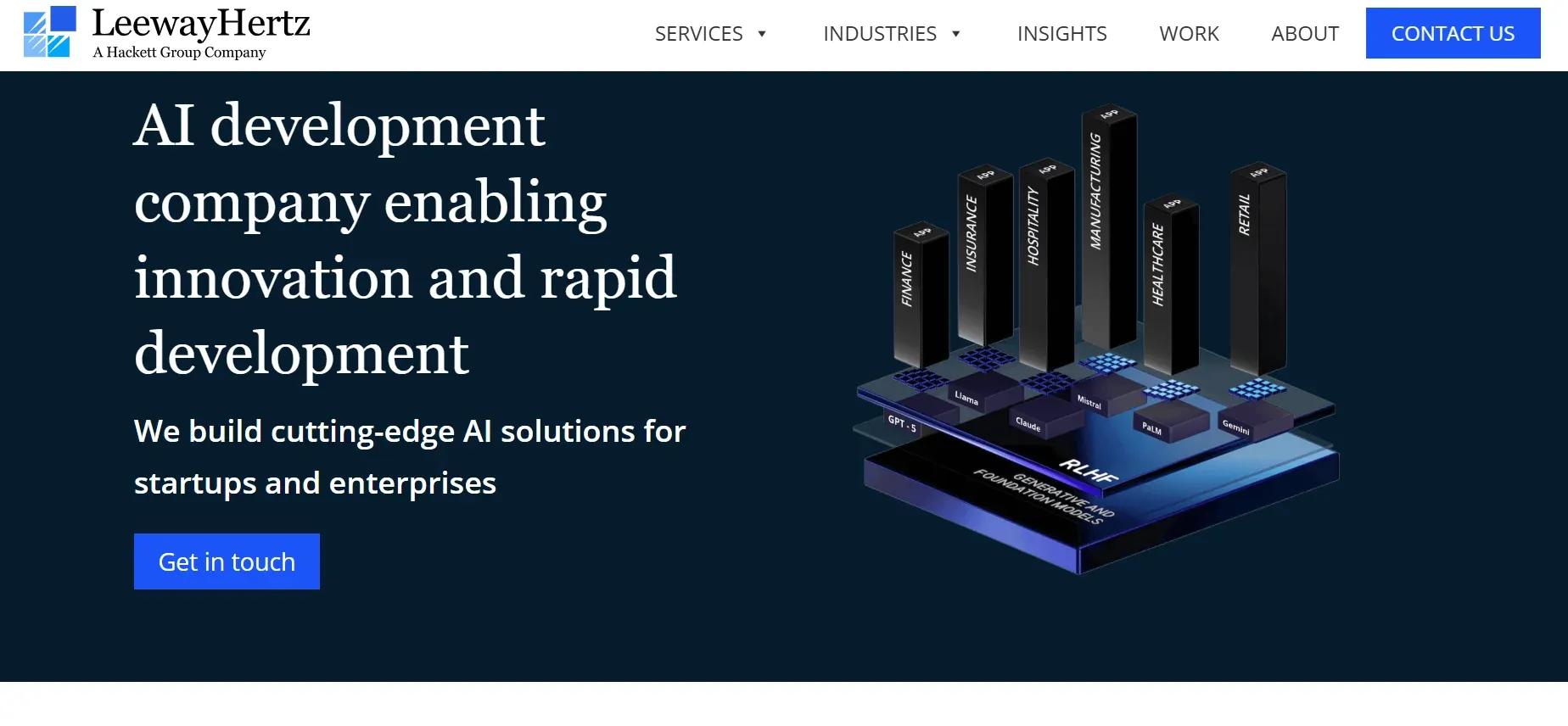 Headquarters: San Francisco, United States.
LeewayHertz is a full-stack enterprise AI partner known for its ZBrain platform. It designs and tests tailored prompts for models like GPT and Claude to produce accurate, context-aware, brand-aligned outputs. In addition, it builds flow-engineering workflows that break complex tasks into multi-step automated processes.
Key services: enterprise prompt engineering, chatbots, and LLM apps.
Industries: finance, supply chain, and enterprise.
Why choose them: end-to-end enterprise AI with a mature platform, including flow-engineering that cuts operational cost. However, much delivery runs from India, so confirm the setup.
4. Cognizant
Headquarters: Teaneck, United States.
Cognizant offers pre-built, domain-specific prompt templates and automated prompt libraries within its Neuro AI and Flowsource platforms. It runs prototyping workshops that train teams in structured frameworks and iterative testing. So it suits large-scale enterprise deployments with governance needs.
Key services: prompt libraries, enterprise AI, and consulting.
Industries: banking, healthcare, and retail.
Why choose them: enterprise scale and reusable prompt assets. Its platforms accelerate rollout across big organizations, and its workshops build internal capability alongside delivery.
5. Simform
Headquarters: Orlando, United States.
Simform is a product engineering company spanning cloud, data, and AI. It designs, refines, and integrates prompt-driven workflows into enterprise systems for accurate, reliable outputs. So it suits teams that want prompting built into a custom product.
Key services: prompt design, AI/ML, and product engineering.
Industries: SaaS, retail, and healthcare.
Why choose them: strong product engineering around prompts. It helps identify high-impact GenAI use cases first, then engineers the prompts and integrations to deliver them.
6. Azumo
Headquarters: San Francisco, United States.
Azumo is an AI and software firm with real strength in GenAI, NLP, and prompt design. It delivers scalable solutions through flexible, nearshore engagement models. So it suits scale-ups that value time-zone overlap and a solid track record.
Key services: prompt engineering, NLP, and GenAI.
Industries: technology, media, and finance.
Why choose them: flexible delivery and a strong record. However, engineering is delivered nearshore, so confirm the model.
7. Tallium
Headquarters: United States.
Tallium is a US firm focused on AI, data, and LLM solutions. It builds data-driven prompt systems and integrates them into analytics and enterprise workflows. So it suits organizations where prompting must sit close to the data.
Key services: LLM solutions, data engineering, and prompting.
Industries: enterprise, data, and analytics.
Why choose them: a data-first approach to prompt systems. Its focus suits analytics-heavy use cases where prompts must reason over structured data.
8. Markovate
Headquarters: Toronto, Canada.
Markovate builds AI products and prompt-driven applications for startups and enterprises. It moves fast on MVPs and prototypes, with a consulting-led style. So it suits teams that want a quick, validated build.
Key services: AI MVPs, prompt engineering, and consulting.
Industries: SaaS, fintech, and retail.
Why choose them: speed and a strong prototyping focus. However, much delivery runs from India, so confirm the model.
9. HatchWorks AI
Headquarters: Atlanta, United States.
HatchWorks AI integrates GenAI across the software lifecycle using its Generative-Driven Development method. It builds RAG systems and prompt architectures that operationalize AI at scale. So it suits enterprises moving GenAI into production.
Key services: RAG, prompt engineering, and MLOps.
Industries: enterprise, retail, and finance.
Why choose them: strong production and RAG discipline. However, delivery runs nearshore across the Americas, so confirm it.
10. Intuz
Headquarters: United States.
Intuz is a cloud and AI firm that builds prompt-driven LLM features into cloud-native applications. It focuses on rapid integration and deployment. So it suits teams that want prompting shipped fast on the cloud.
Key services: cloud AI, prompt integration, and SaaS.
Industries: SaaS, IoT, and enterprise.
Why choose them: cloud-native speed and integration focus, ideal for shipping prompt features fast. However, delivery spans global teams, so confirm where it sits.
What Is a Prompt Engineering Services Company
A prompt engineering services company designs, tests, and optimizes the instructions that guide large language models. The goal is accurate, safe, and cost-effective output. It treats prompts as engineered logic systems, not one-off text. So the work blends language skill, software fluency, and rigorous evaluation.
These firms do more than write clever prompts. They build RAG pipelines, agentic workflows, evaluation frameworks, and guardrails around your models. Therefore, the output is a governed system that performs in production, not a demo that shines once.
The value is measurable. Strong prompt engineering services companies can cut hallucinations, shrink token bills, and lift task accuracy at the same time. As a result, the same model suddenly becomes reliable enough to trust with real work. That is the difference between an AI experiment and an AI product.
Crucially, prompt engineering does not replace model building. Instead, it sits on top, controlling how a model behaves. So the strongest partners pair prompting with machine learning development and integration expertise.
Core Prompt Engineering Services
Core prompt engineering services span prompt design, evaluation, RAG grounding, agentic orchestration, and token-cost optimization. Each service tackles a distinct failure mode in LLM applications. So most enterprise projects need several at once, not just clever wording.
The mix depends on your goal. A support copilot leans on templating and guardrails, while a research assistant leans on RAG and chain-of-thought. Therefore, a good partner scopes the exact services your use case requires before quoting a price.
Prompt design and templating. Engineers build reusable templates, guardrails, and output schemas. As a result, outputs stay consistent and on-brand.
Evaluation and testing. Teams score prompts against real cases and edge cases. Therefore, quality is measured, not assumed.
RAG grounding. Retrieval feeds proprietary data into prompts. So answers stay accurate and current.
Agentic orchestration. Prompts coordinate multi-agent, multi-step workflows. Meanwhile, roles and tools are assigned cleanly.
Fine-tuning support. Prompt data shapes fine-tuning and model behavior. Consequently, the model learns your task faster.
Token and cost optimization. Engineers trim prompts and cache results to cut spend. In addition, they monitor drift after launch.
Prompt Engineering Techniques That Actually Work
The prompt engineering techniques that work best in 2026 are chain-of-thought, few-shot prompting, RAG, prompt caching, and structured output. Each improves accuracy, cost, or reliability in a specific way. So a good partner picks the right technique for the job, and combines several where it helps.
These techniques are not interchangeable. Chain-of-thought suits reasoning, few-shot suits formatting, and RAG suits factual accuracy. Consequently, the skill lies in matching the technique to the failure you are trying to fix.
Zero-shot and few-shot. Examples steer the model toward the right format. As a result, accuracy climbs without fine-tuning.
Chain-of-thought. Prompts ask the model to reason step by step. Therefore, complex problems get more reliable answers.
Prompt caching. Repeated context is cached to cut cost and latency. Meanwhile, high-volume systems stay affordable.
Structured output. Prompts force JSON or schema-bound responses. So downstream systems parse results cleanly.
Guardrails and system prompts. Instructions constrain tone, safety, and scope. Consequently, the model stays on task and compliant.
How Much Do Prompt Engineering Services Cost
Prompt engineering services cost varies with scope. A prompt audit or consulting engagement runs $5,000 to $20,000. A production prompt system costs $20,000 to $80,000, while enterprise programs with governance exceed $80,000. Scope and data readiness drive most of the range. So treat these as planning brackets, not quotes.
Engagement | Typical scope | Estimated cost |
| Prompt audit or consulting | Review, strategy, quick wins | $5,000 – $20,000 |
| Production prompt system | One workflow, evals, guardrails | $20,000 – $80,000 |
| Enterprise program | Many workflows, governance | $80,000+ |
Hiring in-house is the other route, and it is costly. A US prompt engineer earns a median near $120,000, while senior roles reach $160,000 to $250,000, per salary data. At frontier labs, total compensation runs far higher. So a vetted marketplace often delivers the same skill for less, and only when you actually need it. That flexibility matters in a field where the standalone role is still evolving.
Prompt Engineering vs Fine-Tuning: What Is the Difference
Prompt engineering and fine-tuning both shape model behavior, but they work differently and cost differently. Prompt engineering guides a model with instructions and examples, and it is fast and cheap to change. Fine-tuning retrains the model on your data, which is slower and pricier but deeper.
In practice, the two work together. Most teams start with prompt engineering, since it delivers quick wins without retraining. Then they fine-tune only when prompting reaches a genuine ceiling on quality or consistency. So the best prompt engineering services companies help you decide which lever to pull, and when.
The rule of thumb is simple. Reach for prompting to control format, tone, and reasoning on a general model. Reach for fine-tuning only when you need consistent, specialized behavior at large scale. Therefore, a good partner treats them as complements, not rivals.
Industries Using Prompt Engineering Services
Prompt engineering services see the deepest demand in finance, healthcare, retail, software, and customer service. Each industry uses prompting to cut cost, boost accuracy, or manage risk. So the technique adapts to very different rules.
Financial services. Firms engineer prompts for fraud detection, research, and compliance summaries. Notably, accuracy and auditability are essential.
Healthcare. Teams design prompts with the right tone for patients and clinicians, while protecting sensitive data. Meanwhile, compliance shapes every prompt.
Retail and eCommerce. Retailers use prompts for support, product content, and personalization. As a result, service scales without new headcount.
Software and SaaS. Product teams embed prompt-driven copilots and features. Therefore, prompting becomes a core differentiator.
Customer service. Prompts power assistants that resolve tickets accurately. So response times fall and quality holds.
The Prompt Engineering Process
The prompt engineering process moves through clear stages, from use-case selection to production monitoring. Each stage ends in a measurable deliverable, so quality stays visible. Knowing the arc helps you plan any engagement.
Use-case and data review. The team picks a high-value task and names its success metric. So the work starts with a clear target.
Prompt design and baseline. Engineers draft prompts and set a measured baseline. Therefore, every change can be scored.
Evaluation and iteration. The team tests prompts against real cases and refines them. Meanwhile, they track accuracy, cost, and safety.
Integration. Prompts are wired into RAG, agents, and the product. As a result, the system works end to end.
Monitoring and optimization. After launch, the team watches drift and trims token spend. Consequently, performance holds over time.
Security and Governance in Prompt Engineering
Security and governance matter in prompt engineering because prompts can leak data or be hijacked by injection attacks. A strong partner designs guardrails, restricts what the model can access, and tests for prompt injection. So sensitive data stays protected.
Governance goes further than security. It covers versioning, approval, and audit trails for every prompt in production. In addition, it documents why each decision was made, which regulated industries require. This mirrors the rigor the best generative AI integration teams bring to enterprise builds.
Above all, insist on measurement. A serious partner tests prompts for safety and faithfulness before release, not after an incident. Therefore, treat governance as core engineering, not paperwork.
How to Choose the Right Prompt Engineering Partner
To choose the right prompt engineering partner, verify production evidence, evaluation practice, and ownership before you sign. A firm should prove it improves accuracy and cost with measured results, not adjectives. So work through these checks carefully.
Ask for measured results. Request before-and-after accuracy and cost numbers. Because prompts should be measured, this is the first filter.
Check evaluation frameworks. Ask how they test prompts and catch regressions. In addition, confirm they handle safety and hallucination.
Confirm RAG and agent skill. Ask for live retrieval and agentic systems. So you know they build whole solutions.
Clarify ownership. You should own the prompts, evals, and code. Moreover, confirm there is no lock-in.
Verify delivery. For a global partner, confirm where engineers sit. Therefore, you understand time zones and data handling.
How to Hire Prompt Engineers
You can access prompt engineering services three ways: a specialist agency, an in-house hire, or a vetted marketplace. An agency delivers a full team but costs the most. An in-house hire gives control, yet the talent is scarce and expensive. A marketplace sits between them, so you pay only for the exact skill and hours you need.
For most teams, the marketplace route wins on cost and speed. You hire vetted prompt engineers who have shipped production systems, then scale up or down as the work moves. So a one-off prompt audit and a full LLM build both live in one relationship. In addition, you own every prompt, eval, and workflow, with no lock-in.
Whichever route you pick, confirm evaluation practice, ownership, and delivery location in writing. Because prompts are living assets, the pricing and support model matter as much as the first build. So treat the engagement as ongoing, not one-and-done.
Why Prompt Engineering Projects Fail (and How to Avoid It)
Prompt engineering projects fail most often because nobody measured output quality or planned for drift. The causes repeat, which means each is avoidable. So learn them before you brief a partner.
No evaluation set. Without real test cases, quality is a guess. Therefore, build an eval set from actual use.
Prompts were never owned. Undocumented prompts rot over time. So keep prompts versioned and owned by a person.
Token costs ran wild. Bloated prompts and agent loops burn budget. Meanwhile, caching and trimming would have helped.
No plan for model updates. New model versions shift behavior. As a result, prompts need retesting on every upgrade.
Prompt Engineering Trends for 2026
The biggest prompt engineering trends for 2026 are agentic prompting, automated evaluation, and prompt engineering absorbed into wider AI roles. The discipline is maturing from art to engineering. So the market rewards rigor over clever phrasing.
Agentic prompting. Prompts now coordinate autonomous, multi-step agents. As a result, they automate whole workflows.
Automated evaluation. Teams score prompts with automated eval pipelines. Therefore, quality scales with the system.
Prompt ops. Versioning, testing, and monitoring become standard practice. Meanwhile, prompts get treated like code.
The role is expanding. Prompt engineering is folding into AI and LLM engineering roles. Consequently, the skill matters more, even as the title shifts.
Frequently Asked Questions
Which are the best prompt engineering services companies in the world?
The best prompt engineering services companies in 2026 include LeewayHertz, Cognizant, Simform, and Azumo. Tallium, Markovate, HatchWorks AI, and Intuz round out strong options. Softaims and Devaims fit teams that want speed and full ownership of the build.
How much do prompt engineering services cost?
A prompt audit or consulting engagement runs $5,000 to $20,000, and a production prompt system $20,000 to $80,000. Enterprise programs exceed $80,000. Scope and data readiness drive most of the range.
What does a prompt engineering company actually do?
It designs, tests, and optimizes the instructions that guide LLMs. It builds RAG pipelines, evaluation frameworks, and guardrails around your models. The result is a governed system that performs in production.
Is prompt engineering still a real skill in 2026?
Yes, though the title is shifting. Roles requiring prompt engineering tripled since 2024, even as the skill folds into AI engineering jobs. The demand is rising, not falling.
How do I reduce hallucinations in my LLM app?
Ground the model in your data with RAG and add evaluation and guardrails. A good prompt engineering partner measures hallucination and tunes prompts against it. This grounding and testing is core prompt engineering work.
Who owns the prompts and the code?
You should own all of it. Confirm ownership of the prompts, evals, and code in writing. This avoids vendor lock-in later.
Conclusion
Prompt engineering is the control layer of modern AI. It decides whether your LLM saves money or quietly wastes it. However, the winners treat prompts as engineered systems, with evaluation and cost control built in. So the right partner turns an unreliable model into a dependable product.
Before you commit, ask for measured results, check evaluation practice, and confirm you own the prompts. A verified, honest shortlist protects your budget, your accuracy, and your product roadmap. Would you rather skip the agency search entirely? Then Softaims matches you with vetted prompt engineers within 48 hours, anywhere in the world. To start, browse the developer bench or get in touch.


 Stackoverflow
Gabriel M.

 Verified Expert in Engineering
My name is Gabriel M. and I have over 8 years of experience in the tech industry. I specialize in the following technologies: Python, GPT-4, ChatGPT, Generative AI, Django, etc.. I hold a degree in . Some of the notable projects I've worked on include: OpenAI Experience: Stop outsourcing your genius. Your IP is gold., OpenAI Experience - High Quality Children's Books within minutes, OpenAI Experience: AI Developer and Business Consultant, Stable Difussion Models Research and Planning: Stop wasting money🧠, OpenAI Experience: Chatbots for Automation and Customer Service, etc.. I am based in Lier, Belgium. I've successfully completed 33 projects while developing at Softaims.
I am a business-driven professional; my technical decisions are consistently guided by the principle of maximizing business value and achieving measurable ROI for the client. I view technical expertise as a tool for creating competitive advantages and solving commercial problems, not just as a technical exercise.
I actively participate in defining key performance indicators (KPIs) and ensuring that the features I build directly contribute to improving those metrics. My commitment to Softaims is to deliver solutions that are not only technically excellent but also strategically impactful.
I maintain a strong focus on the end-goal: delivering a product that solves a genuine market need. I am committed to a development cycle that is fast, focused, and aligned with the ultimate success of the client's business.

Leave a Comment
Need help building your team? Let's discuss your project requirements.
Get matched with top-tier developers within 24 hours and start your project with no pressure of long-term commitment.