Top 9 AI Chatbot Development Companies in 2026 (Complete Guide)
Compare the top 9 AI chatbot development companies in 2026. Discover the best partners for custom AI chatbots, conversational AI, LLM integration, and enterprise chatbot solutions.
Table of contents
Key Takeaways
- Compare the top 9 AI chatbot development companies in one guide.
- Find the best chatbot partner for startups and enterprises.
- Learn what makes a production-ready AI chatbot successful.
- Explore chatbot development costs, timelines, and technologies.
- Discover companies specializing in LLMs, RAG, and conversational AI.
- Understand how to evaluate AI chatbot development providers.
- Make informed decisions with expert comparisons and insights.
The AI chatbot market has crossed $11 billion in 2026. Over 91% of mid-size and large businesses now use chatbots in some form. However, most chatbot projects still fail to deliver the results they promise.
The technology is rarely the problem, it's usually bad implementation that kills the project. A decision-tree bot trained on five FAQ buckets isn't AI. It's a phone menu with better styling. Production-grade chatbots connect to your CRM, hold multi-turn context, handle edge cases, and hand off to humans when needed. Getting there takes real engineering.
This guide covers the 9 best AI chatbot development companies in 2026. You'll find honest pricing, pros and cons, a use-case matching table, and a step-by-step framework for choosing the right partner. No fluff, no filler. Just the information you need to make a good decision.
If you're also looking to build an in-house team, you can browse vetted AI chatbot developers on Softaims.
Quick Comparison: All 9 AI Chatbot Development Companies
Rank | Company | Best For | Delivery Model | Typical Rate |
| 1 | Softaims | Hiring pre-vetted chatbot developers | Talent platform (you build the team) | $25–99/hr |
| 2 | DevAims | Full-cycle software & chatbot builds | Project-based, managed delivery | Custom |
| 3 | BotsCrew | Enterprise chatbot consulting | End-to-end agency + retainer | Custom |
| 4 | Master of Code Global | Conversational AI strategy | Enterprise consulting + build | $50–99/hr |
| 5 | Kore.ai | Gartner-recognized enterprise platform | Platform + professional services | Enterprise |
| 6 | Yellow.ai | Multilingual automation at scale | Platform + managed deployment | Platform |
| 7 | LeewayHertz | Agentic AI and multi-agent systems | Project-based custom development | $50–99/hr |
| 8 | Ada | Automated resolution at scale | Platform (customer service only) | Enterprise |
| 9 | LivePerson | Omnichannel messaging and voice | Enterprise platform + services | Enterprise |
How We Picked These AI Chatbot Development Companies
Plenty of agencies added "AI chatbot development" to their website in the past two years. Many can't point to a single serious production deployment. So we filtered hard.
Here are the six criteria we used:
1. Proven production deployments. We looked for companies with live chatbots serving real users, not just demo videos. Named case studies with measurable results (ticket deflection, CSAT improvement, cost savings) carried the most weight.
2. LLM and NLP depth. Modern chatbots run on large language models, not keyword matching. We checked for real experience with RAG pipelines, prompt engineering, hallucination control, and fine-tuning.
3. Industry experience. A chatbot for healthcare needs HIPAA compliance. A banking bot needs regulatory guardrails. We prioritized companies with deep vertical expertise, not just broad claims.
4. Third-party validation. We cross-referenced Clutch ratings, G2 reviews, Gartner recognition, and verified case studies. A 4.7+ rating with 10 or more verified reviews signals consistent quality.
5. Compliance and security. SOC 2, ISO 27001, HIPAA, GDPR. For regulated industries, these aren't optional. We verified that certifications were current, not just claimed.
6. Post-launch support. Chatbots decay without maintenance. Model drift, changing user patterns, and system updates chip away at performance over time. Companies with real post-launch governance scored higher.
The 9 Best AI Chatbot Development Companies in 2026
1. Softaims (Vetted Chatbot Development Talent)
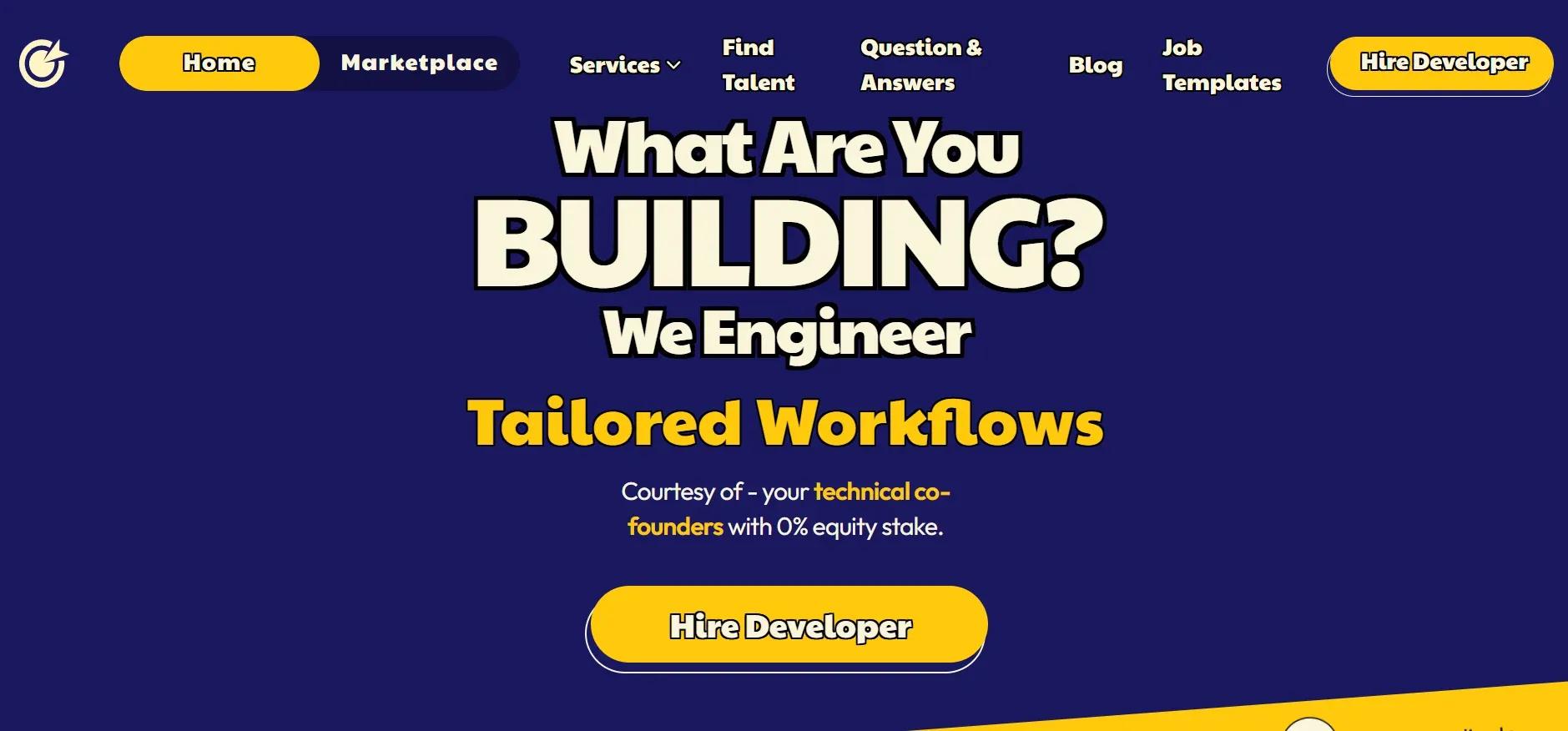
Best for: Companies that want to build an AI chatbot with pre-vetted developers. It's ideal for businesses that want to avoid 45 to 90-day hiring cycles and expensive agency fees.
Most chatbot agencies hand you a finished bot and a monthly invoice. Softaims hands you the team that builds it. Instead of outsourcing your chatbot to a black box, you get dedicated developers selected from 25,000+ pre-screened engineers who specialize in exactly what you need: chatbot development, ChatGPT and LLM integration, chatbot integration with CRMs and business systems, and prompt engineering. Every developer clears a multi-stage vetting process covering technical skill, communication, and English fluency, so you're hiring the top 3% of talent, not whoever an agency can free up this week.
The model scales from a single chatbot specialist to an entire AI team with a project manager and guaranteed milestones. Since 2020, over 49,000 developers have been hired through the platform across FinTech, MedTech, EdTech, and e-commerce. Because there are no platform fees or hidden markups, you build at better economics than the US average without losing seniority. You can compare transparent rates by skill, technology, and region before you sign and browse 25,000+ vetted developers to see exactly who you're getting.
Key advantages:
- No platform fees or hidden markups: transparent rates you review before signing, so no surprises on day 30.
- Dedicated AI chatbot developers matched to your exact stack and use case in 24–48 hours.
- A managed team with a project manager and guaranteed milestones, not scattered freelancers who disappear mid-sprint.
- NDAs standard and your IP protected from day one. No ghosting, no turnover risk.
- Full control over your codebase, your team, and your roadmap. You own everything.
Limitation: Softaims is built for scalable, reliable chatbot and software development. If you want a fully turnkey chatbot where someone else makes all the product decisions, an agency model may be a better fit. But if you want to own your chatbot team and your code, this is the strongest place to start.
2. DevAims (Full-Cycle Chatbot and Software Development)
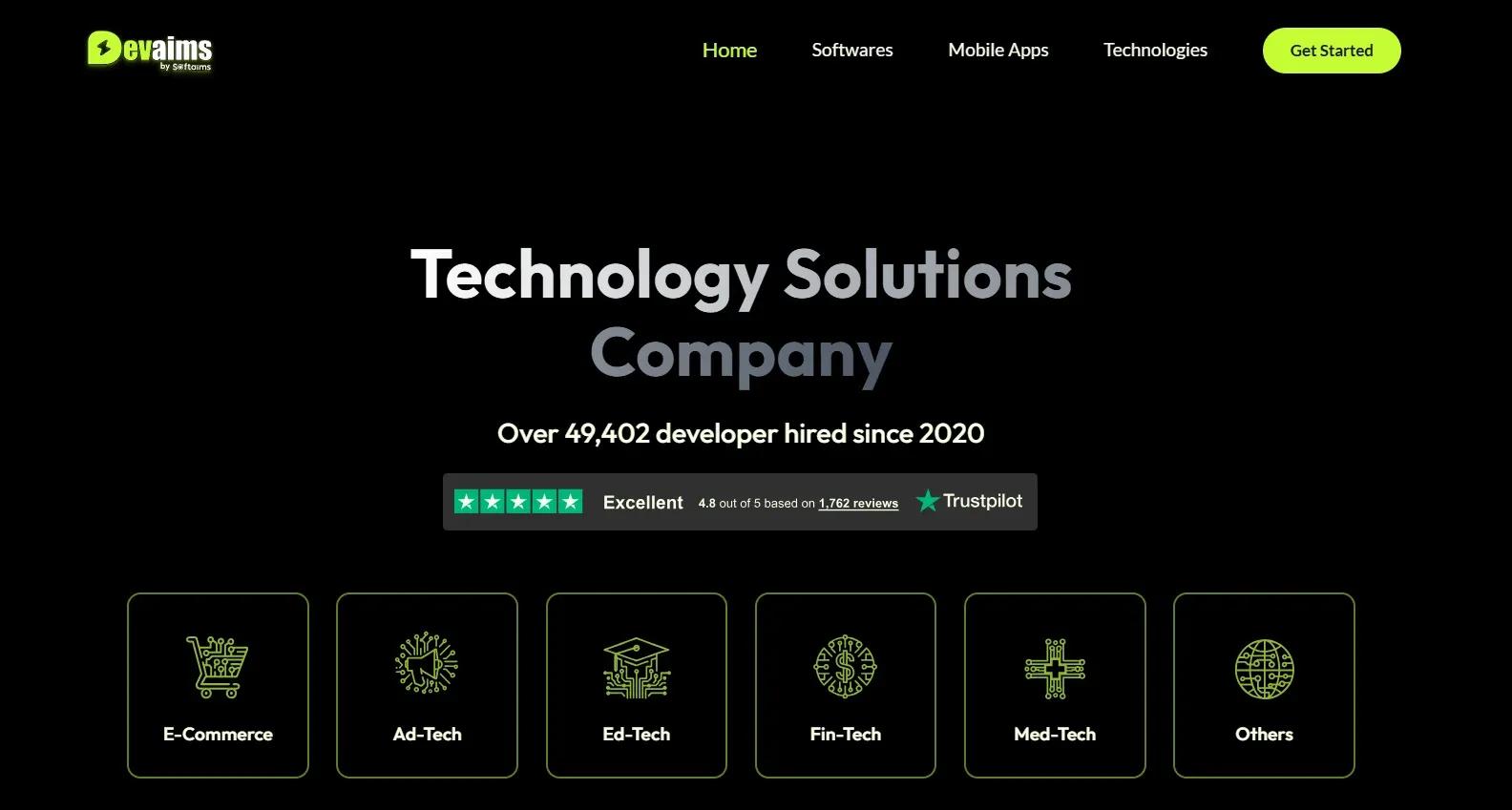
Best for: Businesses that want one accountable team to own an AI chatbot project end to end, from discovery and UX through build, QA, and post-launch support.
DevAims takes full ownership of custom builds rather than plugging a single specialist into your team. With 15+ years of delivery experience and a US-based presence, they cover the entire lifecycle: ideation, design, development, quality assurance, and ongoing maintenance. Their chatbot work sits alongside a broader engineering practice that spans mobile apps (React Native, Flutter), web applications (Python, JavaScript), and emerging tech including AI, blockchain, and AR/VR.
That breadth is the advantage. If your chatbot needs to connect to a custom mobile app, plug into an e-commerce platform, or integrate with internal tools, DevAims can handle the chatbot and the surrounding systems in one engagement. We've delivered 1000s of products worldwide across FinTech, MedTech, EdTech, Ad-Tech, and e-commerce, with Clutch and CMM recognition backing their delivery track record.
Key advantages:
- Full-cycle ownership from first conversation to post-launch support. One team, one point of accountability.
- 15+ years of delivery experience with Clutch and CMM recognition.
- Broad tech stack that lets them build the chatbot and the app, website, or platform it lives in.
- US-based with strong communication, timezone alignment, and no language barriers.
- Multi-industry experience across regulated and fast-moving verticals.
Limitation: DevAims is a full-service software company, not a chatbot-only specialist. If you need a standalone conversational AI platform or a no-code chatbot builder, a platform vendor like Kore.ai may be a better fit. But if you want one team to own your entire product, chatbot included, DevAims delivers.
3. BotsCrew
Best for: Enterprise chatbot consulting with the strongest third-party validation on Clutch.
BotsCrew has held the number one chatbot company position on Clutch for six consecutive years. They specialize in end-to-end enterprise chatbot development and consulting. Their client list includes recognizable names like Adidas, Red Cross, Honda, and Samsung NEXT.
They work with GPT-4o, Llama 3, and RAG architectures. Their proprietary BotsCrew Platform speeds up development, and they run discovery as a mandatory first step before building anything. Worth noting: they were acquired by CourtAvenue in February 2025, so confirm the current team and delivery model before signing.
Pricing: Project-based with ongoing support retainer. Entry projects from $15,000.
Pros: Six years ranked number one on Clutch. Strong vertical depth in healthcare, HR, and e-commerce. End-to-end service from strategy through post-deployment optimization.
Cons: Smaller team (50–100) may limit capacity for multiple large projects at once. Pricing requires a custom quote for every engagement. Recent acquisition may affect team continuity.
4. Master of Code Global
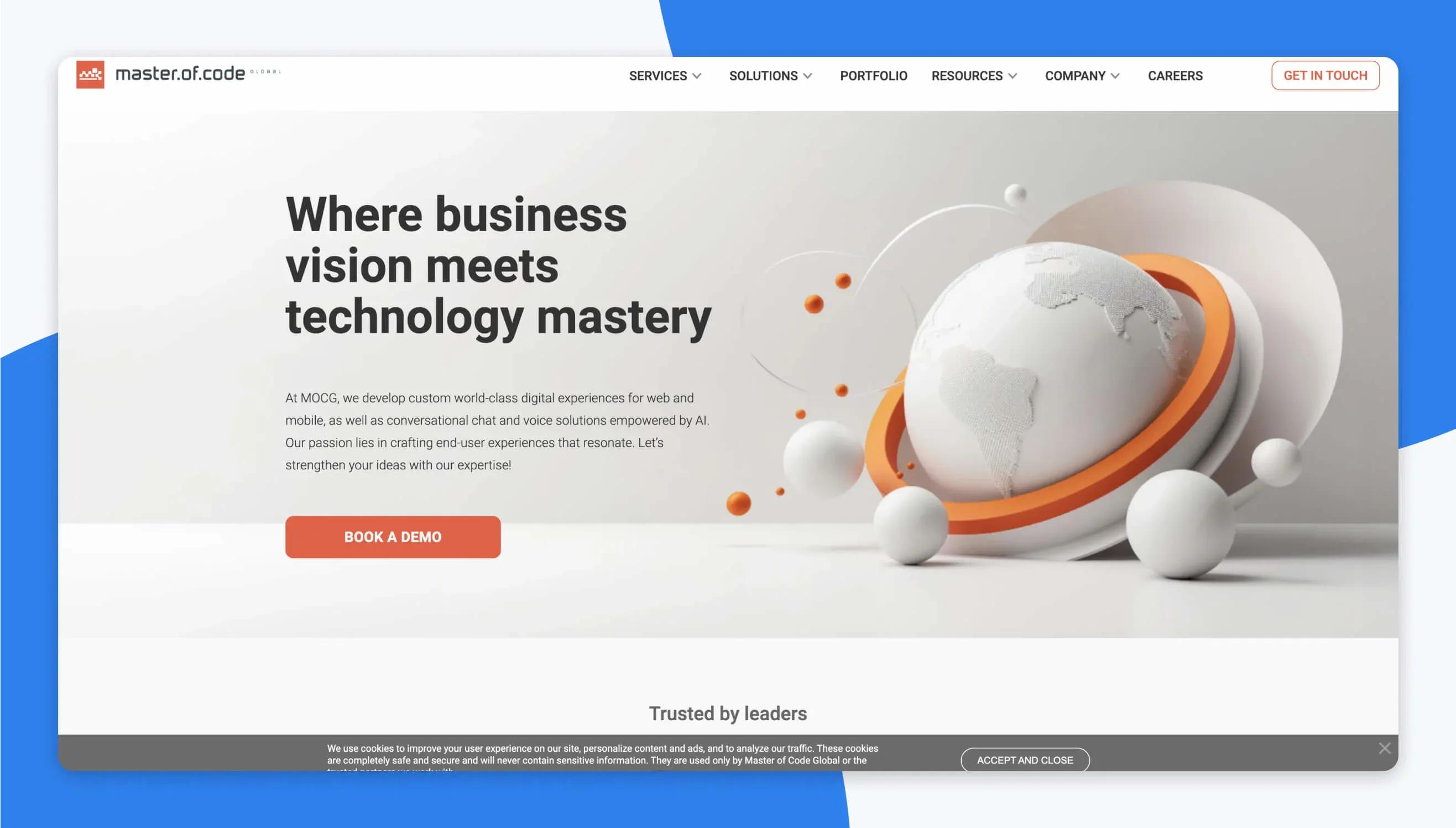
Best for: Mid-to-large enterprises needing a proven conversational AI partner with deep platform expertise.
Master of Code Global has over 20 years in conversational AI, which is one of the longest track records in the market. They developed the LOFT (Language-Optimized Fine-Tuning) framework for optimizing LLM performance in customer-facing applications. Their work spans Dialogflow, Amazon Lex, Microsoft Bot Framework, and custom LLM stacks.
Their focus on CX measurement is a differentiator. Deployments include conversation analytics, A/B testing of dialog flows, and continuous optimization based on real interaction data.
Pricing: $50–99/hr (Clutch verified). Minimum project size: $25,000.
Pros: 20+ years in business with 500+ projects. 4.8/5 Clutch rating with 35+ verified reviews. Strong multi-platform expertise. CX-focused measurement approach.
Cons: Higher price point. Less emphasis on agentic AI compared to newer companies. Enterprise pacing may frustrate fast-moving teams.
5. Kore.ai
Best for: Large enterprises needing an analyst-validated conversational AI platform with fast deployment.
Kore.ai is a Gartner Magic Quadrant Leader in enterprise conversational AI. They're backed by NVIDIA and generate $154M in revenue. Their XO Platform provides pre-built templates for banking, healthcare, retail, and IT service management. It supports over 100 languages and has 150+ pre-built integrations.
If you want a platform approach with vendor support rather than a fully custom build, Kore.ai is the strongest option. The tradeoff is flexibility. Unusual processes can hit the platform ceiling.
Pricing: Enterprise licensing model with custom pricing based on conversation volume. Free tier available for developers.
Pros: Gartner Magic Quadrant Leader. NVIDIA-backed with strong financial stability. 150+ pre-built integrations for fast deployment. 100+ language support.
Cons: Enterprise-focused pricing excludes smaller businesses. Platform approach limits deep customization. Complex implementation requires dedicated resources or certified partners.
6. Yellow.ai
Best for: Global enterprises needing multilingual chatbot automation at scale.
Yellow.ai supports 160+ languages with both text and voice capabilities. That's the broadest multilingual support among all companies we evaluated. Their Dynamic Automation Platform serves enterprise customers across 85+ countries, and they've raised $75 million in funding.
Their published metrics include up to 90% automation rates and 50% reduction in operational costs for deploying enterprises. However, platform lock-in is a real consideration. If you want vendor-agnostic solutions, this may not be the right fit.
Pricing: Platform-based with enterprise licensing. Custom enterprise contracts for large deployments.
Pros: 160+ languages. Gartner Challenger recognition. 1,000+ employees across four continents. Strong pre-built integrations.
Cons: Platform company with less flexibility for deeply custom architectures. Higher total cost of ownership for enterprise licenses. Vendor lock-in risk.
7. LeewayHertz
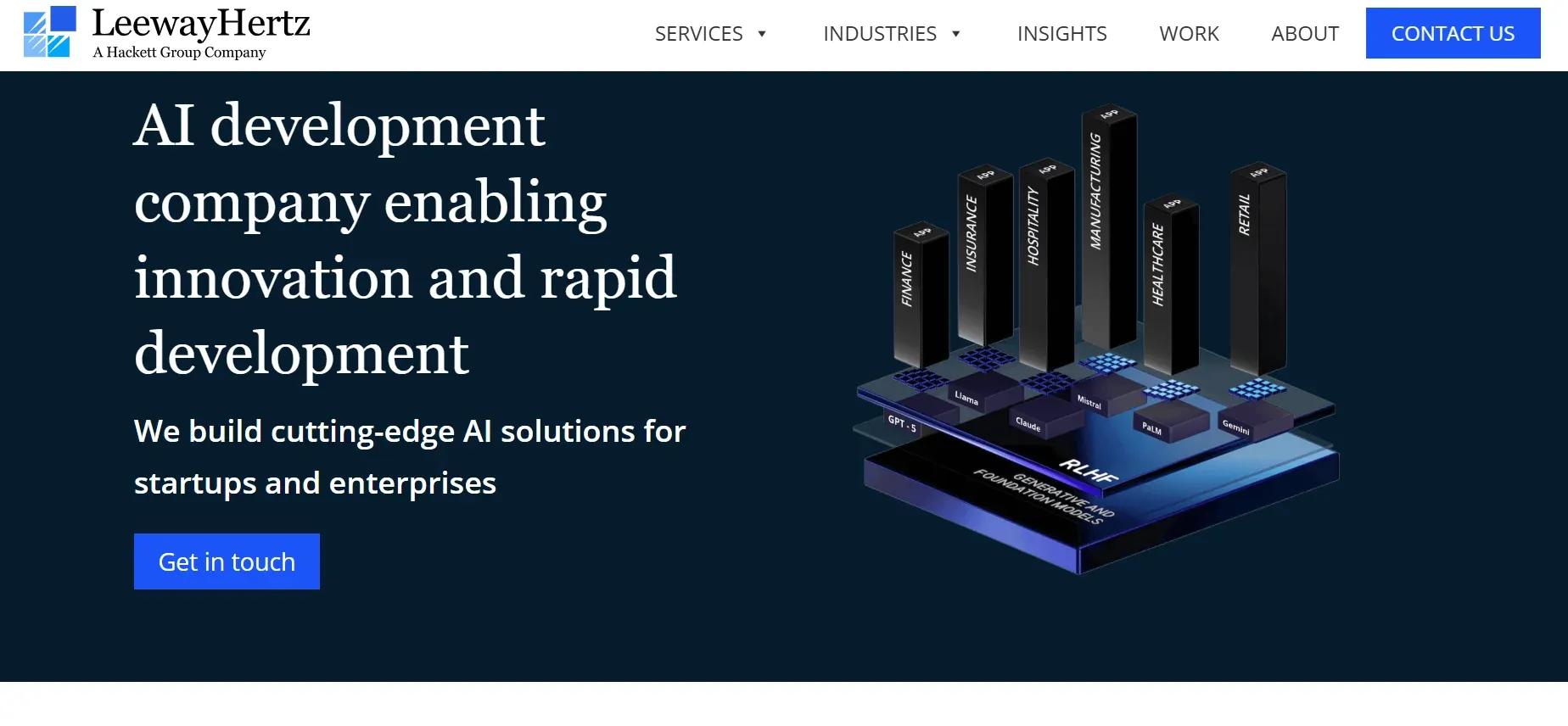
Best for: Organizations exploring agentic AI and multi-agent chatbot architectures.
LeewayHertz is a San Francisco-based firm with 18+ years in business. They've built one of the largest content footprints in AI chatbot and agent development. Their work covers RAG-based knowledge chatbots, AI customer service agents, and multi-agent orchestration systems built with LangChain and LangGraph.
They also have strong expertise in custom LLM fine-tuning, which lets clients create proprietary models trained on their own data.
Pricing: $50–99/hr (Clutch verified). Minimum project size: $10,000.
Pros: 18+ years in business. Strong capabilities in agentic AI, RAG, and multi-agent systems. 4.7/5 Clutch rating. Deep technical content library.
Cons: Higher pricing tier. Content-heavy marketing can overshadow case study specifics. Smaller verified review count compared to competitors.
8. Ada
Best for: Enterprise customer service teams seeking the highest automated resolution rates.
Ada achieves an 83% automated resolution rate across its enterprise client base. That's the highest published benchmark we found. They serve clients including Shopify, Meta, Verizon, AirAsia, and Square. Their AI Reasoning Engine combines LLMs with company-specific knowledge bases for contextual answers.
Ada is backed by $190M+ in funding from Accel, Spark Capital, and Tiger Global. Though they only focus on customer service, which means they're not suited for general-purpose chatbot use cases like lead gen or internal tools.
Pricing: Platform-based enterprise pricing. Free pilot programs available for qualified enterprises.
Pros: 83% automated resolution rate. $190M+ in funding. Marquee enterprise clients. Purpose-built for customer service.
Cons: Customer service only. Not suited for lead gen, HR bots, or internal tools. Platform lock-in. Enterprise pricing only.
9. LivePerson
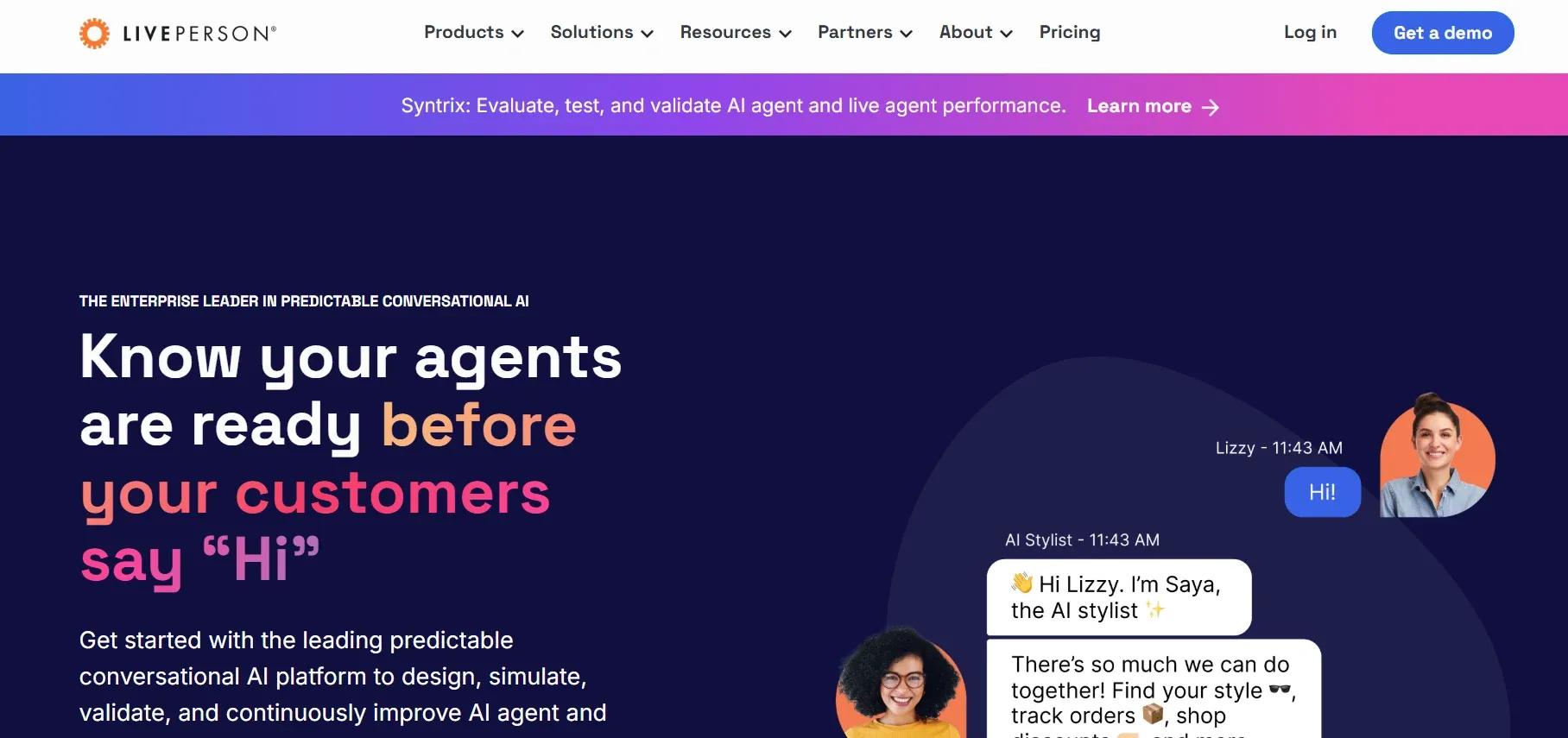
Best for: Large enterprises needing omnichannel chatbot deployment across web, SMS, and social media.
LivePerson is a US-based leader in conversational AI for large enterprises. Their proprietary Conversational Cloud lets companies deploy and manage thousands of bots across multiple channels. They're widely used by Fortune 500 firms in retail, telecom, and financial services.
Their strength is omnichannel orchestration. Customers can start a conversation on WhatsApp, continue on web chat, and switch to SMS without losing context.
Pricing: Enterprise pricing. Custom contracts based on conversation volume and channels.
Pros: Mature platform with thousands of bot deployments. Strong Fortune 500 client base. Omnichannel orchestration across web, SMS, and social. Long track record in the space.
Cons: Enterprise-only pricing. Platform approach limits customization. Less focused on newer agentic AI patterns.
Best AI Chatbot Development Company by Use Case
Different problems need different partners. Here's a quick match based on what you're actually trying to build.
Use Case | Best Vendor Match | Why |
| Hiring chatbot developers (build your own team) | Softaims | 25,000+ vetted devs, flexible hiring, fast matching |
| Full-cycle custom chatbot build | DevAims, BotsCrew | End-to-end development with post-launch support |
| Customer support automation | BotsCrew, Ada, Kore.ai | Deep CX track record, CSAT measurement |
| Lead qualification / sales | BotsCrew, LivePerson | CRM integration, multi-channel deployment |
| Multilingual support (50+ languages) | Yellow.ai, Kore.ai | Broadest language coverage, 100+ languages |
| Healthcare chatbot (HIPAA) | BotsCrew, LeewayHertz | Compliance experience, regulated delivery |
| Financial services chatbot | Kore.ai, Ada | Regulatory compliance built in |
| Enterprise platform approach | Kore.ai, Yellow.ai | Pre-built templates, 150+ integrations |
| Voicebot / contact center AI | LivePerson, Master of Code | Omnichannel voice and chat experience |
| Agentic AI / multi-step workflows | LeewayHertz | LangGraph, multi-agent orchestration |
If you need to hire individual chatbot development specialists or chatbot integration experts instead of engaging a full agency, Softaims lets you browse pre-vetted talent by skill and experience level.
How Much Does AI Chatbot Development Cost in 2026
Chatbot costs vary widely. A basic FAQ bot and an enterprise agentic system are completely different projects. Here's what to expect.
Cost by Complexity
Complexity | Custom Build Cost | Timeline | Monthly SaaS Alternative |
| Basic / rule-based | $2,000–$30,000 | 2–4 weeks | $0–$100/month |
| AI-powered / intermediate | $25,000–$100,000 | 2–4 months | $200–$500/month |
| Enterprise / multi-channel | $100,000–$300,000 | 4–8 months | $1,200–$5,000/month |
| Agentic AI / custom LLM | $300,000–$1,000,000+ | 6–12 months | Custom contracts |
Developer Rates by Seniority
Role | Hourly Rate | Best For |
| Junior developer (0–2 years) | $25–$50 | Basic chatbots, simple integrations |
| Mid-level developer (2–5 years) | $50–$90 | Multi-platform bots, CRM integration |
| Senior AI engineer (5+ years) | $90–$150 | Complex architecture, LLM fine-tuning |
You can check current rates across regions and skill levels on the Softaims developer pricing page.
Hidden Costs to Budget For
Most companies underestimate the total cost. Here's what often gets missed:
- Data preparation and cleaning typically adds 20–30% of the total project cost
- Ongoing model retraining runs 10–15% annually
- CRM/ERP integration takes more time than expected if your systems are legacy
- Compliance certification (HIPAA, SOC 2) adds documentation and audit overhead
- Post-launch monitoring and optimization is ongoing, not a one-time expense
The average chatbot interaction costs about $0.50, while a human agent interaction runs $6–$15. That 12x cost difference is what drives the ROI case for most businesses. According to Gartner, conversational AI deployments will reduce contact center labor costs by $80 billion in 2026.
What Services Do AI Chatbot Development Companies Provide?
The best AI chatbot development companies don't just build a bot and walk away. Here's what a full-service engagement typically includes.
Custom Chatbot Development
This is the core offering. The company maps out user personas, conversation flows, and intent hierarchies. They decide whether you need a rule-based bot, an AI-powered bot, or a hybrid. Then they build it from scratch, tailored to your workflows and brand voice.
Conversational AI Strategy
Before building anything, good partners help you answer the basics. Which workflows are worth automating? What does success look like in numbers? Which LLM and architecture fit the use case? Skip this step and you end up building something technically solid but commercially pointless.
LLM Integration and RAG Architecture
Modern chatbots need more than an API key and a prompt. They need RAG pipelines that ground answers in your actual data, prompt engineering that produces reliable responses, and guardrails to prevent hallucinations. If your chatbot needs to answer from internal documentation, product data, or knowledge bases, RAG is the baseline. If you need ChatGPT integration specialists or prompt engineering talent, those are separate skill sets worth evaluating.
CRM and Business System Integration
A chatbot that can't create tickets, look up contacts, or update records is leaving most of its value on the table. Top companies integrate with Salesforce, HubSpot, Zendesk, ServiceNow, and custom databases. This is where the real operational savings come from.
Training, Testing, and Optimization
Pre-launch work includes edge-case testing, integration testing under load, and intent accuracy evaluation. Post-launch work includes retraining from real conversation transcripts, A/B testing dialog variants, and pushing resolution rates up over time. Teams consistently underbudget this part.
Analytics and Monitoring
You need dashboards that track containment rate, drop-off points, resolution time, and customer satisfaction. Without monitoring, a chatbot that starts at 85% resolution rate can slide to 60% within six months as usage patterns change and upstream systems get updated.
How to Choose the Right AI Chatbot Development Company
Picking the wrong partner costs you months and money. Here's a seven-step framework that works.
Step 1: Define Your Chatbot's Business Goal
"Reduce support volume" isn't specific enough. A real goal looks like: "Deflect 40% of tier-1 tickets and bring cost per interaction from $9 to under $2 within 90 days of launch." Clear goals help you evaluate which vendors can actually deliver.
Step 2: Decide What Type of Bot You Need
A customer support chatbot, a lead qualification bot, a voice bot, and an internal HR assistant are all different projects. They need different architectures, different integrations, and different expertise. Match the vendor to the type of bot, not the other way around.
Step 3: Check for Production Case Studies
Ask for case studies with measurable results, not just testimonials. You want specific numbers: ticket deflection rate, CSAT improvement, cost per interaction before and after. If a vendor can't show two production examples with real metrics, the track record isn't there.
Step 4: Verify Integration Experience with Your Stack
Ask directly: have you integrated with our CRM? Our helpdesk? Our ERP? Vendors who've already worked with your exact tools can deliver in weeks instead of months. If they haven't, budget extra time for integration work.
Step 5: Ask About Hallucination Control
Every vendor says they "use GPT-4." The differentiator isn't the model. It's the pipeline: retrieval architecture, evaluation frameworks, confidence thresholds, and human handoff logic. If the answers here are vague, the solution probably is too.
Step 6: Check Compliance Certifications
For healthcare, you need HIPAA. For finance, SOC 2 and PCI-DSS. For European markets, GDPR. Verify that certifications are current, not just claimed. Compliance should shape the architecture from day one, not get bolted on at the end.
Step 7: Start with a Proof of Concept
Before committing to a full build, invest in a 4–6 week POC. This validates the team's technical capability, communication quality, and delivery speed. It also catches misaligned expectations early, before they cost you $50,000 or more.
If you'd rather build your own chatbot team instead of hiring an agency, Softaims matches you with pre-vetted AI engineers within 48 hours.
What Is the Difference Between a Chatbot, AI Agent, and Chatbot Builder?
These terms get used interchangeably in sales pitches. They shouldn't be. Each solves a different problem. Choosing the wrong category costs you months.
AI Chatbot | AI Agent | Chatbot Builder Platform | |
| What it builds | Conversational system that answers and routes | Autonomous system that takes multi-step actions | Self-serve no-code/low-code bot |
| Starts on its own? | No, responds to user input | Yes, monitors triggers and acts | No, responds to user input |
| Integration depth | Deep (CRM, ERP, ticketing) | Deepest (acts across multiple systems) | Limited to platform connectors |
| Setup time | Weeks | Weeks to months | Hours to days |
| Typical cost | $5,000–$100,000+ | $15,000–$100,000+ | $0–$500/month |
| Best when | You need conversation handling with system integration | You need autonomous execution, not just answers | You have a standard, self-contained use case |
Here's the real-world difference. A chatbot tells a customer their order is delayed. An AI agent detects the delay, finds alternative shipping options, contacts the customer proactively, and updates the CRM. No human does the clicks.
Most businesses start with a chatbot and graduate to agents as their needs grow. That's a healthy progression. Just make sure your vendor can support both.
AI Chatbot Market in 2026: Key Statistics
If you need numbers to build a business case, here they are.
Metric | Value | Source |
| Global chatbot market size (2026) | $11–$11.8 billion | Grand View Research, Mordor Intelligence |
| Projected market size by 2031 | $32.45 billion | Mordor Intelligence |
| Compound annual growth rate | 23.15% | Mordor Intelligence |
| Enterprise adoption rate (50+ employees) | 91% | AutoFaceless / Dante AI |
| Cost of AI chatbot interaction | $0.50 | Chatbot.com |
| Cost of human agent interaction | $6–$15 | Chatbot.com |
| Projected contact center labor cost reduction | $80 billion | Gartner |
| Customer support share of chatbot market | 42.4% | Mordor Intelligence |
| Average ROI per $1 spent on chatbots | $8 return | Azumo |
| AI-resolved service cases | 30% | Salesforce |
| North America market share | 31.3% | Grand View Research |
| Fastest-growing region | Asia Pacific (24.7% CAGR) | Mordor Intelligence |
The bottom line: chatbots aren't experimental anymore. They're standard infrastructure. The question isn't whether to invest. It's which partner to trust with the implementation.
Which Industries Benefit Most from AI Chatbot Development
Not every industry gets the same value from chatbots. Here's where the ROI is strongest.
Customer service accounts for 42.4% of the entire chatbot market. This is the biggest use case by far. Chatbots handle routine questions, create tickets, and escalate complex issues. Salesforce reports that 30% of service cases are now resolved by AI alone.
E-commerce and retail is the largest vertical by market share at roughly 28%. Chatbots handle product recommendations, order tracking, returns, and cart abandonment. E-commerce chatbots improve conversion rates by up to 30% and cut cart abandonment by 20–30%.
Healthcare is the fastest-growing vertical at a 24.97% CAGR through 2031. Chatbots manage appointment scheduling, symptom triage, medication reminders, and insurance questions. HIPAA compliance is non-negotiable here, so your vendor needs documented healthcare experience.
Banking and finance chatbot interactions are expected to exceed a 90% success rate by 2026. Banks using digital assistants see up to 25% revenue increases. However, 63% of banks report difficulty integrating chatbots with legacy core systems, so experienced integration work matters.
HR and recruitment is growing at a 25.3% CAGR through 2030. Chatbots automate onboarding, answer policy questions, screen candidates, and manage leave requests. Companies report up to 40% reduction in HR ticket volume after deployment.
Frequently Asked Questions
How long does it take to build an AI chatbot?
A focused MVP can ship in 4–8 weeks. Production hardening (integrations, testing, escalation logic, monitoring) adds another 4–8 weeks. Most production-ready chatbots take 2–4 months from kickoff with an experienced partner.
How much does a custom AI chatbot cost?
$2,000–$30,000 for basic rule-based bots. $25,000–$100,000 for AI-powered bots with CRM integration. $100,000–$1,000,000+ for enterprise multi-channel or agentic systems. Monthly SaaS alternatives range from free to $5,000+/month.
Can chatbots integrate with my existing CRM and helpdesk?
Yes, and they should. A chatbot that can't create tickets, look up contacts, or update deals is missing most of its value. Top vendors integrate with Salesforce, HubSpot, Zendesk, ServiceNow, and custom APIs.
How do I measure chatbot ROI?
Track four things: cost savings from reduced support volume, faster response times, increased conversions (for sales bots), and customer satisfaction scores. Businesses report an average $8 return for every $1 invested in chatbot technology.
What's the difference between rule-based and AI chatbots?
Rule-based bots follow decision trees and can only handle scenarios you've pre-programmed. AI chatbots use LLMs and NLP to understand natural language, handle open-ended queries, and learn from conversations. AI chatbots handle complexity better but cost more to build.
Do AI chatbots require ongoing maintenance?
Yes. Chatbots decay without maintenance. Model drift, shifting user patterns, and upstream system updates all chip away at performance. Budget for ongoing retraining, prompt tuning, and monitoring. Without it, an 85% resolution bot can slide to 60% in six months.
Are AI chatbots secure for handling sensitive data?
Reputable vendors offer enterprise-grade security, encryption, and compliance certifications (SOC 2, HIPAA, GDPR, ISO 27001). Always verify security practices and data handling policies before signing. Ask where conversation data is stored and who has access to it.
Can chatbots handle voice as well as text?
Many modern platforms support both voice and text channels. Companies like LivePerson, Kore.ai, and Yellow.ai offer omnichannel deployment across web chat, phone, SMS, WhatsApp, and social media. Specify your channel requirements during vendor selection.
Should I use a chatbot platform or build custom?
Use a platform (like Kore.ai or Yellow.ai) when your needs are standard and the platform connectors cover your integrations. Build custom when you need specific business logic, deep system integration, or compliance requirements that platforms can't handle out of the box.
What technologies do top AI chatbot companies use?
The most common stack includes LLMs (GPT-4, Claude, Llama 3), RAG pipelines for knowledge grounding, vector databases (Pinecone, Weaviate), NLP frameworks (Dialogflow, Rasa), and integration with CRM/ERP systems via APIs. The specific stack depends on your use case and scale requirements.
Conclusion
The AI chatbot market is growing at 23% annually and enterprise adoption has crossed 91%. The opportunity is clear. However, the difference between a chatbot that drives millions in savings and one that irritates users comes down to the partner you choose.
Start with your business goal, not the technology. Match the vendor to your specific use case. Check for production case studies with real numbers. And always start with a proof of concept before committing to a full build.
If you want to build your own chatbot team with vetted talent, transparent pricing, and no agency overhead, Softaims is the strongest place to start. You get dedicated AI chatbot developers matched to your stack in 24–48 hours, with a project manager, guaranteed milestones, and your IP protected from day one. Browse vetted developers or get a free consultation.
If you'd rather hand the entire chatbot project to one team and let them own it end to end, DevAims delivers full-cycle development with 15+ years of experience and US-based communication.


 GitHub
 Stackoverflow
Sergey M.

 Verified Expert in Engineering
My name is Sergey M. and I have over 20 years of experience in the tech industry. I specialize in the following technologies: Python, Scripts & Utilities, Cryptocurrency Trading, Telegram, Bot Development, etc.. I hold a degree in . Some of the notable projects I’ve worked on include: Crypto Price Monitor, Lottery Results scrapper., Maestro-Colore, Svit Roslyn, Health Mechanics, etc.. I am based in Kiev, Ukraine. I've successfully completed 8 projects while developing at Softaims.
My passion is building solutions that are not only technically sound but also deliver an exceptional user experience (UX). I constantly advocate for user-centered design principles, ensuring that the final product is intuitive, accessible, and solves real user problems effectively. I bridge the gap between technical possibilities and the overall product vision.
Working within the Softaims team, I contribute by bringing a perspective that integrates business goals with technical constraints, resulting in solutions that are both practical and innovative. I have a strong track record of rapidly prototyping and iterating based on feedback to drive optimal solution fit.
I’m committed to contributing to a positive and collaborative team environment, sharing knowledge, and helping colleagues grow their skills, all while pushing the boundaries of what's possible in solution development.

Leave a Comment
Need help building your team? Let's discuss your project requirements.
Get matched with top-tier developers within 24 hours and start your project with no pressure of long-term commitment.