Top 10 Computer Vision Development Companies in the World (2026)
Choosing the right computer vision development company can make or break your AI project. This guide compares the top providers in 2026, their services, strengths, pricing, and the key factors to consider before hiring.
Technically reviewed by:
Aliaksandr C.|Papan D.
Table of contents
Key Takeaways
- Not every computer vision company builds production-ready AI. Many can train a model, but only a few can successfully deploy it on real hardware, integrate it with your existing systems, and keep it performing over time.
- The right partner saves months of development and thousands in infrastructure costs. Experienced computer vision companies already have the tools, AI expertise, and deployment workflows needed to launch projects faster and with less risk.
- Choosing a company is about more than AI accuracy. Data quality, edge deployment, hardware integration, long-term maintenance, and security often determine whether a project succeeds or fails.
- Computer vision is transforming nearly every industry. From manufacturing and healthcare to retail, logistics, agriculture, and security, AI-powered vision systems are helping businesses automate inspections, reduce costs, and improve decision-making.
- Ask the right questions before signing a contract. Understanding who owns the AI model, how data is managed, and how the system will scale can prevent expensive problems after deployment.
- Project costs vary widely based on complexity. A proof of concept may cost under $80,000, while enterprise deployments with custom AI models, edge devices, and system integrations can exceed $200,000.
As businesses increasingly adopt AI and automation, the demand for expert computer vision development companies continues to grow. The best firms combine expertise in machine learning, image processing, and edge deployment to build accurate, real-world vision systems for industries like healthcare, manufacturing, retail, and logistics.
With the global computer vision market expected to grow from $19.82 billion in 2024 to $58.29 billion by 2030, choosing the right development partner has become more important than ever. This list highlights the top computer vision development companies in 2026 based on their technical expertise, innovation, and proven track record.
Why Hire a Computer Vision Development Company
For many businesses, partnering with a computer vision development company is more practical than building an in-house team. The biggest reason is access to talent. Computer vision projects require specialists with expertise in machine learning, deep learning, image processing, and the mathematics behind AI models. Hiring experienced engineers is expensive, and retaining them can be even more challenging as demand for AI talent continues to grow.
Cost is another key factor. Building an internal computer vision team means investing in skilled developers, GPUs, data annotation, training infrastructure, and ongoing maintenance. An experienced computer vision development company already has these resources in place, helping businesses avoid large upfront investments while reducing development time.
Speed also matters. Established companies have proven workflows, pre-trained models, and existing tools that allow them to build, test, and deploy computer vision solutions much faster than a team starting from scratch. This helps businesses launch projects sooner, reduce development risks, and see a return on their investment more quickly.
Services Offered by Computer Vision Development Companies
A computer vision development company offers much more than basic image recognition. The best companies build AI solutions that can analyze images and videos, detect and track objects, read text, identify unusual activity, and understand complex visual scenes. These services help businesses automate tasks, improve accuracy, and make faster decisions across industries such as manufacturing, healthcare, retail, logistics, and security.
Service | Function | Representative use |
| Object detection | Locates and classifies items in a frame | Defect inspection, people counting |
| Object tracking | Follows an item across video frames | Traffic flow, warehouse movement |
| Semantic segmentation | Labels each pixel in an image | Tumor boundaries, crop analysis |
| Optical character recognition | Extracts text from images | Invoices, license plates, forms |
| Pose estimation | Interprets body position | Worker safety, ergonomics |
| Anomaly detection | Flags deviations from the norm | Manufacturing, perimeter security |
These services enable businesses to automate visual tasks that would otherwise require constant human attention. Whether it's inspecting products on a production line, tracking inventory in a warehouse, or analyzing customer behavior in a retail store, computer vision helps improve accuracy, reduce manual work, and increase operational efficiency. The best computer vision development companies also integrate these AI solutions with your existing software and hardware, making them a seamless part of your business operations.
Computer Vision in Manufacturing
Manufacturing is one of the biggest beneficiaries of computer vision. AI-powered inspection systems can detect defects, measure product quality, and identify problems much faster and more accurately than manual inspections. Even tiny flaws that are difficult for the human eye to spot can be detected in real time, helping manufacturers reduce waste and improve product quality.
A computer vision development company builds these systems using high-resolution cameras and custom AI models trained to identify defects such as cracks, scratches, missing parts, or alignment issues. The solution is then integrated with production lines, industrial equipment, and quality control systems so inspections happen automatically without slowing production.
The biggest challenge is not just building an accurate AI model. It is making sure the system performs reliably in real-world conditions, including changing lighting, dust, vibration, and high production speeds. When implemented correctly, computer vision reduces inspection costs, minimizes human error, increases production efficiency, and helps manufacturers deliver more consistent products.
How to Choose a Computer Vision Development Company
When you shortlist computer vision development companies, weigh technical depth above portfolio breadth. Confirm that the firm has a genuine command of the architectures your problem requires, whether that means generative models for synthetic data or compact networks tuned for constrained edge hardware.
A credible provider will also be candid about data. Because model performance is bounded by the quality of its training set, the firm should hold disciplined protocols for collection, cleaning, and annotation. Press them on edge cases too, since it is the rare and unexpected scenario, not the typical one, that quietly defeats most deployed models.
Questions worth asking every vendor
- What comparable systems have you delivered, and in what conditions did they run?
- Describe your process for data acquisition, cleaning, and annotation. Who owns the labeled dataset at the end?
- How do you validate model performance under variable real-world conditions rather than on a curated benchmark?
- What is your infrastructure for scalable deployment, monitoring, and support?
- How do you satisfy data privacy obligations and regulatory frameworks such as GDPR and CCPA?
- How do you optimize models for edge and resource-constrained devices?
- Can you provide case studies that evidence business impact and return, not just laboratory accuracy?
- How do you handle maintenance, retraining, and upgrades once the system is live?
These questions help an executive cut through technical jargon and assess whether a vendor has the operational maturity to deliver durable value.
Questions to Ask Before Hiring
- Have you built similar computer vision solutions before?
- How do you collect, clean, and label training data?
- Who owns the trained model, source code, and labeled dataset?
- How do you test model accuracy in real-world conditions?
- Can your solution scale as our business grows?
- How do you protect sensitive data and comply with regulations like GDPR and CCPA?
- Can you optimize AI models for edge devices and embedded hardware?
- What support do you provide after deployment, including monitoring and model updates?
These questions will help you evaluate whether a company has the experience and processes needed to deliver a reliable, long-term solution.
Hardware and System Integration
A great AI model is only part of a successful computer vision project. It also needs to run efficiently on the hardware and software your business uses. Many AI models perform well in the cloud but struggle on edge devices such as NVIDIA Jetson, OAK-D cameras, or other embedded systems. Ask potential partners about the hardware they have worked with, the performance they achieved, and how they optimized models for speed and accuracy.
Integration is equally important. The best computer vision development companies connect AI solutions with your existing ERP, CRM, manufacturing systems, security platforms, or cloud infrastructure. They also help select the right cameras, processors, and edge devices to ensure reliable performance. A company that can successfully integrate AI into your existing workflows is far more likely to deliver a solution that creates real business value.
The top 10 computer vision development companies
# | Company | Best for | Focus |
| 1 | Softaims | Full-cycle systems you own outright | Model, edge deployment, application |
| 2 | Devaims | Vision embedded in a working product | Software and applications around the model |
| 3 | Clarifai | API-first, label-efficient AI | Platform, annotation, multimodal data |
| 4 | Standard AI | Autonomous retail | Checkout-free stores, privacy-preserving |
| 5 | Samsara | Connected industrial operations | Edge AI cameras, fleet safety |
| 6 | Verkada | Cloud-managed enterprise security | Hybrid-cloud cameras, attribute search |
| 7 | AMP | Automated sorting and recovery | Robotic picking, material recognition |
| 8 | Mobileye | Automotive perception | Vision-first ADAS, EyeQ silicon |
| 9 | Microsoft Azure AI Vision | Enterprise cloud and compliance | APIs, document AI, spatial analysis |
| 10 | Google Cloud Vision AI | Research-grade multimodal vision | Visual inspection, video intelligence |
1. Softaims
Best for: Businesses looking for end-to-end computer vision development with full ownership of the code and AI models.
Many computer vision projects fail because of poor data, inaccurate labeling, or models that cannot run efficiently on the target hardware. Softaims solves these challenges by managing the entire development process. The same team handles data preparation, AI model development, deployment, and the software that delivers results to your users.
We provide end-to-end computer vision development services, including custom AI model development, edge AI deployment, AI implementation, and AI application development. Whether you need object detection, image segmentation, OCR, or edge optimization, you can hire vetted AI developers with the skills your project requires.
Why choose Softaims:
- End-to-end computer vision development from one team.
- Experience deploying AI models on cloud and edge devices.
- Full ownership of your AI model, source code, and training data.
- Transparent pricing with vetted AI developers.
2. Devaims
Best for: Businesses that need both computer vision development and a complete software product.
An AI model creates value only when it becomes part of a real application. Devaims helps businesses turn computer vision models into complete software products by building the dashboards, mobile apps, and business tools that people use every day.
Along with computer vision development, Devaims provides web development, mobile app development, backend development, and system integration. Because one team manages both the AI model and the application, projects move faster and are easier to maintain after launch.
Why choose Devaims:
- AI model development and software development under one roof.
- Custom web and mobile applications built around your AI solution.
- Faster updates and easier maintenance after deployment.
- Experience building complete AI-powered products.
3. Clarifai
Best for: Teams that want to ship vision features fast through an API, without building a model pipeline from scratch.
Clarifai was among the first to make deep learning broadly accessible, exposing it through a developer-friendly API. Founded by an ImageNet competition winner, the company focuses on label-efficient AI, enabling organizations to train capable models on considerably less annotated data by leveraging transfer learning.
Downside: You are building on their platform, so you inherit their pricing and their roadmap. For a highly specialized industrial model, a custom build usually gives you more control and lower long-term cost.
4. Standard AI
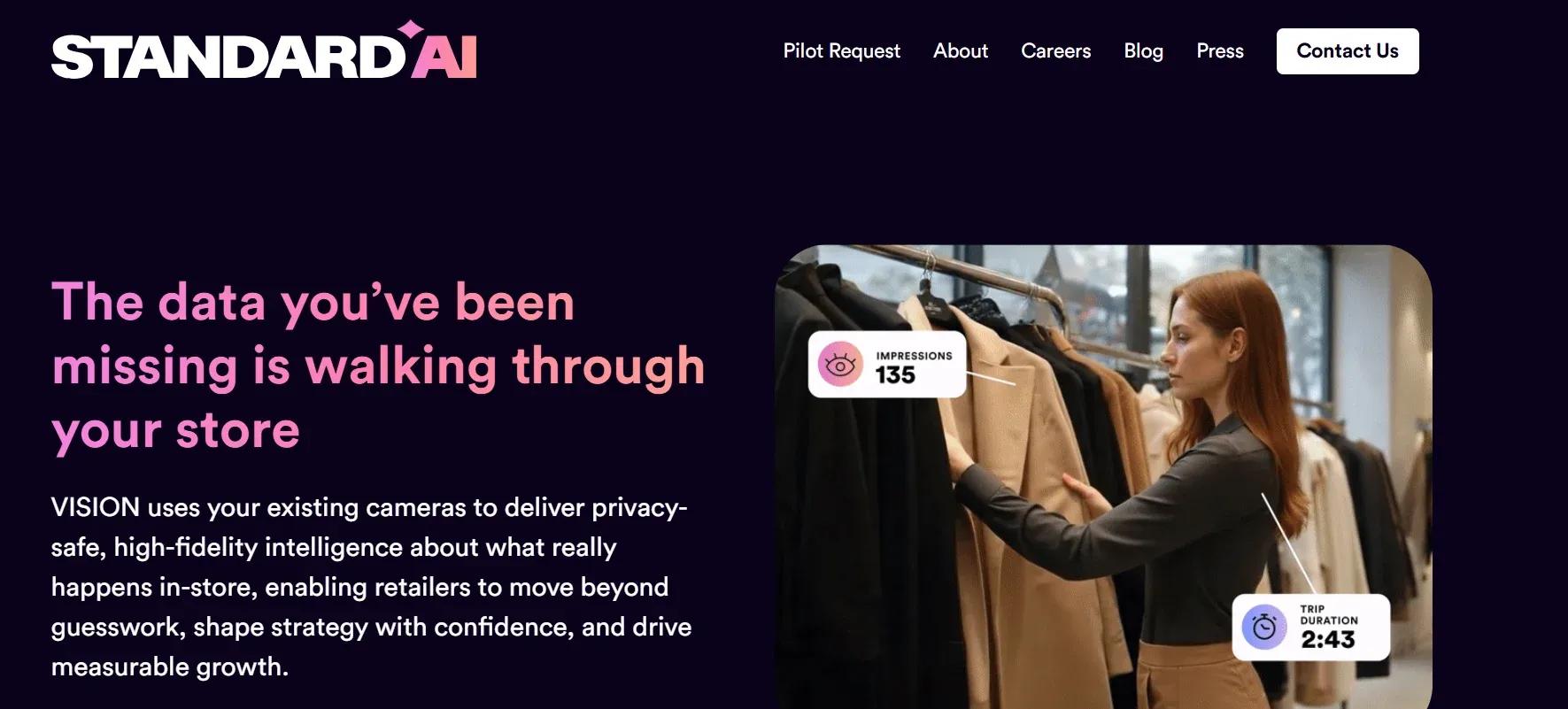
Best for: Retailers that want checkout-free stores without installing smart shelves or sensor carts.
Standard AI has reimagined the physical store as an operating system. Its defining innovation is checkout-free retail that depends solely on ceiling-mounted cameras, dispensing with instrumented shelving and sensor-laden carts.
Downside: This is a single-purpose retail product, not a general vision partner. If your problem sits outside autonomous checkout, they are not the right call.
5. Samsara
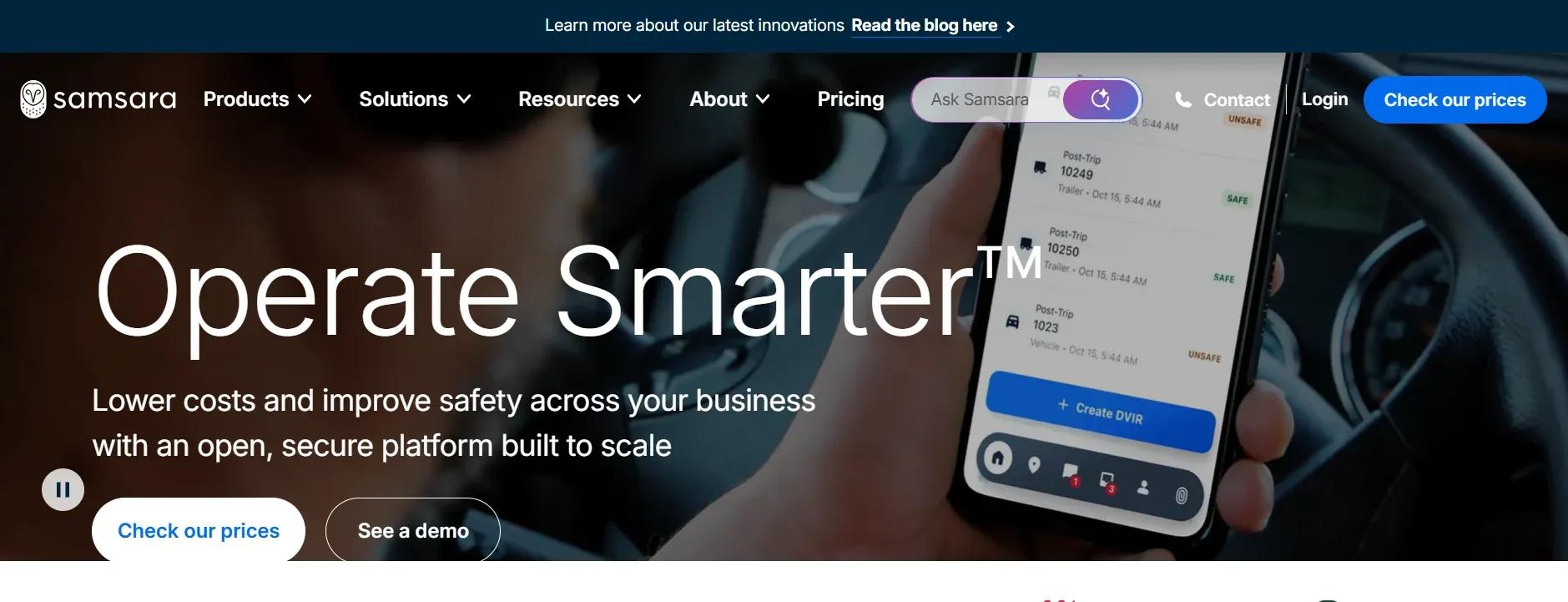
Best for: Fleet and logistics operators who want to cut accidents and see their whole operation in one dashboard.
Samsara applies computer vision to provide operators with genuine visibility into physical operations, most prominently in fleet management and logistics. Tight hardware and software integration enable the platform to analyze vast amounts of driving footage and translate it into safety scores and operational alerts.
Downside: It is a subscription platform tied to their hardware, so you are buying into an ecosystem rather than commissioning a system you own.
6. Verkada
Best for: Enterprises that want to search a large camera network in seconds rather than trawl footage by hand.
Verkada has unsettled the traditional enterprise security market by pairing industrial-grade cameras with a modern cloud interface. The architecture is deliberately hybrid: footage is retained locally for bandwidth efficiency while analytics run in the cloud.
Downside: It is a closed hardware and software ecosystem with recurring licensing. That suits security teams, but it leaves little room to build custom vision logic on top.
7. AMP
Best for: Waste and recycling operators who need to sort mixed material faster and more accurately than a human line can.
AMP directs computer vision at one of the least structured environments imaginable, the high-speed recycling conveyor, where material arrives crushed, overlapping, and unpredictable.
Downside: The solution is purpose-built for material recovery. Outside sorting and recycling, there is nothing here for you.
8. Mobileye
Best for: Vehicle manufacturers and mobility firms building driver assistance or autonomy on camera-first perception.
Mobileye, an Intel company, remains the reference point in advanced driver assistance systems. Its guiding conviction is vision-first: cameras, when matched with purpose-built silicon, can supply sufficient situational awareness for autonomy without heavy reliance on costly lidar.
Downside: This is automotive-grade technology sold at automotive scale. Unless you are shipping vehicles or mobility hardware, it is not an option you can realistically engage.
9. Microsoft Azure AI Vision
Best for: Enterprises already on Azure that need vision APIs with serious compliance coverage behind them.
Microsoft offers one of the most complete suites of computer vision development services through Azure. Its advantage lies in the scale of its research investment and its ability to package sophisticated multimodal models behind an approachable developer API.
Downside: Unlike dedicated computer vision development companies, this is a platform, not a partner. You get APIs and documentation, but nobody is engineering your specific problem, and costs scale with every call you make.
10. Google Cloud Vision AI
Best for: Teams that want state-of-the-art models through an API, especially for manufacturing inspection and video understanding.
Google continues to set the research agenda through its foundational work on Transformers and the Gemini model family, and it surfaces much of that capability through Cloud Vision AI.
Downside: As with any hyperscaler, you rent the capability rather than own it. Per-call pricing adds up at volume, and you have no control over model changes or deprecations.
Computer Vision Applications Across Industries
Computer vision is transforming the way businesses operate across many industries. By analyzing images and videos in real time, it helps organizations automate repetitive tasks, improve accuracy, reduce costs, and make faster decisions.
- Manufacturing: Detects product defects, automates quality inspections, and improves production efficiency.
- Healthcare: Assists doctors by analyzing X-rays, MRI scans, CT scans, and medical images to support faster and more accurate diagnoses. The computer vision healthcare market is expanding at nearly 33% annually.
- Retail: Tracks customer behavior, powers cashier-free checkout, manages inventory, and improves the shopping experience.
- Logistics: Monitors warehouse operations, tracks packages, and optimizes inventory management.
- Agriculture: Uses drones and smart cameras to monitor crop health, detect pests, and improve precision farming.
- Security: Supports facial recognition, intrusion detection, license plate recognition, and real-time surveillance.
As AI technology continues to improve, more businesses are adopting computer vision to automate visual tasks that once required manual effort. Companies that successfully use computer vision can improve efficiency, reduce operational costs, and gain a competitive advantage.
How a Computer Vision Project Works
A successful computer vision project starts with understanding your business goals and evaluating your data. A computer vision development company first checks whether the available images or videos are suitable for training an AI model. If the data is incomplete or low quality, they may recommend collecting more data or creating synthetic datasets before development begins.
Once the data is ready, the team trains and tests the AI model, optimizes it for accuracy and speed, and deploys it to the cloud or edge devices. After launch, they continue to monitor performance, retrain the model when needed, and make updates as new data becomes available. This ongoing support helps keep the system accurate and reliable over time.
Common Challenges in Computer Vision Projects
Building a computer vision solution is not just about creating an accurate AI model. Real-world conditions such as poor lighting, weather, camera angles, motion blur, and changing environments can all affect performance. A reliable computer vision development company tests its models under real operating conditions to ensure they perform consistently outside the lab.
Data privacy and security are also important considerations. Businesses that process images or videos containing personal information must comply with regulations such as GDPR and CCPA. The best computer vision development companies follow strong security practices, reduce bias through diverse training data, and implement proper data governance to protect sensitive information. Choosing a partner with certifications like ISO 27001 or SOC 2 can provide additional confidence for enterprise projects.
Computer Vision Trends in 2026
Computer vision technology is evolving quickly, and several trends are shaping the future of AI-powered visual systems.
One of the biggest changes is the rise of edge AI. Instead of sending images to the cloud for processing, AI models now run directly on cameras and edge devices. This reduces latency, improves privacy, and enables real-time decision-making for applications such as manufacturing, robotics, autonomous vehicles, and smart surveillance.
Another major trend is the adoption of Vision Transformers (ViTs) and foundation models. These advanced AI models require less labeled data and can be fine-tuned for different use cases, reducing development time and improving accuracy. At the same time, synthetic data is becoming more common, allowing companies to train AI models for rare or dangerous scenarios without collecting large amounts of real-world data.
How Much Does Computer Vision Development Cost
The cost of a computer vision project depends on factors such as project complexity, data quality, AI model requirements, and deployment environment.
Project Type | Estimated Cost | Timeline |
| Proof of Concept (PoC) or MVP | $40,000–$80,000 | 2–4 months |
| Production System with Integration | $80,000–$200,000 | 4–8 months |
| Enterprise or Multi-site Deployment | $200,000+ | 6–12 months |
The biggest cost factors are data collection and annotation, custom AI model development, hardware requirements, and integration with existing systems. Businesses should also budget for ongoing monitoring, maintenance, and model retraining to keep the solution accurate as conditions change.
Conclusion
Choosing the right computer vision development company can have a major impact on the success of your AI project. The best partners do more than build AI models. They help with data preparation, model development, deployment, hardware integration, and long-term support to ensure your solution delivers real business value.
Before making a decision, define your goals, identify your use cases, and evaluate companies based on their technical expertise, industry experience, and track record of successful projects.
If you're looking for a trusted partner, Softaims provides end-to-end computer vision development services, from custom AI models to deployment and ongoing support. Book a free consultation to discuss your project and get matched with vetted AI developers within 48 hours.
Frequently Asked Questions
What should I look for when choosing a computer vision development company? Prioritize demonstrable depth in your specific task over a broad portfolio. Confirm proven edge deployment, a disciplined data and annotation process, and candor about accuracy under real operating conditions. Establish at the outset who will own the model and the labeled dataset upon engagement conclusion.
What is the difference between cloud AI and edge AI?
Cloud AI performs inference on remote servers, which is well-suited to large models and batch analysis. Edge AI runs the model on the device beside the camera, delivering real-time response and keeping footage on site. Most latency-sensitive and privacy-sensitive deployments now favor the edge.
Can computer vision operate in low light or outdoors?
Yes, provided it was engineered for those conditions. Models must be trained on imagery that includes glare, rain, shadow, and darkness. Request accuracy figures gathered in your environment rather than on a curated benchmark set.
How long does it take to develop a custom computer vision product?
Typically three to eight months, encompassing annotation, training, and integration. Where target imagery is rare or of poor quality, extend that estimate, since data preparation is almost always the longest phase.
How much does it cost to implement a computer vision solution?
Cost varies considerably with complexity, accuracy requirements, and deployment environment. The principal drivers are annotation volume, the need for custom hardware integration, and whether inference runs in the cloud or at the edge. A short consulting or discovery engagement at the outset is the most reliable way to establish a defensible budget against your return objectives.
Who retains ownership of the model and the training data?
You should. Ensure the contract assigns you the model, weights, annotated dataset, and source code, so that maintenance and future development are never contingent on a single vendor.


 GitHub
Jyotsna S.

 Verified Expert in Engineering
My name is Jyotsna S. and I have over 4 years of experience in the tech industry. I specialize in the following technologies: Node.js, React, React Bootstrap, Git, TypeScript, etc.. I hold a degree in Master of Science (MS), Bachelor of Computer Science (BCompSc). Some of the notable projects I've worked on include: Edvanza- An AI-powered personalised guidance App for professionals, Innergy, Slush Dating App, AI based career enhancement platform. I am based in Bengaluru, India. I've successfully completed 4 projects while developing at Softaims.
Information integrity and application security are my highest priorities in development. I implement robust validation, encryption, and authorization mechanisms to protect sensitive data and ensure compliance. I am experienced in identifying and mitigating common security vulnerabilities in both new and existing applications.
My work methodology involves rigorous testing—at the unit, integration, and security levels—to guarantee the stability and trustworthiness of the solutions I build. At Softaims, this dedication to security forms the basis for client trust and platform reliability.
I consistently monitor and improve system performance, utilizing metrics to drive optimization efforts. I'm motivated by the challenge of creating ultra-reliable systems that safeguard client assets and user data.

Leave a Comment
Need help building your team? Let's discuss your project requirements.
Get matched with top-tier developers within 24 hours and start your project with no pressure of long-term commitment.