Top 10 Custom AI Model Development Companies in the USA (2026)
Finding the right custom AI model development company isn't easy. This guide compares the top 10 AI development companies in the USA for 2026, explains their strengths, services, pricing, and helps you choose the best partner for your business.
Technically reviewed by:
Aliaksandr C.|Jyotsna S.
Table of contents
Key Takeaways
- Compare the top 10 custom AI model development companies in the USA.
- Learn which companies are best for startups, enterprises, and industry-specific AI projects.
- Understand the difference between custom AI models, fine-tuning, and off-the-shelf solutions.
- See typical development costs, timelines, and factors that affect pricing.
- Discover how to evaluate AI vendors based on expertise, security, scalability, and long-term support.
- Get practical tips to choose the right AI development partner for your business goals.
A general AI model knows a little about everything, but nothing about your business. So when accuracy, privacy, and fit really matter, a custom model wins. In 2026, that means fine-tuning a language model on your data, training a vision model to spot defects, or building a forecasting model for your demand. This guide ranks the top custom AI model development companies in the world and covers the entire topic, so you only need this one page.
By the end, you will know the four ways to build a custom model, which one fits your case, what it costs, and how to pick a partner without getting burned. So let us start with the basics, then get into the good stuff.
What is custom AI model development
Custom AI model development is the work of building or adapting an AI model for one business, instead of using a general tool as-is. In plain terms, you take an AI and teach it your data, your rules, and your goals.
There is an important difference between an AI app and a custom model. An AI app is the product your users see, like a chatbot. A custom model is the brain inside it, and building it is the heart of custom AI model development. So a firm might build the model, the app, or both. This guide is about the model, which is where the hard science lives.
The payoff is real. According to one industry benchmark, domain-specific fine-tuning can lift a model's accuracy by around 20%. Also, a smaller custom model often runs cheaper and faster than a giant general one. So you get better results at a lower running cost.
The four ways to build a custom AI model
Here is the most useful thing in this guide. Most people think custom AI model development means training from scratch, but that is rarely the right move. In fact, there are four approaches, and they climb in cost and effort. A good partner starts at the bottom and only moves up when needed.
Approach | What it means | Cost and effort | Best for |
| Prompt engineering | Careful instructions to a ready model | Lowest | Style, tone, and simple tasks |
| RAG | Connect a model to your own data | Low to medium | Private, current knowledge and search |
| Fine-tuning | Train a ready model on your examples | Medium | Domain accuracy, set format or tone |
| Train from scratch | Build a new model from zero | Highest | Rare, unique problems with huge data |
Here is the simple rule most experts follow. If the model just needs facts from your data, use RAG. If it needs to answer in a set style or format, try prompt engineering first. If that is not enough, then fine-tune. And you almost never train from scratch, since that needs massive data and budget. So beware any vendor who jumps straight to "we will build you a model from the ground up." That is often the most expensive path, not the best one.
Fine-tuning methods, in plain English
Fine-tuning is where most custom AI model development happens, so it helps to know the main methods. You do not need to master them. However, if a vendor can explain these clearly, that is a good sign.
- SFT (supervised fine-tuning). You give the model labeled examples of the right answers, and it learns to copy that pattern. This is the most common method.
- RLHF (reinforcement learning from human feedback). People rank the model's answers, and it learns to prefer the better ones. This is how models learn tone and judgment.
- DPO (direct preference optimization). A simpler, newer way to teach preferences from pairs of answers, often cheaper than full RLHF.
- LoRA and QLoRA. These are money-savers. Instead of retraining the whole model, they tweak a small part, so you get most of the benefit for a fraction of the compute. As a result, fine-tuning is far cheaper than it was two years ago.
The takeaway is simple. Thanks to methods like LoRA, you no longer need a huge GPU budget to get a strong custom model. So even mid-size firms can now afford one.
Types of custom AI models you can build
Custom AI model development is not just about language. The table below shows the main types and where they help.
Model type | What it does | Where it helps |
| Fine-tuned LLM | Understands your domain language | Legal, medical, finance, support |
| Computer vision | Reads images and video | Defect checks, medical scans, security |
| NLP model | Reads and sorts text | Sentiment, search, document sorting |
| Forecasting model | Predicts numbers over time | Demand, energy, supply chain |
| Recommendation model | Suggests the next best thing | E-commerce, media, learning |
| Generative model | Creates text, images, or data | Content, design, synthetic data |
Many projects mix these. For example, a support tool might use a fine-tuned LLM for chat and an NLP model to route tickets.
Why the market is booming in 2026
Custom AI model development is no longer a research luxury. In fact, McKinsey reports that about 88% of companies now use AI in daily work. So the race is on to make that AI actually fit each business.
The money follows. Grand View Research expects the global AI market to reach about $1.81 trillion by 2030, while the machine learning market heads toward roughly $420 billion by 2030. At the same time, open tools have exploded. Hugging Face now hosts over 500,000 models, so teams can start from a strong base instead of zero. Because of all this, the best custom AI model development companies are busy, and the strong ones book up early.
How we ranked the top custom AI model development companies
We judged every firm by the same standards, because custom model work rewards real depth over hype.
- Real data science. They have ML engineers and data scientists who train and fine-tune models, not just teams that call an API.
- The right approach. They start with the simplest option that works, and they only build custom when it earns its cost.
- Data skill. Since roughly 80% of model work is data prep, we favored firms that take data quality seriously.
- MLOps and monitoring. They deploy models properly, watch for drift, and retrain, so accuracy holds up.
- Governance and track record. They handle bias, privacy, and security, and they have real case studies and reviews.
Comparison of the top 10 custom AI model development companies
# | Company | Best for | Focus |
| 1 | Softaims | Custom models + vetted talent | Right approach, owned by you |
| 2 | Devaims | Model plus the product around it | End-to-end, one team |
| 3 | LeewayHertz | Generative AI and LLMs | Custom LLM apps, fine-tuning |
| 4 | Azumo | LLM fine-tuning specialists | SFT, RLHF, DPO, LoRA, SOC 2 |
| 5 | InData Labs | Data science depth | Vision, NLP, data quality |
| 6 | SoluLab | Strategy-first LLMs | Custom LLMs, enterprise fit |
| 7 | ScienceSoft | Regulated industries | Enterprise ML, compliance |
| 8 | Markovate | Custom ML products | ML architectures, generative AI |
| 9 | Openxcell | Custom LLMs and RAG | Fine-tuning, RAG systems |
| 10 | Azati | Enterprise LLM engineering | Fine-tuning, MLOps, integration |
Clutch ratings come from public Clutch profiles as of early 2026 and can change, so check them before you publish. Softaims and Devaims are our two top picks for 2026.
Our top picks for 2026: Softaims and Devaims lead this list. Both bring real data science, both start with the simplest approach that works, and both hand you full ownership of the model, the data, and the code. Softaims is the best fit when you want a vetted team matched to your exact model type. Devaims is the best fit when you want one team to build the model and the product around it.
The 10 best custom AI model development companies
1. Softaims
Best for: Companies that want a custom model tailored to their data and goals, built by a team that chooses the smartest approach rather than overselling a from-scratch build.
Most custom model projects do not fail on the algorithm. They fail on data and process, which is where about 80% of the real work in custom AI model development sits. So Softaims puts the right people on that work: data scientists, ML engineers, and MLOps experts who clean your data, choose the method, and ship a model that holds up in production. They also start honestly. If RAG or a quick fine-tune solves your problem, they will say so rather than push the priciest path. As a result, you can bring on vetted AI and ML developers for the exact model type you need, whether that is LLM fine-tuning, vision, or forecasting.
Ownership is the other big win. With a custom build, you keep the model, the weights, the training data, and the code, so there is no black box and no lock-in. Because the cost depends on your project, you can also see it clearly. You can check current rates by skill and experience level before you commit and browse the vetted talent pool to see who would build it.
Why teams pick them:
- Honest advice on approach, so you do not overpay for a from-scratch model.
- Strong data and MLOps work, where most projects actually win or lose.
- You own the model, the weights, the data, and the code, with no lock-in.
- Clear rates agreed up front, with no platform fees.
One thing to know: A custom model is worth it when accuracy, privacy, or fit really matter. However, if a ready API does the job, that is cheaper, and Softaims will tell you so.
2. Devaims
Best for: Companies that want one team to build the model and the app it lives in, then keep both accurate.
A model alone is not a product. It needs data pipelines, an app, and monitoring to stay useful. Devaims owns that whole picture, from data prep and training through deployment and the MLOps that keep the model sharp. So you get a working, self-improving product, not a demo that stalls in a notebook. Because one team owns the model and the software, you avoid the gaps that appear when you split the work across vendors.
One thing to know: They are product-focused. So they fit a model that ships inside an app better than pure, research-only model work.
3. LeewayHertz
Best for: Generative AI and large-language-model builds.
LeewayHertz has deep experience fine-tuning and building on models like GPT and LLaMA, plus its own platform for building LLM tools on your data. They work across banking, healthcare, retail, and logistics, making them well-suited to domain-specific language models.
One thing to know: Their core is generative AI. So for a specialized vision or sensor model, a vision-first team may fit better.
4. Azumo
Best for: Serious LLM fine-tuning, done by the book.
Azumo is a fine-tuning specialist. They use SFT, RLHF, DPO, and efficient methods like LoRA and QLoRA, all under SOC 2 with private infrastructure options. Also, they start by checking whether prompt engineering, RAG, or fine-tuning fits best, which is a healthy sign.
One thing to know: They focus on language models. So for computer vision or forecasting, look elsewhere.
5. InData Labs
Best for: Models that need strong data science and clean data.
InData Labs has a decade of work in computer vision, NLP, and prediction, and it is known for doing the unglamorous data work really well. Because model quality lives or dies on data, that focus matters.
One thing to know: They are a data science specialist. So if you need heavy app design too, pair them with a product team.
6. SoluLab
Best for: Custom LLMs with a strategy-first approach.
SoluLab builds enterprise-grade LLM solutions with a focus on fit and ROI, using models like Llama, Mistral, and Claude with LangChain and vector databases. So they suit firms that want a clear plan before the build.
One thing to know: Confirm the senior team on your project, since scope can span many services.
7. ScienceSoft
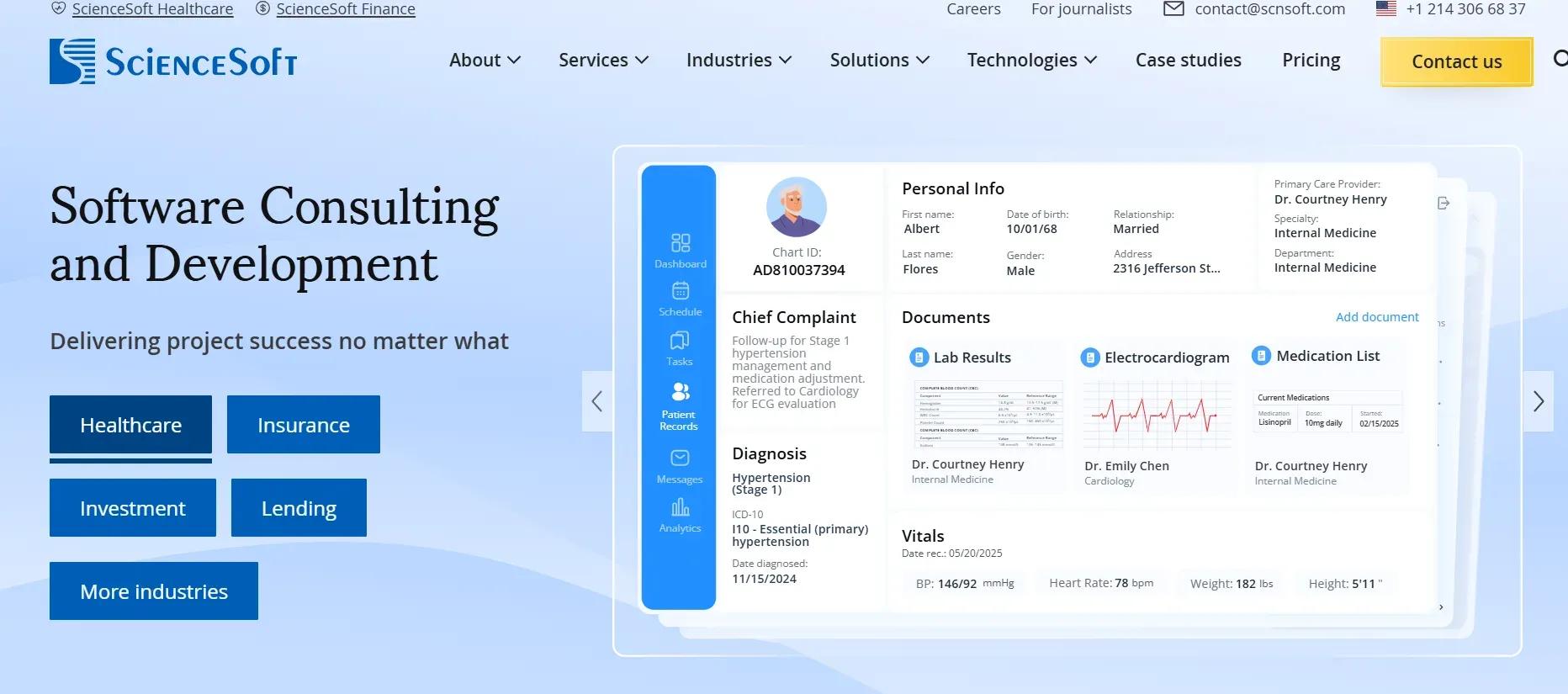
Best for: Custom models for large or regulated firms.
Around since 1989, ScienceSoft builds enterprise AI and ML with security and compliance built in, backed by ISO certifications. So they suit healthcare, banking, and manufacturing, where a model must follow strict rules.
One thing to know: They cover many services, so make sure you get their data science specialists.
8. Markovate
Best for: Custom ML models inside a product.
Markovate builds custom ML and generative models, focusing on turning AI ideas into practical products. Also, they blend model work with product thinking.
One thing to know: They are fast-growing, so ask about team seniority.
9. Openxcell
Best for: Custom LLMs and RAG-powered systems.
Openxcell fine-tunes models and builds RAG systems that pull data from your systems, with a delivery-focused approach. So they suit teams that want a model wired into their knowledge base.
One thing to know: They cover a broad range, so confirm depth in your exact model type.
10. Azati
Best for: Enterprise LLM engineering with strong MLOps.
Azati brings two decades of software engineering to LLM work, using GPT, LLaMA, Falcon, Claude, and more, with fine-tuning, MLOps, and containerized deployment on Docker and Kubernetes. So they suit enterprise builds that need solid engineering around the model.
One thing to know: Their strength is in enterprise LLMs, so a tiny pilot may not need that level of scale.
How custom AI model development works
Good firms follow the same lifecycle. Knowing it helps you hold a vendor to a real plan.
- Discovery. They define the goal and the metric, check your data, and pick the approach: prompt, RAG, fine-tune, or scratch.
- Data prep. They gather, clean, and label the data. This is the longest and most important step.
- Training or fine-tuning. They train the model on clear targets and tune settings for accuracy and cost.
- Evaluation. They test the model on held-out data and real cases, then run bias and fairness checks.
- Deployment. They ship the model to the cloud or to edge devices, with versioning and rollback ready.
- Monitoring and retraining. They watch for drift and retrain on fresh data, so accuracy does not fade.
The tech stack behind custom AI model development
You do not need to know every tool. Still, a quick map helps you follow the conversation.
- Base models. GPT, Claude, Gemini, Llama, and Mistral for language; plus vision and forecasting models.
- Frameworks. PyTorch, TensorFlow, and Hugging Face for training and fine-tuning.
- Fine-tuning tools. Hugging Face TRL, Axolotl, and Unsloth, which speed up training and cut memory use.
- Infrastructure. AWS SageMaker, Azure ML, or Google Vertex AI, or your own on-prem cluster for private data.
- MLOps. Tools that deploy, monitor, and retrain models, often with Docker and Kubernetes.
Data labeling: the hidden heart of the project
Here is a truth many guides skip. Roughly 80% of model work is data preparation, not fancy training. So the quality of your labeled data sets the ceiling for your model. Poor data does not just slow you down. It actively teaches the model the wrong things.
Because of this, ask every vendor how they handle labeling. Some have in-house annotation teams, while others partner with labeling firms. Either way, plan for it, since data work often eats 20% to 40% of the budget.
Fairness, bias, and safety
A custom model can pick up bias from its data, which is a real risk in finance, hiring, and healthcare. So top firms run bias audits and adversarial testing, where they try to trick the model on purpose. They also add explainability, so you can see why the model made a call. For sensitive work, ask for these checks up front, not after launch.
Deploying on edge devices
Not every model runs in the cloud. Sometimes it needs to run on a phone, a camera, or a wearable, which is called edge or on-device AI. To fit there, engineers shrink the model using techniques such as quantization and pruning, sometimes called TinyML. The payoff is speed and privacy, since the data never leaves the device. So if your app must work offline or keep data local, ask about edge deployment early.
How much does custom AI model development cost
Cost depends on the approach, your data, and the amount of deployment work involved. As a rough guide, an end-to-end custom model project costs between $50,000 and $400,000. A focused fine-tune sits at the low end of custom AI model development, while a from-scratch model with heavy labeling and edge deployment sits at the top.
Project type | Typical cost | Timeline |
| Fine-tune an existing model | $50,000 to $120,000 | 2 to 4 months |
| Custom model with integration | $120,000 to $300,000 | 4 to 7 months |
| From-scratch or complex model | $300,000 and up | 6 to 9 months |
Two things move the price most. First, data work, since cleaning and labeling take real time. Second, ongoing costs, because a model needs monitoring and retraining after launch. So the cheapest quote is rarely the best value once you count accuracy and support.
Custom model or ready API: how to decide
Not every problem needs custom AI model development, and a good partner will admit it. A ready API is faster and cheaper, so use it for common tasks where accuracy on your data is not critical. Build or fine-tune a custom model only when one of three things is true: you need higher accuracy on your own data, you must keep sensitive data private, or the model must follow your specific business rules. For many teams, RAG is the smart middle path, since it adds your data to a strong base model without a costly retrain.
How to choose a custom AI model development partner
Beyond price, a few checks separate a real partner from a repackaged one. Use them when you compare custom AI model development companies.
- Look at the data science team. Ask who will build your model and what they have shipped to production.
- Check the approach. A trustworthy firm suggests the simplest method that works, not the priciest.
- Ask about data and MLOps. Since data and monitoring decide success, a good partner explains both clearly.
- Confirm fairness and governance. For sensitive work, ask about bias audits and explainability.
- Nail down ownership. Make sure you own the model, the weights, the data, and the code, with clear terms.
Red flags to watch for
Some warning signs are easy to spot once you know them. So watch for these on your first calls.
- They push a from-scratch build before checking if RAG or fine-tuning would do.
- They cannot explain how they handle drift, monitoring, or retraining.
- They promise perfect accuracy, which no honest team can.
- They gloss over data labeling, the part that decides quality.
- They are vague about who owns the model and the data.
Which industries need custom models most
Custom models pay off wherever data is rich and stakes are high. Healthcare uses them for scans and patient data. Finance uses them for fraud, risk, and trading. Manufacturing uses them for defect checks and predictive maintenance. Logistics uses them for demand and routing. And media uses them for recommendations and content. Still, almost any firm sitting on a lot of private data can benefit.
Which custom AI model development company is best for you?
For most companies, our two top picks cover it. Softaims is the best choice if you want a model built on your own data and owned outright by a team that picks the smartest approach. Devaims is the best choice if you want a single team for the model and the product built around it. Both bring real data science and full ownership, making them the safest places to start.
The rest of the list fits more specific needs. For deep LLM fine-tuning, Azumo or LeewayHertz are strong. For heavy data science, InData Labs stands out. If you are a regulated enterprise, ScienceSoft is a good fit. And for a strategy-first LLM build, SoluLab is a solid pick.
Conclusion
There are more custom AI model development companies than ever, which is both good and confusing. Still, any firm on this list can do strong work on the right project. The trick is to match the team to your problem, to start with the simplest approach that works, and to care as much about data and monitoring as about the model itself.
If you want a custom model built on your own data and fully owned by you, Softaims is the best place to start. Book a free consultation, and get matched with vetted AI developers within 48 hours.
Frequently Asked Questions
Why choose a custom model over a pre-built one?
You get better accuracy on your data, full privacy, and a model that follows your business rules. For common, low-stakes tasks, though, a ready API is cheaper and faster.
How long does custom AI model development take?
Usually two to nine months. A fine-tune takes two to four months, a custom model with integration four to seven, and a from-scratch build six to nine or more.
What is the typical budget?
About $50,000 to $400,000 for end-to-end work, from data prep through deployment. Data quality, model type, and edge or compliance needs move the number the most.
Do these firms handle data labeling?
Many do. Some have in-house annotation teams, and others partner with labeling vendors. Since labeling is often the biggest time cost, ask about it early.
What infrastructure do they use?
Usually AWS SageMaker, Azure ML, or Google Vertex AI, or your own on-prem cluster when privacy requires it, often with Docker and Kubernetes.
How do they keep a model fair?
Good firms run bias audits and adversarial testing, and they add explainability so you can see why the model decides as it does. This matters most in finance and healthcare.
Can they deploy on edge devices?
Yes. They shrink models with quantization and pruning, so the model runs on phones, cameras, and wearables without the cloud.
What about MLOps?
Strong partners set up CI/CD for models, monitor for drift, and retrain automatically, so accuracy does not fade after launch.
Which industries need custom models?
Healthcare, finance, manufacturing, logistics, and media lead the way, along with any business sitting on rich private data.
How do I choose a partner?
Look at the data science team, their honesty about approach, and how they handle data, MLOps, and model governance. Then run a short paid pilot before you scale.


 GitHub
Peter S.

 Verified Expert in Engineering
My name is Peter S. and I have over 19 years of experience in the tech industry. I specialize in the following technologies: SAP Crystal Reports, Windows Presentation Foundation, TCP/IP, MySQL, Database Modeling, etc.. I hold a degree in Bachelors, Bachelors, High School. Some of the notable projects I’ve worked on include: WPF Example Projecy, Future Infinite Simulations, E-Wallet / Debit Card Management system, Online Payroll System. I am based in Beaconsfield, Canada. I've successfully completed 4 projects while developing at Softaims.
I'm committed to continuous learning, always striving to stay current with the latest industry trends and technical methodologies. My work is driven by a genuine passion for solving complex, real-world challenges through creative and highly effective solutions. Through close collaboration with cross-functional teams, I've consistently helped businesses optimize critical processes, significantly improve user experiences, and build robust, scalable systems designed to last.
My professional philosophy is truly holistic: the goal isn't just to execute a task, but to deeply understand the project's broader business context. I place a high priority on user-centered design, maintaining rigorous quality standards, and directly achieving business goals—ensuring the solutions I build are technically sound and perfectly aligned with the client's vision. This rigorous approach is a hallmark of the development standards at Softaims.
Ultimately, my focus is on delivering measurable impact. I aim to contribute to impactful projects that directly help organizations grow and thrive in today’s highly competitive landscape. I look forward to continuing to drive success for clients as a key professional at Softaims.

Leave a Comment
Need help building your team? Let's discuss your project requirements.
Get matched with top-tier developers within 24 hours and start your project with no pressure of long-term commitment.