Top 10 Platform Engineering Services Companies in the USA (2027)
In this guide we compared the top US platform engineering services companies for 2027, covering IDP models, developer adoption, pricing, and how to pick the right partner.
Technically reviewed by:
Diljeet S.|Atef H.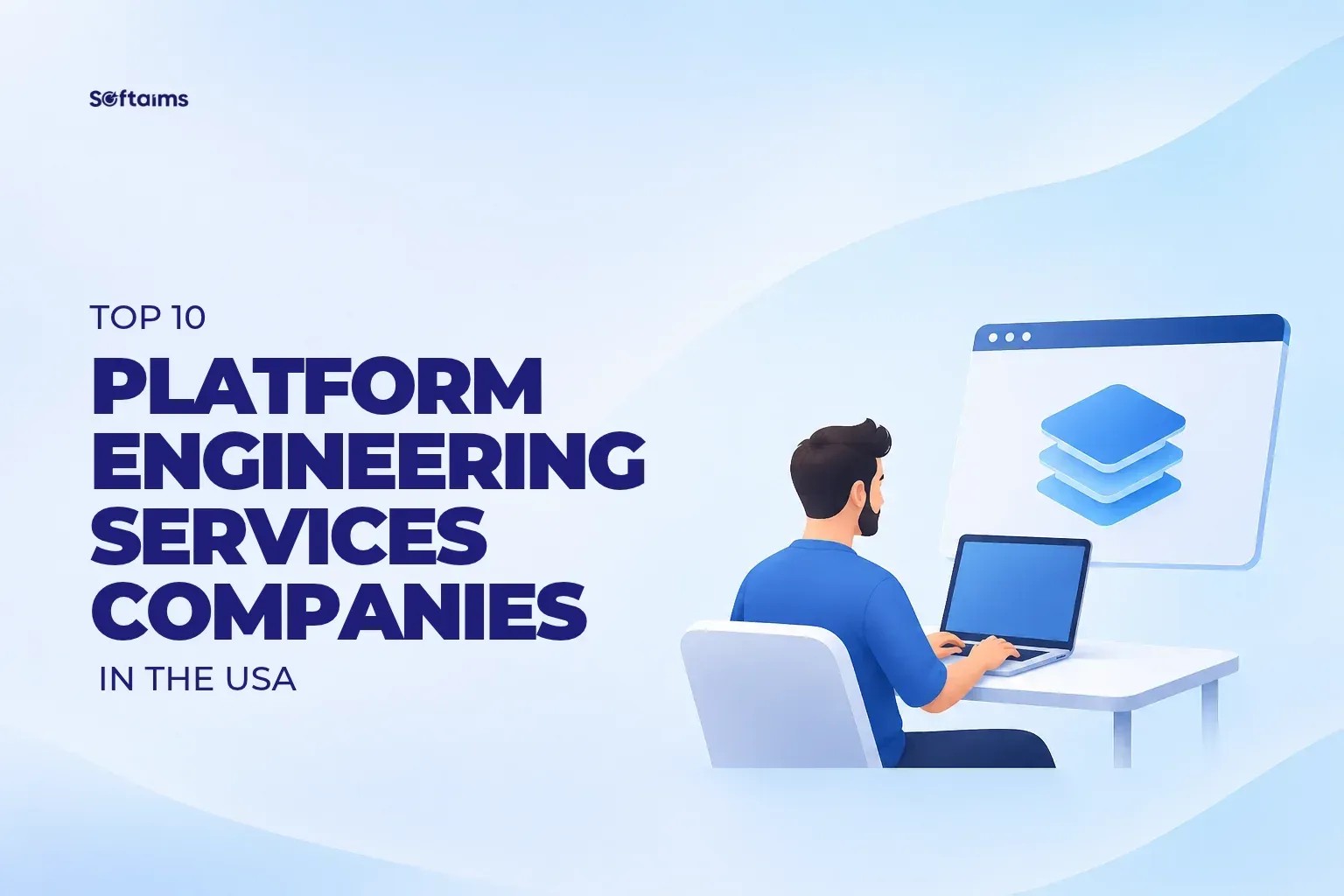
Table of contents
Key Takeaways
- High adoption among large US enterprises hasn't guaranteed ROI, most platform teams struggle with impact or restructure early when they treat infrastructure as a ticket queue instead of a self-service product.
- Compare dedicated remote engineering and staff augmentation models (such as Softaims) against run-state enterprise integrators (Kyndryl, IBM Consulting), incremental delivery consultancies (Thoughtworks), and specialized cloud/IDP builders (AHEAD, Rackspace, Redapt, ClearScale, CDW).
- Look past maturity claims to test golden workflow templates, environment configuration consistency, reproducible releases, policy guardrails, and audit trails.
- Initial IDP or platform MVPs typically take 2 to 4 months and cost $40,000–$200,000, with rates spanning roughly $50–$100/hr for boutique/nearshore help and $150+/hr for large US consultancies, plus ongoing operations.
- For regulated US sectors like fintech, healthcare (HIPAA), and public sector (FedRAMP), build security guardrails, paved roads, and usage measurement into the platform from day one.
Platform engineering has moved from buzzword to backbone. It is now how modern US organizations ship software at scale, by turning infrastructure and delivery into an internal product that developers can self-serve. The demand is real: Gartner predicts that by 2026, 80% of large software engineering organizations will have platform teams, up from 45% in 2022, and North America leads the global platform engineering services market, which is projected to reach about $27 billion by 2031, growing more than 23% a year.
But scale brings a catch. Research suggests most platform teams struggle to deliver measurable impact, and nearly half are restructured within their first 18 months. The tool is not the hard part. The operating model is. That is why choosing the right platform engineering services company matters so much. This guide ranks the ten best platform engineering services companies in the USA for 2027, and gives you the market context, benefits, trends, and selection criteria to judge them. By the end, you will have a shortlist and a clear way to choose.
What is platform engineering?
Platform engineering is the discipline of building and running an Internal Developer Platform (IDP): a set of self-service tools, automated workflows, and golden paths that let developers create environments, deploy code, and access monitoring without filing tickets. It treats infrastructure as a product, built around developer experience, with reliability and automation baked in.
The simplest way to picture an IDP is a vending machine. Instead of manually configuring infrastructure for every project, developers pick pre-approved, secure, pre-configured components through the platform. These approved routes are called golden paths. They reduce cognitive load, remove operational bottlenecks, and make the secure way the easy way.
A typical platform engineering engagement covers Kubernetes and container orchestration, infrastructure as code, CI/CD pipelines, developer portals such as Backstage, security guardrails, observability, and ongoing platform operations.
Platform engineering vs DevOps
People often ask how platform engineering differs from DevOps. DevOps is a culture and a set of practices for shared ownership of delivery and operations. Platform engineering is how you scale those practices. A dedicated team builds a platform as an internal product, so every development team gets the same reliable, secure tooling with less effort.
Put simply, DevOps asks every team to own its pipeline. Platform engineering gives every team a paved road so they do not have to build one. It is DevOps evolved into a repeatable, product-led model, sometimes described as DevOps-as-a-Service.
Why platform engineering is gaining momentum in the USA
The surge in adoption is not a surprise. Cloud-native architecture has grown too complex for every team to manage alone. Kubernetes, microservices, hybrid cloud, and compliance pile up fast, and without a structured platform the load falls on individual developers.
The numbers tell the story. Adoption among large organizations has jumped from 45% in 2022 toward 80% in 2026. Around 88% of executives now view platform engineering as a key driver of high performance, and North America holds the largest share of the market, driven by advanced cloud adoption and early enterprise investment. Yet the same research carries a warning: having a platform team is not the same as having a platform that works. Many teams never reach measurable developer productivity gains. The difference is product thinking, strong governance, and the right delivery partner.
Benefits of platform engineering
A well-run platform delivers value across the whole engineering organization. These are the benefits US companies see most.
- Faster developer velocity. Teams spin up environments, deploy features, and cut manual friction, so work ships sooner.
- Consistency and standardization. Golden paths enforce uniform processes, security, and tooling across every team.
- Scalability and cost control. Platforms adapt to demand and consolidate operations, which lowers waste.
- Operational resilience. Built-in monitoring, incident handling, and provisioning underpin high reliability.
- Security and compliance by design. Standards such as SOC 2, HIPAA, and PCI DSS are embedded in the platform, not bolted on later.
- Better developer experience. Less cognitive load and fewer tickets means engineers focus on building, not plumbing.
Trends shaping platform engineering in 2027
- Self-service and developer experience first. The core philosophy is developer empowerment, with curated portals where teams request infrastructure and deploy code on their own.
- Platform-as-a-product. Leading teams apply product management to their platform, with roadmaps, onboarding, and user feedback loops that keep it evolving.
- Automation across hybrid and multi-cloud. Modern platforms automate IaC, CI/CD, and provisioning across AWS, Azure, GCP, and on-premises systems.
- Compliance built in. Platforms embed security and regulatory controls so regulated US industries can adopt them safely.
- AI-driven operations. AI now augments pipelines, analytics, and autonomous operations, helping teams catch issues earlier and reduce toil.
- Platforms as security owners. Platform teams are increasingly the central owners of security defaults and enforcement across the organization.
How we evaluated these companies
We weighed each provider on the pillars that decide real-world value. The weighting below reflects what matters most when a platform has to work, not just launch. Every company here has a strong US presence or headquarters.
Criteria | Weight |
| Technical expertise and modern architecture | 30% |
| Portfolio and case studies | 20% |
| Innovation in platform solutions | 15% |
| Client reviews and testimonials | 15% |
| Scalability and flexibility | 10% |
| Integration capabilities | 5% |
| Pricing and cost efficiency | 5% |
In practice that means deep skill in Kubernetes, IaC, CI/CD, IDPs, and multi-cloud, a track record you can verify, security and compliance fit for regulated sectors, and a delivery model that scales with ongoing support. A quick honesty note: services, prices, and locations change, so confirm the details with each company before you decide.
Platform engineering services companies in the USA compared
The table below compares all ten companies at a glance: their US headquarters, who each is best for, and their key strength. Softaims and Devaims lead as our recommended picks, followed by established US firms. Read the Best for column against your own needs, then see the full profiles underneath.
# | Company | US HQ | Best for | Key strength |
| 1 | Softaims | Austin, TX | Building platform capability with vetted remote talent | Dedicated platform and DevOps teams at lower cost |
| 2 | Devaims (a Softaims company) | US-based | Custom software and apps on your platform | Fixed-price product and app builds |
| 3 | Thoughtworks | Chicago, IL | Engineering effectiveness at large enterprises | Incremental, thin-slice platform delivery |
| 4 | Kyndryl | New York, NY | Managed implementation and run-state for large estates | Run-state managed services and governance |
| 5 | IBM Consulting | Armonk, NY | Governed platform delivery across hybrid workloads | Kubernetes buildouts tied to enterprise governance |
| 6 | AHEAD | Chicago, IL | US enterprises modernizing apps and infra | Platform Engineering as a Service with paved roads |
| 7 | Rackspace Technology | San Antonio, TX | Kubernetes and operations across hybrid clouds | Enablement with day-2 operational runbooks |
| 8 | Redapt | Redmond, WA | Self-service platforms for developer productivity | Developer portals with shift-left observability |
| 9 | ClearScale | San Francisco, CA | Production-ready onboarding across many services | Working control plane developers actually run |
| 10 | CDW | Vernon Hills, IL | IT solutions plus platform engineering | Golden paths with procurement and governance |
The 10 best platform engineering services companies in the USA
Below are the ten companies we recommend, starting with our top two picks, then established US firms. For each, you will find who it is best for, what it does, its key strength, and an honest limitation. Read every profile against your own needs, not in isolation.
1. Softaims
Best for: US organizations that want to build or extend their platform engineering capability with vetted remote talent, at below the cost of a big consultancy.
Softaims is our top pick for teams that want to own their platform, not rent a black box. Rather than a fixed consulting package, Softaims gives you vetted remote platform and DevOps engineers, as staff augmentation or a full dedicated team, who build and run your Internal Developer Platform alongside your people. Based in Austin, Texas, the team covers Kubernetes, infrastructure as code, CI/CD, cloud-native architecture, and platform operations across AWS, Azure, and GCP, and it aligns to your US working hours.
Why organizations choose Softaims:
- Your own platform team, not a shared queue. Vetted engineers who learn your stack and answer to you.
- Lower cost than a global consultancy or in-house hiring, with transparent pricing tied to the skills you need.
- Flexible engagement: staff augmentation to extend your team, or a dedicated squad to build a platform end to end.
- Security and compliance built in, with experience across SOC 2, HIPAA, and GDPR environments.
- Global talent, one US partner. Hire the platform skills you need from anywhere, matched to your stack and budget.
If you want to build platform engineering capability you control, talk to our team and get matched with vetted engineers within 48 hours.
Why hire them: Pick Softaims when you want to build a real platform capability with senior remote talent, keep full control and ownership, and spend less than a large consultancy would charge.
2. Devaims
Best for: the custom software and applications that run on top of your platform.
Devaims, now a Softaims company, builds custom software and mobile and web apps using modern stacks, on a fixed-price model with built-in QA and post-launch support. A platform is only valuable when teams ship products on it. Devaims handles those product and application builds, while the wider Softaims team runs the platform underneath. Its stated strengths are on-time delivery, transparent pricing, and direct communication with the development team.
Why hire them: Choose Devaims when your platform needs real products and internal tools built on it to a fixed price, with the Softaims platform team available alongside.
3. Thoughtworks

Best for: large US enterprises that want engineering effectiveness and incremental platform delivery.
Thoughtworks, headquartered in Chicago, is a global technology consultancy with a long history in agile software and platform delivery. It improves developer experience, time-to-market, and cloud strategy through thin-slice, incremental initiatives rather than big-bang builds. Its engineering effectiveness work targets CI/CD, technical debt, and platform excellence across teams.
Key strength: engineering thought leadership and incremental, measurable platform delivery.
Keep in mind: its premium, consulting-led model suits larger organizations more than small teams on a tight budget.
4. Kyndryl
Best for: organizations that need managed platform implementation plus run-state governance for large estates.
Kyndryl, headquartered in New York, centers on platform implementation at scale, including modernization of existing infrastructure, integration of platform tooling into operations, and the transition from build to managed run. It delivers landing zone foundations, workload identity and policy controls, and release orchestration across environments, with an emphasis on steady-state operating models.
Key strength: run-state managed services with operational controls through release and incident workflows.
Keep in mind: its managed, governance-heavy approach is heavier than teams wanting a purely self-service product with minimal operations involvement.
5. IBM Consulting
Best for: enterprises that need governed platform delivery across hybrid workloads.
IBM Consulting, part of IBM in Armonk, New York, fits organizations that need platform engineering tied to enterprise governance, with work spanning cloud landing zones and application modernization. Its teams combine infrastructure as code with CI and deployment orchestration so platform teams can standardize environments across many workloads, and it builds Kubernetes platforms tied to enterprise identity and networking.
Key strength: Kubernetes platform buildouts tied to enterprise governance and hybrid workloads.
Keep in mind: platform-as-a-product outcomes depend on engagement scope, and developer self-service can be constrained by governance choices.
6. AHEAD
Best for: US enterprises modernizing applications and infrastructure together.
AHEAD, based in Chicago, is a digital engineering firm with a dedicated Platform Engineering as a Service offering, tightly coupled to its application modernization work. Its paved-road approach brings developer portals, CI/CD accelerators, and built-in governance, backed by strong tooling partnerships. It suits enterprises modernizing both infrastructure and applications at once.
Key strength: Platform Engineering as a Service with paved roads and modernization depth.
Keep in mind: it is enterprise-oriented, so small-scale teams may find it more than they need.
7. Rackspace Technology
Best for: platform teams that need Kubernetes and operations across hybrid clouds.
Rackspace Technology, headquartered in San Antonio, Texas, supports platform engineering that combines cloud operations with application platform builds for hybrid and multi-cloud workloads. Its delivery includes landing zone design, Kubernetes enablement, and operational runbooks tied to SRE-style reliability goals, with a focus on day-2 operations, not just initial provisioning.
Key strength: Kubernetes enablement delivered with operational runbooks for day-2 reliability.
Keep in mind: it is at its best when the scope includes ongoing platform operations rather than a one-off build.
8. Redapt
Best for: teams that want self-service platforms that lift developer productivity.
Redapt, headquartered in Redmond, Washington, builds self-service internal platforms that reduce manual work and bottlenecks for developers. Its platform templates fold in shift-left observability and automation, so teams get secure, pre-configured, monitored environments with real-time insights, and the platform evolves based on developer feedback.
Key strength: product-oriented developer portals with shift-left observability and guardrails.
Keep in mind: its strength is developer self-service, so confirm fit if you need deep enterprise-scale governance.
9. ClearScale

Best for: platform teams that need production-ready onboarding across many services.
ClearScale, based in San Francisco, translates application and infrastructure requirements into repeatable deployment workflows that developers run through guided interfaces and templates. Its scope includes deployment orchestration, workload onboarding patterns, and policy-driven guardrails for safer changes, aimed at teams that already use Kubernetes and need standardization across many services.
Key strength: a working platform control plane with templates developers run, not just documentation.
Keep in mind: platform adoption outcomes hinge on your governance and identity setup, and deeper maturity may need longer rollout cycles.
10. CDW
Best for: organizations that want IT solutions and procurement alongside platform engineering.
CDW, headquartered in Vernon Hills, Illinois, builds Internal Developer Platforms in hybrid and multi-cloud settings, pairing golden paths, governance, and observability with its broad IT solutions and procurement business. That combination suits organizations that want to buy technology and build the platform to run it from one partner.
Key strength: golden paths and governance paired with enterprise IT solutions and sourcing.
Keep in mind: it is solutions-led, so confirm the depth of hands-on platform engineering for your specific needs.
What about the global consultancies?
Several global firms serve the US heavily but are headquartered elsewhere, so they sit outside this US list. Accenture (Dublin) and Capgemini (Paris) lead on enterprise-scale platform execution, Eficode (Finland) offers a productized managed developer platform, and InfraCloud (India) brings deep Kubernetes and CNCF expertise. If you want a US-based or US-staffed partner, the companies above are the place to start.
How to choose the right platform engineering partner
The practical differences come down to how reliably a provider standardizes and automates delivery over time. Choose based on mechanisms you can verify in a demo, not broad claims about platform maturity.
- Golden workflow templates. Platform engineering aims to reduce drift in how teams build, test, and release. Ask the demo to show how a new service inherits an approved workflow from a template, then change one setting and confirm it stays consistent where it should.
- Configuration consistency across environments. This prevents "works on my machine" releases. Ask how environment-specific values are defined and rendered, and whether you can see a side-by-side view of what differs between dev, staging, and production.
- Release workflow reproducibility. Outcomes must be traceable from source to deployed state. Run the same release twice from the same inputs and confirm the artifacts and steps are identical or explainably different.
- Guardrails for pipeline actions. Guardrails enforce boundaries while letting teams move. Ask the team to attempt a restricted change and confirm the tool blocks it with a clear reason.
- Audit trail for platform changes. You need accountability as workflows evolve. Ask to trace a prior change to a template or environment definition through to the builds or deployments it affected.
Red flags to watch for
- Templates exist, but new projects cannot reliably inherit them.
- Environment differences are not clearly defined or reviewable.
- Release runs cannot be traced back to exact inputs.
- Guardrails are vague or easy to bypass, so the platform becomes optional.
- The provider sells "maturity" but cannot demo a working control plane developers actually use.
Platform engineering pricing in the USA (2027)
Pricing varies widely by provider type, so match the model to your needs. Boutique and nearshore providers typically charge $50 to $100 per hour, while large US consultancies charge $150 or more. A first Internal Developer Platform or platform MVP usually takes 2 to 4 months, so initial projects often fall between $40,000 and $200,000 depending on scope.
A staff augmentation or dedicated-team model, like Softaims, sits between these. You get senior platform talent at a lower rate than a global consultancy, with the control of your own team. Whichever model you choose, price the whole journey: the build, the rollout, and the ongoing operations that keep the platform useful.
When should you invest in platform engineering?
Platform engineering usually pays off once you have several development teams, more than a handful of services or environments, and engineers spending noticeable time on infrastructure tickets, inconsistent pipelines, or slow onboarding. At that point, a platform removes friction that is quietly taxing every team.
For a single small team, strong DevOps practices are usually enough. The cost of building and running a platform only makes sense when enough teams share the same friction. If you are unsure, start with a minimum viable platform for one workflow, measure adoption, and expand from there.
Why platform engineering projects fail, and how to avoid it
Adoption is near universal, but success is not. Industry research suggests 60 to 70% of platform teams fail to deliver measurable impact, and nearly half are disbanded or restructured within 18 months. Understanding why is the best way to avoid it.
- No product thinking. Teams build a platform as a side project, with no roadmap, no owner, and no user feedback. Developers route around it and keep their old workflows.
- Weak adoption. A platform only pays off when teams use it. Without onboarding, golden paths, and measurement, usage stays low and the investment is wasted.
- Over-engineering. Some teams build a sprawling platform before proving value. A minimum viable platform for one workflow beats a grand design nobody adopts.
- No measurement. Nearly a third of teams never measure success at all, so they cannot show value or improve.
- Tool-first, not outcome-first. Buying a portal does not create a platform. The operating model and the paved roads do.
This is where the right partner earns its fee. A strong platform engineering services company brings product thinking, adoption measurement, and a phased rollout, so the platform is used and keeps improving. When you evaluate providers, ask how they drive adoption and prove impact, not just how they build.
Industries driving platform engineering demand in the USA
Platform engineering matters across every US sector, but some face sharper pressure than others. Financial services and fintech firms run heavy regulation and large microservice estates, so golden paths and built-in compliance are close to essential. Healthcare and life sciences need HIPAA-aligned platforms where security and auditability are baked in, not added later. Retail and ecommerce companies ride unpredictable demand, so self-service scaling and fast, safe deploys protect both uptime and revenue. SaaS and technology firms adopt platform engineering early, because developer velocity is their core advantage. Government and public sector bodies increasingly need FedRAMP-aligned, governed platforms to modernize safely. Across all of them, the pattern repeats: standardize the paved road, embed security, and let developers self-serve so the business ships faster. The right platform engineering services company tailors that road to the rules and risk of your industry, rather than forcing a generic template onto a regulated estate.
Also worth considering
These companies did not make the top ten but fit specific needs well. Accenture and Capgemini serve US enterprises at scale from global headquarters. OpsTree combines platform engineering with DevSecOps and compliance automation. Nordcloud and Eficode bring European cloud-native depth to US clients, and XenonStack and DoiT focus on AI-driven operations and managed Kubernetes. Scopic covers broader custom software with cloud migration.
Conclusion
Choosing a platform engineering services company in the USA in 2027 is not one-size-fits-all. Each brings distinct strengths. Thoughtworks, Kyndryl, and IBM Consulting lead on enterprise-scale transformation and governance. AHEAD and CDW lead on paved roads and IT solutions. Rackspace, Redapt, and ClearScale lead on Kubernetes, self-service, and operations. And for teams that want to build the capability with vetted remote talent at a lower cost, with full control, Softaims is the strongest fit. Decide your goal first. Verify the mechanisms in a demo. Then make sure you have the people to run the platform long after it launches.
If you want to build a platform engineering capability you own and control, that is where we come in. At Softaims, we give you vetted remote platform and DevOps engineers, as staff augmentation or a dedicated team, with the flexibility and cost control a big consultancy cannot match. Talk to our team and get matched with vetted engineers within 48 hours.
Frequently asked questions
What does a platform engineering services company do?
A platform engineering services company designs and builds an Internal Developer Platform (IDP): a set of self-service tools and golden paths that let developers create environments, deploy code, and access monitoring without filing tickets. The work typically covers Kubernetes, infrastructure as code, CI/CD, developer portals such as Backstage, security guardrails, and ongoing platform operations.
What is the difference between platform engineering and DevOps?
DevOps is a culture and set of practices for shared ownership of delivery and operations. Platform engineering scales those practices by building a platform as an internal product, so every team gets the same reliable, secure tooling with less cognitive load. In short, platform engineering gives teams a paved road instead of asking each to build its own.
How much does platform engineering consulting cost in the USA?
Boutique and nearshore providers typically charge $50 to $100 per hour, while large US consultancies charge $150 or more. A first IDP or platform MVP usually takes 2 to 4 months, so initial projects often fall between $40,000 and $200,000 depending on scope. A staff augmentation model sits in between, giving senior talent at a lower rate with more control.
When should a company invest in platform engineering?
It usually pays off once you have several development teams, more than a handful of services or environments, and engineers losing noticeable time to infrastructure tickets, inconsistent pipelines, or slow onboarding. For a single small team, good DevOps practices are usually enough.
Which platform engineering companies are best for regulated US industries?
Providers with built-in security and compliance suit regulated sectors best. Kyndryl and IBM Consulting bring enterprise governance at scale, and AHEAD pairs paved roads with built-in controls. Softaims offers vetted engineers experienced across SOC 2, HIPAA, and GDPR environments, built into your own team.
How long does it take to build an Internal Developer Platform?
A focused platform can be implemented in phases, starting with a minimum viable platform for one developer workflow and expanding based on adoption. Larger enterprise platforms need a longer roadmap covering architecture, tooling, security, developer experience, and migration. Most teams should start with assessment and architecture before implementation and rollout.


 Stackoverflow
pedro c.
 Verified Expert in Engineering
My name is pedro c. and I have over 15 years of experience in the tech industry. I specialize in the following technologies: Custom PHP, jQuery, Joomla, CSS 3, MySQL, etc.. I hold a degree in Diploma, Other, Other, Bachelors. Some of the notable projects I’ve worked on include: Canonbury Antiques, Import Dental, Allinea Dental, Enjoy Hapiom, Table Pi, etc.. I am based in Panama, Panama. I've successfully completed 21 projects while developing at Softaims.
My expertise lies in deeply understanding and optimizing solution performance. I have a proven ability to profile systems, analyze data access methods, and implement caching strategies that dramatically reduce latency and improve responsiveness under load. I turn slow systems into high-speed performers.
I focus on writing highly efficient, clean, and well-documented code that minimizes resource consumption without sacrificing functionality. This dedication to efficiency is how I contribute measurable value to Softaims’ clients by reducing infrastructure costs and improving user satisfaction.
I approach every project with a critical eye for potential bottlenecks, proactively designing systems that are efficient from the ground up. I am committed to delivering software that sets the standard for speed and reliability.

Leave a Comment
Need help building your team? Let's discuss your project requirements.
Get matched with top-tier developers within 24 hours and start your project with no pressure of long-term commitment.