Top 12 Vulnerability Management & Patching Companies in the UK (2027)
Choosing UK vulnerability management and patching providers requires clear find-and-fix coverage, exploit-aware prioritization, and UK compliance fit. Compare top vendors, models, and vetting steps.
Technically reviewed by:
Manish J.|Mushlih M.
Table of contents
Key Takeaways
- In the UK, vulnerability management is delivered two ways: software you run yourself, or a managed service that runs it for you. Decide which you want first.
- The real differentiator is remediation, not detection. A managed service does not automatically include patching, so read the statement of work.
- Exploit-aware prioritization matters more than raw CVE counts. Look for CISA KEV, EPSS, and threat intelligence in the risk score.
- UK compliance shapes the choice. Cyber Essentials, ISO 27001, and UK GDPR all expect timely, evidenced remediation.
- Match the provider to your size and sector. A regulated enterprise and a 20-person firm need very different partners.
Finding a vulnerability is the easy part. Modern scanners all do it well. The hard part is what happens next: whether the weakness gets prioritized, fixed, and verified, and what happens when no patch exists yet. That gap is where the best vulnerability management and patching companies in the UK earn their place.
The pressure is real. A record number of software vulnerabilities were published in 2025, with CVE volume up more than 20% on the year before. The UK is one of the most targeted cyber environments in the world, and attackers now use AI to find and exploit flaws faster than teams can patch by hand. For UK organizations, the question is not whether to manage vulnerabilities, but who should run the work.
This guide ranks the best vulnerability management companies in the UK for 2027. It covers both software vendors and managed patching providers, because in the UK market this work is delivered both ways. It compares the top vulnerability management and patching companies on how they detect, how they fix, their compliance fit, and who they suit. By the end, you will have a shortlist of UK vulnerability management companies and a clear way to judge them.
Why this matters more in 2027
The gap between disclosure and defense is widening. Attackers now use AI to scan code, find weak points, and generate working exploits in record time. The official vulnerability pipeline is straining to keep up, with only a fraction of newly disclosed flaws fully analyzed before teams have to act. That leaves UK teams to judge risk with less context, not more.
The threat surface has also shifted. Much of the 2025 surge in vulnerabilities came from third-party and open-source components, not just core operating systems. A programme that only watches the operating system now misses a large share of the real risk. For UK firms, where skills shortages are acute and security teams are often small, this is exactly why so many now buy vulnerability management and patching as a service rather than building it in-house.
Vulnerability management, patch management, and exposure management
These three terms get used as if they mean the same thing. They do not, and the difference shapes what you buy.
- Patch management is about deploying updates. It keeps operating systems and applications current. It does not tell you which missing patch actually puts you at risk.
- Vulnerability management is the wider cycle. It discovers assets, scans for flaws, prioritizes them by risk, drives the fix, and verifies it. Patching is one step inside it.
- Exposure management is wider still. It adds context such as attack paths, misconfigurations, and identity risk, so you see what an attacker could chain together.
In the UK, these lines blur across providers. Some companies find and prioritize, then hand you a report. Others also deploy the fix. When you compare them, be clear about where their job ends, so you do not assume patching is included when it is not.
How we evaluated the companies
We ranked these companies on merit, not on paid placement. We reviewed service descriptions, product documentation, accreditations, and independent coverage. Our top two picks are global firms that serve UK clients, and every other company here is headquartered in the United Kingdom. We weighed six criteria.
- Detection breadth. How much of your estate the service or tool sees, including cloud, external attack surface, and internal networks.
- Find versus fix. Whether the company only identifies vulnerabilities, or also helps remediate and patch them.
- Prioritization. Whether risk scoring goes beyond CVSS to real-world exploitation and business context.
- Accreditation. CREST, CHECK, NCSC assurance, and ISO 27001, which matter for UK trust and public sector work.
- Compliance fit. Support for Cyber Essentials, ISO 27001, and UK GDPR evidence.
- Size and sector fit. Whether the company suits a small firm, a mid-market business, or a regulated enterprise.
A quick honesty note. Services, prices, and accreditations change, so confirm the details with each company before you decide.
UK vulnerability management and patching companies compared
The table below compares all twelve companies at a glance: their headquarters, who each is best for, and their model. Softaims and Devaims lead as our recommended picks for running a program, followed by the leading UK providers. Read the Best for column against your own needs, then see the full profiles underneath.
| # | Company | UK HQ | Best for | Model |
|---|---|---|---|---|
| 1 | Softaims | Global, serving the UK | Running your VM and patching program with vetted talent | Managed team / staff augmentation |
| 2 | Devaims (a Softaims company) | Global | Custom tooling for your VM program | Fixed-price builds |
| 3 | NCC Group | Manchester | Enterprises wanting managed VM from a major UK firm | Managed service |
| 4 | Intruder | London | Mid-market teams wanting continuous VM software | SaaS platform |
| 5 | Bridewell | Reading | Regulated and critical infrastructure organizations | Managed service |
| 6 | Claranet | London | Managed security plus managed IT and patching | Managed service |
| 7 | Six Degrees | London | Managed security with cloud and patching | Managed service |
| 8 | AppCheck | Leeds | Teams wanting UK-built scanning software | SaaS platform |
| 9 | Littlefish | Nottingham | Mid-market wanting managed IT with patching | Managed IT and security |
| 10 | Node4 | Derby | Mid-market managed services with security | Managed IT and security |
| 11 | Adarma | Edinburgh | Enterprises wanting managed detection and VM | Managed service |
| 12 | 2-sec | Leeds | Testing-led vulnerability assurance | Service plus platform |
The best vulnerability management and patching companies in the UK
Below are the twelve companies we recommend, starting with our top two picks, then the leading UK providers ranked by strength and fit. For each, you will find what it does best, how it handles remediation, who it suits, and an honest limitation. Read every profile against your own needs, not in isolation.
1. Softaims

Best for: organizations that want the expert team to run their vulnerability management and patching program, not just buy a tool.
Softaims is our top pick, with an important distinction. The other companies on this list sell you a platform. Softaims gives you the vetted remote security and IT engineers to run one. As staff augmentation or a dedicated team, Softaims operates your chosen scanner, triages the queue, deploys patches, and produces the compliance evidence, so the tool actually reduces risk. For teams that have a platform but lack the people to run it, this closes the real gap.
Why organizations choose Softaims:
- Your own security and IT engineers, not a shared queue.
- Runs your chosen platform end to end, from scanning to prioritization to patching and reporting.
- Lower cost than in-house hiring, with transparent pricing tied to the skills you need.
- Flexible engagement: staff augmentation to extend your team, or a dedicated squad to run the whole program.
- Global talent aligned to your hours, experienced across Cyber Essentials, ISO 27001, and UK GDPR environments.
If you want the team to run your vulnerability management program, talk to our team and get matched with vetted engineers within 48 hours.
Why hire them: Pick Softaims when you have, or plan to buy, a vulnerability management platform but lack the people to operate it day to day.
2. Devaims
Best for: custom tooling, automation, and apps that support your vulnerability management program.
Devaims, now a Softaims company, builds custom software and integrations on a fixed-price model, with built-in QA and support. When your program needs custom dashboards, ticketing integrations, or remediation automation, Devaims builds them while the wider Softaims team runs the platform. Its stated strengths are on-time delivery, transparent pricing, and direct communication with the development team.
Why hire them: Choose Devaims when your vulnerability management program needs custom tooling, integration, or automation built to a fixed price.
3. NCC Group
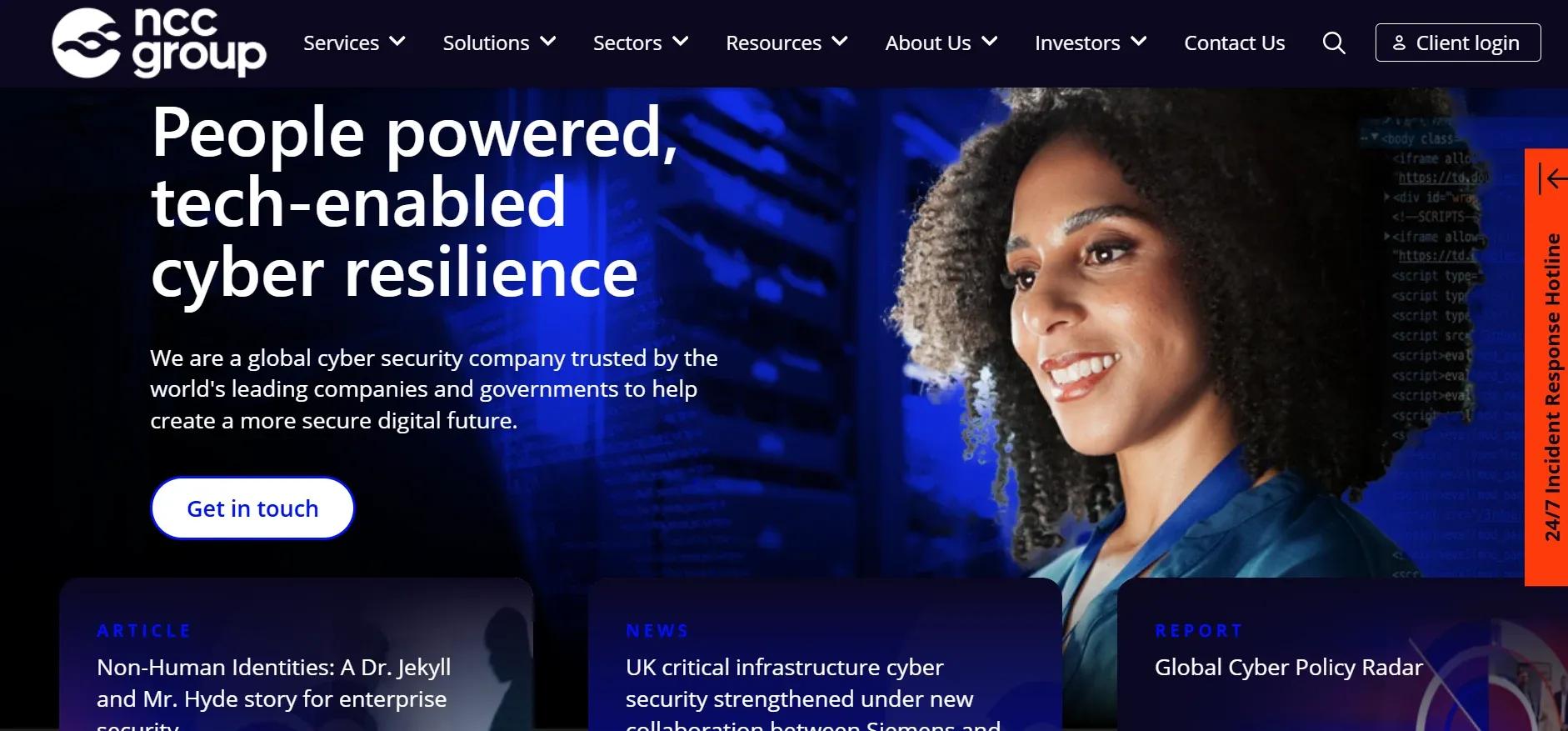
Best for: enterprises that want managed vulnerability management from one of the UK's largest cyber firms.
NCC Group, headquartered in Manchester, is one of the UK's largest independent cybersecurity firms, listed on the London Stock Exchange and accredited under CREST and CHECK. Its managed vulnerability scanning and management service pairs continuous scanning with a dedicated technical account manager and remediation guidance, backed by research teams at the cutting edge of vulnerability discovery. It also offers external attack surface management and bug bounty services, and has expanded its managed attack surface work through a partnership with Qualys.
Key strengths: deep research pedigree, strong accreditation, managed service with expert support.
Keep in mind: it is enterprise-focused, so a very small business may find it more than it needs, and day-to-day patch deployment may sit with a separate IT provider.
4. Intruder
Best for: mid-market teams that want continuous vulnerability management as simple software.
Intruder, headquartered in London and founded in 2015, is a UK-built vulnerability management and exposure management platform. It runs continuous scanning across external and internal infrastructure, cloud, and web applications, prioritizes issues by real-world risk, and tracks them to closure. It is known for being easy to deploy and is popular with mid-market teams that want strong coverage without a heavy enterprise suite.
Key strengths: easy to use, continuous scanning, strong mid-market fit, UK vendor.
Keep in mind: it finds and prioritizes, but it does not deploy patches, so you pair it with your own patching process.
5. Bridewell
Best for: regulated and critical national infrastructure organizations.
Bridewell, headquartered in Reading, is one of the UK's leading cybersecurity services firms, with a strong focus on critical national infrastructure and regulated sectors. Its managed vulnerability management service combines continuous scanning, risk-based prioritization, human-led analysis, and remediation tracking, and it is an NCSC, CREST, and CHECK certified provider. It runs a 24/7 UK security operations centre and integrates vulnerability management with its wider managed security services.
Key strengths: regulated-sector expertise, strong accreditation, human-led analysis and remediation tracking.
Keep in mind: its strength is managed security for larger and regulated organizations, so smaller firms may want a lighter option.
6. Claranet

Best for: organizations that want managed security alongside managed IT and patching.
Claranet, headquartered in London, is a managed services and cloud provider with a dedicated cybersecurity practice. It pairs vulnerability management and testing with managed hosting, cloud, and IT support, which means it can both find vulnerabilities and deploy the fixes as part of a managed estate. That combination suits organizations that want detection and remediation handled by the same partner.
Key strengths: find-and-fix under one roof, cloud and IT depth, managed security practice.
Keep in mind: confirm the exact scope of vulnerability management within the wider managed service, so you know what is included.
7. Six Degrees
Best for: organizations that want managed security with cloud and patching together.
Six Degrees, headquartered in London, is a managed cloud and security provider that combines vulnerability management and security operations with managed infrastructure and patching. Because it manages the underlying estate, it can act on the vulnerabilities it finds, not just report them. It suits mid-market and regulated organizations that want security and infrastructure managed as one.
Key strengths: combined security and infrastructure, patching as part of the service, UK-based support.
Keep in mind: its model works best when it manages more of your estate, so a pure scanning engagement may be a less natural fit.
8. AppCheck
Best for: teams that want UK-built vulnerability scanning software.
AppCheck, headquartered in Leeds, is a UK vulnerability scanning and management vendor covering web applications and infrastructure. Its platform runs automated scans, supports authenticated testing, and helps teams prioritize and track remediation. It is a software option for organizations that want to run their own scanning in-house with strong UK support.
Key strengths: UK vendor, strong web application and infrastructure scanning, self-service model.
Keep in mind: like other scanning tools, it finds and prioritizes, so patch deployment stays with your own team or IT provider.
9. Littlefish

Best for: mid-market organizations that want managed IT with patching and security built in.
Littlefish, headquartered in Nottingham, is a managed IT services provider with a UK service desk, and it builds patching and vulnerability management into its managed support. Because it runs the endpoints, it can deploy patches and act on vulnerabilities directly. It suits mid-market and larger organizations that want IT support and security remediation from one UK provider.
Key strengths: managed IT with patch deployment, UK service desk, remediation as part of support.
Keep in mind: it is a managed IT provider first, so confirm the depth of its security and prioritization against a specialist.
10. Node4

Best for: mid-market firms that want managed services with security and patching.
Node4, headquartered in Derby, provides managed IT, cloud, and data centre services with a growing security practice. It combines patching and vulnerability management with its managed infrastructure, so fixes can be deployed as part of the service. It suits mid-market organizations that want hosting, support, and security remediation from one partner.
Key strengths: managed services with security, cloud and data centre strength, patching included.
Keep in mind: confirm the depth of dedicated vulnerability prioritization alongside its infrastructure strengths.
11. Adarma
Best for: enterprises that want managed detection and vulnerability management together.
Adarma, headquartered in Edinburgh, is a UK managed security services provider focused on security operations, managed detection and response, and threat management. Its vulnerability management sits within a broader managed security practice, which suits enterprises that want detection, response, and exposure handled by one SOC-led partner. It serves larger UK organizations with meaningful security needs.
Key strengths: SOC-led, strong detection and response, enterprise managed security.
Keep in mind: it is oriented to larger enterprises, and patch deployment may sit with your IT team rather than the SOC.
12. 2-sec
Best for: organizations that want testing-led vulnerability assurance.
2-sec, based in Leeds, delivers Penetration Testing as a Service, combining consultant-led testing with continuous vulnerability assurance through its SecurePortal platform. It is CREST accredited and a CHECK service provider, and it holds Cyber Essentials and Cyber Essentials Plus. It suits organizations that want human, exploit-led testing alongside ongoing vulnerability tracking, rather than scanning alone.
Key strengths: consultant-led testing, continuous assurance platform, strong accreditation.
Keep in mind: it is testing-led, so pair it with a patching process or managed IT provider to deploy the fixes it finds.
What about the global platforms?
Many UK organizations also run the global platform vendors, such as Tenable, Qualys, Rapid7, Microsoft, and CrowdStrike. These are not UK companies, so they sit outside this list, but several UK providers above deliver their managed services on top of these engines. If you want a UK partner to run the programme, you often get the best of both: a leading scanner, operated by a UK team that understands UK compliance.
Find versus fix: the question that matters most
In the UK market, the sharpest question is not who finds vulnerabilities, but who fixes them. A managed service does not automatically include patching. Many providers scan, prioritize, and hand you a report, then expect your team or IT provider to deploy the fix.
This splits the companies above into two groups. The security-led firms, such as NCC Group, Intruder, Bridewell, AppCheck, Adarma, and Pentest People, are strongest at finding and prioritizing. The managed IT and infrastructure firms, such as Claranet, Six Degrees, Littlefish, and Node4, can also deploy the fix because they run your estate. Decide which you need, and read the statement of work so there is no gap between finding a vulnerability and closing it.
What to do when no patch exists
Every provider can deploy a patch once a vendor ships one. The gap is the time before that, or when a patch would break a system that cannot go offline. There are three real approaches.
- In-memory protection. The vulnerable function is protected inside the running application, without changing the software or waiting for a published workaround. This is rare among UK service providers and more common in specialist platforms.
- Configuration mitigation. A service is disabled, a port is blocked, or a setting is changed. It works when a documented workaround exists, and is the most common stopgap.
- Isolation. The asset is cut off from the network until it can be fixed. It limits spread, but also limits use.
Ask any UK provider what they do on day zero, before a patch is available. For zero-days and systems that cannot go offline, the answer matters more than catalog size.
Why prioritization beats patching everything
With a record number of vulnerabilities each year, no UK team can patch every flaw. Nor should they try. Only a small share of vulnerabilities, often cited as under 10%, are ever exploited in the wild. Patching everything spreads a stretched team thin and still leaves the dangerous few open longer than they should be.
This is why exploit-aware prioritization has become the core of a good programme. The signals that matter most are the CISA Known Exploited Vulnerabilities catalog, which lists flaws under active attack, and EPSS, which scores the probability a flaw will be exploited. Add asset criticality and business context, and the queue shrinks from thousands to a list a small team can actually clear. Ask each provider exactly which signals feed its risk score.
Compliance for UK organizations
For UK businesses, remediation is also a compliance requirement. Cyber Essentials and Cyber Essentials Plus, the UK government-backed scheme, expect vulnerabilities to be patched within set timeframes. ISO 27001 and UK GDPR both expect a managed process with evidence. For public sector work, NCSC-aligned assurance and CREST or CHECK accreditation carry real weight.
A strong provider logs every scan, finding, fix, and verification with timestamps, then produces evidence mapped to these frameworks. Auditors can then see that a specific vulnerability was found on a date and closed within its SLA, without your team assembling evidence by hand. When you compare UK providers, confirm which accreditations they hold and which frameworks their reporting supports.
Common mistakes to avoid when choosing a company
Most buyer regret traces back to a few avoidable mistakes. These are the ones that cost the most.
- Assuming patching is included. Many managed services only find and prioritize. Confirm who deploys the fix before you sign.
- Buying on detection alone. Every scanner finds vulnerabilities. If no one acts on them, you have only bought a longer to-do list.
- Ignoring the no-patch case. Zero-days and systems that cannot go offline are where breaches happen. Ask what the provider does on day zero.
- Overbuying for your size. An enterprise managed service may be more than a small firm needs. Match the provider to your scale.
- Skipping accreditation checks. For UK trust and public sector work, CREST, CHECK, and NCSC assurance matter. Verify them.
- Forgetting compliance evidence. If the provider cannot export timestamped proof, your team rebuilds it by hand at audit time.
How to choose a vulnerability management and patching partner in the UK
Use these checks before you sign.
- Decide software or service. Choose whether you want to run the programme yourself or have a UK partner run it for you.
- Confirm find and fix. Check whether the provider only identifies vulnerabilities, or also deploys the patches.
- Check accreditation. Confirm CREST, CHECK, NCSC assurance, and ISO 27001 where they matter to you.
- Demand exploit-aware prioritization. Look for CISA KEV, EPSS, and threat intelligence in the score, not CVSS alone.
- Ask what happens on day zero. In-memory, configuration-based, or nothing. Get the honest answer.
- Match compliance to your sector. Confirm Cyber Essentials, ISO 27001, and UK GDPR evidence support.
- Read the statement of work. Make sure there is no gap between finding a vulnerability and closing it.
Benefits of working with UK vulnerability management companies
Choosing one of the leading vulnerability management companies in the UK brings advantages beyond simply finding flaws. These are the benefits UK businesses see most.
- Local compliance expertise. UK providers understand Cyber Essentials, UK GDPR, and NCSC guidance, so their reporting maps to the standards your auditors expect.
- UK-based support and data handling. Working with a UK vulnerability management company means local business-hours cover and data kept under UK rules.
- Accreditation you can trust. CREST, CHECK, and NCSC-assured providers give public sector and regulated buyers confidence that the work meets a recognized bar.
- Find-and-fix in one place. Many UK patch management and managed IT providers both detect vulnerabilities and deploy the fixes, which closes the gap that software alone leaves.
- Stronger cyber security posture. Continuous vulnerability management and timely patch management reduce the window attackers can use, and lower the chance of a breach.
- Scale as you grow. A good UK provider lets you add assets, users, and services without rebuilding your vulnerability management programme from scratch.
Industries that rely on vulnerability management companies in the UK
Vulnerability management and patch management matter across every UK sector, but some face sharper pressure than others. Financial services firms carry heavy regulation and are prime targets, so continuous vulnerability management is close to mandatory. Healthcare and the NHS run large, mixed estates where unpatched systems put patient data and services at risk. Legal and professional services hold sensitive client data that attackers prize. Retail and ecommerce face constant web application attacks, which makes regular scanning essential. Critical national infrastructure and public sector bodies must meet NCSC-aligned standards, so they lean on accredited UK vulnerability management companies for both detection and remediation. Whatever the sector, the pattern is the same: find the flaws, prioritize by real risk, and patch what matters before an attacker does.
Pricing and engagement models in the UK
UK vulnerability management is priced in a few different ways, and the model tells you as much as the headline number. Check which one each company uses before you compare quotes.
- Subscription software, per asset or per target. SaaS vendors such as Intruder and AppCheck charge an annual subscription scaled to the number of assets or targets you scan. This is simple to budget and suits teams that run the programme themselves.
- Managed service, retainer or per asset. Managed providers such as NCC Group and Bridewell price as an ongoing service, often as a monthly retainer or per-asset fee, with a named contact and regular reporting. You pay more than for software alone, but a UK team runs the work.
- Day rates for consultancy and testing. Testing-led and consultancy work, such as penetration testing or remediation support, is often priced by the day. UK specialist day rates commonly run from several hundred pounds into four figures, depending on seniority.
- Bundled into managed IT. Providers such as Claranet, Six Degrees, Littlefish, and Node4 fold patching and vulnerability management into a wider managed IT contract, usually priced per user or per device.
A common trap is pricing the scan and forgetting the fix. In the UK, detection is often the cheaper part. Remediation, retesting, and compliance evidence are where the real value sits, so price the whole journey from finding a vulnerability to closing it.
Also worth considering
These UK companies did not make the top ten but fit specific needs well. Nettitude, part of LRQA, pairs penetration testing with vulnerability management. CyberOne offers managed detection and security for the mid-market. e2e-assure provides UK managed detection and response. SecurityHQ runs a global SOC with a strong UK presence. For managed IT with patching, providers such as Softcat and Computacenter also serve large UK estates. Smaller regional MSPs can also be a good fit for local firms that want a close, hands-on relationship. The right shortlist depends on your sector, your size, and whether you want a specialist or a single partner for everything.
Pair vulnerability management with penetration testing
A scanner finds known flaws, but it does not think like an attacker. It can miss business logic errors, chained exploits, and weaknesses that only show up when several small issues combine. That is the gap penetration testing fills. A good pentest is manual and exploit-led, so it shows what a real attacker could actually do, not just what a tool flags.
The two work best as a pair. Continuous vulnerability management keeps everyday risk down, while a periodic penetration test validates your defences and finds what the scanners miss, and produces evidence auditors accept for Cyber Essentials, PCI DSS, and ISO 27001.
For UK organisations, 2-sec offers penetration testing across web applications, APIs, infrastructure, mobile, wireless, and even LLM and AI systems, with CREST-aligned expertise and prioritised remediation guidance. Adding a regular pentest alongside your vulnerability management programme closes the gap a scanner alone leaves open.
The platform is only half the answer
A tool does not fix anything on its own. Someone has to run it, tune the policies, read the queue, and act on the alerts. That is where most programmes stall. Even with record vulnerability volume, many UK teams still close fixes by hand, because they lack the people and the hours. A platform you cannot staff is a licence you do not use.
This is the real constraint for most mid-market teams. The infrastructure is mixed, the queue is long, and the security team is two or three people. Buying a stronger platform does not solve a staffing gap. Many companies now pair their chosen platform with remote security and IT engineers, through staff augmentation or a dedicated team, so the tool is actually run day to day. That is how you turn a purchase into real risk reduction. Build the team alongside the tool, not after.
Conclusion
The best vulnerability management companies in the UK in 2027 all detect well. What separates these vulnerability management and patching companies is whether they also fix, how they prioritize, and how they fit your sector. NCC Group, Bridewell, and Adarma lead on managed security at scale. Intruder and AppCheck lead on UK-built software. Claranet, Six Degrees, Littlefish, and Node4 can both find and deploy the fix. Decide software or service first. Confirm who closes the vulnerability, not just who finds it. Shortlist three or four, and ask each for a clear statement of work. Then make sure you have the people to run it, so the programme keeps working long after the contract is signed.
This guide is published by Softaims, and that last point is the one we were built to solve. Even the best UK provider or platform only cuts risk when skilled people operate it, and with the UK's security skills shortage, those people are hard to hire and keep. Softaims closes that gap by giving you the team itself. The benefits of hiring from Softaims:
- The people to run your whole programme. Vetted security and IT engineers who operate your chosen tool or managed service, from scanning and prioritisation through to patching and audit-ready reporting.
- Lower cost than in-house hiring. Experienced engineers sourced globally and matched to your stack, for less than recruiting and carrying the roles yourself.
- Flexible engagement. Extend your own team with staff augmentation, or hand the programme to a dedicated squad, and scale up or down as the work changes.
- UK compliance covered. Engineers experienced across Cyber Essentials, ISO 27001, and UK GDPR, so your evidence is ready when auditors ask.
- A fast start. You get matched with the right engineers within 48 hours, not the months a specialist hire usually takes.
Whichever provider or platform you choose from this list, Softaims can be the team that makes it work day to day. If you have the tool but not the people, talk to our team and we will match you with vetted engineers.
Frequently asked questions
What are the best vulnerability management companies in the UK in 2027?
It depends on your needs. For managed vulnerability management at enterprise scale, NCC Group and Bridewell lead. For UK-built software you run yourself, Intruder and AppCheck are strong. For find-and-fix under one roof, Claranet, Six Degrees, Littlefish, and Node4 can both detect and deploy the patch. Match the company to your size and sector.
Does a managed vulnerability management service include patching?
Not always. Many UK services scan, prioritize, and report, then expect your team or IT provider to deploy the fix. Managed IT providers such as Claranet, Six Degrees, Littlefish, and Node4 can also patch because they run your estate. Always read the statement of work so there is no gap between finding and fixing.
What accreditations should a UK provider have?
Look for CREST and CHECK accreditation, NCSC assurance, and ISO 27001. These show independent checks of capability and security, and they carry real weight for public sector and regulated work. Cyber Essentials and Cyber Essentials Plus also show a baseline of good practice.
How does vulnerability management support Cyber Essentials and UK GDPR?
Cyber Essentials expects vulnerabilities to be patched within set timeframes, and UK GDPR expects a managed process with evidence. A strong provider logs every scan, finding, and fix with timestamps, then exports reports mapped to these frameworks. That gives you audit-ready proof without assembling it by hand.
Should a UK business use software or a managed service?
It depends on your team. If you have security staff who can run the programme, UK software such as Intruder or AppCheck gives you control. If your team is small or stretched, a managed service from a provider such as NCC Group or Bridewell runs it for you. Many firms use a mix, with software for scanning and a partner for the heavy lifting.
Can a vulnerability management platform protect against zero-days?
Most cannot, because they wait for a vendor patch. Some can apply configuration-based mitigations when a workaround is published, and specialist platforms can protect a vulnerable function in memory before a patch exists. Ask every provider what the platform or service does on day zero, before a fix is available.


 GitHub
Jonathan R.

 Verified Expert in Engineering
My name is Jonathan R. and I have over 5 years of experience in the tech industry. I specialize in the following technologies: Technical Writing, Security Analysis, Cybersecurity Monitoring, Cybersecurity Tool, IT Support, etc.. I hold a degree in Bachelor of Technology (BTech), Associate of Science (AS). Some of the notable projects I've worked on include: Log Analysis and Splunk SIEM Familiarity, Sample Vulnerability Assessment Report (Redacted), Web Development for Personal Website, Cybersecurity Risk Assessment, Organization Website, etc.. I am based in Omaha, United States. I've successfully completed 6 projects while developing at Softaims.
I employ a methodical and structured approach to solution development, prioritizing deep domain understanding before execution. I excel at systems analysis, creating precise technical specifications, and ensuring that the final solution perfectly maps to the complex business logic it is meant to serve.
My tenure at Softaims has reinforced the importance of careful planning and risk mitigation. I am skilled at breaking down massive, ambiguous problems into manageable, iterative development tasks, ensuring consistent progress and predictable delivery schedules.
I strive for clarity and simplicity in both my technical outputs and my communication. I believe that the most powerful solutions are often the simplest ones, and I am committed to finding those elegant answers for our clients.

Leave a Comment
Need help building your team? Let's discuss your project requirements.
Get matched with top-tier developers within 24 hours and start your project with no pressure of long-term commitment.