Flutter in 2026: Impeller, WASM, and the Features That Make Cross-Platform Development Viable
Flutter's 2026 story is no longer about whether it can compete — it's about where it wins. Impeller eliminated jank, WASM unlocked the web, and multi-view changed desktop. Here's what actually matters.
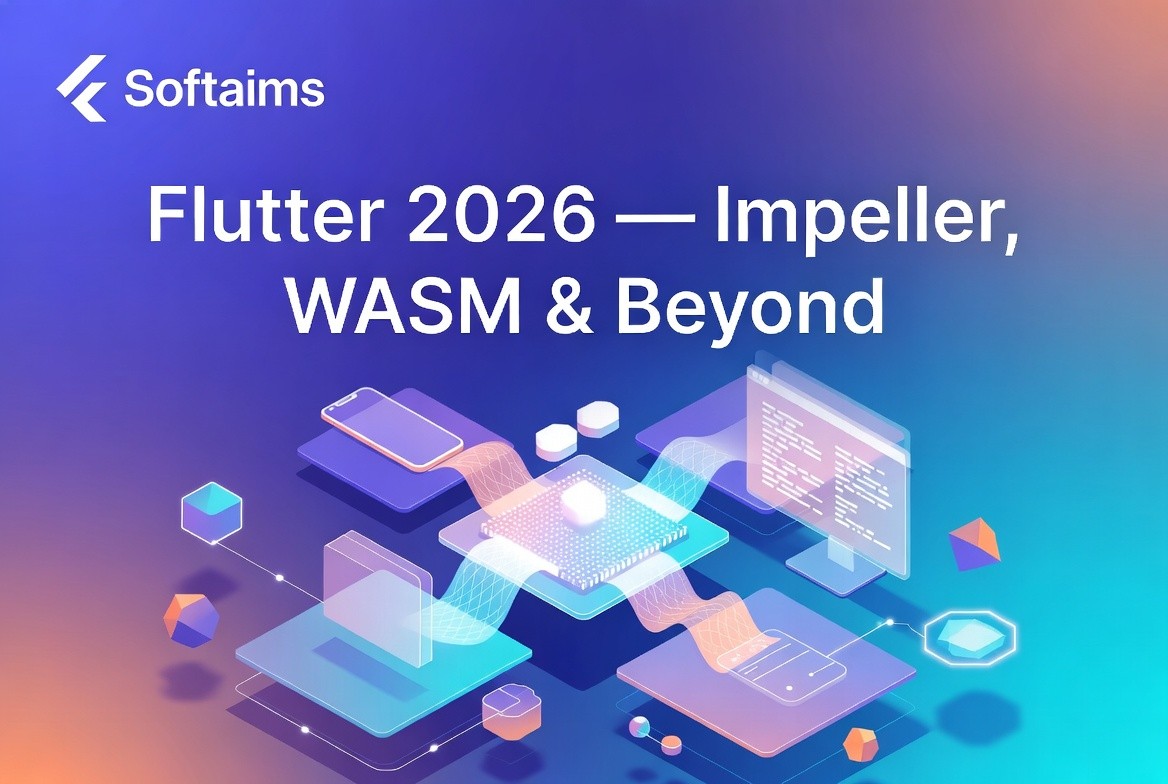
Table of contents
Key Takeaways
- Impeller is now the default renderer on iOS, Android, and macOS — it eliminates shader compilation jank by pre-compiling all shaders at build time, making first-run animation smoothness identical to subsequent runs.
- Flutter Web with WASM compilation (Dart compiled to WebAssembly) delivers 2-3x faster execution than the JavaScript target — production-viable for complex, interactive web apps in 2026.
- Dart 3's sealed classes and pattern matching are the biggest DX improvements in years — they enable exhaustive switch expressions that the compiler enforces, eliminating entire categories of state management bugs.
- Flutter's multi-view API for desktop lets a single Flutter app manage multiple windows independently — essential for productivity apps, dashboards, and desktop tools that need more than one window.
- The Flutter ecosystem maturity gap vs React Native has closed significantly in 2026 — pub.dev has production-quality packages for nearly every mobile use case, and go_router + Riverpod is a stable, well-documented stack.
Flutter skeptics in 2021 had legitimate concerns: jank on first run due to shader compilation, poor web performance, and a limited ecosystem. In 2026, each of those concerns has a specific, shipped answer. Impeller solved the jank. WASM solved web performance. Pub.dev has a mature ecosystem. The remaining question is not whether Flutter is production-ready — it is — but which platforms it's the best choice for.
This guide covers the features that define Flutter development in 2026: what they are, why they matter, and how to use them.
1. Impeller: How Flutter Eliminated Jank for Good
The most complained-about Flutter issue before Impeller was shader compilation jank — when a new animation played for the first time, Flutter's legacy Skia renderer compiled the GPU shader on the fly, causing a visible frame drop (20-100ms stutter). It was especially bad on iOS.
Impeller solves this by compiling all shaders at build time, not at runtime. The first time an animation plays, the shader is already compiled. There is no jank.
1. Impeller: How Flutter Eliminated Jank for Good — what the listing was illustrating. Instead of copying a long snippet, treat the next few paragraphs as the contract you should enforce in review: what must be true for this to be safe, observable, and maintainable in 2026-era production.
The original example spanned roughly 1 substantive lines. Walk it mentally as a sequence: initialization, the happy path, then the failure surfaces (validation errors, network faults, partial writes). Cross-check the official release notes for your exact framework minor version—defaults and deprecations move faster than blog posts.
Translate to your codebase. Rename types, align with your router or ORM version, and wire the same invariants—idempotency keys where retries exist, structured logs with correlation IDs, and metrics that prove the path is actually exercised.
Opening line pattern (for orientation only): # Impeller is the default in Flutter 3.10+ on iOS and Android # Verify it's enabled in your app: flutter run --enable-impeller # Force enable (default on stable…. Use your formatter, linter, and type checker to keep drift visible; do not rely on visually diffing pasted samples.
What Impeller also improves:
- Custom painters:
CustomPaintwidgets render significantly faster with the Metal (iOS) and Vulkan (Android) backends - Blur effects:
BackdropFilterwith blur is now GPU-accelerated rather than CPU-rendered - Gradient performance: complex gradients in animations no longer cause jank
Migration note: A small number of Skia rendering edge cases aren't yet supported in Impeller (certain gradient types, specific clip behaviors). If you encounter rendering differences after upgrading, check the Flutter issue tracker for known Impeller limitations.
2. Flutter Web with WASM: Production-Viable in 2026
Flutter Web previously compiled Dart to JavaScript. It worked, but JavaScript's single-threaded nature and the overhead of JS-interop made complex Flutter web apps noticeably slower than native mobile.
WASM (WebAssembly) compilation changes this. Dart compiles directly to WASM bytecode, bypassing JavaScript entirely. The result is 2-3x faster execution for compute-heavy operations and significantly better animation performance.
2. Flutter Web with WASM: Production-Viable in 2026 — what the listing was illustrating. Instead of copying a long snippet, treat the next few paragraphs as the contract you should enforce in review: what must be true for this to be safe, observable, and maintainable in 2026-era production.
Teams ship faster when they separate mechanics from policy. Mechanics are API names and boilerplate; policy is who may call what, what gets logged, and what guarantees callers get. Cross-check the official release notes for your exact framework minor version—defaults and deprecations move faster than blog posts.
Re-implement the policy in your repo with your conventions—environment-based config, feature flags for risky paths, and tests that lock the behavior you care about. The old snippet is a sketch of mechanics, not a universal patch.
First concrete line in the removed listing looked like: # Build for web with WASM (requires Flutter 3.22+) flutter build web --wasm # For development flutter run -d chrome --wasm. Verify that still matches your stack before you mirror the structure.
Requirements for WASM: The browser must support WasmGC (WebAssembly Garbage Collection). Chrome 119+, Firefox 120+, and Edge 119+ all support it. Safari support arrived in Safari 18 (iOS 18 / macOS Sequoia). As of 2026, over 90% of global browser usage supports WasmGC.
When to use WASM target: complex UI-heavy apps (data visualization, design tools, interactive dashboards). Simple content sites with Flutter Web may not see enough benefit to justify the larger binary size.
3. Dart 3: Sealed Classes and Pattern Matching
Dart 3 shipped sealed classes, records, and pattern matching — the most significant language additions since null safety. They transform how you model and handle state in Flutter apps.
Sealed classes: exhaustive type hierarchies
3. Dart 3: Sealed Classes and Pattern Matching — what the listing was illustrating. Instead of copying a long snippet, treat the next few paragraphs as the contract you should enforce in review: what must be true for this to be safe, observable, and maintainable in 2026-era production.
Read this as a checklist, not a transcript. For each external dependency in the old example, ask: timeouts? retries with jitter? circuit breaking? What is the worst partial failure, and how would an operator detect it within minutes? Cross-check the official release notes for your exact framework minor version—defaults and deprecations move faster than blog posts.
Add integration coverage that hits the real adapter—not only mocks—at least on a smoke schedule. Mocks hide version skew between your code and the service you call.
Structural anchor from the removed code (abbreviated): // Sealed class — compiler enforces that all subtypes are handled sealed class AuthState {} class AuthLoading extends AuthState {} class AuthAuthenticated exten….
Records: lightweight data classes
Same section, another listing: Use the same review checklist as above—policy, observability, failure handling, and version drift—this block only illustrated a different slice of the same workflow.
Production incidents rarely come from “unknown syntax”; they come from implicit assumptions baked into examples: small payloads, warm caches, single-region deployments, and friendly error payloads. Cross-check the official release notes for your exact framework minor version—defaults and deprecations move faster than blog posts.
Expand the narrative: document expected throughput, cardinality, and blast radius if this path misbehaves. Add dashboards that show error rate and latency percentiles, not just averages.
The listing began with: // Records — immutable, structurally typed, no boilerplate (String name, int age) getUser() => ('Alice', 30); final user = getUser(); print(user.$1); // 'Alice'…—use that as a mental bookmark while you re-create the flow with your modules and paths.
4. go_router: The Standard Flutter Navigation in 2026
go_router (now part of the Flutter organization) is the standard navigation solution for Flutter apps in 2026. It supports deep linking, URL-based navigation for web, and nested navigation — all things Navigator 1.0 handled poorly.
4. go_router: The Standard Flutter Navigation in 2026 — what the listing was illustrating. Instead of copying a long snippet, treat the next few paragraphs as the contract you should enforce in review: what must be true for this to be safe, observable, and maintainable in 2026-era production.
Security and ergonomics move together. If the sample touched credentials, cookies, headers, or user input, re-validate against your org’s baseline: secret scanning, SSRF rules, SSR-safe patterns, and least-privilege IAM. Cross-check the official release notes for your exact framework minor version—defaults and deprecations move faster than blog posts.
Where the example used shorthand (“fetch user”, “save model”), spell out authorization checks and audit events you actually need for compliance.
Code lead-in was: import 'package:go_router/go_router.dart'; final router = GoRouter( initialLocation: '/', debugLogDiagnostics: true, redirect: (context, state) { final isLogged….
5. Multi-View Desktop: Multiple Windows from One App
5. Multi-View Desktop: Multiple Windows from One App — what the listing was illustrating. Instead of copying a long snippet, treat the next few paragraphs as the contract you should enforce in review: what must be true for this to be safe, observable, and maintainable in 2026-era production.
Performance work belongs in context. Note allocation patterns, N+1 queries, and accidental serialization hot loops. Cross-check the official release notes for your exact framework minor version—defaults and deprecations move faster than blog posts.
Profile with production-like data volumes; optimize the top frame, then re-measure. Caching should have explicit TTLs and invalidation stories—otherwise you debug “stale data” tickets for quarters.
Snippet started with: // Flutter 3.13+ — create additional windows for desktop import 'package:flutter/material.dart'; import 'dart:ui' as ui; // In your Flutter app, use FlutterView….
6. Performance Profiling in 2026: DevTools and the Impeller Timeline
6. Performance Profiling in 2026: DevTools and the Impeller Timeline — what the listing was illustrating. Instead of copying a long snippet, treat the next few paragraphs as the contract you should enforce in review: what must be true for this to be safe, observable, and maintainable in 2026-era production.
Testing strategy: one happy path, one permission-denied path, one dependency-down path, and one “absurd input” path. Pay special attention to connection pool limits, statement timeouts, and what happens when the caller cancels mid-flight.
Property-based or fuzz tests help when parsers accept strings; snapshot tests help when output is structured HTML or JSON—use the right tool per boundary.
Removed listing began: # Launch DevTools flutter run --profile # Profile mode — close to release, DevTools enabled # Then in the terminal output, click the DevTools URL # Key metrics ….
Common Impeller performance tips:
- Use
RepaintBoundaryaround widgets that animate independently — it isolates them to their own layer and avoids repainting the whole tree - Avoid
Opacitywidget for animations — useAnimatedOpacityorFadeTransitionwhich use the compositing layer directly - Profile on a physical device in profile mode — the simulator/emulator does not reflect real GPU performance
7. Flutter's Platform Channel Modernization: FFI and Pigeon
7. Flutter's Platform Channel Modernization: FFI and Pigeon — what the listing was illustrating. Instead of copying a long snippet, treat the next few paragraphs as the contract you should enforce in review: what must be true for this to be safe, observable, and maintainable in 2026-era production.
Observability first. Before expanding features on this path, ensure you can answer: who called it, with what payload shape, and how long each hop took. Pay special attention to connection pool limits, statement timeouts, and what happens when the caller cancels mid-flight.
OpenTelemetry (or your vendor equivalent) should span process boundaries if the example crossed services. Keep PII out of spans unless policy allows redaction.
First line reference: # Pigeon — type-safe platform channel code generation # Define the API in Dart, generate native code automatically # In pigeons/messages.dart @ConfigurePigeon(P….
Pigeon generates fully type-safe Swift, Kotlin, and Dart code from a single API definition. No manual platform channel String-based method dispatch, no JSON encoding/decoding. This is the standard approach for native integration in production Flutter apps in 2026.
Frequently Asked Questions
Flutter vs React Native in 2026 — which should I choose?
Flutter if: you want pixel-perfect UI across all platforms including web and desktop, you're willing to write Dart, or you need consistent performance across Android and iOS. React Native if: your team is JavaScript-heavy, you need close native component integration (especially for complex platform-specific UI), or you're building a content app where native look-and-feel is important. Both are production-ready in 2026 — the choice is about team fit and UI requirements.
Is Flutter Web actually production-ready with WASM?
For rich, interactive apps (dashboards, tools, productivity apps): yes. For SEO-dependent content sites: not yet — Flutter Web doesn't render to semantic HTML, so crawlers see a canvas element. If SEO matters, use a traditional web framework. If you're building a web app (something users log into), Flutter Web + WASM is viable.
How is Flutter's ecosystem compared to native development?
For common needs (networking, local storage, auth, maps, payments, analytics, push notifications), pub.dev has mature packages. For edge cases and platform-specific features (ARKit, HealthKit, WearOS complications), you may need to write platform channels. The ecosystem gap with native has mostly closed for typical app categories.
What's the right state management solution in 2026?
Riverpod (riverpod.dev) is the most widely recommended for new projects — it's a compile-safe evolution of Provider with better testability and no BuildContext dependency. BLoC is still widely used in enterprise Flutter teams and has excellent tooling. For simple apps, Flutter's built-in setState + InheritedWidget is fine. The "right" answer depends on team familiarity and app complexity.
Does Flutter support hot reload in 2026?
Yes — hot reload (stateful, preserves state) and hot restart (full restart) are core Flutter features. They work on all platforms including Flutter Web. This is one of Flutter's biggest DX advantages over native development.
How do I handle platform-specific UI in Flutter?
Use Theme.of(context).platform or defaultTargetPlatform to conditionally render platform-specific components. The cupertino package provides iOS-style widgets. For truly native look-and-feel, flutter_platform_widgets abstracts Material/Cupertino automatically. Most production Flutter apps use Material Design consistently across platforms rather than adapting to each platform's native style.
Conclusion
Flutter's trajectory in 2026 is one of the clearest in the cross-platform space: the technical limitations that held it back are solved (Impeller, WASM), the language has matured dramatically (Dart 3), and the ecosystem is deep enough for production apps. The developers who bet on Flutter early are now reaping the dividend of a single codebase that genuinely runs everywhere at native performance.
The remaining questions are not technical — they're organizational. Does your team want to learn Dart? Do you need web SEO? Do you have existing native codebases to integrate? Answer those, and the Flutter decision becomes clear.
If you need Flutter engineers who know the 2026 stack — Impeller, go_router, Riverpod, Pigeon — Softaims pre-vetted Flutter developers are available for both short and long-term engagements.
Looking to build with this stack?
Hire Flutter Developers →

Nouffer M.

 Verified Expert in Engineering
My name is Nouffer M. and I have over 19 years of experience in the tech industry. I specialize in the following technologies: Angular, PostgreSQL, Java, Spring MVC, Python, etc.. I hold a degree in Diploma, Master of Science (M.S.). Some of the notable projects I’ve worked on include: Appexe. I am based in Colombo, Sri Lanka. I've successfully completed 1 projects while developing at Softaims.
I value a collaborative environment where shared knowledge leads to superior outcomes. I actively mentor junior team members, conduct thorough quality reviews, and champion engineering best practices across the team. I believe that the quality of the final product is a direct reflection of the team's cohesion and skill.
My experience at Softaims has refined my ability to effectively communicate complex technical concepts to non-technical stakeholders, ensuring project alignment from the outset. I am a strong believer in transparent processes and iterative delivery.
My main objective is to foster a culture of quality and accountability. I am motivated to contribute my expertise to projects that require not just technical skill, but also strong organizational and leadership abilities to succeed.

Leave a Comment
Need help building your team? Let's discuss your project requirements.
Get matched with top-tier developers within 24 hours and start your project with no pressure of long-term commitment.