Top 10 Generative AI Integration Services Development Companies in the USA (2026)
Explore the top generative AI integration services development companies in the USA for 2026. Compare providers helping businesses turn generative AI into useful products, features, and workflows.
Technically reviewed by:
Igor S.|Oleksandr K.
Table of contents
Key Takeaways
- Integration is the hard part. Connecting AI to CRMs, ERPs, and data is where value and risk live.
- It differs from model building. You are connecting and operating a model, not training one.
- Beware offshore firms in disguise. Many "US" lists feature teams headquartered abroad, so verify.
- Costs vary widely. A simple connector starts near $30,000, while enterprise rollouts top $200,000.
- Demand model-agnostic design. Orchestration layers let you switch models without a rebuild.
- 95% of AI pilots return nothing. MIT reviewed 300 deployments, and the causes repeat predictably.
Your AI model can be impressive and still be almost useless to the business. The real test starts when that model needs to work with your CRM, pull information from internal documents, update an ERP, or trigger an action in another system. That is where generative AI integration comes in.
And businesses are clearly moving in that direction. 79% of organizations reported regularly using generative AI in 2025, yet nearly two-thirds said they had not started scaling AI across the enterprise. That gap is exactly where integration becomes important. Getting a model to produce a good answer is one thing. Making it work reliably inside real business processes is another.
The infrastructure challenge is real, too. 77% of executives say they need to adopt generative AI quickly to stay competitive, but only 25% strongly agree their IT infrastructure can support AI at enterprise scale, according to IBM's 2026 research.
That means the best generative AI integration partner needs to understand more than LLMs. They need to handle APIs, RAG pipelines, databases, security, orchestration, monitoring, and the systems your business already depends on.
So, who can actually do that well?
We reviewed the leading generative AI integration services development companies in the USA to bring you the 10 worth considering in 2026. If you already have an AI project in mind, you can also hire vetted AI developers to build and integrate it around your business needs.
The US Generative AI Integration Market in 2026
The GenAI integration market has grown up fast. Enterprises spent $37 billion on generative AI in 2025, per Menlo Ventures. That is more than triple the year before.
Adoption is now mainstream. McKinsey found that 78% of organizations use AI in at least one function, up from 55% two years earlier. In addition, a majority now run AI agents in production. So the question has shifted from whether to adopt to how to integrate.
Yet the hard part is delivery. Because most pilots never reach real workflows, value capture lags badly. MIT found that 95% of enterprise AI deployments produced no measurable return. Therefore, a partner that can integrate AI into daily operations matters more than one that can only demo it.
How We Ranked These Generative AI Integration Companies
We judged these firms on enterprise delivery, not marketing claims. We also excluded firms that only keep a US address while delivering entirely offshore. Each criterion below reflects what real integration work demands.
A genuine US base. Many "US" integration lists are padded with offshore firms. So we confirmed real US headquarters, and flagged nearshore delivery.
Enterprise-system experience. Real value lives inside CRMs, ERPs, and data warehouses. Therefore, we favored firms that connect AI to existing platforms.
Modern integration patterns. RAG, vector databases, copilots, and agents are now table stakes. As a result, we valued proven use of each.
Security and governance. Integration exposes sensitive data. Consequently, we weighted encryption, access control, and private deployment.
Full path to production. Real projects need monitoring and support, not a hand-off. Moreover, we favored firms that operate systems long term.
Best Generative AI Integration Companies in the USA: Comparison Table
Here’s a quick comparison of the top generative AI integration companies in the USA, covering their location, core focus, and best fit. Use it to narrow down your options, then explore the full profiles below.
Company | Location | Integration focus | Best for |
| Softaims | US and global | Hiring vetted AI integration developers | Owned, scalable integrations |
| Devaims | US and global | GenAI integration plus product build | AI embedded in a finished product |
| NineTwoThree | Boston, MA | LLM integration, pilots to production | Turning pilots into scalable systems |
| HatchWorks AI | Atlanta, GA | GenAI in the SDLC, ERP and CRM | Operationalizing GenAI at scale |
| 10Pearls | Washington, D.C. | Custom LLM, RAG, agentic systems | Enterprise digital transformation |
| RTS Labs | Richmond, VA | Secure enterprise AI integration | Long-term, operated AI systems |
| ThirdEye Data | Dallas, TX | Agentic AI, RAG, MLOps | Data-rich enterprise integration |
| Azumo | San Francisco, CA | GenAI, NLP, integration | Scale-ups wanting nearshore delivery |
| BlueLabel | New York, NY | AI-forward products and integration | Product-led AI integration |
| Dogtown Media | Los Angeles, CA | GenAI for health, finance, IoT | Regulated, data-heavy integration |
Details reflect public profiles and case studies as of 2026 and can change, so verify each firm before you commit.
The Top 10 Generative AI Integration Companies in the USA
We’ve narrowed down 10 generative AI integration companies in the USA that stand out for their expertise, real-world projects, and range of services. Each profile covers what the company does best, who it suits, and what to consider before hiring.
1. Softaims
Best for: Hiring vetted generative AI developers directly while keeping full ownership of the project.
Generative AI integration takes more than someone who knows how to build with an LLM. You need engineers who can connect AI models to your existing systems, data, and workflows using RAG, APIs, vector databases, and orchestration tools.
Softaims takes a direct hiring approach. Instead of working through a traditional agency model, you can choose developers based on their skills, experience, location, and budget. Its network includes developers experienced in generative AI, AI agent development, and AI chatbot development.
The biggest advantage is flexibility. You hire the talent you need, build with your own team, and retain ownership of the resulting code and integration. You can also scale your development team as the project grows or winds down.
For companies that want more control than a traditional agency provides, Softaims is a practical option. You can browse AI developers, check pricing, explore OpenAI integration developers, or contact the team.
2. Devaims
Best for: Building the product, app, or workflow around an integrated AI solution.
AI integration only creates value when people can actually use it. That means connecting the model to a well-designed product, reliable backend, clean data, and workflows that fit the way the business operates. Devaims focuses on building that complete layer around the AI.
Instead of treating integration as a separate technical task, Devaims brings the AI, backend, and product development together under one team. Its work spans custom software development and mobile app development, making it a fit for companies building AI-powered web and mobile products.
This approach can also simplify the development process. You are not coordinating separate teams for the AI integration, application, and backend. One team can take the project from the initial idea through development, launch, and ongoing improvements.
Devaims is a strong option for businesses that want to build a complete AI-powered product rather than integrate a model into an existing system alone. Explore the full range of services at Devaims.
3. NineTwoThree AI Studio
Headquarters: Boston, Massachusetts.
NineTwoThree specializes in agentic AI and LLM integration, with a knack for turning pilots into scalable systems. It has delivered over 150 projects for clients like FanDuel and Consumer Reports. Notably, its product thinking helps AI ship as a usable product, not a lab result. So it suits teams that want integration to reach real users.
Key services: LLM integration, agentic AI, and product engineering.
Industries: finance, media, and consumer.
Why choose them: senior talent and a product-first mindset. It excels at moving pilots into production.
4. HatchWorks AI
Headquarters: Atlanta, Georgia.
HatchWorks AI integrates GenAI across the software lifecycle using its Generative-Driven Development method. It builds copilots and assistants that connect into ERPs and CRMs to automate workflows. Furthermore, it offers RAG architecture and embedded engineering pods. So it suits enterprises operationalizing GenAI at scale.
Key services: RAG systems, ERP and CRM integration, and MLOps.
Industries: enterprise, retail, and finance.
Why choose them: strong production and integration discipline. However, delivery runs nearshore across the Americas, so confirm the setup.
5. 10Pearls
Headquarters: Washington, D.C.
10Pearls builds custom LLM solutions and agentic systems for the enterprise. Its work includes RAG to ground models in proprietary data and fine-tuning for specific industries. In addition, it pairs AI with broader digital transformation. So it suits organizations wanting an end-to-end partner.
Key services: custom LLM, RAG, and AI product engineering.
Industries: healthcare, retail, and fintech.
Why choose them: end-to-end capability and strong sector experience. However, it delivers globally, so confirm where your team sits.
6. RTS Labs
Headquarters: Richmond, Virginia.
RTS Labs focuses on integrating AI securely and operating it long term. It suits enterprises that believe in AI but need a partner to scale and run it reliably. Notably, its pricing is engagement-based and aligned to scope and complexity. So it suits teams that want AI operated, not just built.
Key services: enterprise AI integration, data engineering, and support. Industries: logistics, finance, and healthcare.
Why choose them: a focus on secure, operated, long-term systems. Its model fits enterprises past the pilot stage.
7. ThirdEye Data
Headquarters: Dallas, Texas.
ThirdEye Data grew from data engineering into generative and agentic AI. Its work centers on LLM-powered agents, RAG, and MLOps-driven deployment. Notably, its Optira platform productizes document processing. So it suits enterprises with real data infrastructure.
Key services: agentic AI, RAG systems, and MLOps.
Industries: enterprise, finance, and manufacturing.
Why choose them: genuine production agents and data-engineering roots. Its background reduces integration risk.
8. Azumo
Headquarters: San Francisco, California.
Azumo is an AI and software firm with a strong focus on GenAI and NLP integration. It delivers scalable solutions through flexible, nearshore engagement models. In addition, it suits scale-ups that value time-zone overlap. So it fits teams that want steady capacity.
Key services: GenAI integration, NLP, and semantic search.
Industries: technology, media, and finance.
Why choose them: a solid track record and flexible delivery. However, engineering is delivered nearshore, so confirm the model.
9. BlueLabel
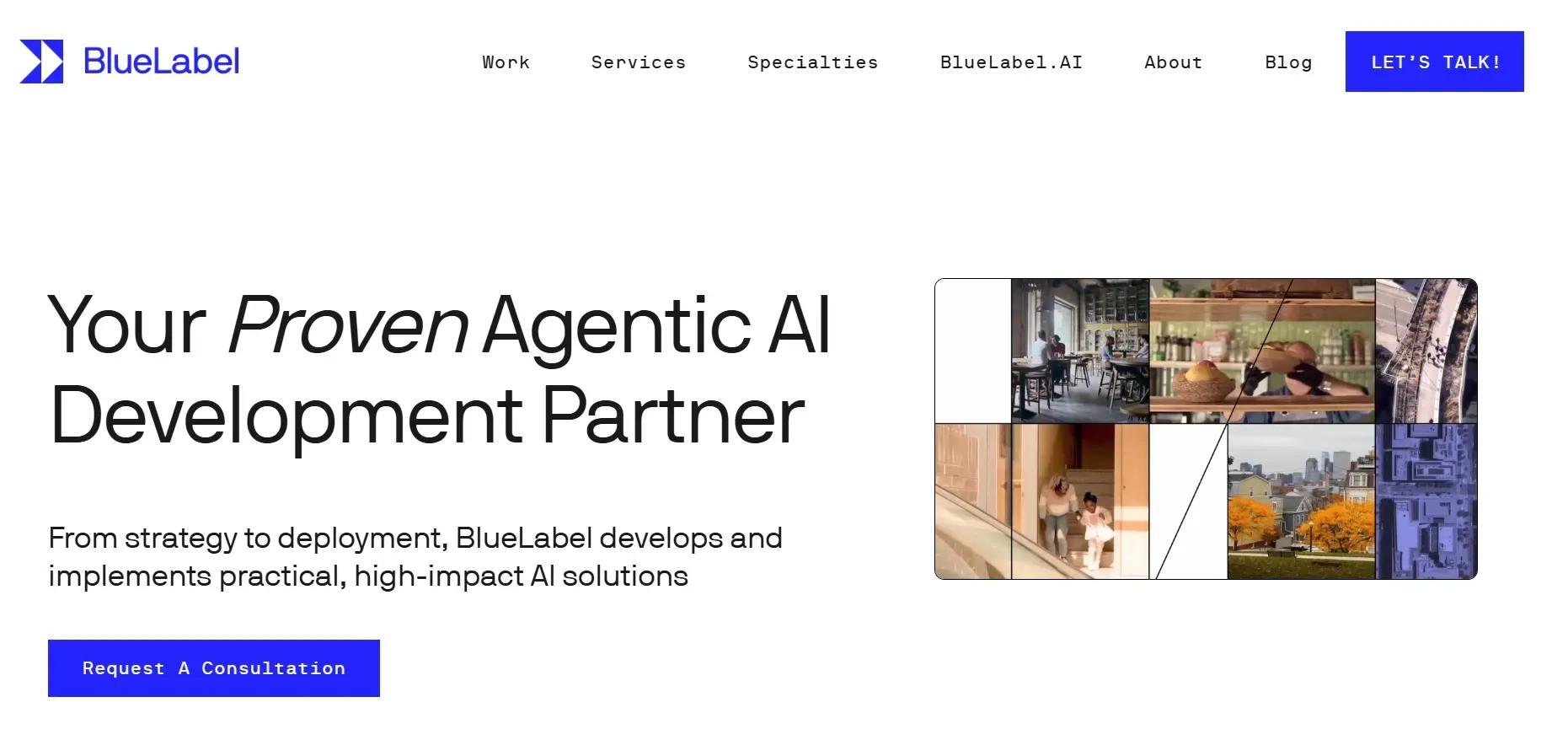
Headquarters: New York, New York.
BlueLabel pairs product design with AI-driven development and integration. It turns ideas into production-ready GenAI mobile and web apps. In addition, it emphasizes validation and phased roadmaps. So it suits product-led AI integration.
Key services: GenAI integration, product design, and app development. Industries: consumer, enterprise, and startups.
Why choose them: strong validation and design-led execution. It holds a solid Clutch reputation across many reviews.
10. Dogtown Media

Headquarters: Los Angeles, California.
Dogtown Media builds data-driven GenAI integrations for regulated sectors. In particular, it focuses on healthcare, finance, and IoT. It understands the full stack, from data pipelines to compliance. So it suits integrations that handle sensitive data.
Key services: GenAI integration, machine learning, and mobile.
Industries: mHealth, fintech, and IoT.
Why choose them: genuine regulated-sector depth and strong analytics. Its clients include Google and major institutions.
What Is a Generative AI Integration Company
A GenAI integration company connects foundation models to your existing systems and workflows. It does not train a model from scratch. Instead, it embeds AI into the tools your teams already use, from CRMs to data warehouses.
The best integrations augment what people already do. Often, that means adding an AI copilot inside a familiar tool, rather than forcing new habits. So adoption climbs, because the AI meets users where they work.
This is a different job from hiring an AI builder. You are asking a partner to connect, secure, and operate a model, not to invent one. Therefore, the skills that matter most are data engineering, security, and production reliability.
Generative AI Integration Services
No two integration projects are identical. Depending on your goal, you may need any of the services below. Each one solves a different problem.
RAG pipelines. Retrieval grounds a model in your own data. Consequently, answers stay accurate and current, and hallucination drops.
AI copilots. Generative AI copilots live inside familiar tools to assist daily work. So teams get help without switching apps.
AI agents. AI agents reason, use tools, and complete multi-step tasks. As a result, they automate whole workflows, not single replies.
API and system connectors. API integration links models to your CRM, ERP, and internal tools. Therefore, the AI works inside your real systems.
Model-agnostic orchestration. An orchestration layer routes each task to the best model. Meanwhile, it lets you switch providers without rebuilding.
Monitoring and MLOps. Observability keeps an integration accurate and safe over time. So drift gets caught before users notice.
Integration Approaches: API Connectors, RAG, and Middleware
There is no single right way to approach generative AI integration. The best approach depends on your data, your systems, and your risk. The table below compares three common patterns.
Approach | What it does | Best for |
| API connectors | Link a model to a single tool or app | Simple, contained use cases |
| RAG pipelines | Ground a model in your own data | Accurate answers from internal content |
| Middleware and orchestration | Route across models and systems | Complex, multi-system deployments |
Most enterprises end up combining these. So a copilot might use an API connector for one tool and a RAG pipeline for another. Therefore, a good partner picks the pattern that fits each use case, rather than forcing one everywhere.
Which Enterprise Systems Get Integrated
GenAI integration delivers the most value inside systems people already use. In practice, that means a handful of platforms recur across projects. Each connection unlocks a different workflow.
CRM systems. AI drafts follow-ups, summarizes accounts, and surfaces next steps. As a result, sales and service teams move faster.
ERP platforms. AI answers operational questions and automates routine tasks. Meanwhile, it reduces manual data entry.
Data warehouses. RAG grounds answers in your analytics and reporting data. So insights become conversational.
Document repositories. AI retrieves and summarizes across contracts, policies, and knowledge bases. Therefore, staff stop hunting for files.
Legacy systems. Middleware connects modern AI to older platforms. Consequently, you modernize without a full rebuild.
Common Generative AI Integration Use Cases
Beyond the technical patterns, it helps to see where generative AI integration pays off. A few use cases recur across US enterprises. Each ties AI to a real business outcome.
Customer support copilots. AI drafts replies and surfaces answers from your help content. As a result, response times fall and quality holds steady.
Sales enablement. AI summarizes accounts, drafts outreach, and flags next steps inside the CRM. So reps spend more time selling.
Document intelligence. AI reads and summarizes contracts, policies, and reports at scale. Meanwhile, staff stop combing through files by hand.
Internal knowledge search. RAG lets employees ask questions and get grounded answers from company data. Therefore, tribal knowledge becomes searchable.
Developer copilots. AI assists engineers inside their tools, from code to documentation. Consequently, delivery speeds up without new habits.
Finance and operations automation. AI handles routine reconciliation, reporting, and data entry. So teams focus on judgment, not busywork.
Across all of these, the pattern is the same. The AI meets people inside the tools they already use. That is why well-designed generative AI integration lifts adoption, not just capability.
How to Choose the Right Generative AI Integration Partner
Choosing among GenAI integration companies differs from hiring an AI builder. You are judging integration depth, security, and operations, not model training. So work through these checks before you sign.
Confirm production integrations. Ask for live systems inside real enterprise tools. Because most pilots never ship, insist on deployed proof.
Check security and deployment. Ask about private, on-prem, or VPC options and data residency. In addition, confirm encryption and access control.
Demand model-agnostic design. A good partner builds orchestration so you can switch models. So you avoid lock-in to one provider.
Verify the US base. Check where your engineers actually sit, not just the address. Therefore, confirm delivery, not marketing.
Clarify ownership and support. You should own the integration and the data. Moreover, confirm monitoring, retraining, and long-term support.
Security and Governance in AI Integration
Generative AI integration exposes your most sensitive data to a model, so security cannot be an afterthought. A strong partner treats encryption, access control, and data protection as defaults. In addition, it confirms exactly where your data is processed and who can access it.
Deployment choice matters too. Regulated engagements often need private, on-prem, or VPC deployment, not a public endpoint. So confirm that the partner can meet HIPAA, SOC 2, or GDPR requirements where they apply. Meanwhile, retrieval grounding reduces hallucination, which matters when answers drive real decisions.
Finally, insist on measurement. A serious partner measures answer faithfulness before release, not after a complaint. Therefore, evaluation and governance should be built into the process from day one.
Generative AI Integration Cost in the USA (2026)
Cost is where most guides on GenAI integration go quiet, so here is the detail. Pricing depends on the number of systems, the data work, and the security bar. A simple connector costs far less than an enterprise-wide rollout. So it helps to see the ranges before you brief a firm.
Engagement | Typical scope | Estimated cost |
| Simple API connection | One tool, one model | From $30,000 |
| Multi-system with RAG | Several systems, retrieval | $60,000 – $150,000 |
| Enterprise-wide deployment | Many systems, governance | $200,000+ |
The biggest cost variable is data. If your data needs collecting, cleaning, and structuring for RAG, expect real time and budget. In addition, security controls, private deployment, and integration resilience all add cost. There are recurring costs too, since model usage, vector databases, and monitoring recur monthly. So plan for a total cost of ownership, not just the build.
For a wider view of vendors and patterns, Softaims also maintains a guide to generative AI integration companies. It covers approaches, security, and how to compare providers.
How Much Does It Cost to Hire AI Integration Engineers
Knowing what integration engineers cost is central to any GenAI integration budget. Salaries swing widely with location, experience, and project complexity. So companies need a clear view of the going rates.
In 2026, those rates still track demand for skilled people. The table below shows average salaries by country, a useful benchmark for planning.
Country | Average Salary (USD) |
| United States | $130,000 - $180,000 |
| United Kingdom | $100,000 - $140,000 |
| Canada | $90,000 - $130,000 |
| Germany | $95,000 - $135,000 |
| Switzerland | $120,000 - $160,000 |
| India | $30,000 - $50,000 |
| Singapore | $85,000 - $125,000 |
| Israel | $115,000 - $155,000 |
Source: Levels.fyi and Salary.com (2024). Figures are indicative and shift with demand.
A full in-house team is therefore costly to build and retain. That is why many teams hire a partner or a vetted marketplace instead. Softaims offers vetted integration engineers, dedicated or freelance, matched within 48 hours. As a result, you skip the long search and the US salary premium.
Why Generative AI Integrations Fail (and How to Avoid It)
Most GenAI projects deliver nothing measurable. MIT found that 95% of enterprise AI deployments produced no measurable return. The causes repeat, which means each one is avoidable.
Nobody owns the metric. If no one can name the metric, the project has no owner. So define one business metric before anything starts.
The data was never ready. Demos run on clean data, while production holds messy data. Therefore, treat data preparation as a real phase with its own budget.
It sat outside the workflow. A tool in a separate tab gets ignored. Systems that succeed live inside the apps people already use.
Nobody planned for drift. AI systems drift without attention. Meanwhile, integrations need monitoring, retraining, and prompt tuning to stay accurate.
Generative AI Integration Trends for 2026
The GenAI integration companies in the USA set trends the market follows. A few clear shifts stand out this year.
Agents are going mainstream. Integrations now complete multi-step tasks, not just answer questions. As a result, they deliver far more value.
Model-agnostic orchestration is standard. Firms build routing layers so you can switch models freely. So you avoid lock-in to one provider.
Copilots meet users in familiar tools. The best integrations add AI inside existing apps. Therefore, adoption climbs without retraining staff.
Governance is central. Buyers expect security, data residency, and faithfulness checks. Consequently, responsible integration is now a baseline requirement.
What a Typical Integration Project Looks Like
Most successful generative AI integration projects follow a clear arc, from a scoped pilot to a running system. The stages below hold across industries. Knowing the shape helps you plan budget and timelines. Each stage should end in a decision or a deliverable.
Discovery and use-case selection. The team picks one high-value workflow and names its success metric. So the project starts with a clear owner and goal.
Data and architecture. Engineers prepare the data and design the retrieval and connection layer. Therefore, the model has clean foundations to work from.
Build and evaluate. The team wires the model into the target system and measures answer quality. Meanwhile, guardrails and access controls go in early.
Deploy and monitor. The integration ships behind monitoring, with rollback and support in place. As a result, issues surface before users feel them.
Operate and improve. After launch, the team retrains, tunes prompts, and tracks drift. Consequently, the system keeps performing over time.
A focused first project usually runs a few weeks to a few months. So you prove value on one workflow before expanding to the next. This staged approach keeps risk low and makes the budget far easier to defend internally.
Frequently Asked Questions
Which are the best generative AI integration companies in the USA?
NineTwoThree, HatchWorks AI, 10Pearls, and RTS Labs lead among genuine US firms. ThirdEye Data, Azumo, BlueLabel, and Dogtown Media round out strong options. Softaims and Devaims suit teams that want to build fast and own the result.
How much does generative AI integration cost?
A simple API connection starts around $30,000, and a multi-system RAG build runs $60,000 to $150,000. Enterprise-wide deployments exceed $200,000. Data readiness drives most of the variation.
What is RAG, and why does it matter for integration?
RAG, or Retrieval-Augmented Generation, grounds a model in your own data. As a result, answers stay accurate and current, and hallucination drops. It is the core pattern for grounding AI in enterprise content.
What systems can generative AI integrate with?
Common targets include CRMs, ERPs, data warehouses, and document repositories. Middleware also connects AI to legacy platforms. A good partner maps these before building.
Can I switch AI models later?
Yes, if the partner builds a model-agnostic orchestration layer. So you can route each task to the best model. That design also lets you switch providers without a rebuild.
Who owns the integration and the data?
You should own all of it. Confirm ownership of the code, the integration layer, and the data in the contract. This avoids vendor lock-in later.
Conclusion
Generative AI integration is now core business infrastructure, not a side experiment. However, the winners are the firms that connect AI to real systems, with security and monitoring built in. So the right partner turns strategy into production integrations that keep earning their keep.
Before you commit, weigh production evidence, security, and where the team actually sits. A verified, honest shortlist protects your budget, your data, and your timeline. Would you rather skip the search entirely? Then Softaims matches you with vetted AI developers within 48 hours, in the USA or anywhere.


 GitHub
Andrew V.

 Verified Expert in Engineering
My name is Andrew V. and I have over 9 years of experience in the tech industry. I specialize in the following technologies: JavaScript, Node.js, Blockchain, Java, Python, etc.. I hold a degree in Bachelor of Engineering (BEng). Some of the notable projects I've worked on include: Scraiber, Speakture, Sheep Farm Agro Project, Medical AI-powered Image Analysis Platform for Improved Diagnosis, Store Discount Card Application, etc.. I am based in Warsaw, Poland. I've successfully completed 6 projects while developing at Softaims.
I am a dedicated innovator who constantly explores and integrates emerging technologies to give projects a competitive edge. I possess a forward-thinking mindset, always evaluating new tools and methodologies to optimize development workflows and enhance application capabilities. Staying ahead of the curve is my default setting.
At Softaims, I apply this innovative spirit to solve legacy system challenges and build greenfield solutions that define new industry standards. My commitment is to deliver cutting-edge solutions that are both reliable and groundbreaking.
My professional drive is fueled by a desire to automate, optimize, and create highly efficient processes. I thrive in dynamic environments where my ability to quickly master and deploy new skills directly impacts project delivery and client satisfaction.

Leave a Comment
Need help building your team? Let's discuss your project requirements.
Get matched with top-tier developers within 24 hours and start your project with no pressure of long-term commitment.