Top 11 Generative AI Integration Services Development Companies in the World (2026 Guide)
Find the best generative AI integration companies helping businesses connect AI models with existing systems, automate workflows, and build reliable AI-powered solutions in 2026.
Technically reviewed by:
Dustin G.|Alexander A.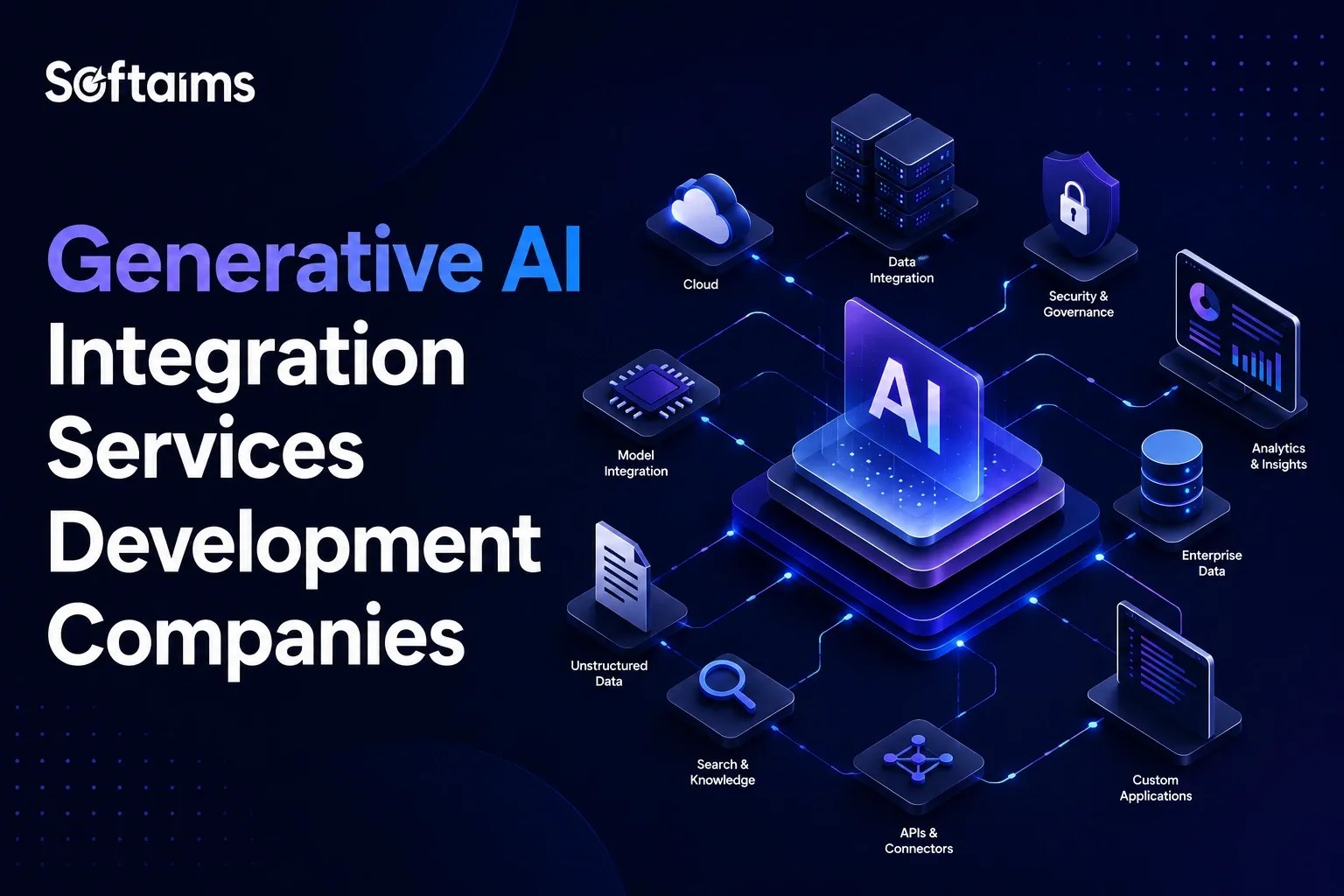
Table of contents
Key Takeaways
- AI integration is the real challenge: Connecting generative AI with existing systems is harder than building the AI model itself.
- Choose the right integration approach: API connectors, RAG pipelines, and middleware each solve different business needs.
- Production reliability matters: Strong AI integration partners focus on monitoring, security, and long-term performance.
- Softaims leads custom AI integration: Softaims helps businesses build owned, scalable generative AI integrations.
- Security cannot be ignored: Encryption, access control, and data protection are essential for enterprise AI adoption.
- Costs depend on complexity: Generative AI integration projects can range from $30,000 to $250,000+ based on requirements.
- The right partner goes beyond development: Successful integrations require support, maintenance, and continuous optimization.
Choosing between generative AI integration companies is different from hiring an AI builder. You are not asking someone to train a model. You are asking them to weave AI into systems that already run your business without breaking any of them.
That is where most projects come unstuck. MIT's NANDA initiative reviewed 300 deployments and found 95% of enterprise generative AI pilots produced no measurable return. The model was rarely at fault. The AI simply never reached the workflows where people actually work.
Demand keeps climbing anyway. Grand View Research expects the generative AI market to reach $109.37 billion by 2030, growing at 37.6% annually.
In this guide, you will learn the top generative AI integration companies in 2026 and cover connectors, middleware, security models, real costs, and questions that quickly expose a weak vendor.
What is generative AI integration
Generative AI integration companies embed generative models into your existing software, data, and workflows. It happens through APIs, custom connectors, middleware, and orchestration layers, rather than by replacing what you already run.
The distinction matters. Building an AI model is a data science problem. Integrating one is a systems problem. It means connecting a model to your CRM, your ERP, your document stores, and your support desk, then keeping that connection secure, fast, and affordable once real traffic hits it.
The five ways generative AI gets integrated
Generative AI integration companies usually combine two or three of these. Knowing the difference helps you scope the work properly.
Method | What it does | Best for |
| API integration | Calls a model directly from your app | Simple, contained features |
| Middleware and connectors | Bridges AI to CRM, ERP, and legacy systems | Enterprise stacks you cannot replace |
| RAG pipelines | Feeds your private data to the model | Grounded answers from company knowledge |
| Workflow automation | Adds AI steps to tools like Power Automate | Approvals, triage, document handling |
| Orchestration layers | Coordinates several models and agents | Multi-step tasks, model-agnostic setups |
How we ranked the top generative AI integration companies
We judged these generative AI integration companies on what determines whether an integration survives production.
- Integration depth. They connect to real enterprise systems, not just a sandbox.
- Data readiness. They can clean and structure the data that feeds the model.
- Security posture. They handle encryption, tokenization, access control, and on-prem or VPC deployment.
- Adoption focus. They embed AI where people already work, instead of adding another tab nobody opens.
- Ongoing support. They monitor uptime, latency, and quality after launch, and they retrain when needed.
Comparison of the top 12 generative AI integration companies
# | Company | Best for | Focus | Rating |
| 1 | Softaims | Custom integration you own | APIs, RAG, prompt engineering | ★ Top pick |
| 2 | Devaims | AI inside a working product | Backend, web, and mobile delivery | ★ Top pick |
| 3 | Boomi | API-first enterprise connectors | iPaaS, Salesforce, SAP, NetSuite | 4.5★ |
| 4 | ELEKS | Legacy modernization | Mainframe to modern AI stacks | 4.9★ |
| 5 | Master of Code | Omnichannel AI experiences | Chat, voice, CRM, brand voice | 4.9★ |
| 6 | Workato | Low-code AI integrations | Visual workflow building | 4.7★ |
| 7 | LeewayHertz | Data to model integration | RAG, retrieval accuracy, agents | 4.8★ |
| 8 | ScienceSoft | On-prem and regulated setups | Data residency, compliance | 4.8★ |
| 9 | Simform | Workflow automation | AI in business process tools | 4.8★ |
| 10 | N-iX | Multi-agent integration | Agent orchestration, MLOps | 4.9★ |
| 11 | Persistent Systems | Global rollouts at scale | Enterprise delivery, governance | 4.7★ |
Ratings reflect public review profiles as of early 2026 and can change, so verify before publishing. Softaims and Devaims are our two top picks for 2026.
The 11 best generative AI integration companies
1. Softaims
Best for: Companies that want generative AI wired into their existing systems, built by vetted engineers, and fully owned by them.
Integration projects rarely fail on the model. They fail on the plumbing: brittle connectors, messy source data, no guardrails, and an AI feature that sits outside the tools people actually use. Softaims handles that plumbing properly, with one team covering the data, connectors, model layer, and the interface your users use.
What you get: The same team covers generative AI end to end, from generative AI software through to prompt engineering that makes outputs consistent rather than unpredictable. That includes RAG pipelines grounded in your documents, secure connections into your CRM and ERP, and evaluation so you can prove the system works before it reaches customers. You can hire vetted AI developers for the exact skill you need, and check rates by skill and seniority before committing.
Why teams pick them:
- One team for the data, the connectors, the model, and the app around it.
- Straight advice on approach, so you do not overbuild what a simple API call solves.
- You own the code, the prompts, the pipelines, and the data, with no lock-in.
- Built to land inside real workflows, not to sit in a separate tab.
2. Devaims
Best for: Companies that want the AI integration and the product it lives inside built by one team.
An integration is only useful once someone uses it. That means a real interface, clean data flowing in both directions, and a system that remains reliable under actual load. Devaims builds the software around the intelligence, so the AI ships as a working product rather than a connector nobody touches.
What you get: Alongside the AI work, Devaims handles software development and mobile app development, so the people wiring up the AI are the same people building the interface and the reporting around it. Because one team owns both sides, changes after launch do not turn into a negotiation between vendors. Their full range is at Devaims.
Why teams pick them:
- The AI integration and the product around it come from one team.
- Full delivery across backend, web, and mobile.
- Faster iteration after launch, since nothing crosses a vendor line.
- Interfaces designed for the people who use them every day.
3. Boomi
Best for: Plug-and-play AI connectors into Salesforce, SAP, NetSuite, and other enterprise platforms.
Boomi is one of the established integration platforms, and it has moved firmly into AI connectivity. Its strength is the connector library, which spares you from writing bespoke integrations for every system you run. Pre-built security and governance modules cut deployment time considerably, which is why enterprise IT teams reach for it.
Downside: You are adopting a platform, with its licensing and its constraints. For a highly bespoke integration, custom middleware gives you more control.
4. ELEKS
Best for: Bridging mainframes and legacy cores to modern generative AI.
ELEKS has been building software since 1991 and brings deep modernization and data engineering experience. That matters here because connecting an LLM to a banking core, an insurance claims platform, or a hospital records system is mostly an archaeology problem. They focus on non-disruptive migration, which keeps the old system running while the AI layer goes on top.
Downside: Built for complexity and scale, so a small integration will feel over-engineered.
5. Master of Code Global
Best for: Consistent AI experiences across chat, voice, email, and CRM.
Master of Code Global has built conversational systems for major brands for years, which gives it a rare asset: real knowledge of how people talk to software. In integration terms, that shows up as orchestration across channels, so a customer gets the same answer in a chatbot, an IVR, and an email thread, while brand voice and compliance stay intact.
Downside: Their center of gravity is conversational AI. For document processing or back-office automation, a different specialist fits better.
6. Workato
Best for: Letting business teams build AI integrations without waiting on engineering.
Workato is a leading low-code automation platform, and its AI capabilities let marketing and operations teams assemble generative workflows visually. That reduces the queue in front of your engineering team and gets simple use cases live quickly, which is often where the fastest return sits.
Downside: Low-code has a ceiling. Complex, high-volume, or deeply custom integrations still need real engineering.
7. LeewayHertz
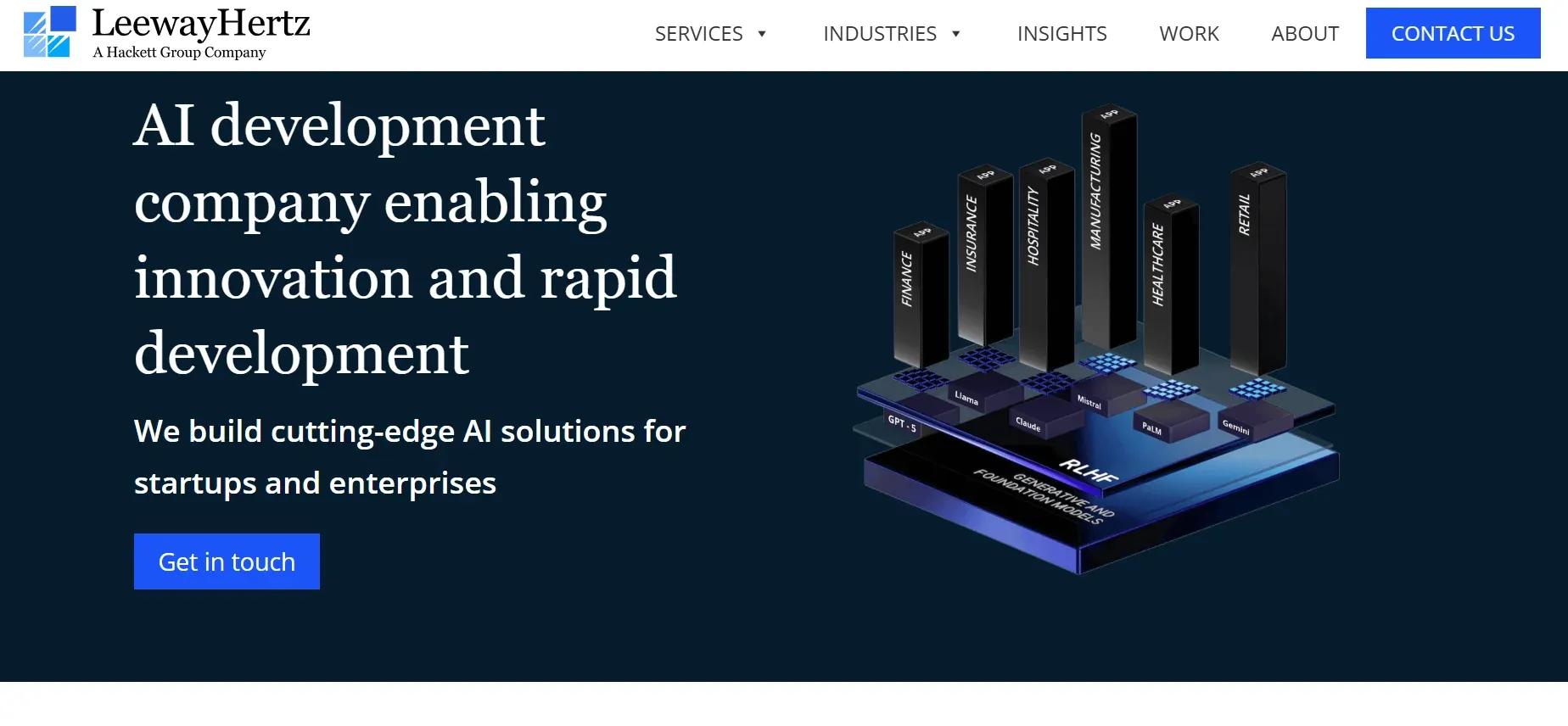
Best for: Connecting proprietary company data to foundation models through RAG.
LeewayHertz works extensively with GPT, Llama, and similar models, and its ZBrain platform is built specifically to ground LLMs in enterprise data. They put real emphasis on retrieval accuracy and feedback loops, which is precisely what separates a RAG system that answers well from one that confidently misleads people.
Downside: Broad across AI, so confirm the seniority of the team assigned to your project.
8. ScienceSoft
Best for: On-premise, hybrid, and air-gapped environments where data cannot leave.
Operating since 1989, ScienceSoft builds with compliance baked in, covering HIPAA, PCI DSS, and GDPR, backed by ISO certifications. For defense, legal, government, and healthcare work, the constraint is usually data residency rather than model quality. They are comfortable delivering inside those limits without gutting performance.
Downside: The firm is broad, so make sure you get the integration and compliance specialists rather than a general pod.
9. Simform
Best for: Embedding generative AI into business process and automation tools.
Simform runs embedded co-engineering pods and has strong Azure and data engineering credentials. Its work fits naturally alongside automation platforms, adding AI steps to approvals, triage, and document handling. The emphasis is on augmenting human decisions rather than removing the human entirely, which is usually the right design.
Downside: The embedded model works best when you have your own engineering leadership in place.
10. N-iX
Best for: Multi-agent systems where several AI agents must coordinate.
N-iX brings over twenty years of engineering and a large AI and data practice, with real depth in agent and multi-agent orchestration, RAG pipelines, and MLOps. Multi-agent work is genuinely hard, since agents need to pass context, avoid loops, and fail safely. Their engineering weight suits supply chain coordination and research synthesis, where several systems must cooperate.
Downside: Built for enterprise scale, so a small pilot may get faster attention elsewhere.
11. Persistent Systems
Best for: Large, multi-region rollouts with governance built in.
Persistent Systems is a large firm with deep platform engineering credentials and strong experience in regulated industries. For retail chains, telcos, and logistics firms rolling AI out across many sites and time zones, the hard part is consistency and support rather than the model itself. They are built for exactly that.
Downside: Governance-first delivery moves at a measured pace. If speed matters most, a smaller firm will move faster.
Why most AI integrations fail
The MIT finding is worth sitting with. Even good generative AI integration companies see the same reasons repeat, and almost all enterprise pilots deliver nothing measurable.
The AI never touches a real workflow. A tool in a separate tab gets abandoned. Systems that succeed appear inside the CRM, the inbox, or the ticket queue people already live in.
The data is not ready. Generative AI grounded in scattered, stale, or duplicated records will produce fluent nonsense. Data preparation is the project, not a warm-up act.
Nobody owns the outcome. Pilots launched by an innovation team with no business owner quietly die after the demo. Assign an owner and a metric before you start.
Costs escalate quietly. Every query consumes tokens, and retrieval adds more. Model this before launch, not after the first invoice.
Security in AI integration
Working with generative AI integration companies means moving your data somewhere, so the questions matter.
Ask where the data goes, whether the model provider trains on it, and whether you need a private deployment. Serious firms use encryption in transit and at rest, tokenization for sensitive fields, and strict role-based access. For regulated or classified work, expect VPC, on-premise, or fully air-gapped options, and make sure data residency requirements are met before a single connector is built.
How much does generative AI integration cost
Generative AI integration companies price work against the number of systems involved, the state of your data, and how much security the environment demands.
Project type | Typical cost | Timeline |
| Simple API connection | $30,000 to $60,000 | 4 to 6 weeks |
| Multi-system integration with RAG | $60,000 to $150,000 | 6 to 12 weeks |
| Enterprise-wide deployment | $150,000 to $200,000+ | 3 to 6 months |
Two costs catch people out. Data preparation usually eats a large share of the budget, because enterprise records are messier than anyone admits. Then there is the running cost, since tokens and retrieval calls accumulate with every user. A good partner models both before you commit.
How to choose a generative AI integration partner
When you compare generative AI integration companies, these questions expose a weak vendor fastest.
- Ask what they have integrated in production. Not demos. Live systems inside real enterprise stacks.
- Ask how they handle your legacy systems. A confident answer here separates integrators from app builders.
- Ask about data readiness. If they gloss over data cleaning, they have not done this before.
- Ask about deployment options. On-prem, VPC, and hybrid should be available if you need them.
- Ask who owns what. You should own the code, the connectors, the prompts, and the data.
Conclusion
There are more generative AI integration companies than ever, and nearly all of these generative AI integration companies can demo a connector. Far fewer can land AI inside the systems your business actually runs on, keep it secure, and make people use it.
If you want generative AI integrated into your stack and owned entirely by you, Softaims is the best place to start. Book a free consultation and get matched with vetted AI developers within 48 hours.
Frequently Asked Questions
What do generative AI integration companies do?
Generative AI integration companies handle the process of embedding generative models into your existing software, databases, and workflows using APIs, custom connectors, or orchestration layers, rather than replacing the systems you already run.
How long does integration typically take?
Usually four to twelve weeks, depending on system complexity, how ready your data is, and how much customization you need. Enterprise-wide rollouts take longer.
Can generative AI work with my legacy CRM?
Yes. Good integrators build middleware that bridges legacy systems to modern AI without ripping out your core infrastructure, so the old system keeps running while the AI layer sits on top.
What about data security during integration?
Reputable firms use encryption, tokenization, and strict access controls, and many offer on-premise or VPC deployment. For sensitive work, confirm data residency and whether the model provider trains on your data.
Do I need to change my existing workflows?
Not usually. The best integrations augment what people already do, often by adding an AI copilot inside familiar tools, rather than forcing everyone to learn new habits.
What does generative AI integration cost?
Simple API connections start around $30,000. Multi-system integrations with RAG land between $60,000 and $150,000. Enterprise-wide deployments run to $200,000 and beyond.
How do you measure whether an integration succeeded?
Track technical metrics like API uptime and latency, adoption metrics like weekly active users, and business metrics like reduced response time or higher conversion. If nobody can name the metric, the project has no owner.
Do integrators provide ongoing support?
Most do. Expect managed services, monitoring dashboards, and periodic retraining or prompt tuning as part of a long-term arrangement, since AI systems drift without attention.
Can I integrate more than one AI model?
Yes. Experienced firms build model-agnostic orchestration layers, so you can route each task to whichever model handles it best and switch providers without rebuilding everything.
Which industries need AI integration most?
Finance, healthcare, retail, manufacturing, and customer support give generative AI integration companies the most demand, because each runs on established systems where AI adds value only if it connects cleanly to what is already there.


 GitHub
Rich M.

 Verified Expert in Engineering
My name is Rich M. and I have over 15 years of experience in the tech industry. I specialize in the following technologies: Technical Writing, Project Management, Technical Documentation Management, Jira, Agile Project Management, etc.. I hold a degree in Bachelor of Science (BS), Master of Computer Science (MSCS). Some of the notable projects I’ve worked on include: My Services, Technical Writing Services, Product Management - SOPs, Strategic Documentation for Marketing, Software, and Product SOPs/PPPs, Requirements Analysis, etc.. I am based in Mandaue City, Philippines. I've successfully completed 14 projects while developing at Softaims.
I am a business-driven professional; my technical decisions are consistently guided by the principle of maximizing business value and achieving measurable ROI for the client. I view technical expertise as a tool for creating competitive advantages and solving commercial problems, not just as a technical exercise.
I actively participate in defining key performance indicators (KPIs) and ensuring that the features I build directly contribute to improving those metrics. My commitment to Softaims is to deliver solutions that are not only technically excellent but also strategically impactful.
I maintain a strong focus on the end-goal: delivering a product that solves a genuine market need. I am committed to a development cycle that is fast, focused, and aligned with the ultimate success of the client's business.

Leave a Comment
Need help building your team? Let's discuss your project requirements.
Get matched with top-tier developers within 24 hours and start your project with no pressure of long-term commitment.