How to Vet and Hire the Top 3% of Tech Talent in 2026 | Softaims
A bad hire costs 3 to 4x of their salary. This guide breaks down the exact software engineer vetting process used to find the top 3% of tech talent and why hiring pre-vetted dedicated tech teams beats DIY recruiting every time.
Technically reviewed by:
Vitalij S.|Lytle F.|Cody R.
Table of contents
Key Takeaways
How to Vet and Hire Top Tech Talent
- A bad tech hire costs at least 30% of first-year salary, and total damage can reach 3-4x the position's salary through productivity losses, code revisions, and project delays
- 56% of recruiters say finding qualified developers is their single biggest challenge in 2026
- Top 3% developers build scalable architecture, not just working code; they evaluate trade-offs before writing a single line
- The 3 non-negotiable traits to screen for are architectural thinking, proactive communication, and adaptability across tech stacks
- 66% of developers reject algorithm-heavy technical assessments; real-world coding challenges predict job success far better
- DIY hiring burns 40+ hours of senior engineering time per role, and the global IT skills shortage will cost $5.5 trillion by 2026
- Softaims filters thousands of applicants down to the top 3%, giving you a full, pre-vetted, dedicated development team
Every company wants to hire top 1% programmers. But most settle for average talent because their software engineer vetting process is broken.
And a bad tech hire doesn't just waste a salary. It causes technical debt, missed deadlines, and product failures. According to the U.S. Department of Labor, a bad hire costs at least 30% of the first-year salary. In fact, the total damage can reach three to four times the position's salary. Meanwhile, 56% of recruiters say finding qualified developers is their biggest challenge. On top of that, productivity losses from a bad hire add 150% in additional costs due to code revisions, manager oversight, and project delays.
In this article, you'll learn how to screen software developers, how to evaluate software developers properly, and how to skip the hassle entirely.
Why "Average" Developers End Up Costing You More
Most companies don't realize the difference between a coder and a true software engineer until it's too late. And by then, the damage is already done.
The Difference Between a Coder and a Software Engineer
A senior developer's resume lands on your desk. Their GitHub is packed with contributions. Their past projects read like a Silicon Valley highlight reel. On paper, they're exactly what you need.
Then you hire them, and they start building exactly what you asked for, no questions, no pushback. Soon, the cracks appear. Basic architectural decisions become roadblocks. "Extensive experience" turns out to be copy-paste familiarity. That's when you realize the difference.
A coder builds what you ask for. An elite remote developer questions whether you're even asking for the right thing. An average developer, for instance, chooses the framework or language they know and builds what you asked for in it. Top 3% developers will assess whether the framework (React, Vue, or a server-rendered one) is right for the project. They will assess the performance needs, SEO impact, and the team's skills before writing a single line of code.
Similarly, an average developer writes a database query that returns correct results. But when you hire top 1% programmers, they write one that still performs when the table grows from 10,000 rows to 10 million.
This is exactly why the best outsourcing custom software development platforms accept only 1-3% of applicants. If you want to know how to evaluate software developers, start by understanding this gap. You can browse top pre-vetted remote developers who've already cleared this bar.
How to Evaluate Software Developers: The 3 Core Traits of a Top 3% Developer
Most companies skip this part of the software engineer vetting process. If you want to learn how to screen software developers or how to evaluate software developers, know that it goes beyond résumés. We screened thousands of developers and studied how top platforms hire remote developers. Elite engineers possess three traits that set them apart.
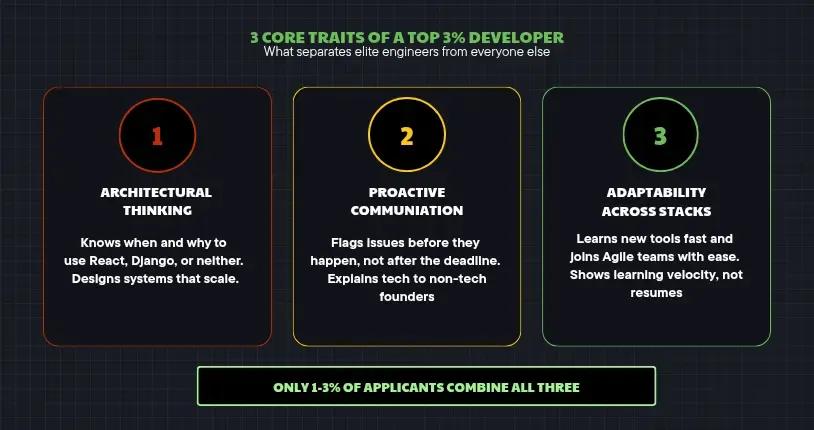
1. Architectural Thinking
They don't know a framework like React or Django; they know when and why to use them. For example, ask an average developer to build an API. They start coding. By contrast, ask a top 3% developer. They ask, "What's the expected request volume?" and "How will this change in 12 months?"
These engineers weigh deployment strategies, state management, and caching before they commit. Ultimately, they build systems that other people can read, extend, and maintain.
How to test for it: Give a system design problem with competing constraints, speed vs. cost, and performance vs. maintainability. Then, watch how they navigate trade-offs.
2. Proactive Communication
Top 3% developers don't wait for tasks. Instead, they flag issues before they happen. Specifically, they write pull requests that explain why, not just what. Also, they call out scope creep during sprint planning, not after the deadline.
This matters most for remote teams. For instance, a developer who goes silent for three days and then delivers the wrong thing costs more than one who asks five questions on day one.
Red flags: Can't explain decisions in plain language. Also gets defensive about past disagreements.
Green flags: Mentions documentation habits. Also, during tests, they ask questions and admit when they don't know the answer instead of lying.
3. Adaptability Across Tech Stacks
Elite developers learn new tech stacks fast and integrate into Agile teams with ease. Tech role skill requirements have shifted 25% since 2015. Also, that pace keeps getting faster because there is a new AI tool every day. Being able to learn quickly, use new tools under pressure, and work on all parts of the stack are all very important in this era.
How to test for it: Ask about a time they used unfamiliar tech on a tight deadline. Dig for specifics. This is how to evaluate software developers on real adaptability and hire dedicated development team.
The Ultimate 4-Step Software Engineer Vetting Process
The top platforms, which accept 1-3% of applicants, use multi-stage frameworks. Each step tests a different skill. As a result, roughly 90% of candidates wash out before writing a single line of code. This matters because 73% of technical hires underperform compared to their interview results. Below is how to screen software developers using the same process.
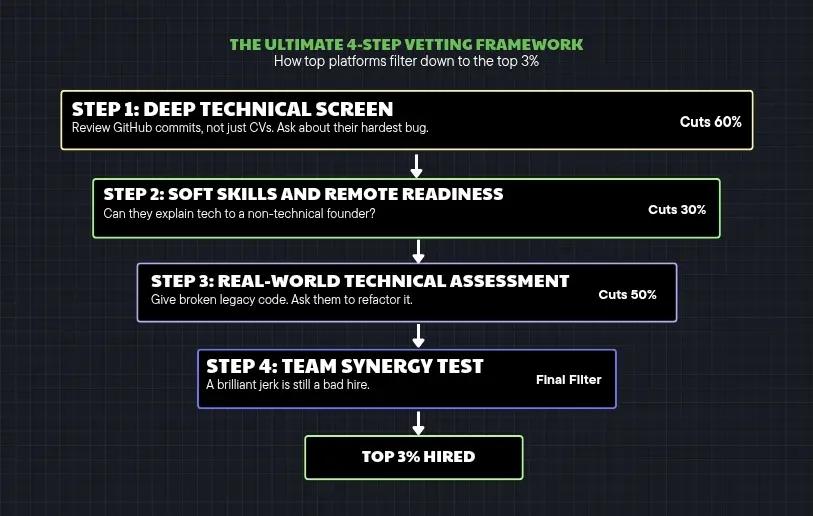
Step 1: The Deep Technical Screen (Cuts ~60%)
Don't just look at a CV. The first step in how to screen software developers is looking at their GitHub commits. Check if commit messages are descriptive or vague. Review whether PRs explain the why behind changes. Look for clean repos with READMEs, tests, and CI/CD badges.
However, many great engineers keep their best work in private repos. A quiet GitHub isn't a deal-breaker, but not getting any work done at all is.
On the first call, ask about the most complex bug they've ever fixed. This reveals whether they debug by system or by luck. Knowing how to evaluate software developers at this stage saves hours later. For role-specific screens, use job description templates to match criteria to real needs.
Step 2: Soft Skills and Remote Readiness (Cuts ~30% More)
Can they explain a complex technical concept to a non-technical founder? This is crucial when you hire remote developers or use IT staff augmentation services. Most companies skip the best way to hire remote developers. That’s why their developers ghost after two weeks.
Give a technical scenario and ask them to respond in writing. Then ask them to explain why a migration requires three sprints rather than one. This is how to screen software developers for remote readiness. Also, see if they've pushed back against a bad choice made by a manager. In particular, look for honesty and tact.
Step 3: Real-World Technical Assessment for Developers (Cuts ~50% More)
Stop asking abstract algorithm puzzle questions like inverting a binary tree. If you want to know how to screen software developers on real ability, give them broken legacy code and ask them to refactor it. Include missing error handling, N+1 queries, bad naming, and tight coupling. This one exercise tests debugging, architecture, and communication at once.
Cap it at 4 hours. Companies using skills-based assessments see 30% better hiring quality and 40% less turnover. Plus, try pair programming; sixty minutes of pairing reveals more than three solo interview rounds.
Step 4: The Team Synergy Test (Final Filter)
Will they work well with your QA, designers, and project managers? A brilliant jerk is still a bad hire. So, don't just run a culture screen as a footnote; make it its own stage.
Introduce them to coworkers from other departments. Then watch if they ask about the product, not just the code. Whether you hire a dedicated development team or use outsourcing custom software development, team fit matters.
The Hidden Cost of DIY Hiring: Why Your Software Engineer Vetting Process Needs Help
Do you have 40+ hours a month to screen software developers, conduct technical interviews, and test candidates? Learning how to evaluate software developers is one thing. Actually doing it at scale is another. Technical screening alone eats 10-20 hours of engineering time per hire. For most teams, the best way to hire remote developers is through IT staff augmentation services or a dedicated development team.
For startup founders and CTOs, time is money. Building this software engineer vetting process in-house is expensive and slow. As 87% of tech leaders struggle to find skilled workers, and 84% of companies report skills gaps. As a result, a slow funnel doesn't just waste time; it filters for developers nobody else wants. This is why many companies now turn to IT staff augmentation services, outsourcing custom software development, or hiring pre-vetted tech teams instead.
How Softaims Gives You the Top 3% (Without the Headache)
So how do you skip all this effort? Softaims has already built this exact rigorous software engineer vetting process. We know how to evaluate software developers at every level, and we filter through thousands so you don't have to. Our pipeline includes deep technical assessments for developers, soft-skill evaluations, real-world coding tests, and team fit analysis. As a result, only the top 3% of elite remote developers make it through.
Here's the big advantage. We don't just give you a pre-vetted top 3% freelancer. Instead, we provide IT staff augmentation services with a dedicated development team and a Project Manager who owns delivery. Zero ghosting. Zero hiring costs, 100% guaranteed delivery.
This is the best way to hire remote developers without the DIY headache. We already know how to screen software developers at scale. Whether you need outsourcing custom software development or want to hire remote developers through a managed team, Softaims handles it. Choose front-end, back-end, or full-stack engineers. Browse 25,000+ screened developers and hire dedicated development team.
Conclusion
In summary, hiring elite remote developers in 2026 takes more than job boards and gut feel. It requires a structured software engineer vetting process that tests architectural thinking, communication, problem-solving, and team fit.
You can spend months learning how to screen software developers and building an in-house vetting machine. Or, start building your product tomorrow. Softaims gives you a pre-vetted dedicated development team already screened to the top 3% standard.
Ready to stop gambling on talent? Book a free consultation with Softaims and hire your dedicated tech team today.
Frequently Asked Questions
How do you test software engineers before hiring?
Use a four-stage software engineer vetting process. First, review GitHub commits and portfolios. Second, run a soft-skill and remote-readiness check. Third, give a real-world technical assessment for developers using code refactoring and pair programming. Finally, test team fit. Drop the algorithm puzzles.
What is the cost of a bad tech hire?
At a minimum, 30% of first-year salary. For senior roles, the total reaches $240,000. Moreover, indirect costs, technical debt, team attrition, and stalled roadmaps often run even higher.
Freelance marketplace vs. dedicated tech team?
Freelancers suit short tasks. But, for ongoing product work, a dedicated development team beats them on quality, consistency, and ownership. Freelancers split focus across clients. In contrast, dedicated teams own outcomes and build shared context over time.
How do you interview a senior software engineer?
Skip textbook questions. Instead, present a system design problem with real trade-offs. Then, ask them to walk through a complex bug they fixed. Additionally, test whether they can explain technical decisions to non-technical stakeholders. A strong software engineer vetting process covers all of this at the senior level.
Where do you find pre-vetted remote developers?
Look for platforms with multi-stage vetting, as the best way to hire remote developers is through built-in screening. Softaims keeps 25,000+ screened developers across React, Node.js, Python, Django, cloud, and more. Each developer passed tests for skill, communication, and team readiness.
How do you assess developer soft skills?
Give a written scenario and ask them to respond in writing. Then, ask them to explain a technical choice to a non-technical person. Additionally, watch how they give and receive feedback during pair programming. Soft skills are a key part of how to evaluate software developers beyond code.


 GitHub
Vitalij S.

 Verified Expert in Engineering
My name is Vitalij S. and I have over 7 years of experience in the tech industry. I specialize in the following technologies: Email Copywriting, Campaign Copywriting, Sales Copywriting, Outreach Email Copywriting, Marketing, etc.. I hold a degree in Bachelor of Science (BS), Bachelor of Science (BS). Some of the notable projects I’ve worked on include: Restaurant & Bar App, Social Media App. I am based in Bucharest, Romania. I've successfully completed 2 projects while developing at Softaims.
I employ a methodical and structured approach to solution development, prioritizing deep domain understanding before execution. I excel at systems analysis, creating precise technical specifications, and ensuring that the final solution perfectly maps to the complex business logic it is meant to serve.
My tenure at Softaims has reinforced the importance of careful planning and risk mitigation. I am skilled at breaking down massive, ambiguous problems into manageable, iterative development tasks, ensuring consistent progress and predictable delivery schedules.
I strive for clarity and simplicity in both my technical outputs and my communication. I believe that the most powerful solutions are often the simplest ones, and I am committed to finding those elegant answers for our clients.

Leave a Comment
Need help building your team? Let's discuss your project requirements.
Get matched with top-tier developers within 24 hours and start your project with no pressure of long-term commitment.