Hire React Developers

Hire the Top 3%
of React Developers

Stop wasting weeks on interviews. We match you with elite React developers who have passed our rigorous 5-hour technical assessment.

No long-term contracts
2-week free trial
Replace anytime

500+

VETTED DEVELOPERS

48h

AVG. HIRE TIME

98%

TRIAL SUCCESS

Trusted by Leading Companies

TechCorpFinovaHealthOSCloudSyncRetailMaxDataFlow

Struggling to Find React Developers Who Actually Deliver?

  • Wasting weeks interviewing unqualified candidates
  • Know React syntax but can't architect scalable apps
  • Unreliable freelancers who ghost mid-project
  • Junior devs needing constant hand-holding
  • Developers who can't optimize for performance at scale
  • High turnover leaving your codebase in a mess
SolutionWe Solve This
  • 5+ years of production React experience
  • Passed our grueling 5-hour technical assessment
  • Built and scaled apps for 100K+ users
  • Proven track record of on-time delivery
  • Available in YOUR timezone for daily syncs
  • Expert in performance optimization & code architecture
  • Long-term commitment — not a one-project freelancer

Hire React Developers in 4 Simple Steps

01

Tell Us Your Needs

Share your project requirements, tech stack, and ideal candidate profile.

Day 1

02

Meet Pre-Vetted Developers

We handpick 2-3 elite React developers perfectly matched to your needs.

Within 48 hours

03

Interview Your Top Choices

Meet the candidates, assess their fit, and make your selection with confidence.

Day 3-5
04

Start Building (Risk-Free)

Developer starts working. If you're not happy in 2 weeks, we replace them for free.

Week 1

Meet Our Top React Developers

A small selection of our vetted talent pool. All developers have passed our rigorous 5-hour technical assessment.

Resources & Tools

Everything you need to hire and manage React developers

Podcasts

Conversations with senior engineers and hiring leads on vetting talent, team design, and shipping reliably—grounded in how strong React teams are actually built and run.

Expert-led

Guides & Articles

Long-form guides written by practitioners who ship production systems—architecture, performance, security, and what hiring managers should look for in senior React engineers.

Editorial depth

Tools

A curated directory of tools our technical leads use in reviews and delivery—not a generic list, but utilities we trust for real client work and code quality.

Curated stack

Job Board

Open roles we keep aligned with realistic seniority, compensation bands, and skill expectations—so you see what serious React hiring looks like, not noise.

Actively maintained

Career Roadmap

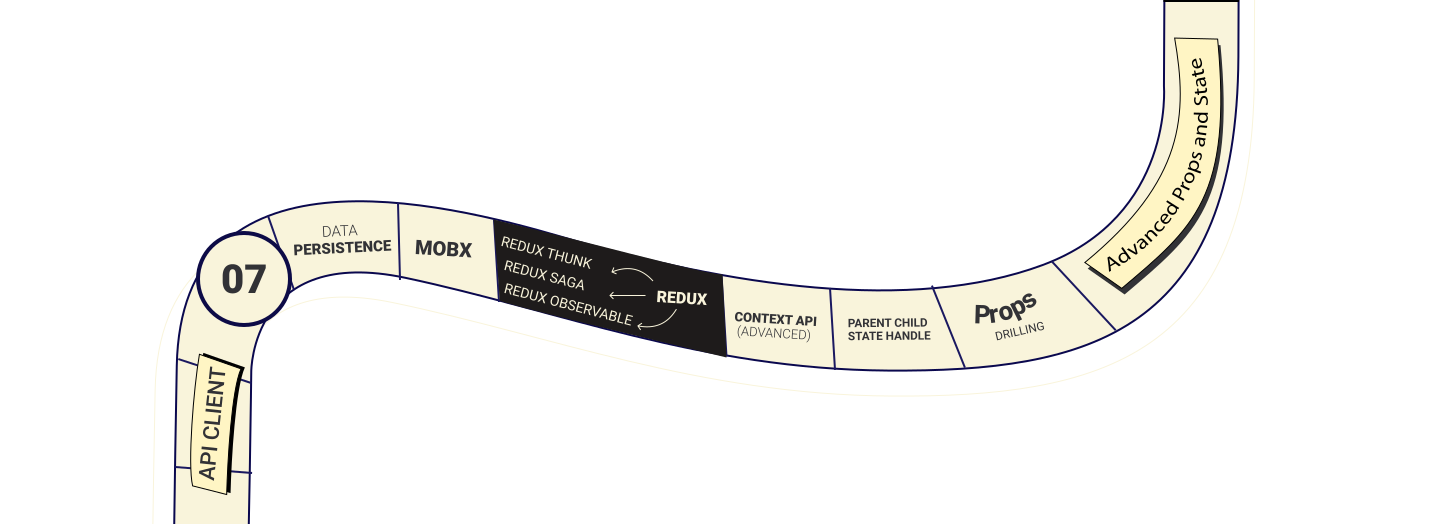
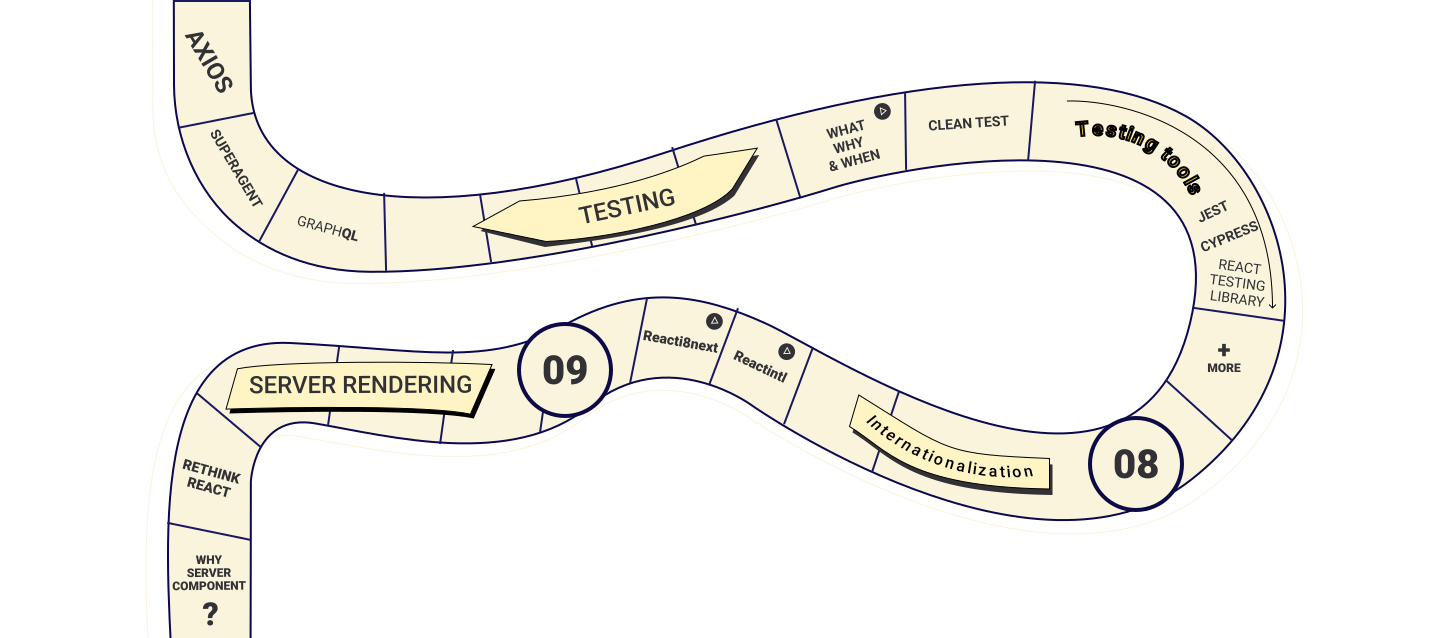
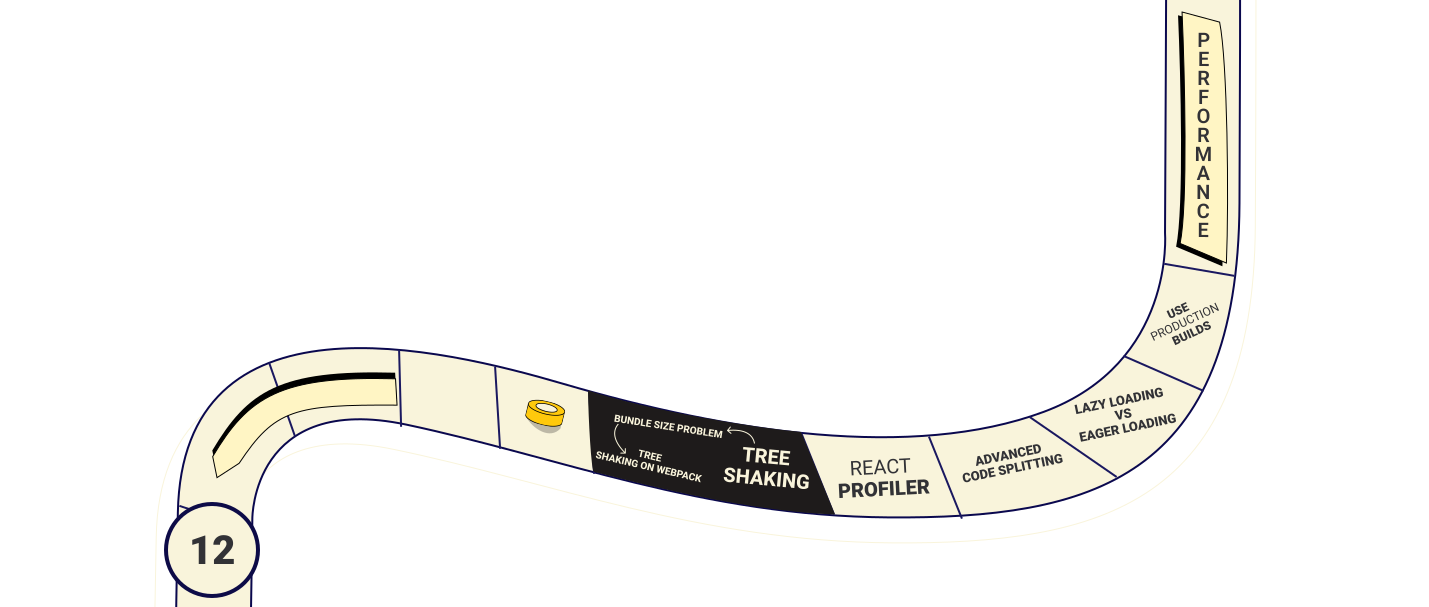
A structured progression from core skills to staff-level ownership—milestones, system design expectations, and what interviewers test at each stage for React specialists.

Interactive

Interview Questions

Technical and behavioral prompts modeled on real screening loops—designed to reveal depth, trade-off thinking, and ownership rather than memorized trivia.

Hiring-grade

Job Description Template

A clear job description framework you can adapt quickly—scoped for outcomes, seniority, and collaboration so recruiters and engineering leads stay aligned on React roles.

HR & eng aligned

Projects

Open-source and in-depth project spotlights we use to assess craft—architecture choices, trade-offs, and maintainability signals that separate strong React contributors from the rest.

Engineering signal

Our React Developers Master These Technologies

Next.jsReact QueryAxiosLodashD3.jsThree.jsFramer MotionReact Hook FormReact DnDReact VirtualImmerdate-fnsZodReact TableReact SpringReact PDFReact FlowReact Map GLReact DropzoneReact Markdown

Transparent Pricing - No Hidden Fees

Hire pre-vetted React developers with predictable pricing.

Junior Developer

2-4 years experience

$25 - $35

per hour

  • Proficient in core React & Hooks
  • Component development
  • Basic state management
  • Bug fixing & maintenance
  • Daily standups
  • Unit & integration testing
  • Git version control
  • Responsive UI implementation
Hire Junior Developer
MOST POPULAR

Mid-Level Developer

4-7 years experience

$35 - $40

per hour

  • Advanced React architecture
  • Complex state (Redux/Zustand)
  • Performance optimization
  • API integration
  • Code reviews
  • Custom hooks development
  • CI/CD pipeline participation
  • Mentoring junior developers
Hire Mid-Level Developer

Senior Developer

7+ years experience

$40 - $60

per hour

  • System architecture & design
  • Tech stack selection
  • Team leadership & mentoring
  • Scaling to 1M+ users
  • Security & CI/CD
  • Cross-functional collaboration
  • Technical roadmap planning
  • Hiring & onboarding support
Hire Senior Developer

Save 15-25% with quarterly or annual contracts. Contact us for enterprise pricing.

Why Hire React Developers from SoftAims?

🎯

Rigorous 5-Hour Vetting

Only the top 3% of applicants pass our technical and behavioral assessments.

48-Hour Matching

Skip the weeks of sourcing. Get matched with ready-to-work talent in 2 days.

🛡️

2-Week Risk-Free Trial

Test the waters. If they aren't the perfect fit, you pay nothing and we replace them.

🌍

Global Talent / Your Timezone

Hire globally, but work locally with at least 4 hours of daily timezone overlap.

📊

Transparent Project Tracking

Complete visibility into hours, commits, and progress through our portal.

💰

Save 58% vs Traditional Hiring

No recruitment fees, benefits, or office costs. Pay only for the work done.

🔄

Flexible Scaling

Scale your team up or down with 2 weeks' notice as your project needs change.

📚

Continuous Learning

Our devs receive ongoing training to stay ahead of the React ecosystem.

React Development Across Industries

Our developers have domain-specific experience in highly regulated and complex industries.

From Our Resources

Popular FAQs

What services does Softaims offer for React development?

Softaims delivers full-lifecycle React engineering for teams that need production-grade frontends, not just UI prototypes. Our React developers design and implement component libraries and design-system-aligned interfaces, build fast single-page applications (SPAs) and multi-route apps with modern data-fetching patterns, and ship progressive web apps (PWAs) where offline support and installability matter. We integrate REST, GraphQL, and real-time APIs; implement authentication flows and role-aware UIs; and tune Core Web Vitals through code splitting, memoization, lazy loading, and careful dependency choices. For organizations standardizing on React 18+ and the broader ecosystem, we work with Next.js, Vite, React Router, state tools such as Redux Toolkit, Zustand, or TanStack Query, and testing stacks like Jest, Vitest, and React Testing Library. Beyond build work, we provide staff augmentation: senior and mid-level React engineers who join your standups, follow your Git and CI/CD conventions, document decisions, and hand off maintainable code with clear ownership. Whether you are launching a new product, modernizing a legacy UI, or hardening an existing app for scale, we align engineering scope to measurable outcomes—performance budgets, accessibility baselines, and release reliability.

Is React a programming language?

No. React is a declarative UI library for building interactive interfaces; it is written in JavaScript (most commonly) or TypeScript and runs in the browser or in JavaScript runtimes used for server rendering. Meta (formerly Facebook) maintains React as open source, and the wider community contributes patterns, meta-frameworks, and tooling. In practice, professional React development pairs the library with a real programming language and platform knowledge: ES modules, async programming, DOM semantics, accessibility, HTTP, bundlers, and often a framework such as Next.js or Remix for routing, data loading, and deployment integration. Saying “we use React” therefore describes the UI layer; the engineering discipline still spans language fundamentals, architecture, testing, and operations—areas our vetted React developers are evaluated on before they join client teams.

How can I hire a remote React developer from Softaims?

Start by sharing a concise brief: product context, tech stack, team structure, timezone overlap needs, and the problems you need solved in the next 30–90 days. We match you with candidates who have already passed our technical screen, then you interview for culture fit and domain familiarity—your standards stay in control of the final hire. Once selected, the developer onboards to your tools (Slack, Jira, Linear, GitHub, GitLab, etc.), adopts your branching and review rules, and works within your sprint rhythm. Remote collaboration succeeds on clarity: we emphasize written updates, demo-ready increments, and proactive risk flagging so stakeholders are never guessing about progress. If priorities shift, we help adjust scope or rotate expertise so delivery stays aligned with business goals. The outcome is a remote engineer who behaves like an embedded teammate, not an opaque outsource ticket queue.

How much does it cost to hire a React developer?

React developer rates reflect experience depth, ownership level, and the technical surface area of your product—not a single flat number. A engineer shipping complex client state, performance-sensitive dashboards, or large-scale design systems typically requires different pricing than someone extending a well-documented codebase. At Softaims, we price engagements after a structured scoping conversation: stack (React, TypeScript, Next.js, state layer), expected autonomy, overlap with design and backend teams, compliance or security constraints, and timeline risk. We support hourly, part-time, full-time, and fixed-scope project models so you can match cost to runway and roadmap. Transparent proposals summarize assumed responsibilities, communication cadence, and how we measure success (for example, sprint throughput, defect rates, or Lighthouse and bundle-size targets). That way you are not buying a generic “developer seat”—you are aligning spend with the seniority and outcomes your roadmap actually needs.

What does a React developer do on a daily basis?

Day to day, a strong React developer translates product and design intent into reliable, testable UI code. That usually means breaking screens into composable components with explicit props and state boundaries, choosing appropriate state management (local state, context, or global stores) so data flow stays predictable, and wiring asynchronous data with loading, empty, and error UX. They review pull requests, keep bundle size and re-render behavior in check, and debug issues using browser devtools, React DevTools, and logging. Collaboration is constant: clarifying API contracts with backend engineers, aligning spacing and interaction details with designers, and participating in agile ceremonies. Quality work also includes writing or extending automated tests, documenting non-obvious behavior, and following accessibility guidelines so keyboard and screen-reader users are first-class. At Softaims, we look for developers who treat these habits as default—not optional polish—because that is what keeps React codebases maintainable after the first release.

How does Softaims ensure the quality of its React developers?

Quality is enforced before placement and reinforced during delivery. Our vetting combines timed coding exercises, structured technical interviews on React fundamentals (hooks lifecycle, concurrency concepts where relevant, performance pitfalls), and discussion of past systems—how candidates debugged production issues, improved test coverage, or refactored tangled UI code. We assess familiarity with TypeScript where clients require it, and with testing and CI expectations that mirror modern SaaS teams. After a developer starts with you, performance is observable through code review hygiene, delivery cadence, and communication—not vague promises. We also invest in continuous learning so engineers stay current with stable React releases, ecosystem shifts, and security-conscious frontend practices. That multi-layer approach is how we reduce hiring risk: you get people who have already demonstrated they can ship and explain their tradeoffs under scrutiny.
React icon

How to Hire React Developers: The Complete 2026 Guide

  • Author icon

    By Mykyta H.

  • Verified BadgeVerified Expert in Engineering
  • Experience icon

    11 years of experience

My name is Mykyta H. and I have over 11 years of experience in the tech industry. I specialize in the following technologies: Python, TypeScript, React, MySQL, WordPress, etc.. I hold a degree in . Some of the notable projects I’ve worked on include: Rapid4 - A dashboard and a web app for radio streaming services, Fanmio - streaming platform & video chat with celebrities, DTS. I am based in Katy, United States. I've successfully completed 3 projects while developing at Softaims.

Information integrity and application security are my highest priorities in development. I implement robust validation, encryption, and authorization mechanisms to protect sensitive data and ensure compliance. I am experienced in identifying and mitigating common security vulnerabilities in both new and existing applications.

My work methodology involves rigorous testing—at the unit, integration, and security levels—to guarantee the stability and trustworthiness of the solutions I build. At Softaims, this dedication to security forms the basis for client trust and platform reliability.

I consistently monitor and improve system performance, utilizing metrics to drive optimization efforts. I’m motivated by the challenge of creating ultra-reliable systems that safeguard client assets and user data.

Introduction to Hiring React Developers

React has become the dominant choice for building modern web interfaces, and the demand for skilled React developers continues to grow in 2026. Whether you need to hire React developers for a fast-moving startup, scale an enterprise product, or bring a specific feature to life, finding the right talent requires more than posting a job description and waiting. This guide covers everything needed to hire React JS developers confidently, from identifying the right skills and engagement model to evaluating candidates, understanding costs, and onboarding talent that delivers from day one.

Softaims connects companies with pre-vetted React developers who have passed a rigorous 5-hour technical assessment. Only the top 3% of applicants make it through. The result is a talent pool where every developer has already proven their ability to build, scale, and maintain production-grade React applications before they ever join your team.

Illustration representing hiring React developersReact technology icon

Why Companies Hire React Developers in 2026

React remains the most widely used JavaScript UI library in production environments. Its component-based architecture enables teams to build reusable, maintainable interfaces that scale cleanly as products grow. Companies hire React JS developers because React solves a real problem: building complex, dynamic interfaces that perform well under real user load without becoming impossible to maintain over time.

Facebook, Netflix, Airbnb, and Shopify all use React at the core of their frontend architecture. The reason is consistent: React's virtual DOM optimizes rendering, its unidirectional data flow keeps state predictable, and its ecosystem of libraries covers nearly every frontend requirement a product team could face. For companies building anything from SaaS dashboards to e-commerce storefronts to real-time data applications, React JS developers for hire bring proven patterns and a rich toolchain to the table.

The React ecosystem in 2026 has also matured significantly. Next.js has become the standard framework for production React applications, React Server Components have redefined how data fetching works at the component level, and TypeScript has become the default for any serious React codebase. Companies that hire React developers today are investing in a technology with deep community support, active maintenance by Meta, and a clear long-term roadmap.

Key Skills to Look for When You Hire React Developers

When you hire React JS developers, technical skill screening should go well beyond checking whether a candidate has worked with React before. The gap between a developer who knows React syntax and one who can architect a scalable, performant React application is significant. The following skills separate developers who can maintain existing code from those who can build systems that scale.

  • Deep proficiency in JavaScript and TypeScript, including async patterns, closures, and type system design
  • Mastery of React Hooks, including useState, useEffect, useCallback, useMemo, useRef, and custom hook patterns
  • Understanding of React's reconciliation algorithm and how to prevent unnecessary re-renders
  • Experience with state management using Redux Toolkit, Zustand, Jotai, or TanStack Query depending on application requirements
  • Proficiency with Next.js including App Router, Server Components, streaming, and deployment on edge infrastructure
  • Experience with testing using Jest, React Testing Library, Vitest, and end-to-end tools like Playwright or Cypress
  • Understanding of Core Web Vitals and how to optimize LCP, CLS, and INP in React applications
  • Familiarity with accessibility standards and how to build WCAG-compliant React interfaces
  • Experience with design systems and component libraries such as Radix UI, shadcn/ui, or custom in-house systems
  • Proficiency in Git, pull request workflows, and CI/CD pipeline participation
  • Ability to write clean, documented, and maintainable code that other developers can build on

Companies hiring React Hooks developers specifically should also look for deep familiarity with concurrent features introduced in React 18, including useTransition, useDeferredValue, and Suspense boundaries for streaming UI patterns.

6 Engagement Models When You Hire React Developers

One of the most important decisions when you hire React developers is choosing the right engagement model. The model affects cost, flexibility, communication cadence, and how deeply a developer integrates with your existing team. Softaims supports six engagement models so companies can match the way they hire to the actual needs of their product and timeline.

1. Remote React Developers

Hire React developers who work fully remotely and integrate directly into your team as if they were in-house. Remote developers from Softaims work within your tools, follow your sprint rhythm, participate in standups, and communicate through your existing channels. Every Softaims developer is matched with at least 4 hours of daily timezone overlap, so collaboration never depends on async-only communication. This model works particularly well for product teams that already operate remotely and want to scale without adding office overhead.

2. Offshore React Developers

Offshore hiring gives companies access to world-class React JS developers at significantly lower rates than local US or UK markets, without compromising on technical quality. Softaims sources and vets offshore React developers from Eastern Europe, South Asia, and Latin America, regions with strong engineering talent pools and competitive rates. Offshore developers hired through Softaims are pre-vetted, English-proficient, and experienced working with international product teams. This model delivers the highest cost efficiency for companies with flexible timezone requirements.

3. Dedicated React Developers

Hire dedicated React developers who work exclusively on your product, full-time, for as long as you need them. Dedicated developers become genuine extensions of your team, building deep familiarity with your codebase, architecture decisions, and product direction over time. This model is the strongest fit for companies with ongoing development needs, long product roadmaps, or complex React codebases that require consistent ownership. When you hire dedicated React JS developers through Softaims, you get the commitment of a full-time hire without the overhead of traditional employment.

4. Project-Based React Developers

For companies with a clearly scoped piece of work, such as a new feature build, a performance audit, a React migration, or a design system implementation, the project-based model provides skilled React developers for a defined scope and timeline. Developers are matched to your requirements, onboarded quickly, and focused entirely on delivering the defined outcome. This model is cost-effective for companies that do not need ongoing React capacity after the project concludes.

5. Dedicated React Team

When a single developer is not enough, Softaims can assemble a complete React development team around your product requirements. A dedicated team typically includes senior React developers, a tech lead, and supporting engineers with complementary skills such as Node.js backend development, UI/UX implementation, or DevOps. The team operates under your product direction with full transparency into progress, and can be scaled up or down with two weeks notice as your roadmap evolves. This model is particularly effective for startups launching a product and enterprises running a major frontend initiative.

6. Staff Augmentation

Staff augmentation lets companies add pre-vetted React developers directly into an existing engineering team without going through a full hiring cycle. The augmented developers work alongside your in-house engineers, adopting your tools, conventions, and review processes from day one. This model is ideal when a team has the right foundation but needs additional React capacity to hit a deadline, cover a skills gap, or handle a surge in development volume. Staff augmentation through Softaims can be activated in as little as 48 hours.

How Much Does It Cost to Hire React Developers in 2026

React developer rates in 2026 vary based on seniority, location, and engagement model. Understanding the full cost picture helps companies make informed decisions about where to source talent and which model delivers the best return on investment.

CountryJunior (Per Hour)Junior (Per Year)Mid-Level (Per Hour)Mid-Level (Per Year)Senior (Per Hour)Senior (Per Year)
United States$30-$50$60,000-$80,000$50-$80$100,000-$130,000$80-$150$150,000-$180,000
United Kingdom$25-$40$50,000-$70,000$40-$60$80,000-$100,000$60-$100$100,000-$140,000
Canada$20-$35$45,000-$65,000$35-$55$70,000-$95,000$55-$90$95,000-$130,000
Germany$25-$40$50,000-$70,000$40-$60$80,000-$100,000$60-$100$100,000-$140,000
India$10-$20$20,000-$35,000$20-$35$40,000-$60,000$35-$60$60,000-$90,000
Poland$15-$25$30,000-$45,000$25-$40$50,000-$70,000$40-$70$70,000-$100,000
Ukraine$10-$20$20,000-$35,000$20-$35$40,000-$60,000$35-$60$60,000-$90,000
Brazil$10-$20$20,000-$35,000$20-$35$40,000-$60,000$35-$60$60,000-$90,000
Source: Glassdoor (2026)

Companies that hire React developers through Softaims access pre-vetted talent at rates significantly below the US market average. A senior React developer hired through Softaims in an offshore or remote model typically costs $40,000-$90,000 annually compared to $150,000-$180,000 for an equivalent local US hire, with no recruitment fees, benefits overhead, or long-term employment commitments.

Local vs Offshore React Developer Cost Comparison

FactorLocal US HireReact Developer via Softaims
Junior Annual Salary$60,000-$80,000$20,000-$35,000
Senior Annual Salary$150,000-$180,000$60,000-$90,000
Mid-Level Hourly Rate$50-$80/hr$25-$35/hr
Average Time to Hire4-8 weeks24-48 hours
Benefits and Overhead+25-35% on top of salaryNone
Contract FlexibilityFull-time preferredFull-time, part-time, or project-based
Talent PoolRegionalGlobal

Factors That Affect the Cost to Hire React JS Developers

  • Seniority level: Junior developers handle component work and bug fixes. Senior React developers make architectural decisions, mentor teams, and own complex features end to end. The price difference reflects the scope of ownership, not just years of experience.
  • Location: Tech hub rates in San Francisco, New York, or London carry significant premiums. Offshore and remote models access the same engineering quality from markets with lower living costs.
  • Engagement model: Full-time dedicated developers offer the deepest integration but the highest ongoing cost. Project-based and staff augmentation models are more cost-efficient for defined or temporary needs.
  • Tech stack depth: React developers with strong Next.js, TypeScript, and cloud deployment experience command higher rates than those with vanilla React skills only. The broader the stack ownership, the higher the rate.
  • Industry domain: React developers with experience in regulated industries such as FinTech or healthcare, where compliance and security requirements shape UI architecture, typically price at a premium over those with general web application backgrounds.

Interview Questions to Use When You Hire React JS Developers

Technical interviews for React developers should reveal how candidates think about real production problems, not whether they can recall documentation. The goal is to assess architectural judgment, debugging ability, and the ability to communicate tradeoffs clearly. Generic JavaScript questions reveal very little about React-specific competence.

  • Walk me through how React's reconciliation process works and how it decides what to re-render.
  • How would you manage state in a large React application where multiple components need access to the same data?
  • What is the difference between useEffect and useLayoutEffect, and when would you choose one over the other?
  • How would you identify and fix a React application that is re-rendering too frequently?
  • Explain how React Server Components work and how they differ from client components in Next.js.
  • What are the tradeoffs between Redux Toolkit, Zustand, and TanStack Query for different types of application state?
  • How do you approach code splitting and lazy loading in a large React application?
  • Describe a production performance problem you diagnosed and fixed in a React application.
  • How would you structure a React component library to be consumed across multiple products?
  • What accessibility considerations do you build into React components by default?

For companies hiring React Hooks developers specifically, add questions about useTransition and useDeferredValue for concurrent rendering, and ask candidates to explain when Suspense is the right tool versus a manual loading state approach.

Red Flags to Watch For When Hiring React Developers

The most common red flag when hiring React developers is a candidate who can describe React concepts accurately but cannot apply them to real constraints. Knowing that the virtual DOM exists is not the same as knowing how to profile and fix a slow render tree in a production codebase with 200 components. Push every candidate to move from definition to application.

A second major red flag is vague answers about past work. Strong React developers can describe specific projects with specifics: the tech stack, the team size, the hardest technical problem, and the exact decisions they made. Candidates who speak only in generalities about their experience are often inflating their actual involvement or seniority.

Resistance to code review or collaborative iteration is a practical red flag for team environments. React development in 2026 is almost always collaborative. Candidates who frame peer feedback as interference rather than a quality mechanism will create friction in any modern engineering team regardless of their individual technical ability.

Finally, watch for candidates who are unfamiliar with the current React ecosystem. A developer who has not worked with React 18 concurrent features, who is still using Create React App as their default setup, or who has no experience with Next.js App Router is likely working from knowledge that is two or more years out of date.

How to Evaluate React Developers Step by Step

A consistent evaluation process reduces hiring mistakes and makes it possible to compare candidates fairly across different interview stages. The following process is what strong engineering teams use when they hire React developers at any seniority level.

  1. Resume review: Look for production React experience, not just React listed as a skill. Specific project descriptions, tech stack details, and team context reveal far more than a skills section. Look for longevity in roles as a signal of reliability.
  2. Technical screening: Use a short asynchronous coding exercise focused on React-specific patterns, such as building a custom hook, optimizing a slow component, or implementing a data-fetching pattern with error and loading states.
  3. Portfolio review: Ask candidates to walk through one of their past React projects, focusing on architecture decisions, what they would do differently now, and any performance or scalability challenges they encountered.
  4. Technical interview: Go deep on one or two real scenarios from their past work. The goal is to understand how they think, not what they have memorized. Ask about specific bugs, tradeoffs, and decisions made under real constraints.
  5. Behavioral interview: Assess collaboration style, how they handle technical disagreement, and how they communicate progress and blockers to non-technical stakeholders.
  6. Reference check: Speak with a previous technical lead or engineering manager, not just an HR contact. Ask specifically about code quality, reliability under deadline pressure, and how the candidate handled critical feedback.

Hiring Process Checklist for React Developers

A hiring checklist keeps technical and non-technical stakeholders aligned and prevents strong candidates from being lost to slow internal processes. Companies that hire React developers without a defined process regularly lose top candidates to competitors who move faster.

  1. Define the role clearly: Specify seniority, ownership scope, expected tech stack, and what success looks like at 30, 60, and 90 days.
  2. Write a precise job description: Focus on outcomes and technical context rather than a generic list of technologies. Describe the product, the team, and the problem the new hire will own.
  3. Source from the right channels: Use specialist platforms like Softaims for pre-vetted React talent rather than relying solely on general job boards where unqualified applicants dominate the pipeline.
  4. Screen for production experience: Filter out candidates who list React without evidence of using it in real, maintained, user-facing applications.
  5. Run consistent interviews: Use the same technical and behavioral questions across all candidates so comparisons are objective and defensible.
  6. Move quickly: Strong React developers make decisions within days of receiving an offer. A two-week internal approval process is enough to lose the best candidates to faster-moving companies.

Best Practices for Onboarding React Developers

Structured onboarding directly determines how quickly a React developer starts contributing and how long they stay. Teams that invest in onboarding see faster ramp-up, fewer early mistakes, and meaningfully better retention than teams that hand a new hire a repository link and leave them to figure it out.

Start with the development environment. A new React developer should have a working local setup, access to all repositories, and a clear understanding of branching conventions, PR review expectations, and deployment processes before writing a single line of production code. Ambiguity here creates early frustration that is difficult to recover from.

Pair the new developer with a senior team member for the first two to four weeks. The pairing relationship gives new hires a clear point of contact for questions that would otherwise slow their progress. The goal is a developer who feels confident contributing independently within 30 days, and mentorship is the most reliable path to that outcome.

Define early wins deliberately. Give new React developers a real but well-scoped task in the first week, something that results in a merged pull request and visible progress. Early momentum builds confidence and signals to the broader team that the new hire is capable and engaged.

Common Challenges When Hiring React Developers

React developer hiring is competitive in 2026. Senior talent evaluates multiple opportunities simultaneously and typically makes decisions within 72 hours of receiving an offer. Hiring timelines that stretch beyond two weeks from first contact to offer regularly result in losing the strongest candidates. Speed is a competitive advantage in React developer hiring.

Distinguishing practical experience from theoretical knowledge is a persistent challenge. Many candidates can describe React patterns fluently but struggle to apply them to real production constraints such as performance budgets, legacy codebase limitations, or accessibility requirements. Technical assessments that mirror actual work, not abstract algorithm puzzles, are the most reliable filter for this gap.

Retention is a third challenge. React developers receive frequent outreach from recruiters and have abundant options. The highest-performing React developers stay where the engineering culture is strong, the technical problems are interesting, and growth is visible. Retention investment starts at the offer stage and requires consistent reinforcement through the first year.

Why Hire React Native Developers Alongside React Developers

Many product teams that hire React developers also need to hire React Native developers to extend their product to iOS and Android. React Native shares React's component model and JavaScript foundation, which means teams with strong React engineers can often move to mobile faster than teams starting from scratch with a new technology. Companies that hire React Native app developers through Softaims access the same vetting process and engagement models available for web React developers.

For companies building cross-platform products, hiring dedicated React Native developers who also have strong React web experience creates teams that can share component logic, design system tokens, and business logic across platforms. This reduces duplication and keeps mobile and web products architecturally consistent. Softaims maintains a vetted pool of developers who specialize in both React and React Native, making it possible to hire a single developer or a full cross-platform team depending on the scope of the product.

Future Trends Shaping How Companies Hire React JS Developers

React Server Components have fundamentally changed how data fetching and rendering work in React applications. Companies hiring React developers in 2026 increasingly require experience with the Next.js App Router and the server/client component boundary. This is no longer an advanced specialization but a baseline expectation for senior React roles at companies building production web applications.

TypeScript has become the default for serious React codebases. Companies that hire React JS developers now screen for TypeScript proficiency as a requirement rather than a preference, and developers who work exclusively in JavaScript are increasingly at a disadvantage in the hiring market. The demand for React developers who can design clean TypeScript interfaces, use generics effectively, and maintain typed component APIs is growing faster than the supply.

AI-assisted development is changing the productivity expectations placed on React developers. Tools like GitHub Copilot, Cursor, and v0 are becoming part of standard React workflows. Companies hiring React developers are beginning to screen for the ability to work effectively alongside these tools, using them to accelerate output while maintaining code quality and architectural integrity rather than accepting whatever the tool produces without review.

Micro-frontend architecture continues to grow at the enterprise level. Large organizations are decomposing monolithic React frontends into independently deployable modules owned by separate teams. This requires React developers with strong knowledge of module federation, shared design systems, and cross-team API design, skills that remain relatively scarce and command a premium in the current market.

Conclusion

To hire React developers who deliver in production, the most important filters are demonstrated experience with the current React ecosystem, strong TypeScript skills, the ability to optimize for performance, and the communication habits that make remote and async collaboration work. Surface-level React knowledge that breaks down under specific technical questioning is the single biggest risk in React developer hiring and the most common cause of expensive early attrition.

The right engagement model matters as much as the right developer. Remote and offshore models deliver strong cost efficiency without sacrificing quality. Dedicated models provide the codebase ownership that long-term products need. Project-based and staff augmentation models give companies flexibility when needs are temporary or scope-defined. Choosing the model that matches the actual product situation, rather than defaulting to full-time local hiring, consistently produces better outcomes at lower cost.

Softaims matches companies with pre-vetted React and React Native developers across all six engagement models, with candidates ready to interview within 48 hours. To get started, speak with the Softaims team or browse available React developers directly.

Find and hire remote developers by roles

Find and hire remote engineers by skills