Mobile App Architecture in 2026: MVI, MVVM, Clean Architecture & What Actually Works
MVVM and MVI both work — the real question is which fits your team and app. This guide covers Clean Architecture layers, real code in Swift and Kotlin, and the patterns production teams use in 2026.
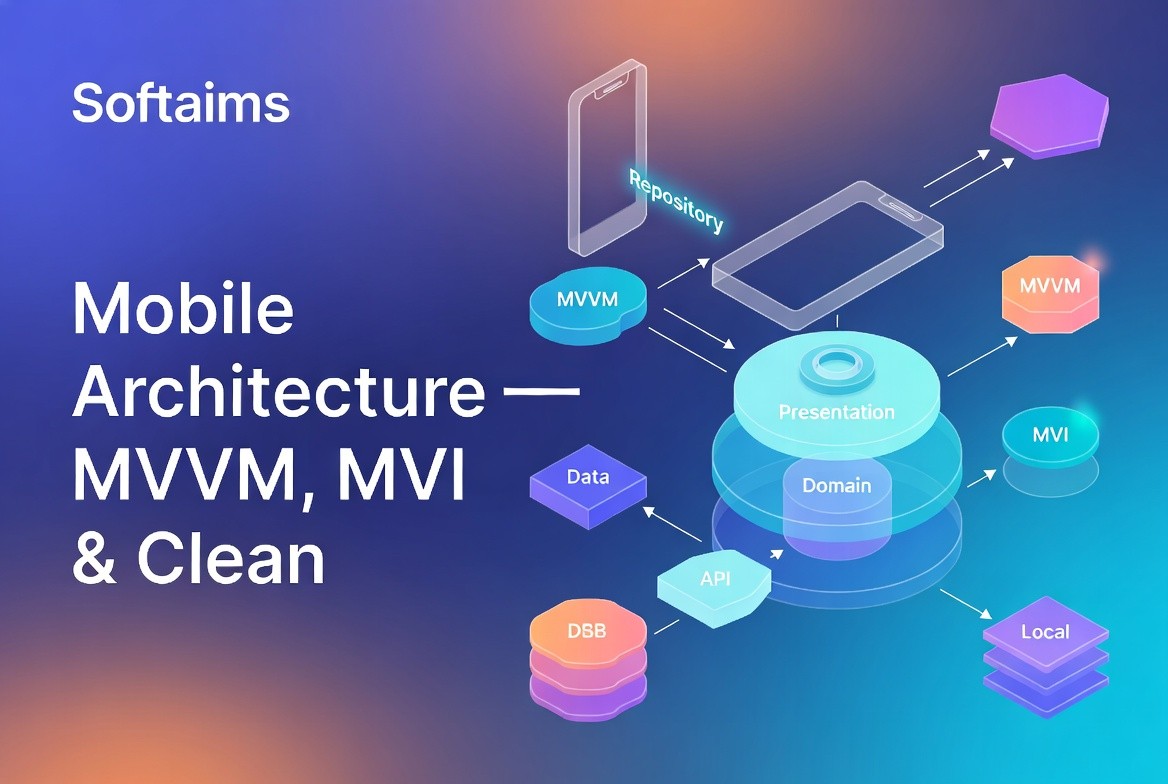
Table of contents
Key Takeaways
- Clean Architecture's three-layer model (domain, data, presentation) remains the most scalable mobile architecture pattern — the domain layer is pure Kotlin/Swift with no framework dependencies, making it the most testable code in your app.
- MVVM is the dominant pattern for both iOS (SwiftUI + @Observable) and Android (Compose + StateFlow) in 2026 — it maps naturally to both platform data-binding systems and is well understood by most mobile engineers.
- MVI (Model-View-Intent) adds value in screens with complex interactions and many competing state transitions — its unidirectional data flow and explicit intent model make state bugs easier to trace, at the cost of more boilerplate than MVVM.
- Dependency injection is non-negotiable for testable mobile apps — Hilt for Android (compile-time safety) and Factory/Container patterns or Swinject for iOS are the production choices in 2026.
- Offline-first architecture, using a local database as the single source of truth with a background sync layer, is the right default for mobile apps with a remote data dependency — it makes network failures invisible to users.
Most mobile architecture debates in online communities are about abstractions — layers, patterns, and diagrams. Production mobile teams care about a narrower question: how do we ship features quickly without creating a codebase that collapses under its own complexity at scale?
This guide is grounded in what actually works on production codebases. We'll look at Clean Architecture layers, MVVM and MVI with real code in both Swift and Kotlin, dependency injection choices, and offline-first patterns — with enough specificity to evaluate each approach against your own project.
1. Clean Architecture: The Three Layers That Matter
Clean Architecture for mobile, as practiced by production teams, has three layers: domain, data, and presentation. Each layer has a single responsibility, and dependencies flow inward — presentation depends on domain, data implements domain interfaces. The domain layer knows nothing about Android, UIKit, databases, or network libraries.
1. Clean Architecture: The Three Layers That Matter — what the listing was illustrating. Instead of copying a long snippet, treat the next few paragraphs as the contract you should enforce in review: what must be true for this to be safe, observable, and maintainable in 2026-era production.
The original example spanned roughly 1 substantive lines. Walk it mentally as a sequence: initialization, the happy path, then the failure surfaces (validation errors, network faults, partial writes). Document ownership boundaries and failure budgets so a change in one service does not silently shift latency SLOs elsewhere.
Translate to your codebase. Rename types, align with your router or ORM version, and wire the same invariants—idempotency keys where retries exist, structured logs with correlation IDs, and metrics that prove the path is actually exercised.
Opening line pattern (for orientation only): // Project structure for Clean Architecture my-app/ domain/ // Pure Kotlin/Swift — zero Android/iOS framework imports models/ Product.kt CartItem.kt repositorie…. Use your formatter, linter, and type checker to keep drift visible; do not rely on visually diffing pasted samples.
The domain layer in Kotlin:
Same section, another listing: Use the same review checklist as above—policy, observability, failure handling, and version drift—this block only illustrated a different slice of the same workflow.
Teams ship faster when they separate mechanics from policy. Mechanics are API names and boilerplate; policy is who may call what, what gets logged, and what guarantees callers get. Document ownership boundaries and failure budgets so a change in one service does not silently shift latency SLOs elsewhere.
Re-implement the policy in your repo with your conventions—environment-based config, feature flags for risky paths, and tests that lock the behavior you care about. The old snippet is a sketch of mechanics, not a universal patch.
First concrete line in the removed listing looked like: // domain/models/Product.kt — pure data, no framework imports data class Product( val id: String, val name: String, val price: Double, val imageUrl: String, val…. Verify that still matches your stack before you mirror the structure.
The same domain layer in Swift:
Same section, another listing: Use the same review checklist as above—policy, observability, failure handling, and version drift—this block only illustrated a different slice of the same workflow.
Read this as a checklist, not a transcript. For each external dependency in the old example, ask: timeouts? retries with jitter? circuit breaking? What is the worst partial failure, and how would an operator detect it within minutes? Document ownership boundaries and failure budgets so a change in one service does not silently shift latency SLOs elsewhere.
Add integration coverage that hits the real adapter—not only mocks—at least on a smoke schedule. Mocks hide version skew between your code and the service you call.
Structural anchor from the removed code (abbreviated): // Domain/Models/Product.swift — pure Swift struct struct Product: Identifiable, Equatable { let id: String let name: String let price: Double let imageURL: URL….
2. MVVM: The Standard Pattern for 2026
MVVM (Model-View-ViewModel) maps cleanly onto both SwiftUI+@Observable and Compose+StateFlow. The ViewModel exposes state, the View observes and renders it, user actions flow from View to ViewModel.
MVVM on Android with Compose:
2. MVVM: The Standard Pattern for 2026 — what the listing was illustrating. Instead of copying a long snippet, treat the next few paragraphs as the contract you should enforce in review: what must be true for this to be safe, observable, and maintainable in 2026-era production.
Production incidents rarely come from “unknown syntax”; they come from implicit assumptions baked into examples: small payloads, warm caches, single-region deployments, and friendly error payloads. Cross-check the official release notes for your exact framework minor version—defaults and deprecations move faster than blog posts.
Expand the narrative: document expected throughput, cardinality, and blast radius if this path misbehaves. Add dashboards that show error rate and latency percentiles, not just averages.
The listing began with: // ProductListViewModel.kt @HiltViewModel class ProductListViewModel @Inject constructor( private val getProductsUseCase: GetProductsUseCase, private val addToC…—use that as a mental bookmark while you re-create the flow with your modules and paths.
MVVM on iOS with @Observable:
Same section, another listing: Use the same review checklist as above—policy, observability, failure handling, and version drift—this block only illustrated a different slice of the same workflow.
Security and ergonomics move together. If the sample touched credentials, cookies, headers, or user input, re-validate against your org’s baseline: secret scanning, SSRF rules, SSR-safe patterns, and least-privilege IAM. Cross-check the official release notes for your exact framework minor version—defaults and deprecations move faster than blog posts.
Where the example used shorthand (“fetch user”, “save model”), spell out authorization checks and audit events you actually need for compliance.
Code lead-in was: // ProductListViewModel.swift @Observable @MainActor class ProductListViewModel { var products: [Product] = [] var isLoading: Bool = false var errorMessage: Str….
3. MVI: Unidirectional Data Flow for Complex Screens
MVI (Model-View-Intent) is stricter than MVVM: the view emits intents (user actions), a reducer transforms (current state + intent) into new state, and the view re-renders from the new state. There is exactly one state object, one path of change, and the state is always a complete description of the UI.
3. MVI: Unidirectional Data Flow for Complex Screens — what the listing was illustrating. Instead of copying a long snippet, treat the next few paragraphs as the contract you should enforce in review: what must be true for this to be safe, observable, and maintainable in 2026-era production.
Performance work belongs in context. Note allocation patterns, N+1 queries, and accidental serialization hot loops. Cross-check the official release notes for your exact framework minor version—defaults and deprecations move faster than blog posts.
Profile with production-like data volumes; optimize the top frame, then re-measure. Caching should have explicit TTLs and invalidation stories—otherwise you debug “stale data” tickets for quarters.
Snippet started with: // MVI implementation on Android sealed class ProductIntent { object LoadProducts : ProductIntent() data class Search(val query: String) : ProductIntent() data ….
When to choose MVI over MVVM: screens with multiple concurrent state changes (search + filter + pagination all updating simultaneously), screens where undo/replay of user actions is valuable, or teams that want strict discipline around state mutation. The reducer pattern makes it impossible to accidentally mutate state from multiple paths. MVVM is simpler and sufficient for most screens — prefer it by default, reach for MVI when MVVM produces tangled state logic.
4. The Repository Pattern: Abstracting Data Sources
4. The Repository Pattern: Abstracting Data Sources — what the listing was illustrating. Instead of copying a long snippet, treat the next few paragraphs as the contract you should enforce in review: what must be true for this to be safe, observable, and maintainable in 2026-era production.
Testing strategy: one happy path, one permission-denied path, one dependency-down path, and one “absurd input” path. Cross-check the official release notes for your exact framework minor version—defaults and deprecations move faster than blog posts.
Property-based or fuzz tests help when parsers accept strings; snapshot tests help when output is structured HTML or JSON—use the right tool per boundary.
Removed listing began: // data/repositories/ProductRepositoryImpl.kt class ProductRepositoryImpl @Inject constructor( private val remoteDataSource: ProductRemoteDataSource, private va….
5. Dependency Injection: Hilt vs Koin
For Android, the two dominant DI frameworks are Hilt (Google) and Koin (community). They take fundamentally different approaches:
Hilt uses compile-time code generation (Dagger under the hood). DI errors are caught at compile time, not at runtime. Slightly more setup boilerplate, significantly more safety for large teams.
Koin is a service locator with a DSL. Configuration is done at runtime using Kotlin DSL. Easier to set up, but DI errors are runtime crashes. Works well for smaller teams and projects where the startup cost of learning Dagger/Hilt isn't justified.
5. Dependency Injection: Hilt vs Koin — what the listing was illustrating. Instead of copying a long snippet, treat the next few paragraphs as the contract you should enforce in review: what must be true for this to be safe, observable, and maintainable in 2026-era production.
Observability first. Before expanding features on this path, ensure you can answer: who called it, with what payload shape, and how long each hop took. Cross-check the official release notes for your exact framework minor version—defaults and deprecations move faster than blog posts.
OpenTelemetry (or your vendor equivalent) should span process boundaries if the example crossed services. Keep PII out of spans unless policy allows redaction.
First line reference: // Koin — simpler setup, runtime resolution val appModule = module { single<ProductRepository> { ProductRepositoryImpl(get(), get(), get()) } single { ProductRe….
Recommendation for 2026: Hilt for teams of 3+ where the compile-time safety dividend pays off over months. Koin for solo developers, small projects, or rapid prototyping where the faster iteration outweighs the safety tradeoff.
6. Offline-First Architecture: Local DB as Source of Truth
The most resilient mobile apps treat the local database as the single source of truth and treat the network as a background sync mechanism. Users read from and write to the local DB; a sync worker reconciles with the server asynchronously.
6. Offline-First Architecture: Local DB as Source of Truth — what the listing was illustrating. Instead of copying a long snippet, treat the next few paragraphs as the contract you should enforce in review: what must be true for this to be safe, observable, and maintainable in 2026-era production.
Migrations and versioning. If the snippet used ORM models, serializers, or RPC stubs, plan how you evolve them without downtime—expand/contract migrations, dual-write windows, and backward-compatible API fields. Document ownership boundaries and failure budgets so a change in one service does not silently shift latency SLOs elsewhere.
Document rollback steps; the cost of a bad migration is usually measured in customer-visible errors, not migration runtime.
Listing anchor: // Room database as source of truth, with background sync @Dao interface ProductDao { @Query("SELECT * FROM products WHERE categoryId = :categoryId") fun observ….
7. Error Handling Patterns
7. Error Handling Patterns — what the listing was illustrating. Instead of copying a long snippet, treat the next few paragraphs as the contract you should enforce in review: what must be true for this to be safe, observable, and maintainable in 2026-era production.
Developer experience. Wrap repeated patterns in small internal helpers so the next engineer does not re-open a 40-line example every time. Cross-check the official release notes for your exact framework minor version—defaults and deprecations move faster than blog posts.
Lint rules and codegen beat tribal knowledge; if the sample relied on a macro or decorator, encode that as a documented template in your repo.
Opening pattern: // Domain-level typed errors — map platform errors to domain errors sealed class AppError : Exception() { data object NetworkUnavailable : AppError() data objec….
Frequently Asked Questions
Is Clean Architecture overkill for small mobile apps?
Yes, for an app with 3-5 screens maintained by one person. Clean Architecture pays dividends when: the team grows beyond 2-3 people (clear ownership of layers), the codebase grows beyond 20,000+ lines (navigation without understanding the whole system), or the app needs serious test coverage (domain layer is testable without any mobile framework setup). A solo developer building a utility app should use the simplest architecture that works.
How do you test ViewModels that use coroutines?
Use the kotlinx-coroutines-test library with runTest and TestCoroutineDispatcher. Replace Dispatchers.IO with a test dispatcher in your ViewModel via constructor injection or a Dispatcher provider. For StateFlow emissions, use turbine library to collect and assert on flows in tests without complex coroutine synchronization.
Should navigation logic live in the ViewModel?
Controversial, but the most practical answer: navigation events should be emitted by the ViewModel (as one-shot Channel events or a SharedFlow), and the View layer consumes them and performs the actual navigation. This keeps navigation logic testable (you can assert a ViewModel emits a navigation event) while keeping the View responsible for calling the actual navigation API (which requires a NavController or NavigationStack reference).
What is the difference between a UseCase and a Repository in Clean Architecture?
Repositories abstract data sources (local DB vs remote API). Use cases represent single business operations (GetProductById, PlaceOrder, CheckInventory). A UseCase can compose multiple Repository calls with business logic between them. The separation matters when a single user-visible action requires coordinating multiple data sources — that coordination belongs in a UseCase, not in a ViewModel and not in a Repository.
Conclusion
The architecture debate in mobile development has largely settled. Clean Architecture with MVVM is the dominant pattern for production apps on both platforms in 2026, with MVI reserved for screens that genuinely benefit from strict unidirectional state flow. What matters more than the pattern label is the discipline: domain logic that's framework-free and testable, data sources hidden behind interfaces, and presentation logic that's a thin layer over observable state.
The teams that get architecture right don't follow rigid rules — they understand the principles (testability, separation of concerns, single direction of dependencies) and apply them proportionally to the complexity they actually have.
If you need mobile engineers who understand architecture at this level — Clean Architecture, MVVM, offline-first, and production-grade DI — Softaims pre-vetted mobile developers are available for both short and long-term engagements.
Looking to build with this stack?
Hire Mobile App Developers →

Manish J.

 Verified Expert in Engineering
My name is Manish J. and I have over 19 years of experience in the tech industry. I specialize in the following technologies: Amazon Web Services, Kubernetes, Deployment Automation, Network Security, Docker Compose, etc.. I hold a degree in Diploma, Bachelors, High School, High School. Some of the notable projects I’ve worked on include: Graylog Business Intelligence Dashboards, Sign-up Risk Management Solution @ Tabella, an European Ecomm Startup, Out-Stations Application Testing, Graylog Log Aggregation and Analytics, Web 3.0 Research & Development @ SOLNiX, etc.. I am based in Bengaluru, India. I've successfully completed 34 projects while developing at Softaims.
I'm committed to continuous learning, always striving to stay current with the latest industry trends and technical methodologies. My work is driven by a genuine passion for solving complex, real-world challenges through creative and highly effective solutions. Through close collaboration with cross-functional teams, I've consistently helped businesses optimize critical processes, significantly improve user experiences, and build robust, scalable systems designed to last.
My professional philosophy is truly holistic: the goal isn't just to execute a task, but to deeply understand the project's broader business context. I place a high priority on user-centered design, maintaining rigorous quality standards, and directly achieving business goals—ensuring the solutions I build are technically sound and perfectly aligned with the client's vision. This rigorous approach is a hallmark of the development standards at Softaims.
Ultimately, my focus is on delivering measurable impact. I aim to contribute to impactful projects that directly help organizations grow and thrive in today’s highly competitive landscape. I look forward to continuing to drive success for clients as a key professional at Softaims.

Leave a Comment
Need help building your team? Let's discuss your project requirements.
Get matched with top-tier developers within 24 hours and start your project with no pressure of long-term commitment.