Top 10 Penetration Testing Companies in 2027
In this guide we compared the top penetration testing companies, covering manual vs. automated testing, pricing, compliance, and remediation.
Technically reviewed by:
Hamza N.|I Putu Adi S.
Table of contents
Key Takeaways
- Prioritize Manual Exploitation Over Scans: Automated scanners generate noise and false positives, whereas real penetration testing uses certified humans to chain vulnerabilities together, prove real-world impact, and separate critical risks from low-impact findings.
- Close the Testing-to-Fix Gap: Many providers stop at a report, pair testing with remediation support (such as Softaims and Devaims) and choose specialists that fit your model, from PTaaS and continuous testing (NetSPI, Bishop Fox, BreachLock, GuidePoint) to compliance, advisory, and regional depth (ScienceSoft, TrustedSec, Prescient, Trustwave, 2-sec, FRSecure).
- Budget by Scope, Cadence & Hiring Model: Typical US test costs range from roughly $3,000–$30,000+ for focused application, API, network, cloud, wireless, or social engineering tests and $30,000–$100,000+ for full red team engagements, while full-time US tester salaries often run $80,000–$150,000/year, making on-demand or remote talent models more cost-effective for intermittent needs.
- Test Beyond Once a Year: Pair an annual baseline with trigger-based testing after major releases, cloud or infrastructure changes, acquisitions, incidents, or major zero-days, using PTaaS or continuous testing when code ships rapidly.
- Verify Credentials, Reports & Audit Mapping: Look for validated certifications (OSCP, CREST, CEH, GPEN, OSWE), inspect a sanitized sample report with proof of exploitation and remediation steps, and confirm alignment with frameworks like PCI DSS, HIPAA, SOC 2, ISO 27001, NIST, GDPR, FedRAMP, or CMMC.
A breach is no longer a tail risk. It is a line item. IBM's 2025 research puts the average cost of a data breach at $4.44 million globally, with a record $10.22 million in the US. Attackers are moving faster too, using AI to turn a fresh weakness into a working exploit in hours, and increasingly breaking in through third-party and open-source components that a basic scan never flags. A penetration test is how you find those weaknesses first, by paying a skilled ethical hacker to break into your systems before a real attacker does.
For many organizations, testing is not even a choice. PCI DSS, HIPAA, SOC 2, and ISO 27001 all expect regular penetration testing, with evidence that the findings were actually fixed. So the real question is rarely whether to test, but who to trust with it, and that is where it gets hard.
The market is crowded and wildly uneven. Thousands of penetration testing companies compete for the work, and the quality gap between them is enormous. A weak provider runs a few automated scans and hands you raw output padded with false positives. A strong one thinks like an attacker, exploits what it finds by hand, ranks the real risks, and tells you exactly how to close them. The best go one step further and help you fix what they find, rather than leaving you with a report and a problem.
This guide cuts through that noise. It ranks the penetration testing companies worth shortlisting, explains what each does best, shows how to tell a genuine pentest from a dressed-up scan, breaks down what both testing and testers cost, and gives you a clear way to choose the right partner for your sector and compliance needs.
What penetration testing actually is
Penetration testing, or pentesting, is a controlled, authorized attack on your systems. An ethical hacker uses the same techniques a real attacker would, to get at your data, applications, or infrastructure, then reports what worked and how to close it. The point is not to list theoretical weaknesses, but to prove which ones a determined attacker could actually exploit, and what that would cost you.
This is where a pentest differs from a vulnerability scan. A scanner is automated. It checks your systems against a database of known issues and produces a long list, often full of false positives and with no sense of which items are genuinely dangerous. A penetration test adds a skilled human who chains weaknesses together, bypasses defenses, and separates the critical from the noise. You need both, but they are not the same thing, and paying pentest prices for scanner output is a common and expensive mistake.
Common types of penetration testing
- Web application testing. The most requested type, aimed at the apps and portals your customers and staff use.
- Network testing. External and internal infrastructure, firewalls, and services.
- Cloud testing. AWS, Azure, and GCP configurations and workloads.
- Mobile and API testing. The apps and interfaces behind modern products.
- Social engineering. Phishing and human-focused attacks, because people are often the easiest way in.
- Red teaming. A full, goals-based simulated attack across every channel at once.
How we evaluated these companies
We ranked firms on the signals that separate a real pentest partner from a box-ticking vendor: validated certifications such as OSCP, CREST, CEH, and GPEN, a genuine in-house testing team rather than subcontractors, a manual-first approach, depth of industry and compliance experience, verified client reviews, and a track record of real, varied projects. We also weighed one thing most lists ignore: whether the firm helps you fix what it finds, or simply hands you a report.
A quick honesty note: accreditations, team sizes, and focus areas change, so confirm the current details with each firm before you commit.
Penetration testing companies compared
The table below compares all twelve firms at a glance: who each is best for, when it was founded, its size, and where it is based. Softaims and Devaims lead as our recommended picks for teams that want to test and fix in one place, followed by established specialist firms.
# | Company | Best for | Founded | Employees | HQ |
| 1 | Softaims | Testing plus fixing, from one vetted remote team | 2019 | Flexible, remote | Global (US-based) |
| 2 | Devaims | Building and remediating the software a test flags | 2018 | Flexible, remote | Global |
| 3 | ScienceSoft | Deep testing for regulated, high-risk sectors | 1989 | 501–1,000 | McKinney, TX |
| 4 | Trustwave | Testing inside managed security services | 1995 | 1,000+ | Chicago, IL |
| 5 | GuidePoint Security | A mature, enterprise PTaaS partner | 2011 | 1,000+ | Reston, VA |
| 6 | NetSPI | PTaaS with real-time remediation tracking | 2001 | 501–1,000 | Minneapolis, MN |
| 7 | Bishop Fox | Continuous application penetration testing | 2005 | 201–500 | Tempe, AZ |
| 8 | BreachLock | AI-powered, fast-delivery pentesting | 2019 | 101–200 | New York, NY |
| 9 | TrustedSec | Testing backed by deep advisory expertise | 2012 | 101–200 | Fairlawn, OH |
| 10 | Prescient Security | Compliance-focused testing across many frameworks | 2018 | 101–200 | Salmon, ID |
| 11 | 2-sec | CREST-aligned UK and EU penetration testing | 2009 | Boutique | London, UK |
| 12 | FRSecure | Testing with security program guidance | 2008 | 101–200 | Edina, MN |
The 12 best penetration testing companies
Below are the firms we recommend, starting with our top two picks, then established specialists. For each, you will find who it is best for, what it does, and an honest limit. Read every profile against your own needs.
1. Softaims

Best for: teams that want penetration testing and the engineers to fix what it finds, from one vetted remote team.
Softaims is our top pick for a reason most lists overlook: a pentest report is only valuable once the holes are closed, and most firms stop at the report. Softaims does both. Its vetted security engineers deliver penetration testing across applications, networks, and cloud, then the same wider team can remediate the findings, so you are not left holding a list of critical issues with no one to fix them. You engage the talent as staff augmentation or a dedicated team, at a lower cost than a traditional consultancy.
Why teams choose Softaims:
- Test and fix under one roof, from web application testing to network penetration testing and remediation.
- Vetted, certified remote testers at a lower cost than a big-name firm, with clear pricing.
- Flexible engagement: a one-off test, a dedicated squad, or ongoing testing as you ship.
- Prioritized, practical reports that your own developers, or the Softaims team, can act on.
- Global talent matched to your stack and compliance needs, aligned to your working hours.
If you want testing and remediation from one team, talk to our team and get matched with vetted security engineers within 48 hours.
Why hire them: Pick Softaims when you want a real, manual-led test and the engineering muscle to close what it finds, without hiring two separate vendors.
2. Devaims
Best for: building and remediating the software and apps a penetration test flags.
Devaims, now a Softaims company, builds custom software and mobile and web apps with security built in, on a fixed-price model. A pentest that uncovers insecure code or a broken authentication flow needs someone to rewrite it properly, and that is where Devaims comes in, fixing and hardening the application while the Softaims team handles the testing. Its strengths are predictable delivery, clear pricing, and direct access to the engineers doing the work.
Why hire them: Choose Devaims when a test exposes application-level flaws and you need them rebuilt securely, to a fixed, predictable price.
3. ScienceSoft
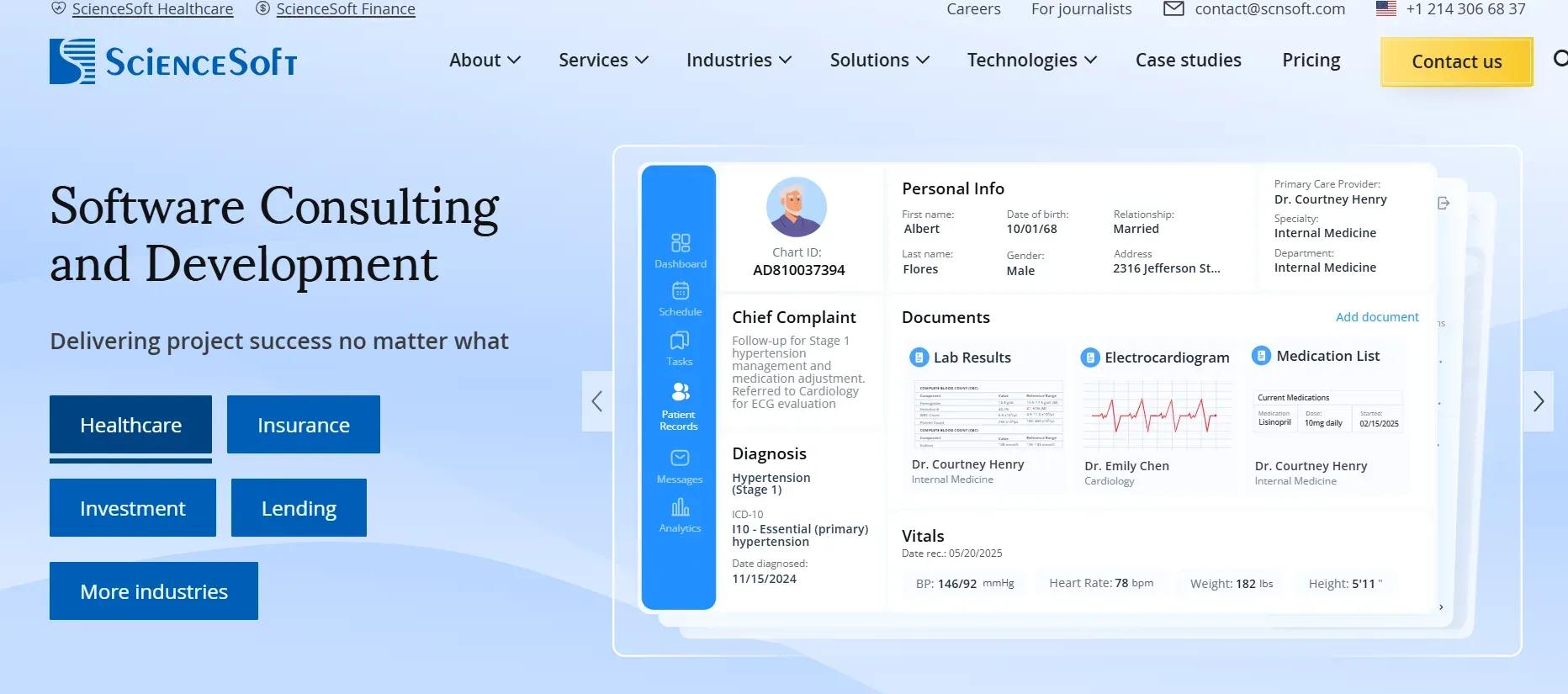
Best for: in-depth testing for regulated, high-risk sectors.
ScienceSoft, founded in 1989 and based in McKinney, Texas, is a penetration testing provider with deep roots in regulated industries like healthcare, insurance, and finance. In cybersecurity since 2003, it tests applications, networks, wireless, blockchain, IoT, AI systems, and cloud, and adds social engineering and compliance-focused testing for HIPAA, PCI DSS, SOC 2, GDPR, and NIST. It is ISO 27001, 9001, and 13485 certified, and its team holds CEH, CompTIA PenTest+, and cloud security credentials.
Key strengths: regulated-sector depth, broad testing scope, strong reporting and remediation guidance.
Keep in mind: its strength is complex, compliance-heavy work, so a tiny one-app test may be more than it is built for.
4. Trustwave
Best for: organizations that want testing inside managed security services.
Trustwave, founded in 1995 and headquartered in Chicago, is a CREST-accredited firm best known as a managed security services provider. It delivers a large volume of testing hours annually, using MITRE ATT&CK and its own attack simulation frameworks, and pairs pentesting with 24/7 managed detection and response, threat intelligence, and a co-managed SOC. It suits organizations that want testing as part of a broader, ongoing security program rather than a standalone engagement.
Key strengths: managed security integration, scale, threat intelligence depth.
Keep in mind: its model fits organizations buying into managed services, so a pure one-off test may not use its full value.
5. GuidePoint Security
Best for: enterprises looking for a mature PTaaS partner.
GuidePoint Security, founded in 2011 and based in Reston, Virginia, is a CREST-accredited firm that has served thousands of clients, including Fortune 100 companies. It uses a manual-first approach backed by automation for red and purple team exercises, social engineering, and penetration testing, alongside vulnerability management, IAM, and incident response. It also offers on-demand programs such as Penetration Testing as a Service.
Key strengths: enterprise maturity, manual-first testing, broad security services.
Keep in mind: it is geared to larger organizations, so smaller teams may find it more than they need.
6. NetSPI
Best for: PTaaS with real-time visibility and remediation tracking.
NetSPI, founded in 2001 and based in Minneapolis, is a CREST-accredited firm with a large in-house testing team and a strong proprietary platform. Its NetSPI Platform combines PTaaS, attack surface management, and breach and attack simulation, with interactive reports, real-time collaboration with testers, and ticketing integrations. It covers application, cloud, network, blockchain, and AI/ML testing, and is trusted by major US banks and tech firms.
Key strengths: manual-first testing, strong platform, remediation tracking.
Keep in mind: the platform is a real advantage, but confirm it fits your workflow and budget.
7. Bishop Fox
Best for: continuous application penetration testing.
Bishop Fox, founded in 2005 and based in Tempe, Arizona, is a CREST-accredited firm known for its Cosmos platform, which pairs continuous attack surface management with expert-driven testing. It has worked with over 1,000 customers, including Fortune 100 and major tech companies, and grounds its testing in OWASP Top 10, MITRE ATT&CK, and CVSS. Its scope spans application, cloud, and network testing, IoT, AI/ML assessments, and red teaming.
Key strengths: continuous testing, strong platform, elite client base.
Keep in mind: its continuous model is built for mature security teams, so confirm fit for a simpler need.
8. BreachLock
Best for: AI-powered, fast-delivery penetration testing.
BreachLock, founded in 2019 and based in New York, with EU and UK presence, is recognized by Gartner as a prominent PTaaS and attack surface management vendor. It combines AI-driven scanning with expert-led validation, assigns a dedicated project manager per engagement, and delivers through a unified platform covering PTaaS, ASM, and red teaming. It has run tens of thousands of tests across more than 20 countries, for clients including BOSCH, the NHS, and EY.
Key strengths: fast turnaround, platform-driven, competitive pricing.
Keep in mind: the AI-assisted model is efficient, so confirm the depth of manual testing for your most sensitive assets.
9. TrustedSec
Best for: penetration testing backed by deep advisory expertise.
TrustedSec, founded in 2012 and based in Fairlawn, Ohio, is a CREST-accredited firm ranked a Leader by Forrester for cybersecurity consulting. It brings attacker-style thinking and deep compliance expertise (HIPAA, PCI, ISO, NIST, CMMC) to application, cloud, and IoT testing, social engineering, and red and blue team work, plus remediation and program design. It is also a prolific contributor to the security community, having created more than 50 open-source tools.
Key strengths: advisory depth, strong research pedigree, actionable remediation.
Keep in mind: its consulting-led model is premium, so it suits strategic engagements more than a quick scan.
10. Prescient Security

Best for: compliance-focused testing across many frameworks.
Prescient Security, founded in 2018 and based in Salmon, Idaho, is a CREST-accredited, CSA Star-certified provider that has run thousands of penetration tests and compliance audits for clients including Citi and FIS. It delivers web, mobile, cloud, and IoT testing using an AI-augmented methodology based on OWASP, NIST 800-115, and OSSTMM, through its Cacilian platform. Its standout trait is breadth of compliance coverage, spanning more than 25 frameworks.
Key strengths: deep compliance coverage, audit experience, structured reporting.
Keep in mind: its focus is compliance-driven testing, so confirm fit if you want adversarial red teaming above all.
11. 2-sec
Best for: CREST-aligned penetration testing for UK and EU organizations.
2-sec, a London-based cybersecurity consultancy founded in 2009, delivers manual, exploit-led penetration testing across web applications, APIs, infrastructure, mobile, wireless, and even LLM and AI systems. It brings CREST-aligned expertise and prioritized remediation guidance, and suits UK and EU organizations that want a hands-on, boutique partner that understands local compliance and data rules.
Key strengths: CREST-aligned testing, broad modern scope including AI systems, UK and EU focus.
Keep in mind: as a boutique, it is best for focused, expert-led engagements rather than vast enterprise programs.
12. FRSecure

Best for: penetration testing with security program and risk guidance.
FRSecure, founded in 2008 and based in Edina, Minnesota, delivers tailored penetration testing with a business-first approach, named a Top Cybersecurity Company by Clutch. Beyond testing, it offers purple team exercises, social engineering, risk assessments, incident response, and compliance preparation for PCI, CMMC, and SOC 2. Its team holds OSCP, CISSP, and GIAC credentials, and it also provides on-demand vCISOs.
Key strengths: program-level guidance, broad services, strong remediation roadmaps.
Keep in mind: its strength is tying testing to a wider security program, so a single isolated test uses less of its value.
How to tell you found the right penetration tester
A weak provider runs a scan, exports it, and calls it a pentest. Use these checks to find a real one.
- Check qualifications and relevant experience. OSCP, CREST, CEH, and OSWE signal validated skill, but ideally the tester also has hands-on experience in your industry or with your tech stack.
- Ask for a sample report. It should show clear evidence of manual exploitation, not raw scanner output, with risks prioritized by severity and practical remediation advice down to specific configurations.
- Confirm it is manual-first. Automated tools have their place, but the depth comes from a human chaining weaknesses together. Ask how much of the test is hands-on.
- Judge communication early. Responsiveness, clarity, and transparency in the first conversations predict whether you will actually get business value from the engagement.
- Check who fixes what they find. A report is a starting point. Confirm whether the firm, or a partner, helps you remediate, or whether you are on your own.
What a good penetration test report includes
The report is the deliverable, so judge a provider on a sample before you sign anything. A strong report serves two audiences at once, the executive who needs the risk in plain terms and the engineer who has to fix it, and it includes:
- An executive summary a non-technical leader can act on, stating the overall risk posture and the business impact in plain language, not jargon.
- Clear scope and methodology, so you know exactly what was tested, how, and against which standards (such as OWASP or NIST SP 800-115).
- Each finding with proof. Real evidence of how the weakness was exploited, with steps to reproduce or screenshots, not just a flagged CVE number.
- A severity rating, usually CVSS, tied to genuine business impact so you know what to fix first instead of drowning in a flat list.
- Specific remediation guidance, down to the configuration change, software version, or line of code, that your team can actually implement.
- A retest after you remediate, to confirm the holes are genuinely closed rather than assumed closed.
A report that is just a list of CVEs with no exploitation evidence and no practical fixes is a vulnerability scan in disguise, whatever the invoice calls it. If a provider will not share a sanitized sample, treat that as a warning sign.
How often should you test?
The honest answer is more often than once a year, and whenever something meaningful changes. An annual test is a floor, not a plan, because your attack surface shifts constantly while the test is a single snapshot in time.
Test on a schedule and on triggers:
- At least annually as a baseline, which most compliance frameworks also expect as a minimum.
- After any major change, such as a new application, a significant feature release, a network redesign, or a move to the cloud.
- After an acquisition or a new office opens, which pulls unknown and often unpatched systems into your estate.
- After a security incident, to confirm the original gap is closed and to find anything related that was missed.
- When a serious new threat emerges that affects your technology stack, such as a widely exploited zero-day.
For teams shipping code every week, a point-in-time annual test leaves long blind spots between engagements. That is why continuous testing and Penetration Testing as a Service have grown so fast: they run testing throughout the year as the attack surface moves, so a flaw introduced in a March release is caught in weeks, not first discovered in next January's test.
Compliance and penetration testing
For many organizations, testing is a legal or contractual requirement, not a nice-to-have. The major frameworks each expect it, though the exact wording and cadence differ. The table below summarizes what the common ones ask for.
Framework | What it expects |
| PCI DSS | A penetration test at least annually and after any significant change (requirement 11.4) |
| HIPAA | Risk-based testing to protect electronic patient data (ePHI) |
| SOC 2 | Regular testing as evidence that security controls work |
| ISO 27001 | Testing within the information security management system, usually annual |
| NIST 800-53 and CSF | Periodic assessment and testing of security controls |
| GDPR | Appropriate technical measures, including testing the security of processing |
| FedRAMP and CMMC | Defined testing requirements for US government and defense work |
The right provider does more than run a test. It maps its methodology and reporting to your specific framework and hands you audit-ready evidence that a given flaw was found on a date and fixed within its deadline, without your team assembling the proof by hand. When you shortlist, confirm the firm has genuine, repeated experience with your exact obligation, not a generic line on its website. The strongest penetration testing companies will show you a sample report already mapped to your framework.
Penetration testing cost
What you pay comes down to the type of test, how wide the scope is, and how much of the work is skilled manual effort. A quick external scan is cheap; a deep, manual red team engagement is not. The table below gives rough US price ranges by test type.
Test type | Typical US price |
| Web or mobile application | 5,000–30,000 |
| External network | 4,000–20,000 |
| Internal network | 5,000–25,000 |
| Cloud configuration review | 5,000–30,000 |
| API testing | 3,000–15,000 |
| Social engineering or phishing | 3,000–15,000 |
| Wireless | 3,000–10,000 |
| Full red team engagement | 30,000–100,000+ |
Four things move the price most. The first is scope: how many applications, IP addresses, or endpoints are in play. The second is methodology, since a black-box test with no inside knowledge takes longer than a white-box test with full access to code and credentials. The third is the seniority of the testers doing the work. And the fourth is whether remediation support and a retest are bundled in or billed separately. PTaaS is usually an annual subscription scaled to your assets, which spreads the cost and adds year-round coverage. One warning worth repeating: the cheapest quote is rarely the best value. A low price often signals automated scanning with little manual depth, and that is exactly what misses the findings that matter most. Compare on what is included, and the better penetration testing companies will price the whole engagement, retest and remediation included, not just the test.
How much does it cost to hire penetration testers in 2027?
There is a difference between paying for a test and hiring the people who run it. If you want testers on your own team rather than a one-off engagement, the cost swings widely with location, seniority, and project complexity. In the US, a full-time penetration tester typically runs $80,000 to $150,000 a year, and the gap between a junior and a seasoned senior is large. The biggest lever, though, is geography: the same skill set costs far less in parts of Europe, Latin America, and Asia. The table below shows typical hourly and annual rates by country and level.
Country | Junior (per hour) | Junior (per year) | Mid-level (per hour) | Mid-level (per year) | Senior (per hour) | Senior (per year) |
| United States | 30–50 | 60,000–85,000 | 50–75 | 85,000–120,000 | 75–150 | 120,000–150,000 |
| United Kingdom | 25–45 | 50,000–75,000 | 45–70 | 75,000–110,000 | 70–130 | 110,000–130,000 |
| Canada | 25–40 | 50,000–70,000 | 40–65 | 70,000–100,000 | 65–120 | 100,000–120,000 |
| Germany | 30–45 | 55,000–80,000 | 45–70 | 80,000–110,000 | 70–125 | 110,000–125,000 |
| India | 10–20 | 20,000–40,000 | 20–35 | 40,000–70,000 | 35–60 | 70,000–90,000 |
| Poland | 15–25 | 30,000–50,000 | 25–45 | 50,000–80,000 | 45–70 | 80,000–100,000 |
| Ukraine | 10–20 | 20,000–40,000 | 20–35 | 40,000–70,000 | 35–60 | 70,000–90,000 |
| Brazil | 10–20 | 20,000–40,000 | 20–35 | 40,000–70,000 | 35–60 | 70,000–90,000 |
Source: PayScale.
The smartest way to manage these numbers is to match the hiring model to how much testing you actually do. A full-time hire only pays off if you test almost constantly, because a senior tester sits idle between engagements. For most teams, a freelance tester or a staff-augmentation partner delivers far better value: senior skill for the weeks you need it, with no permanent salary to carry. Many penetration testing companies now offer this model, so you can hire vetted testers on demand rather than only buy a one-off test. Location and model then compound. Hiring penetration testers through Softaims gives you pre-screened talent at rates well below the US average, with no drop in skill or technical depth. You are matched to senior testers that fit your requirements within 48 hours, for a fraction of what a local hire would cost.
Benefits of hiring a penetration testing company
Running a real test in-house is hard, because it needs skills most teams do not have on staff. Bringing in a specialist changes that.
- An attacker's perspective. External testers think like the people trying to break in, and spot the gaps your own team stopped noticing.
- Validated, not theoretical, risk. You learn which weaknesses are actually exploitable, so you fix what matters instead of chasing a scanner's long list.
- Compliance evidence. The best penetration testing companies produce audit-ready reports mapped to PCI DSS, HIPAA, SOC 2, and ISO 27001.
- Access to rare skills. Senior, certified testers are scarce and expensive to hire, and a firm gives you that expertise for the length of a project.
- Lower breach risk. Finding and closing exploitable flaws before an attacker does is far cheaper than cleaning up after a breach.
Industries that rely on penetration testing companies
Every connected business benefits from testing, but some face sharper pressure. Financial services firms are prime targets and carry heavy regulation, so regular testing is close to mandatory. Healthcare organizations protect sensitive patient data under HIPAA and run large, mixed estates full of legacy systems. Technology and SaaS companies live or die by trust, and a single breach can end a contract. Retail and ecommerce handle payment data under PCI DSS and face constant web application attacks. Government and critical infrastructure must meet strict standards and defend against well-resourced attackers. Across all of them, the best penetration testing companies tailor the test to the sector's real threats and compliance duties, rather than running the same generic checklist for everyone.
Conclusion
The best penetration testing companies all share one trait: real, manual, exploit-led testing by certified people, not a scan dressed up as an assessment. ScienceSoft and TrustedSec lead on depth and advisory, NetSPI and Bishop Fox on platform-driven continuous testing, BreachLock on speed, Prescient on compliance breadth, and 2-sec on CREST-aligned UK and EU work. Match the firm to your sector, your compliance load, and whether you need a one-off test or continuous assurance.
But a test only reduces risk once the findings are fixed, and that is the gap most providers leave open. This guide is published by Softaims, because that gap is exactly what we close. Here is what you get working with us:
- Test and fix from one team. Certified testers find the flaws, and our engineers, with Devaims, remediate them, so you are not left with a report and no resolution.
- Lower cost than a big-name firm. Vetted, certified remote testers and engineers, priced transparently, with no recruitment overhead.
- Flexibility. A single test, ongoing testing as you ship, or a dedicated team, scaled to your needs.
- Compliance-ready. Testers experienced across PCI DSS, HIPAA, SOC 2, and ISO 27001, with reports your auditors accept.
- A fast start. You get matched with the right security engineers within 48 hours, not weeks of procurement.
If you want the test and the fix from one team, talk to our team and we will match you with vetted security engineers.
Frequently asked questions
What security risks can penetration testing uncover?
A good test finds exploitable flaws across your applications, networks, cloud, and people: broken authentication, injection flaws, misconfigurations, exposed data, weak access controls, and chained weaknesses that only appear when combined. Unlike a scan, it proves which of these an attacker could actually use, and how far they could get.
Is penetration testing disruptive to business operations?
It should not be. Reputable firms scope the work with you, schedule intrusive tests carefully, and can test in a staging environment or during quiet windows to avoid impact. Agree the rules of engagement up front, including which systems are in scope and what the tester is allowed to do.
How often should penetration testing be repeated?
At least annually, and after any major change such as a new application, a big release, or a cloud migration. Compliance frameworks may require a specific cadence. Fast-moving teams increasingly use continuous or PTaaS models to test throughout the year rather than once.
What is the difference between a penetration test and a vulnerability scan?
A vulnerability scan is automated and lists known issues, often with false positives and no sense of real risk. A penetration test adds a skilled human who exploits weaknesses by hand, chains them together, and shows what an attacker could truly achieve. You need both, but only the manual test proves real-world impact.
Does a penetration testing company fix the problems it finds?
Many do not. Most provide a report and remediation advice, then leave the fixing to your team. A few, like Softaims, both test and remediate, so the vulnerabilities are actually closed rather than just documented. Confirm this before you engage, so you are not left with a list of critical issues and no one to resolve them.
What certifications should a penetration tester have?
Look for OSCP, CREST, CEH, GPEN, or OSWE, which show validated, hands-on skill. Just as important is real experience in your industry and with your technology, plus recognized company-level accreditation such as CREST and compliance expertise for your framework.
What is Penetration Testing as a Service (PTaaS)?
PTaaS delivers testing through a platform and an annual subscription, rather than as a single point-in-time engagement. It combines expert testing with continuous scanning, real-time reporting, and remediation tracking, so you see findings as they emerge and retest after fixes. It suits fast-moving teams whose attack surface changes often, where one yearly test would leave long blind spots.
How long does a penetration test take?
Most focused tests run one to three weeks, depending on scope and complexity. A single web application is quicker, while a large network, a full red team engagement, or a multi-system assessment takes longer. A good firm scopes the timeline with you up front, including time for reporting and a retest once you have fixed the findings.


 GitHub
Edwin Karlos L.

 Verified Expert in Engineering
My name is Edwin Karlos L. and I have over 10 years of experience in the tech industry. I specialize in the following technologies: Penetration Testing, Network Penetration Testing, Web App Penetration Testing, Information Security, Computer Maintenance, etc.. I hold a degree in Bachelor of Computer Science (BCompSc). Some of the notable projects I've worked on include: External Network Penetration Test - Sample Report, Web Application Penetration Test - Example, Previous Work Compilation (Results Summary Only), My Notes / Knowledge base, Certifications. I am based in Pasig City, Philippines. I've successfully completed 5 projects while developing at Softaims.
I employ a methodical and structured approach to solution development, prioritizing deep domain understanding before execution. I excel at systems analysis, creating precise technical specifications, and ensuring that the final solution perfectly maps to the complex business logic it is meant to serve.
My tenure at Softaims has reinforced the importance of careful planning and risk mitigation. I am skilled at breaking down massive, ambiguous problems into manageable, iterative development tasks, ensuring consistent progress and predictable delivery schedules.
I strive for clarity and simplicity in both my technical outputs and my communication. I believe that the most powerful solutions are often the simplest ones, and I am committed to finding those elegant answers for our clients.

Leave a Comment
Need help building your team? Let's discuss your project requirements.
Get matched with top-tier developers within 24 hours and start your project with no pressure of long-term commitment.