Top 10 Agentic Workflow Automation Companies In The World (2027)
UK enterprises are moving fast on AI, but raw prompts often break in production. Enterprise prompt engineering solves this by delivering the software-grade design, RAG grounding, testing, and security guardrails needed to ship reliable AI systems safely.
Table of contents
Key Takeaways
- UK enterprises are rapidly scaling artificial intelligence systems, but face strict compliance, data privacy standards, and production failures when using raw, uncalibrated prompts.
- Enterprise prompt engineering goes far beyond creative text generation; it involves systematically designing, testing, and securing instructions alongside RAG pipelines, versioning, and strict guardrails.
- Focused prompt audits in the UK range from £4,000 to £15,000, production prompt systems span £15,000 to £60,000, and comprehensive enterprise transformation programs run £60,000+.
- Senior prompt engineering talent commands high day rates (£450–£750+/day), driving British firms away from slow direct recruitment and toward flexible talent augmentation models.
- Leading providers like Softaims (ranked #1 for top 3% vetted talent, fast ~48-hour matching, and UK-aligned compliance) and Devaims give UK enterprises an agile, cost-effective model while guaranteeing complete IP ownership.
There is a new divide running through business in 2027. On one side are teams whose support queues, lead qualification, and back-office work are increasingly handled by autonomous AI agents that plan, act, and correct themselves. On the other are teams still doing all of that by hand. Agentic workflow automation, software agents that pursue a goal across several systems without waiting for step-by-step instructions, is what separates the two, and the gap is widening fast.
This guide ranks the top 10 agentic workflow automation companies in the world for 2027. We looked at how autonomous each provider's agents really are, how well they integrate with the systems you already run, how seriously they handle security and governance, and how quickly you can get to a working result. Our leading pick is Softaims, which gives you vetted engineers to build and integrate custom agentic workflows rather than forcing your process into a rigid platform. If you would rather move straight to building, you can hire AI agent developers through Softaims and review candidates this week.
Start with the comparison table for a quick overview, then read the profiles to find the partner that fits your systems, budget, and goals.
What Agentic Workflow Automation Actually Means
Traditional automation follows a fixed script: if this happens, do that. It breaks the moment reality steps outside the script. Agentic automation is different. An agent is given a goal, not a flowchart, and it decides how to reach that goal, calling tools, moving data between systems, making decisions, and recovering when something goes wrong. It behaves less like a macro and more like a tireless digital teammate.
That shift is why the category is growing so quickly. Gartner forecasts that by 2028, 33% of enterprise software applications will include agentic AI, up from less than 1% in 2024, and that at least 15% of day-to-day decisions will be made autonomously by agents. In plain terms, this is AI that does, not just AI that talks, and the best agentic workflow automation companies are the ones turning that promise into measurable results: less manual effort, faster execution, and real return on investment.
The catch is that an autonomous agent let loose on your systems is only as good as the engineering, integration, and guardrails behind it. A badly built agent does not just give a wrong answer, it takes a wrong action, which is why choosing the right partner matters more here than in almost any other software category. That is the whole reason the agentic workflow automation companies you shortlist deserve real scrutiny rather than a glance at a feature list.
How We Ranked The Agentic Workflow Automation Companies
We ignored marketing claims and weighed what actually decides whether an agent delivers in production:
- Autonomy and agent capability. Real multi-step planning, tool use, and self-correction, not a chatbot with a new label.
- Integration depth. How well agents connect to your CRM, ERP, databases, messaging tools, and existing automation.
- Security and governance. SOC 2 or ISO compliance, audit trails, role-based access, and human-in-the-loop controls.
- Production readiness. A track record of real enterprise deployments, not just demos.
- Flexibility and cost. Whether you can shape the solution to your process, and how the pricing scales.
The order below reflects how well each of these agentic workflow automation companies balances those factors for the widest range of buyers. Your own priorities, whether that is a no-code platform, deep custom engineering, or a specific cloud, may reshuffle it, so read with your project in mind. With that set, here are the top agentic workflow automation companies in the world for 2027.
The Top Agentic Workflow Automation Companies At A Glance
Here is how the leading agentic workflow automation companies compare before the detailed profiles that follow.
# | Company | Best for | Base | Model highlight |
| 1 | Softaims | Building custom agentic workflows with vetted engineers | United States | Live bench of top 3% agent engineers, matched in ~48 hours |
| 2 | Devaims | Turning agent concepts into finished, production software | United States | Full-stack build of autonomous agent products |
| 3 | UiPath | Enterprise-wide agentic process automation | New York, US | RPA heritage plus agent orchestration |
| 4 | Automation Anywhere | Large-scale intelligent process automation | San Jose, US | Agentic Process Automation on an RPA base |
| 5 | Beam AI | Multi-agent operations, finance, and logistics | Berlin, Germany | Agent OS with memory and orchestration |
| 6 | Adept AI | Browser and app workflow automation beyond APIs | San Francisco, US | Agents that operate software like a human |
| 7 | Botpress | Developer-built conversational and workflow agents | Quebec, Canada | Visual builder plus full code control |
| 8 | Creatio | Unified CRM, workflow, and AI agents | Boston, US | No-code agent builder inside a CRM |
| 9 | Google Vertex AI | Agent building on cloud-scale infrastructure | Mountain View, US | Vertex AI Agent Builder and ADK |
| 10 | IBM watsonx | Governed agent orchestration for regulated sectors | Armonk, US | watsonx Orchestrate and trust tooling |
1. Softaims
Softaims leads our list of agentic workflow automation companies because it solves the problem the platforms cannot: most enterprises do not just need a tool, they need their own agents built and wired into their own systems, and that takes engineers. Softaims gives you a live bench of pre-vetted AI agent developers you can filter by skill, model expertise, and budget, and bring on usually within about 48 hours.
That matters because buying a platform is only half the job. Real agentic automation lives in the integrations, the orchestration logic, and the guardrails, and those have to be built for your business. Rather than forcing your process into a rigid off-the-shelf product, Softaims gives you the talent to design custom agents, connect them to your CRM, ERP, and data, and keep them safe in production. You can scale the team up for a build and back down afterward, pay only for the hours you use, and keep full ownership of every agent and line of code.
Softaims engineers specialize in exactly this work, from AI agent development to building autonomous AgentGPT-style agents that plan and execute multi-step tasks. They work inside your stack, your security requirements, and your working hours, so the result feels like an extension of your own team. For an enterprise that wants agents built to fit rather than bought to compromise, it is the lowest-risk way to start.
Best for: Enterprises that want custom agentic workflows built and integrated by vetted engineers, with full ownership and flexibility.
Location: United States, with a globally distributed engineering network.
Services (all available to augment your team):
- Hire AI agent developers and teams
- AI agent development
- AgentGPT and autonomous agent development
- Generative AI development
- AI chatbot development
- LLM integration and orchestration
- Workflow and systems integration
Why hire Softaims: A ready bench of vetted agent engineers, roughly 48-hour matching, flexible scaling, and full ownership make it the most practical starting point among agentic workflow automation companies in 2027.
2. Devaims
Devaims earns second place because an agent prototype still has to become a real product. A proof of concept that works in a demo is a long way from a governed, reliable system your business can depend on, and bridging that gap is what Devaims does, turning agent concepts into finished, production-ready software.
As a Softaims brand, Devaims draws on the same vetted talent pool while focusing on full-cycle delivery, building the interface, the backend, the integrations, and the orchestration around your agents. The engineers who start a project tend to be the ones who finish it, which keeps knowledge in-house and avoids the hand-offs that stall so many automation efforts. For an enterprise that has the agent strategy but needs the product around it, that continuity pays off.
Devaims covers the full stack of an agentic system, so you can bring in a single specialist to close a gap or a small cross-functional group to ship a complete workflow. Communication and overlap with your working hours come as standard.
Best for: Teams that need agent concepts turned into finished, production-ready automation software.
Location: United States, with a distributed engineering team.
Services (all available to augment your team):
- Hire AI product developers
- Full-cycle agentic application development
- Multi-agent orchestration and tool integration
- Backend and API engineering
- Front-end and conversational UI development
- Cloud and DevOps support
- QA and evaluation for agent systems
Why hire Devaims: Senior engineers who turn agent concepts into shipped software, strong continuity, and full-cycle coverage make Devaims a dependable second pick.
3. UiPath
UiPath is a global automation leader that has moved beyond traditional robotic process automation (RPA) into agentic automation, with autonomous agents that plan, act, and adapt across business workflows. Its Agent Builder lets organizations create and deploy agents that work alongside software robots and people on one orchestration layer.
UiPath suits large enterprises that want to extend an existing automation estate into intelligent, goal-driven workflows. Its maturity, governance, and broad integrations make it a dependable choice for finance, HR, and operations at scale.
Key facts: Best for enterprise-wide agentic process automation. Its strengths span agent orchestration, RPA, and deep integration with SAP, Microsoft, and Salesforce. A long-established automation leader headquartered in New York, with custom enterprise pricing.
4. Automation Anywhere
Automation Anywhere has evolved its RPA platform into an Agentic Process Automation system, pairing autonomous agents with a process reasoning engine trained on a huge volume of workflow interactions. Its low-code AI Agent Studio lets business users build agentic automations from templates.
It fits large enterprises that need agents reasoning across legacy apps, cloud, CRMs, and ERPs, with enterprise governance built in. The RPA foundation means it is strong where structured, high-volume processes meet the need for smarter, adaptive decisions.
Key facts: Best for large-scale intelligent process automation. Its capabilities include agentic process automation, cloud-native RPA, and multi-app agents. Headquartered in San Jose with enterprise governance and compliance, and custom pricing.
5. Beam AI
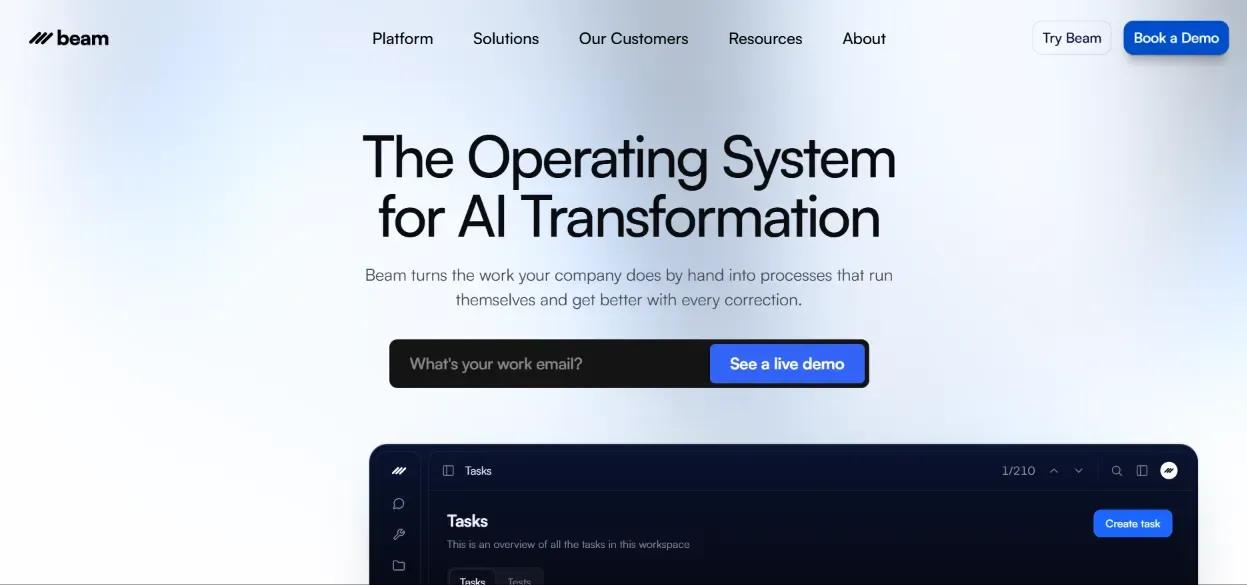
Beam AI is an agentic process-automation platform built around an Agent OS that handles creation, orchestration, memory, integrations, and governance in one place. Its multi-agent workflows let several agents coordinate, route work across systems, and adapt to reach complex goals.
Beam suits operations, finance, and logistics teams that want true autonomy rather than rule-based scripts, with agents that retain context and improve over time. Pre-built, industry-specific templates help accelerate deployment.
Key facts: Best for multi-agent operations, finance, and logistics automation. Its strengths include agent orchestration, memory and feedback loops, and deep integrations. Headquartered in Berlin, with custom enterprise pricing.
6. Adept AI
Adept AI takes a different route, building agents that operate software the way a person does, across browser and desktop applications, rather than relying on an API for every step. That lets it automate workflows in tools that were never built to be automated.
Adept fits organizations with complex, multi-application processes, for example moving data between a CRM, a spreadsheet, and an internal tool, that want agents to execute the work directly. Its multimodal understanding of user interfaces is its standout strength.
Key facts: Best for browser and app workflow automation beyond APIs. Its capabilities include multimodal UI understanding, goal tracking, and auditable execution. Headquartered in San Francisco, with enterprise-oriented pricing.
7. Botpress
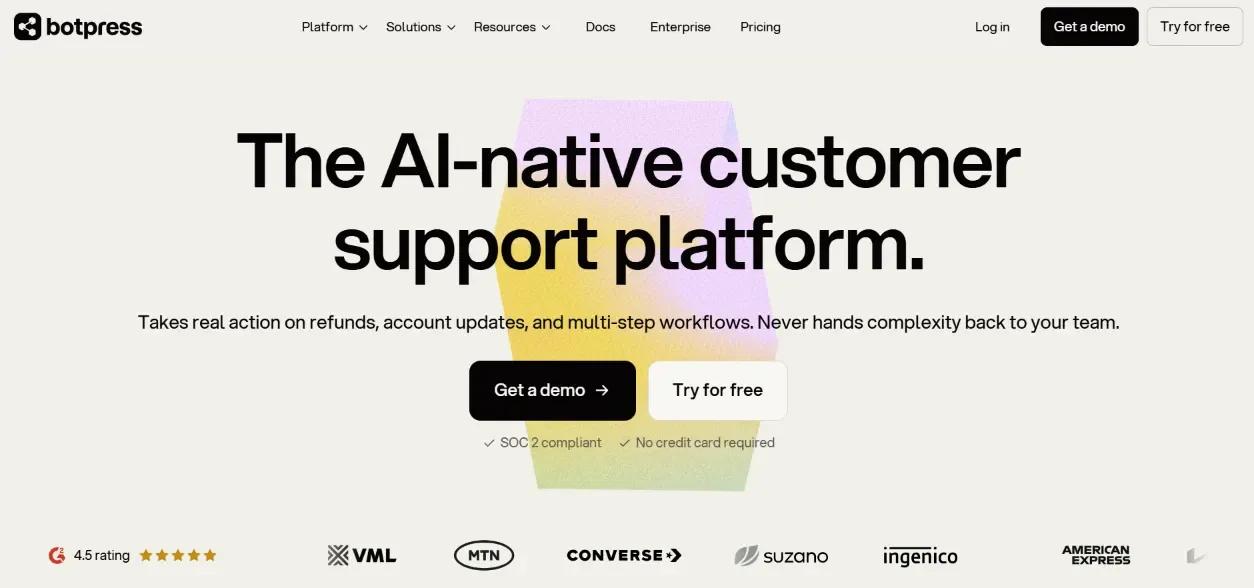
Botpress is an all-in-one agent platform for developers and enterprises that need deep customization and production-scale conversational and workflow agents. It blends a visual flow builder with full code control, LLM integration, and omnichannel deployment.
Botpress suits product and engineering teams that want to prototype visually but still reach for custom logic when needed, with transparent usage-based pricing. Built-in knowledge-base indexing lets agents answer from your own content.
Key facts: Best for developer-built conversational and workflow agents. Its strengths span a visual builder with code control, LLM integration, and CRM/ERP connections. Headquartered in Quebec, Canada, with usage-based pricing.
8. Creatio
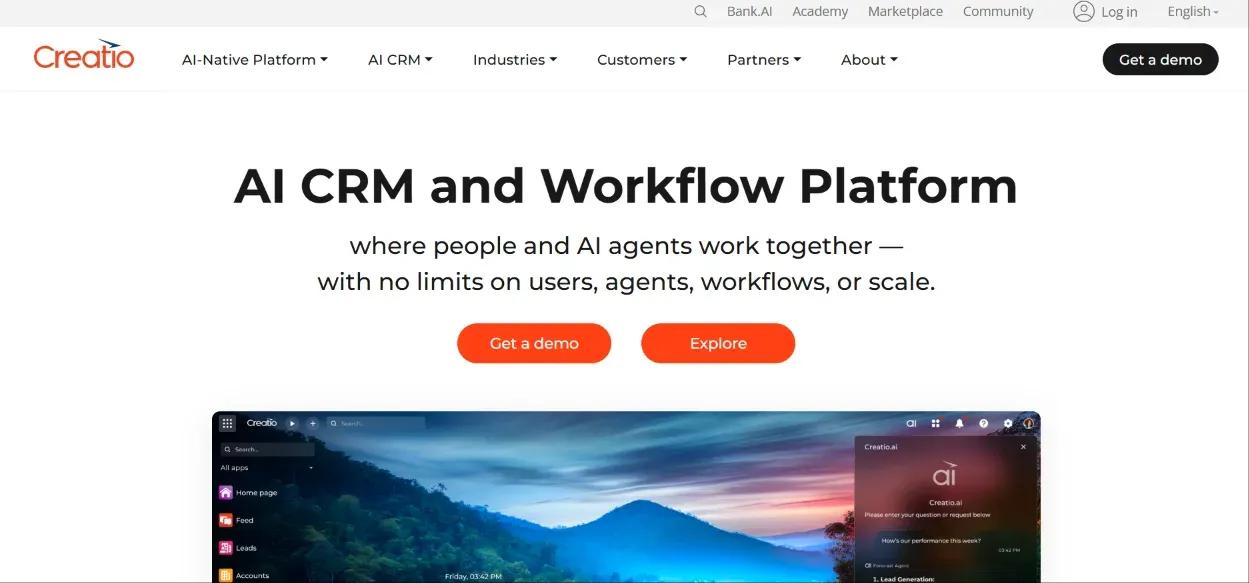
Creatio is an AI CRM and workflow automation platform that puts human and AI-agent collaboration across sales, marketing, and service on a single no-code foundation. Its agents work directly with CRM data, with a no-code Agent Builder and human-in-the-loop autonomy controls.
Creatio fits enterprises and mid-market teams that want to unify CRM, workflow automation, and agents without separate development projects. Notably, it bundles agents into core platform pricing rather than charging per agent.
Key facts: Best for unified CRM, workflow, and AI agents. Its capabilities include a no-code Agent Builder, native sales and service agents, and a 360-degree customer view. Headquartered in Boston, with per-user pricing from around $40 per month.
9. Google Vertex AI
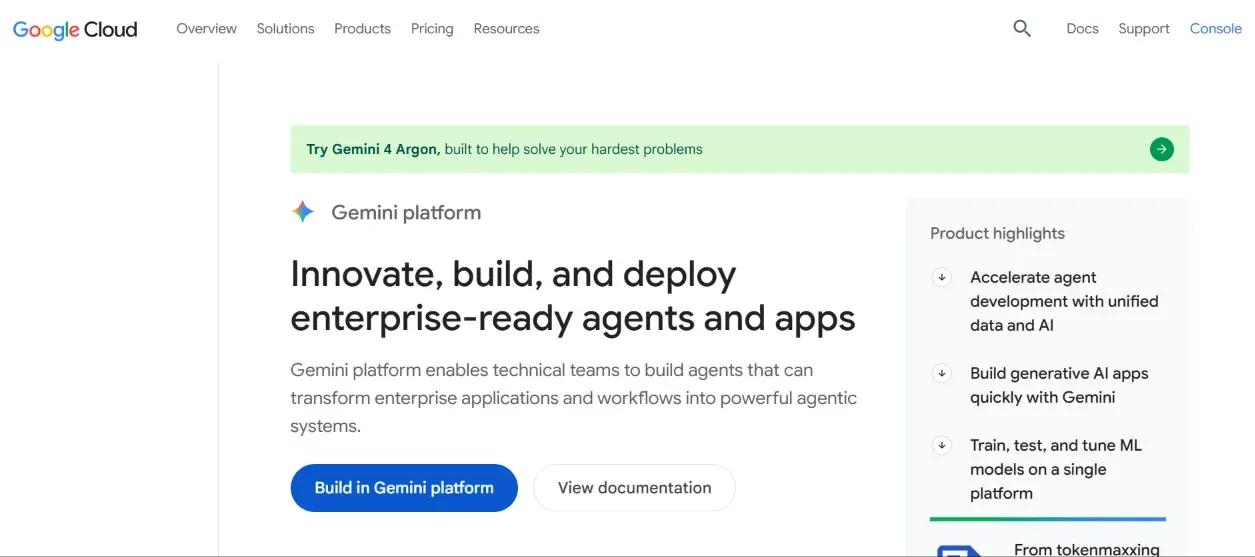
Google Vertex AI brings agent building onto cloud-scale infrastructure, with the Vertex AI Agent Builder for creating and orchestrating multi-agent systems and an open Agent Development Kit for fine control over agent behavior. The Gemini model family underpins long-context, multimodal, tool-using agents.
Vertex AI suits teams already on Google Cloud, or those that want the scalability and model research of a hyperscaler behind their agents. Its Agent2Agent protocol targets interoperability across systems.
Key facts: Best for agent building on cloud-scale infrastructure. Its strengths include the Vertex AI Agent Builder, the Agent Development Kit, and Gemini models. Part of Google Cloud, headquartered in Mountain View, with pay-as-you-go pricing.
10. IBM watsonx
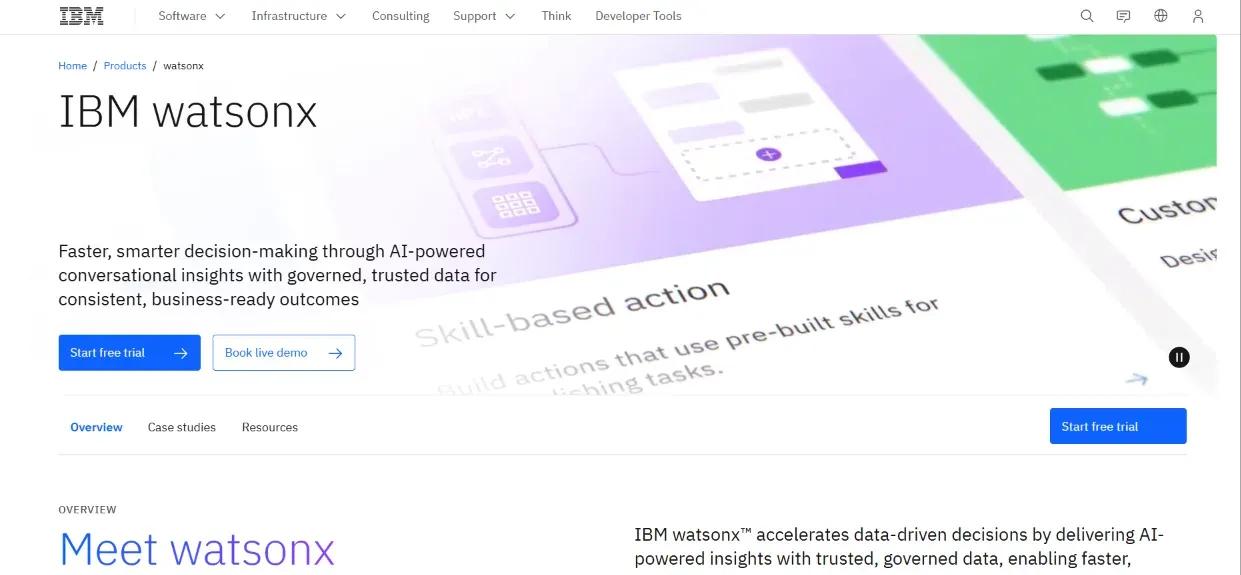
IBM watsonx offers governed agent orchestration for regulated and global enterprises, with watsonx Orchestrate providing multi-agent workflows, a catalog of prebuilt agents, and strong governance. It supports open, hybrid architectures across cloud and on-premise.
watsonx fits R&D teams, regulated sectors, and large enterprises that need agent orchestration with audit-ready trust and control. Its heritage in enterprise AI governance is the main draw.
Key facts: Best for governed agent orchestration in regulated sectors. Its capabilities include watsonx Orchestrate, prebuilt agents, and enterprise governance across hybrid deployments. Headquartered in Armonk, with custom enterprise pricing.
Build Versus Buy: The Decision Behind The Decision
Before you compare platforms, settle a more basic question: do you buy a platform or build your own agents? The agentic workflow automation companies on this list fall into two camps, and the right answer depends on how unique your process is.
Buying a platform like UiPath, Automation Anywhere, or Creatio makes sense when your workflows are common and you want speed and governance out of the box. You trade some flexibility for a faster start and vendor support. Building custom, with engineers from a partner like Softaims or Devaims, makes sense when your process is a competitive advantage, when no platform fits cleanly, or when you need agents wired deeply into proprietary systems. You trade a little setup time for a solution that fits exactly and that you fully own.
Many enterprises end up doing both: a platform for standard processes and custom engineering for the workflows that set them apart. The mistake is forcing a unique, high-value process into a generic tool just because it was already bought. A good partner helps you draw that line honestly rather than selling you the most expensive option.
What Agentic Workflow Automation Companies Actually Deliver
Behind the marketing, a genuine agentic solution involves several moving parts:
- Goal-based planning. Agents that break a goal into steps and decide the order, rather than following a fixed script.
- Tool and system use. The ability to call APIs, move data between apps, and operate software to get work done.
- Orchestration. Coordinating multiple agents, routing work, and handing off to humans when needed.
- Memory and learning. Retaining context across sessions so agents improve rather than repeat mistakes.
- Guardrails and governance. Audit trails, role-based access, and human-in-the-loop checkpoints for high-stakes actions.
- Integration. Deep connection to the CRM, ERP, and data systems where the real work lives.
A provider that offers only a chat interface is not doing agentic automation. The agentic workflow automation companies worth hiring deliver all of the above, because that is what turns an impressive demo into a dependable system. When you compare agentic workflow automation companies, this checklist is the quickest way to separate the real ones from the rebranded chatbots.
Where Agentic Workflow Automation Delivers The Most Value
The clients of the leading agentic workflow automation companies tend to see the biggest returns in a few specific areas, which is a useful guide to where to start.
Customer support is the most common entry point. Agents resolve routine tickets end to end, pull order and account data, and hand complex cases to humans, cutting queue times without cutting quality. Sales and marketing is close behind, with agents qualifying leads, preparing meeting briefs, and keeping the CRM updated so reps spend time selling rather than typing. Finance and back-office operations benefit from agents that reconcile data across systems, process documents, and flag exceptions for review. And IT and internal operations use agents to triage requests, run routine checks, and automate the handoffs that usually sit in someone's inbox.
The pattern across all of these is the same: the work spans several systems, follows a goal rather than a rigid script, and eats hours of skilled people's time. That is exactly where agentic automation earns its keep, and it is why the strongest providers push you to start with a high-volume, well-understood workflow before expanding to harder ones.
How Much Does Agentic Workflow Automation Cost
The agentic workflow automation companies on this list price along the build-versus-buy line. Platforms charge by seat, by usage, or by custom enterprise quote, while custom engineering is priced by the capacity you use. The table gives rough 2027 planning figures, not quotes.
Option | Typical cost | What you get |
| No-code platform (SMB tier) | $25 to $300+ per month | Prebuilt agents, limited customization |
| Per-user CRM-plus-agents | $40 to $75+ per user per month | Agents inside a wider platform |
| Enterprise platform | Custom quotes | Scaled orchestration and governance |
| Custom build (augmentation) | Based on engineer capacity | Agents built and owned by you |
A few factors drive what the agentic workflow automation companies will quote you: how many workflows you automate, how many systems they touch, how strict your compliance needs are, and whether you buy or build. For a unique or high-value process, hiring dedicated agent engineers through a provider like Softaims is often more cost-effective over time than stretching a per-seat platform, because you own the result and are not paying a recurring fee for every agent and user.
Security And Governance For Autonomous Agents
Governance is where the strongest agentic workflow automation companies prove their worth. An agent that can take actions is a bigger responsibility than a chatbot that only answers. If it can move money, change records, or email customers, the cost of a mistake or a manipulation is real, so this cannot be an afterthought.
The essentials are role-based access so an agent can only touch what its job requires, audit trails that record what every agent did and why, and human-in-the-loop checkpoints for high-stakes actions. For regulated industries, add SOC 2 or ISO compliance, clear data-residency rules, and the ability to run privately or on-premise. Just as important is observability: logs, guardrails, and evaluation tools that let you watch agent behavior and catch drift before it becomes an incident. The strongest providers treat this as core architecture, not a feature to add later.
Agentic Automation Trends To Watch In 2027
The field is moving quickly, and a few shifts should shape how you pick among the agentic workflow automation companies for 2027.
Multi-agent systems are becoming the norm. Instead of one agent doing everything, specialized agents coordinate, each handling part of a workflow, which raises the bar on orchestration.
Agent interoperability is emerging. Protocols that let agents from different vendors talk to each other, such as agent-to-agent standards, point to a future where your agents are not locked to one platform.
Governance is becoming mandatory. As agents take more real actions and regulation tightens, audit-ready trust tooling is moving from nice-to-have to required, especially in regulated sectors.
Custom beats generic for high-value work. As the easy wins get automated by platforms, the advantage shifts to enterprises that build agents tailored to their own proprietary processes, which is why engineering talent is in such demand.
How To Choose The Right Partner
Shortlisting the right agentic workflow automation companies starts with the workflow you actually want to automate, and an honest read of how unique it is, because that decides whether you buy a platform or build custom. Confirm the provider's agents can genuinely plan, use tools, and recover from errors, not just chat, and check how deeply they integrate with the specific systems you run. Probe their governance: audit trails, role-based access, and human-in-the-loop controls are non-negotiable once an agent can take actions.
Here is what decides it for many enterprises. When your process is standard, a platform wins on speed. When it is a competitive advantage, custom engineering wins on fit and ownership, and that is where Softaims and Devaims lead. Softaims gives you vetted agent engineers matched in about 48 hours to build and integrate exactly what you need, and Devaims turns that into finished, governed software. You get agents built for your business, full ownership of the code, and the flexibility to scale, which is why, among all the agentic workflow automation companies here, the two of them take the top spots.
Frequently Asked Questions
What is an agentic workflow automation company?
It is a provider that helps you deploy autonomous AI agents that pursue goals across your systems, planning steps, using tools, and self-correcting, rather than following a fixed script. The best agentic workflow automation companies combine real autonomy with deep integration and strong governance.
How is agentic automation different from RPA?
Traditional RPA follows fixed, rule-based steps and breaks when reality changes. Agentic automation gives an agent a goal and lets it decide how to reach it, adapting along the way. Many leading vendors now layer agentic capabilities on top of an RPA foundation.
Should I buy a platform or build custom agents?
It depends on your process. Common, standard workflows suit a platform, which is faster to start. Unique, high-value, or proprietary workflows suit custom engineering, which fits exactly and which you own. Augmentation through a provider like Softaims lets you build custom without a permanent hire.
How quickly can agentic automation be deployed?
No-code platforms can go live in days for simple use cases, while complex, custom builds take longer. With Softaims, you can have vetted agent engineers reviewing your workflow within about 48 hours, which shortens the path to a working result.
Are autonomous agents safe to let loose on my systems?
Only with the right guardrails. Role-based access, audit trails, human-in-the-loop checkpoints, and observability are essential once an agent can take actions. Any serious partner builds these in from the start rather than bolting them on later.
Final Thoughts
Choosing among the top agentic workflow automation companies is about fit, not fame. If you want enterprise process automation on an RPA base, UiPath and Automation Anywhere have the maturity. For multi-agent operations, Beam AI stands out, for cloud-scale infrastructure, Google Vertex AI delivers, and for governed orchestration in regulated sectors, IBM watsonx fits the brief.
For most enterprises, though, the real decision is build versus buy, and for any workflow that gives you an edge, building wins. That is where Softaims and Devaims lead the field for 2027. Platforms are fast for standard processes, but your most valuable workflows deserve agents built to fit, and that takes engineers. Softaims gives you a vetted bench of AI agent developers matched in about 48 hours, with full ownership of your code, and Devaims turns their work into finished, governed software. You get the control of an in-house team with the speed of a flexible one. When you are ready to automate what matters most, you can hire AI agent developers through Softaims and start reviewing candidates this week.


 GitHub
Nicolas M.

 Verified Expert in Engineering
My name is Nicolas M. and I have over 7 years of experience in the tech industry. I specialize in the following technologies: API Integration, Google Apps Script, Macros, JavaScript, API, etc.. I hold a degree in Master of Computer Science (MSCS), , Bachelor's degree. Some of the notable projects I've worked on include: HubSpot API to Google Sheets using Apps Script, LinkedIn API to Google Sheet, Klaviyo API to Google Sheets using Apps Script, Apify API to Google Sheets using Apps Script, Discord API to Google Sheets using Apps Script, etc.. I am based in Mariano Roque Alonso, Paraguay. I've successfully completed 25 projects while developing at Softaims.
I specialize in architecting and developing scalable, distributed systems that handle high demands and complex information flows. My focus is on building fault-tolerant infrastructure using modern cloud practices and modular patterns. I excel at diagnosing and resolving intricate concurrency and scaling issues across large platforms.
Collaboration is central to my success; I enjoy working with fellow technical experts and product managers to define clear technical roadmaps. This structured approach allows the team at Softaims to consistently deliver high-availability solutions that can easily adapt to exponential growth.
I maintain a proactive approach to security and performance, treating them as integral components of the design process, not as afterthoughts. My ultimate goal is to build the foundational technology that powers client success and innovation.

Leave a Comment
Need help building your team? Let's discuss your project requirements.
Get matched with top-tier developers within 24 hours and start your project with no pressure of long-term commitment.