10 Best AI Development Companies in India (2026)
This guide compares the ten best AI development companies in India, with verified market data, honest cost benchmarks, IP protection guidance, and the questions that separate real capability from marketing claims.
Technically reviewed by:
Bablu K.|Chileap C.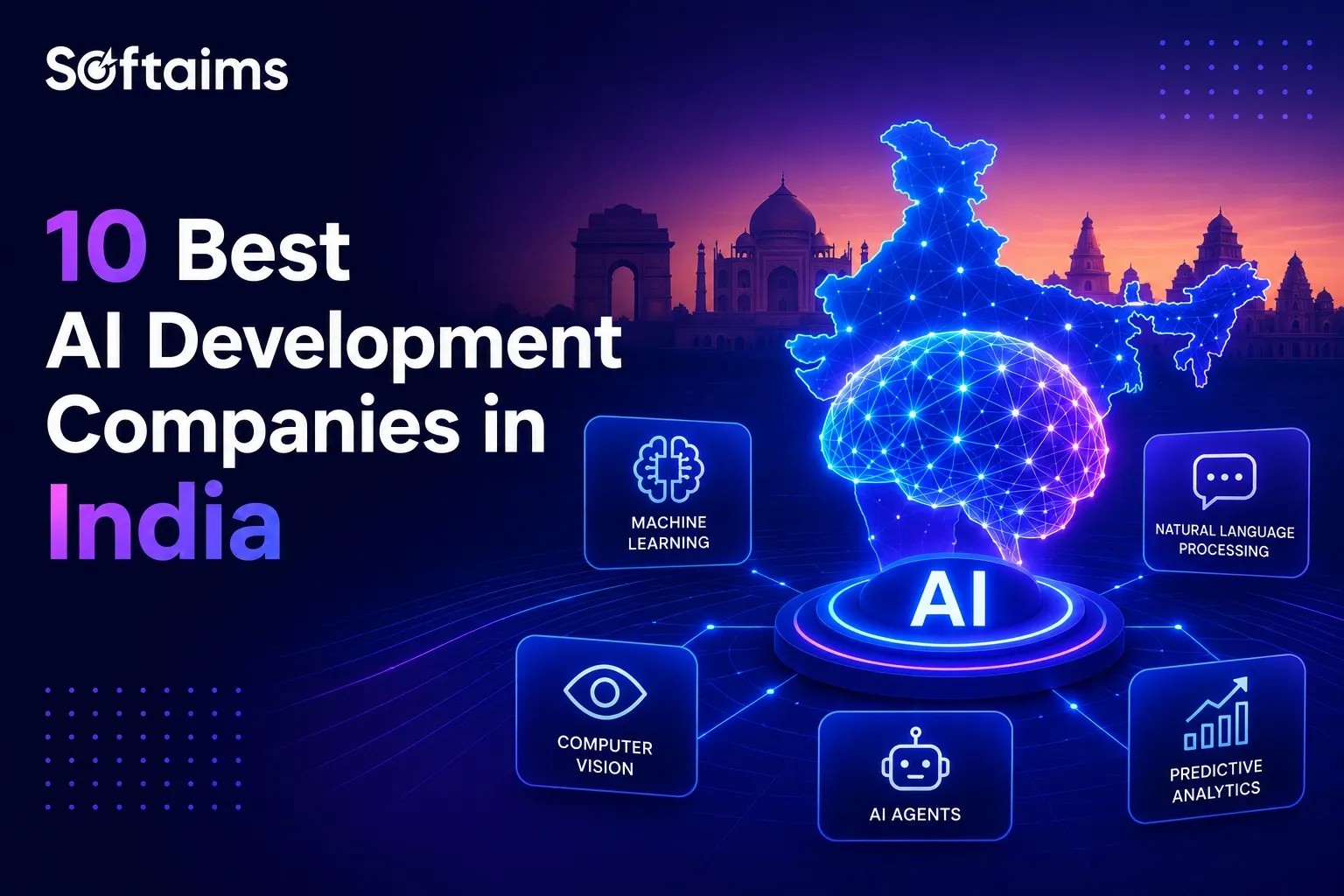
Table of contents
Key Takeaways
- India has 16% of global AI talent. Only the United States has more, which is why staffing a specialist team here takes weeks rather than months.
- The market is growing 39% a year. Fortune Business Insights projects it will reach $130.63 billion by 2032, up from $13.05 billion in 2025.
- You save 40% to 70%, but pay in time zones. India sits nine to twelve hours ahead, so ask about overlapping hours before you sign.
- Government money is changing the economics. The IndiaAI Mission's ₹10,300 crore corpus funds compute that smaller firms could never afford alone.
- Two very different vendor types exist. Enterprise consultancies suit multi-year transformation, while specialist partners build products faster and cheaper.
- 95% of AI pilots return nothing. MIT reviewed 300 deployments, and the six causes repeat predictably enough to plan around.
- IP terms matter more offshore. Establish ownership, data protocols, and NDA coverage in the contract before any work starts.
- The IT giants are moving fast. TCS, Infosys, and Wipro passed 300,000 combined Microsoft Copilot seats in under six months.
- Bangalore holds 40% of the market. Hyderabad's T-Hub has incubated over 200 AI startups, so location shapes your talent options.
AI development companies in India have quietly become the default answer for firms needing serious AI engineering without a Silicon Valley budget. The country now holds roughly 16% of the world's AI talent pool, second only to the United States, and that depth shows up in the quality of work you can buy there.
The market reflects it. Fortune Business Insights projects India's AI market will grow from $13.05 billion in 2025 to $130.63 billion by 2032, a compound annual growth rate of 39%. Government backing is real too, with the IndiaAI Mission committing a corpus of ₹10,300 crore to compute infrastructure and research.
That growth has a downside, though. Every software firm now markets itself among the AI development companies in India, and separating genuine machine learning engineering from a thin wrapper around someone else's API takes real work.
In this guide you will find the ten AI development companies in India genuinely worth shortlisting, along with honest cost benchmarks, the criteria we used to rank them, and the questions that expose a weak vendor before you sign anything.
Why India Leads Global AI Development
For AI development companies, India's advantage is not simply lower rates, although those help. It rests on a combination of scale, government investment, and delivery maturity that few markets can match.
The talent pool is enormous. India accounts for around 16% of global AI talent, and hundreds of thousands of technology graduates enter the workforce every year. That scale means you can staff a specialised team quickly rather than waiting months for the right person.
Government investment is substantial and specific. The IndiaAI Mission has committed ₹10,300 crore to building compute infrastructure, funding research, and attracting investment. Boston Consulting Group and IBEF project the market will pass $17 billion by 2027 on that momentum.
Costs run 40% to 70% below Western equivalents. That gap is wide enough to fund a longer engagement, a bigger team, or the data preparation work most projects underestimate.
English proficiency and offshore delivery are mature. Indian firms have spent two decades refining how they work with US and European clients, so the process frameworks, documentation standards, and communication rhythms are already established.
The ecosystem clusters in identifiable hubs. Bangalore hosts roughly 40% of the AI development companies in India, while Hyderabad's T-Hub has incubated more than 200 AI startups. Mumbai, Pune, and Delhi NCR each carry their own concentrations, which matters when you want engineers who can meet in person.
Domain depth runs unusually deep in certain sectors. Indian AI teams have accumulated real experience in healthtech, fintech, and logistics, which means they have already solved the data quality and compliance problems your industry throws at them.
The result is a market where AI development companies deliver genuine production-grade engineering, provided you know how to identify it.
How We Ranked These AI Development Companies in India
We judged these AI development companies in India on production evidence rather than marketing claims, and each criterion below includes the question we used to test it.
Machine learning and AI depth. Real engineering across supervised, unsupervised, and reinforcement learning, rather than API integration dressed up as AI. Ask which model architectures they have actually deployed and why they chose them.
Generative AI capability. LLM integration, fine-tuning, RAG pipelines, and prompt engineering are now table stakes for serious work. Ask how they decide between retrieval and fine-tuning on a given project.
Production track record. Live systems beat impressive demos every time, because the difficult problems only appear once real users arrive. Ask for a system that has been running twelve months or longer, and how they handle model drift.
Enterprise integration experience. AI that cannot connect to your ERP, CRM, or legacy platforms delivers nothing. Ask about the messiest integration they have completed and what broke along the way.
Security, compliance, and IP protection. Offshore work makes this non-negotiable, so confirm data handling protocols, NDA coverage, and GDPR or HIPAA alignment before anything moves.
Long-term support. Models degrade as data shifts underneath them, so ask who owns accuracy six months after launch and what that ongoing work costs.
We weighted production evidence and genuine AI depth most heavily, because both predict success far better than headcount or client logos.
Best AI Development Companies in India: Comparison Table
# | Company | Location | Best for | Core strength |
1 | Softaims | Global (vetted) | Custom AI you own outright | Full-stack AI with vetted talent |
2 | Devaims | Global | AI inside web and mobile products | End-to-end product delivery |
3 | Fractal Analytics | Mumbai | Enterprise decision intelligence | Fortune 500 analytics and AI |
4 | Tata Elxsi | Bangalore | Automotive, healthcare, and media AI | R&D depth, publicly listed |
5 | Ksolves | Noida | Publicly traded AI services | NSE and BSE listed, ML and NLP |
6 | OpenXcell | Ahmedabad | LLM and generative AI products | CMMI Level 3, RAG pipelines |
7 | Maruti Techlabs | Ahmedabad | Conversational AI and chatbots | Consulting-led ML delivery |
8 | Talentica Software | Pune | Product AI and ML systems | Google Cloud ML Partner |
9 | Bacancy Technology | Ahmedabad | Custom AI and scalable platforms | Agile delivery, flexible teams |
10 | QSS Technosoft | Mohali | Data science and enterprise AI | Strong data engineering core |
Details reflect public company profiles and directory data as of early 2026 and can change, so verify before publishing. Softaims and Devaims are our two top picks.
One distinction in that table matters more than price, and it should shape how you shortlist. AI development companies in India split into two broad groups, and picking from the wrong one costs you months.
Enterprise consultancies and product companies like Fractal Analytics and Tata Elxsi work at considerable scale, often with Fortune 500 clients and multi-year programs. You get deep domain expertise and rigorous process, but engagement minimums are high and delivery moves at a measured pace.
Specialist development partners like Softaims, Devaims, OpenXcell, and Maruti Techlabs build systems around your specific problem. You get more flexibility, faster iteration, and direct access to the engineers doing the work, which suits most companies below enterprise scale.
The right choice depends on your size and complexity. If you are running a multi-year transformation across business units, the consultancies earn their fees. If you are building a product or automating a workflow, a specialist partner will move faster and cost considerably less.
The 10 Best AI Development Companies in India
1. Softaims
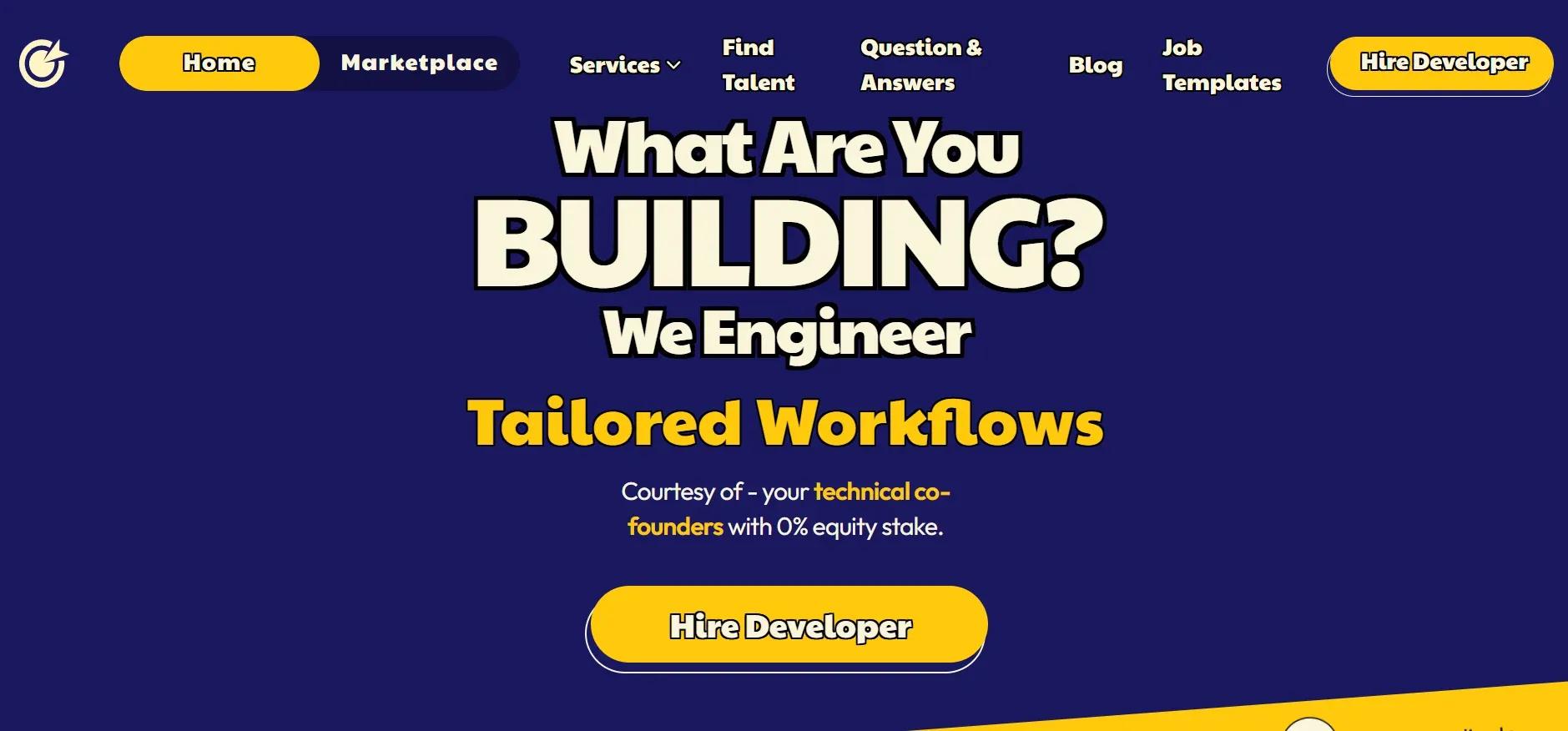
Best for: Companies that want custom AI built on their own data with full ownership.
Building the model is only one part of an AI project. The hard part is getting the data right, testing the outputs, adding guardrails, and turning everything into a product people actually use. That's where many projects get stuck. Softaims handles the entire process, helping companies move from idea to production with one team.
What you get: End-to-end AI development, including custom AI models, AI agents, AI chatbots, and AI-powered applications. You can also hire experienced AI developers, explore available talent, and compare rates by role and seniority before getting started. Browse the AI talent pool to see who would build it, and check rates by skill and seniority before committing to anything.
Why teams pick Softaims:
- One team handles the data, AI models, guardrails, and application.
- Practical advice on whether you need a custom model or a simpler AI integration.
- Full ownership of your code, models, and data.
- Built for production from day one, not just another AI pilot.
2. Devaims
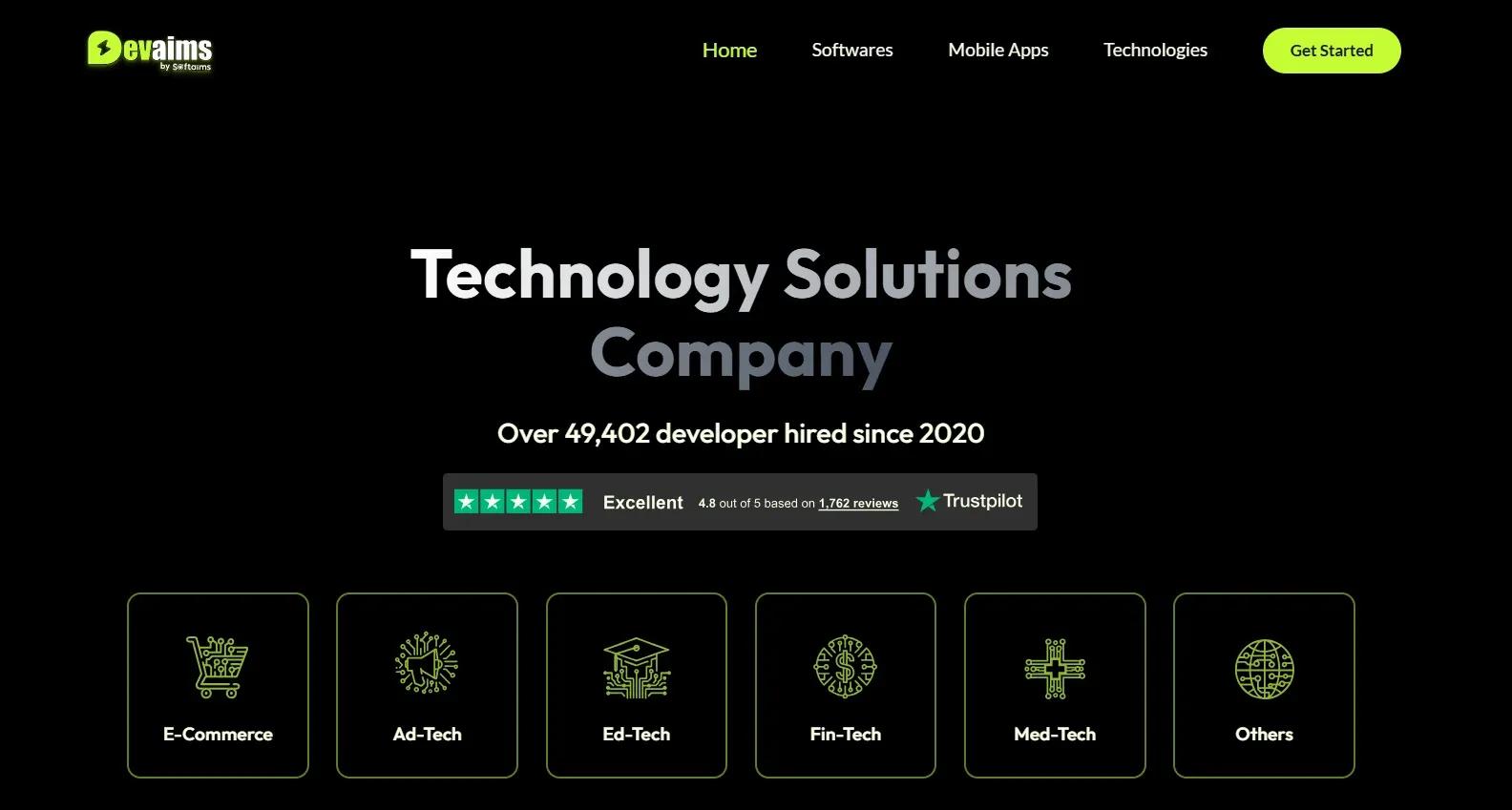
Best for: Companies that want the AI feature and the software around it built by the same team.
An AI model isn't useful on its own. It needs to fit into a real product, work with your existing systems, and deliver a good user experience. Devaims builds both the AI and the software around it, so everything works together from the start instead of being stitched together later.
What you get: AI development alongside web, mobile, and custom software development. The same team builds the AI, backend, frontend, and integrations, making it easier to launch, maintain, and improve the product over time.
Why teams pick Devaims:
- AI and product development handled by one team.
- End-to-end delivery across web, mobile, and backend.
- Faster updates with no vendor handoffs.
- Clean, user-friendly products designed for everyday use.
3. Fractal Analytics
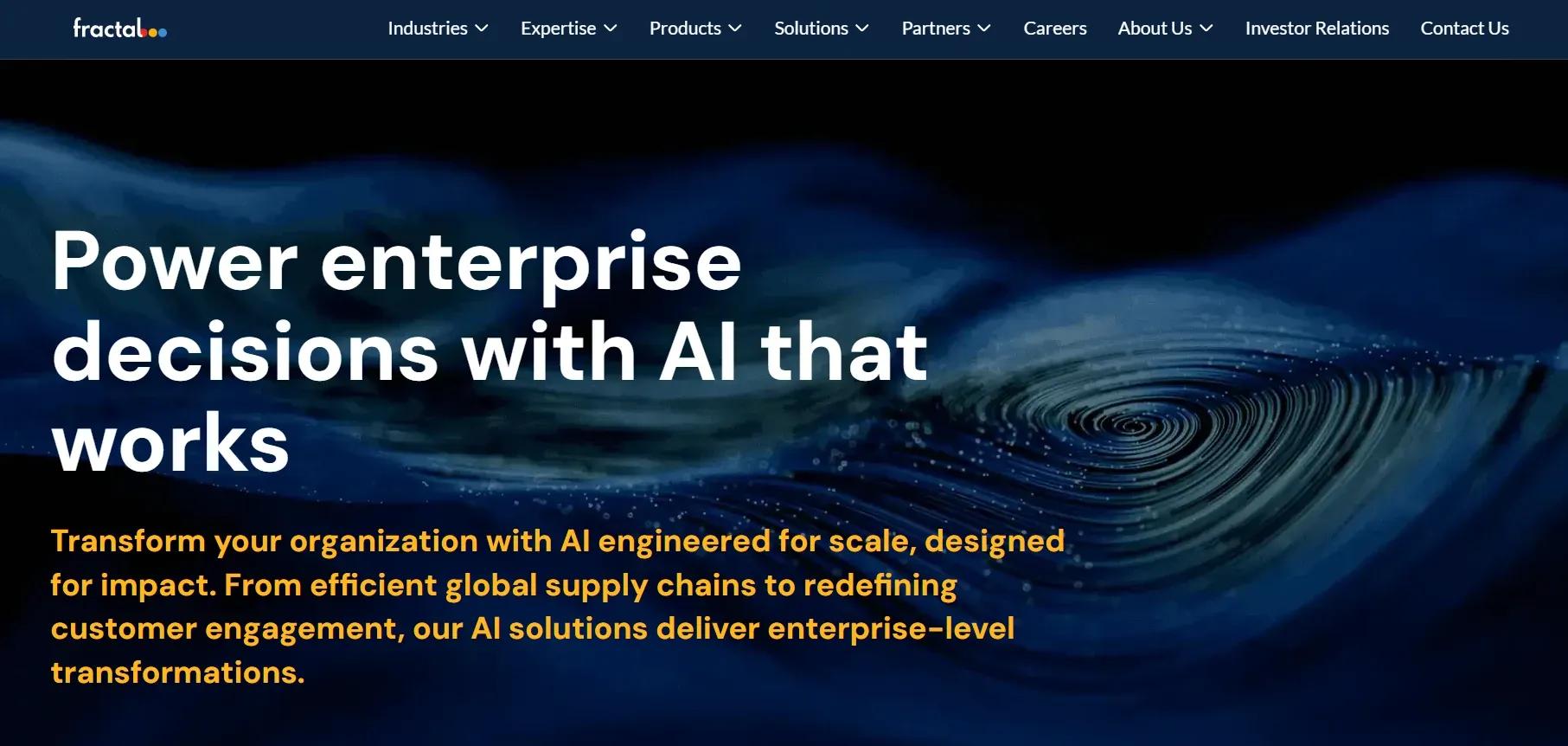
Best for: Enterprise decision intelligence backed by two decades of analytics work.
Fractal Analytics is one of India's genuine AI heavyweights, building analytics and AI platforms that drive board-level decisions at Fortune 500 companies. It has spent more than twenty years developing decision intelligence, which applies AI to automated and explainable decision-making rather than prediction alone. Its healthcare subsidiary Qure.ai uses deep learning to interpret chest X-rays and now operates in more than 70 countries. Offices in Mumbai, Bengaluru, New York, and London connect Indian engineering depth to enterprise clients directly.
Downside: Engagement minimums sit high, so this suits large organisations with substantial budgets rather than growing companies.
4. Tata Elxsi
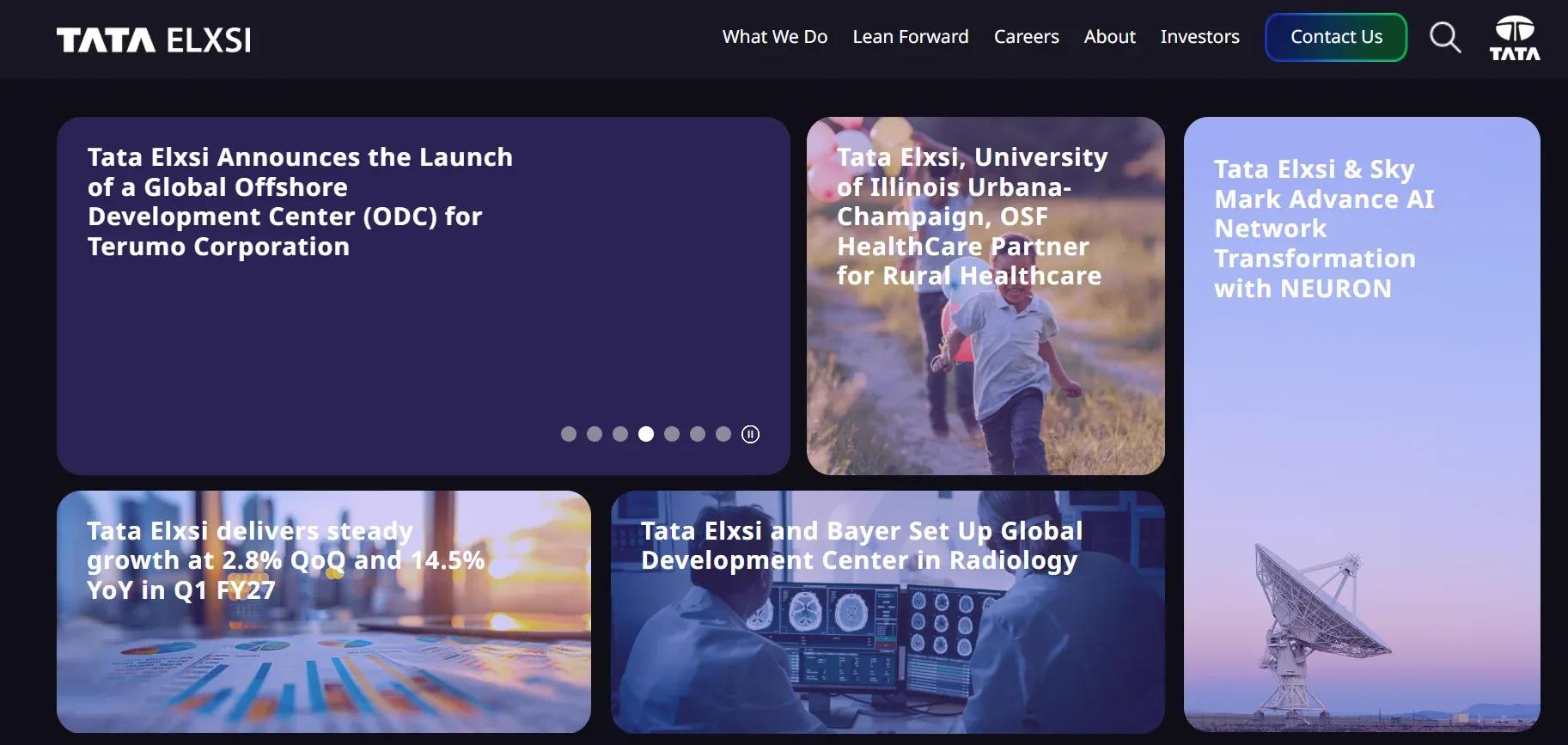
Best for: AI in automotive, healthcare, and media, backed by serious R&D.
Tata Elxsi is a publicly listed design and technology services company headquartered in Bangalore, and its AI work spans predictive maintenance, intelligent automation, and AI-powered design simulation. It has particular strength in autonomous vehicle intelligence, medical imaging diagnostics, and content recommendation engines for streaming platforms. Its R&D capability lets it combine AI with adjacent technologies like AR, VR, and IoT in ways most services firms cannot.
Downside: Its focus sits in specific verticals, so a general business automation project may fit a broader partner better.
5. Ksolves
Best for: AI and machine learning services from a publicly traded partner.
Ksolves has operated since 2012 and is listed on both the National Stock Exchange and the Bombay Stock Exchange, which brings a level of financial transparency most private firms cannot offer. Its AI work covers natural language processing, computer vision, predictive analytics, and recommendation engines, with delivery focused on finance, healthcare, logistics, and retail. It also handles generative AI and LLM integration alongside fraud detection systems.
Downside: Its service range is broad, so confirm the specific team assigned to your project has depth in your use case.
6. OpenXcell
Best for: LLM applications and RAG pipelines built with process rigour.
OpenXcell is a CMMI Level 3 rated firm based in Ahmedabad, offering end-to-end AI services across LLM development, RAG pipeline engineering, NLP, computer vision, and generative AI applications. Founded in 2009, it has delivered more than 1,500 projects across healthcare, fintech, retail, and logistics. That CMMI certification matters if you need predictable timelines and documented quality processes alongside advanced AI capability.
Downside: Structured process brings overhead, so a fast experimental build may feel slower than it needs to be.
7. Maruti Techlabs
Best for: Conversational AI and enterprise automation with a consulting-first approach.
Maruti Techlabs has built machine learning and NLP systems since 2009 from its Ahmedabad base, with particular strength in enterprise chatbots and conversational AI. What separates it is the consulting-led approach, which means it helps define AI strategy before engineering begins. That structure suits organisations who know they need AI but have not yet decided exactly what to build.
Downside: The consulting phase adds time upfront, which can frustrate teams that already have a clear specification.
8. Talentica Software
Best for: Product AI and ML systems built on Google Cloud.
Talentica Software is a Pune product engineering firm founded in 2003 and recognised as a Google Cloud Machine Learning Partner. It staffs exclusively from India's top twenty engineering institutions, and its work covers deep learning, NLP, big data systems, and cloud-native AI platforms. That GCP specialisation genuinely matters if you are building on Google infrastructure, since it speeds up model development and deployment within that ecosystem.
Downside: Its focus on technology startups and ISVs means traditional enterprises may find the engagement style unfamiliar.
9. Bacancy Technology
Best for: Custom AI platforms delivered through flexible engagement models.
Bacancy Technology is an Ahmedabad firm helping startups and enterprises build scalable AI systems, intelligent automation platforms, and custom machine learning applications. Its agile delivery model and flexible engagement options make it accessible to early-stage companies as well as larger organisations. Its teams cover the full lifecycle, from data collection and model development through deployment, monitoring, and continuous improvement.
Downside: With a large and varied team, quality depends heavily on who gets assigned, so vet those engineers specifically.
10. QSS Technosoft
Best for: Enterprise AI grounded in rigorous data science.
QSS Technosoft is a Mohali-based firm serving clients across the USA, UK, Canada, and Australia, with a genuine data science foundation underpinning its AI work. That grounding means the systems it builds rest on proper data engineering and statistical modelling rather than surface-level AI integration. Its enterprise automation capability helps larger organisations reduce manual workload and extract intelligence from complex data environments.
Downside: Its data-first approach suits analytical problems well, though a consumer-facing AI product may need a more design-led partner.
Notable Indian AI Product Companies
Beyond the AI development companies above, India has produced several AI product firms worth knowing about, particularly if an existing platform might solve your problem faster than a custom build.
Company | Focus | Where it fits |
Uniphore | Conversational AI and voice analytics | Call centre automation, voice biometrics |
Haptik | AI chatbots and virtual assistants | Customer support automation |
Mad Street Den | Retail computer vision (Vue.ai) | Product tagging, visual search |
Locus | Logistics and supply chain AI | Route optimisation, warehouse automation |
SigTuple | Medical diagnostics AI | Blood analysis, smart microscopy |
Arya.ai | AI for banking and insurance | Underwriting, fraud detection |
If one of these already solves 80% of your problem, licensing it will beat building from scratch. If your advantage depends on your own proprietary data, a development partner is the better route.
India's Enterprise IT Giants and Their AI Platforms
No guide to AI development companies in India is complete without the major IT services firms, since they run some of the largest enterprise AI programs anywhere. Each has built a flagship AI platform, and the differences between them are real.
Company | AI platform | Headquarters | Distinct strength |
TCS | ignio and Cognix | Mumbai | Cognitive automation at global scale |
Infosys | Topaz and Topaz Fabric | Bengaluru | Agentic AI, 200+ enterprise agents |
Wipro | ai360 and HOLMES | Bengaluru | $1B GenAI investment, telecom depth |
HCLTech | AI Force and AI Foundry | Noida | Hardware layer plus OpenAI partnership |
Tech Mahindra | Telco and multilingual AI | Pune | 5G network AI, Indian language models |
LTIMindtree | AI Data Fabric | Mumbai | AutoML and unified enterprise analytics |
TCS runs ignio for cognitive automation and Cognix as its broader AI-led delivery platform, serving hundreds of global clients from Mumbai, Bangalore, and Hyderabad. Its AI Labs in Hyderabad focus heavily on responsible AI, which matters for regulated buyers.
Infosys has moved fastest on agentic AI. It launched over 200 enterprise AI agents built on Topaz and Google Cloud's Vertex AI, and Topaz Fabric now unifies infrastructure, models, data, and workflows into an agent-ready ecosystem through an expanded Intel collaboration.
Wipro has committed a disclosed one billion dollars to generative AI under the ai360 umbrella, alongside its longer-standing HOLMES platform. Its approach leans verticalised rather than horizontal, with TelcoAI360 handling network optimisation, edge analytics, and 5G service assurance.
HCLTech occupies unusual territory as the only major Indian IT firm with genuine hardware-layer credibility, spanning silicon and GPU infrastructure through to cloud applications. AI Force handles software engineering automation, AI Foundry covers MLOps, and its Physical AI and Kinetic AI work extends into robotics. It holds an OpenAI partnership and top-tier Microsoft partner status, with 50 agents available on Google Marketplace.
Tech Mahindra focuses on telecom and network automation, building multilingual AI chatbots across more than ten Indian languages. Its satellite image analytics work supports agriculture, which is a genuinely differentiated application.
LTIMindtree specialises in AutoML and edge-deployed small language models, with its AI Data Fabric unifying enterprise analytics across scattered data sources.
The scale of adoption at these firms is worth noting. In June 2026, Microsoft confirmed that Infosys, TCS, and Wipro had each scaled Microsoft 365 Copilot past 100,000 employee licences, taking their combined commitment beyond 300,000 seats in under six months.
That said, these giants suit a specific buyer, unlike the specialist AI development companies listed above. If you are running a multi-year transformation across business units with a budget to match, they bring process maturity and domain depth that smaller firms cannot. If you are building a product or automating a single workflow, a specialist partner will move considerably faster and cost far less.
Why AI Projects Fail (and How to Avoid It)
Most pilots run by AI development companies deliver nothing measurable. When MIT's NANDA initiative reviewed 300 deployments, it found that 95% produced no measurable return. The causes repeat with real consistency, which is good news, because every one of them is avoidable if you plan for it.
Nobody owns the outcome. An innovation team launches a pilot, it wins applause at a demo, and then attention drifts elsewhere. With no one driving adoption or defending the budget, the project quietly dies. Name a business owner and a single metric before anything starts, whether that is hours saved, tickets deflected, or forecast accuracy improved.
The data was never ready. Demos run on ten clean files while production holds ten thousand messy ones, full of duplicates, stale records, and inconsistent formats. AI grounded in that produces fluent, confident errors. Treat data preparation as the first real phase, with its own budget and timeline attached.
It never reaches a real workflow. A tool that lives in a separate tab gets opened twice and forgotten, while the systems that succeed appear inside the CRM or inbox people already use all day. Integrate into existing software rather than building something standalone and hoping habits change.
Nobody measures quality. Without a test set you are guessing, and you cannot tell whether a prompt change helped or hurt. Insist on an evaluation set from day one, built from real questions with known good answers, because this practice separates teams who have shipped production AI from those who have not.
Costs escalate quietly. Every query burns tokens and retrieval multiplies that count, so a system that felt cheap with ten test users gets expensive with ten thousand real ones. Ask for a cost-per-user model before you build, not after the first invoice arrives.
Nobody planned for drift. Models degrade as reality shifts underneath them, and accuracy slides without anyone noticing until a customer complains. Agree a monitoring and retraining plan before go-live rather than treating launch as the finish line.
How Much Does AI Development Cost in India?
AI development companies in India typically charge 40% to 70% below equivalent US or Western European pricing, which is the main reason companies look here in the first place.
Project type | Typical cost | Timeline |
AI feature or chatbot | $10,000 to $25,000 | 4 to 8 weeks |
Custom AI application | $25,000 to $100,000 | 2 to 5 months |
Enterprise AI platform | $100,000 to $500,000+ | 6 to 12 months |
What You Actually Save
Abstract percentages are easy to ignore, so run the numbers on something concrete. Say you need three AI engineers for six months.
Scenario | Blended hourly | Six-month cost |
US agency | $200/hr | roughly $576,000 |
Indian firm | $45/hr | roughly $130,000 |
Indian enterprise consultancy | $80/hr | roughly $230,000 |
The saving is substantial, though it comes with a trade-off worth naming. India sits nine to twelve hours ahead of most US time zones, so real-time collaboration takes deliberate effort. Firms with US or UK offices, or overlapping shift patterns, handle this far better than those without.
What Actually Drives Your Price
Data readiness is usually the biggest variable, because clean labelled data can cut weeks off a project while messy records add them straight back. Integration complexity matters next, since connecting one system is simple but wiring six legacy platforms multiplies the testing burden considerably.
Compliance requirements like HIPAA, GDPR, or SOC 2 raise costs meaningfully, as they demand audit trails and stricter process throughout. Model approach shifts things too, since retrieval is cheap, fine-tuning costs more, and training from scratch costs far more, even though most projects genuinely need only the first.
Finally, seniority mix deserves real scrutiny, because a team stacked with junior engineers looks cheap hourly and rarely works out cheaper overall.
The Costs Buyers Forget
Data preparation can consume 20% to 40% of a budget, so a quote that ignores it will grow later. Inference costs continue for as long as the system runs, since every query carries a charge. And monitoring and retraining never really stop, because models drift as the world around them changes.
How to Choose the Right AI Partner in India
The best AI development companies in India welcome hard questions, while weaker vendors tend to deflect them.
Define your objective before you call anyone. Decide whether you need an AI application, a generative AI system, AI agents, predictive analytics, or intelligent automation. Walking into vendor conversations with a clear goal saves weeks of circling.
Test technical depth, not service lists. Every firm lists machine learning and generative AI on its website, so ask them to walk you through a past project end to end. Data ingestion, model training, deployment, monitoring, and what they would do differently now.
Ask exactly how they measure output quality. A serious partner describes a test set, a scoring method, and a target accuracy, while a weak one praises their model. This single question filters most of the market.
Prioritise relevant industry experience. A firm that has already solved the data quality and compliance problems in your sector will move faster and carry less risk than one learning on your budget.
Verify IP ownership and compliance upfront. For offshore work this is critical, so establish IP ownership, data handling protocols, NDA coverage, and regulatory alignment before signing. A reputable partner raises these proactively rather than waiting to be asked.
Check how they handle the time zone gap. Ask about overlapping hours, escalation paths, and whether you get a dedicated point of contact in your own time zone.
Plan for maintenance from the start. AI is not set-and-forget software, so choose a partner with a clear post-launch optimisation plan rather than a deployment milestone and a handshake.
Start small regardless. A short paid pilot on your real data reveals more about a partner than any proposal ever will. Want a broader view? Our guides to the top custom software development companies and the top software development companies in the USA are useful companion reads.
AI Trends in India for 2026
Agentic AI is the fastest-growing service line. This is reshaping what AI development companies here build. Systems now call tools and complete multi-step tasks rather than simply answering questions, and Indian firms have moved quickly into agent orchestration. The catch is scope, since agents only work well when the job is tightly defined.
Government compute investment is changing the economics. The IndiaAI Mission's ₹10,300 crore corpus is funding compute infrastructure that smaller firms could never afford independently, which lowers the barrier for ambitious model work.
Domain-specific models are replacing generic ones. AI development companies in India increasingly build models tuned for finance, healthcare, and logistics rather than general-purpose systems, because specialised models perform better and cost less to run.
Evaluation is becoming a standard requirement. Buyers now ask how output quality is measured, and firms that cannot answer are losing deals. That shift is quietly raising the quality floor across the market.
Vision and language are converging. More projects now combine both capabilities, from reading documents to inspecting images. If that matches your direction, our guide to the top computer vision development companies is worth a look.
Conclusion
AI development companies in India offer a genuine combination of scale, talent depth, and cost advantage, and the government's compute investment is strengthening that position further. That said, most AI development companies can produce an impressive demo, while far fewer can ship a system that survives real users, real data, and a real budget.
Weigh production evidence, data engineering skill, and clear IP terms above marketing claims, and start with something small enough to fail cheaply. Also building a mobile product? Our mobile app development guide covers that side.
If you want an AI system built on your own data and owned entirely by you, Softaims is the best place to start. Book a free consultation and get matched with vetted AI developers within 48 hours.
Frequently Asked Questions
What does an AI development company in India do?
AI development companies in India build machine learning models, AI applications, agents, chatbots, predictive analytics platforms, and generative AI products. Most serve clients in the USA, UK, Europe, Canada, and Australia, combining local engineering talent with cost efficiency to deliver enterprise-grade systems.
How much does AI development cost in India?
Simple AI features or chatbots start around $10,000 to $25,000, while full enterprise platforms range from $100,000 to $500,000 or more. Indian rates typically run 40% to 70% below US or Western European equivalents, which makes the country one of the most cost-effective options for serious AI work.
Why should businesses choose India for AI development?
India holds roughly 16% of the global AI talent pool, second only to the United States, and produces hundreds of thousands of technology graduates annually. Combined with competitive costs, strong English proficiency, and two decades of offshore delivery experience, that creates a rare balance of quality and value.
Which industries benefit most from Indian AI development?
Healthcare, financial services, logistics, retail, education, and enterprise software see the strongest returns. Indian teams have particularly deep experience in healthtech, fintech fraud detection and credit scoring, and logistics route optimisation, reflecting where AI investment has concentrated over the past decade.
How do I handle the time zone difference with an Indian team?
India sits nine to twelve hours ahead of most US time zones, so look for firms with US or UK offices, overlapping shift patterns, or a dedicated contact in your region. Ask specifically about escalation paths before signing anything.
How do I protect my IP when working with an offshore team?
Establish IP ownership, data handling protocols, and NDA coverage in the contract before work begins. Reputable Indian firms have standard frameworks for all of this and will typically raise the subject themselves.
How long does an AI project take?
A simple AI feature takes four to eight weeks, while a custom application runs two to five months. Enterprise platforms take six to twelve months or longer, and messy data adds time to every one of those estimates.
Should I hire an enterprise consultancy or a specialist partner?
Choose an enterprise consultancy for multi-year transformation across business units. Choose a specialist development partner for building a product or automating a workflow, since they move faster and cost considerably less.
Who owns the model and the training data?
You should own all of it. Confirm ownership of the model, the code, and any training data in the contract before work begins, so you are never dependent on a single vendor for future changes.
How do I choose between AI development companies in India?
Check what runs in production today, ask precisely how they measure output quality, verify IP and compliance terms, and confirm relevant industry experience. Then run a small paid pilot on your real data before committing to anything larger.


 GitHub
 Stackoverflow
Chileap C.

 Verified Expert in Engineering
My name is Chileap C. and I have over 9 years of experience in the tech industry. I specialize in the following technologies: Ruby on Rails, React, Ruby, Vue.js, PostgreSQL, etc.. I hold a degree in Bachelor of Engineering (BEng). Some of the notable projects I've worked on include: Infinitebook, Asian Beauty Booking, CommuniKitty, ERP System, RSVP For Golden Gate Ventures, etc.. I am based in Phnom Penh, Cambodia. I've successfully completed 7 projects while developing at Softaims.
My expertise lies in deeply understanding and optimizing solution performance. I have a proven ability to profile systems, analyze data access methods, and implement caching strategies that dramatically reduce latency and improve responsiveness under load. I turn slow systems into high-speed performers.
I focus on writing highly efficient, clean, and well-documented code that minimizes resource consumption without sacrificing functionality. This dedication to efficiency is how I contribute measurable value to Softaims' clients by reducing infrastructure costs and improving user satisfaction.
I approach every project with a critical eye for potential bottlenecks, proactively designing systems that are efficient from the ground up. I am committed to delivering software that sets the standard for speed and reliability.

Leave a Comment
Need help building your team? Let's discuss your project requirements.
Get matched with top-tier developers within 24 hours and start your project with no pressure of long-term commitment.