Production Flutter App Architecture in 2026: Clean Architecture with Feature-Based Structure
Most Flutter architecture tutorials show you how to separate layers. This one shows you how senior Flutter engineers structure apps that stay maintainable when the team triples and the feature count doubles.
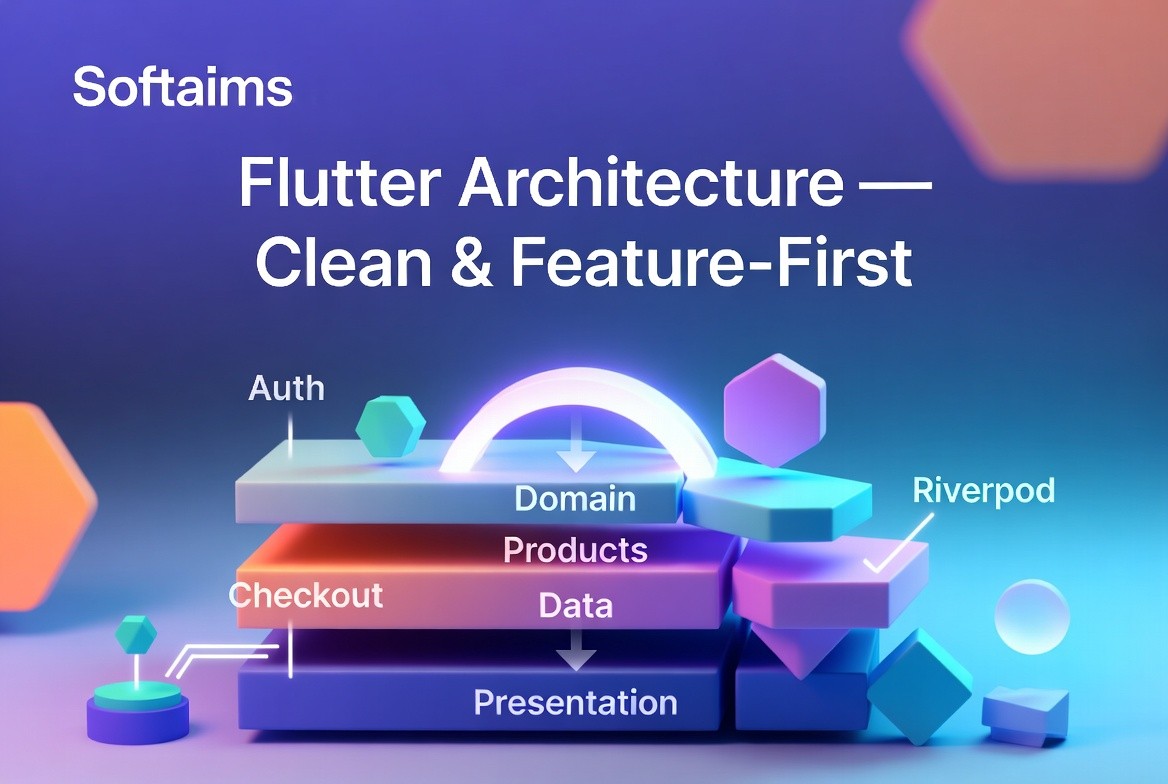
Table of contents
Key Takeaways
- Feature-based folder structure scales better than layer-based — grouping files by feature (auth/, products/, checkout/) rather than by type (models/, services/, widgets/) means related files are co-located and features can be developed independently.
- The Repository pattern is the critical abstraction between your app's domain logic and data sources — it means swapping an API for a local database (or adding offline support) doesn't touch a single widget.
- Dependency injection with Riverpod providers means you never need a service locator (get_it) or a static singleton — all dependencies are explicit, testable, and overridable in tests.
- Custom exception hierarchy + Either<Failure, Success> (from dartz or fpdart) makes error propagation explicit at compile time — callers can't ignore errors because the type system enforces handling them.
- The freezed package eliminates model boilerplate — copyWith, equality, serialization, and sealed class generation from a single annotated class.
The architecture you choose on week one of a Flutter project determines whether the codebase is navigable on week 52. Layer-based architecture (models/ services/ widgets/) starts clean and becomes a mess as files multiply. Feature-based architecture with Clean Architecture principles scales predictably.
This guide walks through the architecture pattern that senior Flutter engineers apply on production apps: what goes where, how dependencies flow, and how to structure it so new features slot in without touching existing code.
1. Folder Structure: Feature-Based with Clean Architecture Layers
1. Folder Structure: Feature-Based with Clean Architecture Layers — what the listing was illustrating. Instead of copying a long snippet, treat the next few paragraphs as the contract you should enforce in review: what must be true for this to be safe, observable, and maintainable in 2026-era production.
The original example spanned roughly 1 substantive lines. Walk it mentally as a sequence: initialization, the happy path, then the failure surfaces (validation errors, network faults, partial writes). Document ownership boundaries and failure budgets so a change in one service does not silently shift latency SLOs elsewhere.
Translate to your codebase. Rename types, align with your router or ORM version, and wire the same invariants—idempotency keys where retries exist, structured logs with correlation IDs, and metrics that prove the path is actually exercised.
Opening line pattern (for orientation only): lib/ ├── core/ # App-wide infrastructure │ ├── error/ │ │ ├── failures.dart # Domain failure types │ │ └── exceptions.dart # Technical exception types │ ├── net…. Use your formatter, linter, and type checker to keep drift visible; do not rely on visually diffing pasted samples.
2. Domain Layer: Business Logic With No Flutter Dependencies
2. Domain Layer: Business Logic With No Flutter Dependencies — what the listing was illustrating. Instead of copying a long snippet, treat the next few paragraphs as the contract you should enforce in review: what must be true for this to be safe, observable, and maintainable in 2026-era production.
Teams ship faster when they separate mechanics from policy. Mechanics are API names and boilerplate; policy is who may call what, what gets logged, and what guarantees callers get. Cross-check the official release notes for your exact framework minor version—defaults and deprecations move faster than blog posts.
Re-implement the policy in your repo with your conventions—environment-based config, feature flags for risky paths, and tests that lock the behavior you care about. The old snippet is a sketch of mechanics, not a universal patch.
First concrete line in the removed listing looked like: // features/auth/domain/entities/user.dart // Pure Dart — no Flutter, no JSON, no HTTP class User { final String id; final String name; final String email; fina…. Verify that still matches your stack before you mirror the structure.
3. Data Layer: Models and Repository Implementation
3. Data Layer: Models and Repository Implementation — what the listing was illustrating. Instead of copying a long snippet, treat the next few paragraphs as the contract you should enforce in review: what must be true for this to be safe, observable, and maintainable in 2026-era production.
Read this as a checklist, not a transcript. For each external dependency in the old example, ask: timeouts? retries with jitter? circuit breaking? What is the worst partial failure, and how would an operator detect it within minutes? Cross-check the official release notes for your exact framework minor version—defaults and deprecations move faster than blog posts.
Add integration coverage that hits the real adapter—not only mocks—at least on a smoke schedule. Mocks hide version skew between your code and the service you call.
Structural anchor from the removed code (abbreviated): // Using freezed for model generation — run: dart run build_runner build import 'package:freezed_annotation/freezed_annotation.dart'; part 'user_model.freezed.d….
4. Dependency Injection with Riverpod Providers
4. Dependency Injection with Riverpod Providers — what the listing was illustrating. Instead of copying a long snippet, treat the next few paragraphs as the contract you should enforce in review: what must be true for this to be safe, observable, and maintainable in 2026-era production.
Production incidents rarely come from “unknown syntax”; they come from implicit assumptions baked into examples: small payloads, warm caches, single-region deployments, and friendly error payloads. Keep side effects at the edges of your state graph so UI rebuilds stay predictable and debuggable under rapid product iteration.
Expand the narrative: document expected throughput, cardinality, and blast radius if this path misbehaves. Add dashboards that show error rate and latency percentiles, not just averages.
The listing began with: // features/auth/presentation/providers/auth_providers.dart import 'package:riverpod_annotation/riverpod_annotation.dart'; part 'auth_providers.g.dart'; // Data…—use that as a mental bookmark while you re-create the flow with your modules and paths.
5. Error Hierarchy: Explicit Failure Types
5. Error Hierarchy: Explicit Failure Types — what the listing was illustrating. Instead of copying a long snippet, treat the next few paragraphs as the contract you should enforce in review: what must be true for this to be safe, observable, and maintainable in 2026-era production.
Security and ergonomics move together. If the sample touched credentials, cookies, headers, or user input, re-validate against your org’s baseline: secret scanning, SSRF rules, SSR-safe patterns, and least-privilege IAM. Cross-check the official release notes for your exact framework minor version—defaults and deprecations move faster than blog posts.
Where the example used shorthand (“fetch user”, “save model”), spell out authorization checks and audit events you actually need for compliance.
Code lead-in was: // core/error/failures.dart sealed class Failure { final String message; const Failure(this.message); } class NetworkFailure extends Failure { const NetworkFail….
6. Testing the Architecture
6. Testing the Architecture — what the listing was illustrating. Instead of copying a long snippet, treat the next few paragraphs as the contract you should enforce in review: what must be true for this to be safe, observable, and maintainable in 2026-era production.
Performance work belongs in context. Note allocation patterns, N+1 queries, and accidental serialization hot loops. Flaky tests erode trust fast—prefer deterministic fixtures, explicit clocks, and isolation from shared global state.
Profile with production-like data volumes; optimize the top frame, then re-measure. Caching should have explicit TTLs and invalidation stories—otherwise you debug “stale data” tickets for quarters.
Snippet started with: // Test the use case with a mocked repository import 'package:mocktail/mocktail.dart'; class MockAuthRepository extends Mock implements AuthRepository {} void m….
Frequently Asked Questions
Is Clean Architecture overkill for a small Flutter app?
For a solo project or a simple 5-screen app, yes — use feature folders with a simple repository pattern and skip the use case layer. The full Clean Architecture setup pays off when: the team has 3+ developers, the app has 10+ distinct features, or you need to support offline mode (data layer abstraction makes this much easier). Don't add complexity you don't need yet.
Should I use get_it or Riverpod for dependency injection?
Riverpod in 2026. get_it is a service locator — dependencies are registered globally and fetched anywhere, which makes it hard to test and easy to create hidden dependencies. Riverpod's providers are explicit, scoped, and overridable in tests. The ergonomics are better and there's no global state to manage.
What's freezed and do I really need it?
Freezed generates copyWith, equality, toString, and JSON serialization for Dart classes. You don't need it, but hand-writing these for every model in a large app is tedious and error-prone. It also generates sealed classes (union types) which pair beautifully with Dart 3 pattern matching. For production apps with 10+ models, it pays for itself immediately.
How should I handle navigation in Clean Architecture?
Navigation belongs in the presentation layer. Use go_router and navigate from widgets or providers using context.go(). Don't navigate from use cases or repositories — they have no business knowing about routes. For imperative navigation (navigate after an async operation), use Riverpod's ref.listenSelf or a router notifier that watches auth state.
Is the Either type from fpdart idiomatic Flutter?
It's more common in teams with functional programming backgrounds. The alternative — throwing exceptions and catching them at the presentation layer — works too, but makes the failure path invisible in function signatures. Either makes it explicit: the compiler forces you to handle both paths. Use whichever your team is comfortable with, but be consistent.
How do I handle global state like the current user across features?
Create a top-level provider (e.g., currentUserProvider) in core/ or in the auth feature's public API. Other features read this provider. When the user logs out, invalidate the provider and all dependent providers update automatically. Never pass the User object as constructor parameters through multiple layers — that's what providers are for.
Conclusion
Flutter architecture in 2026 is a solved problem — not because there's one right answer, but because there are well-understood patterns that map to well-understood tradeoffs. Feature-based folders keep related code co-located. Clean Architecture layers keep business logic testable and technology-independent. Riverpod replaces service locators with explicit, composable dependencies. Freezed eliminates model boilerplate.
None of these patterns are Flutter-specific — they're software engineering fundamentals applied to Flutter's constraints. Teams that apply them consistently ship more features per month on month twelve than on month two. Teams that don't apply them experience the opposite.
Looking for Flutter engineers who structure apps this way by default? Softaims Flutter developers are assessed on architecture decisions as part of the vetting process — not just widget API knowledge.
Looking to build with this stack?
Hire Flutter Developers →

 GitHub
Bilal H.

 Verified Expert in Engineering
My name is Bilal H. and I have over 17 years of experience in the tech industry. I specialize in the following technologies: Full-Stack Development, Java, Spring Boot, node.js, Swing, etc.. I hold a degree in Master of Science in Project Management (MSPM), Bachelor of Commerce (BCom), Master of Information Technology (MIT). Some of the notable projects I’ve worked on include: Moegeldorfer Beauty Clinic Germany (https://moegeldorfer.eu/), Business Intelligence for Chartered Accountants (http://bi4cpa.ca/), SMS (Stress Management System), POS, Planet J (WOW), etc.. I am based in Islamabad, Pakistan. I've successfully completed 18 projects while developing at Softaims.
I value a collaborative environment where shared knowledge leads to superior outcomes. I actively mentor junior team members, conduct thorough quality reviews, and champion engineering best practices across the team. I believe that the quality of the final product is a direct reflection of the team's cohesion and skill.
My experience at Softaims has refined my ability to effectively communicate complex technical concepts to non-technical stakeholders, ensuring project alignment from the outset. I am a strong believer in transparent processes and iterative delivery.
My main objective is to foster a culture of quality and accountability. I am motivated to contribute my expertise to projects that require not just technical skill, but also strong organizational and leadership abilities to succeed.

Leave a Comment
Need help building your team? Let's discuss your project requirements.
Get matched with top-tier developers within 24 hours and start your project with no pressure of long-term commitment.