Top 10 Machine Learning Development Companies in the USA 2026
Finding the right machine learning development company can be difficult. In this guide, we cover 10 leading firms, 2026 pricing, MLOps and LLM expertise, key services, and tips for choosing the right machine learning partner.
Technically reviewed by:
Alexander L.|Matt P.
Table of contents
Key Takeaways
- The US leads global AI. About 54% of global AI software investment is concentrated here.
- Production is the hard part. Data engineering, deployment, and MLOps decide whether ML delivers.
- Costs vary widely. A scoped project starts near $50,000, while enterprise programs top $300,000.
- MLOps is non-negotiable. Without deployment and monitoring, models decay fast.
- Local presence now scales. Softaims pairs 24 US offices with a global vetted bench after the Devaims deal.
- 95% of AI pilots return nothing. MIT reviewed 300 deployments, and the causes repeat predictably.
Moving machine learning from a promising experiment to reliable production software is hard. It takes specialised skill in data engineering, model deployment, and MLOps, not just a clever notebook. So the right US partner decides whether your AI reaches real users or stalls as a demo. That is why choosing among the best machine learning development companies is a serious decision.
The US leads the world on AI investment. So machine learning development companies here face both a bigger opportunity and a higher bar. The strongest firms handle autonomous agents, LLM fine-tuning, retrieval-augmented generation, and enterprise MLOps as standard. Meanwhile, they bring secure data environments and domain compliance. Therefore, the goal is a partner that ships production systems, not one-off models.
This guide ranks the ten best machine learning development companies in the USA for 2026. It features genuine US firms, and it flags any nearshore delivery openly. Softaims and Devaims open the guide, followed by eight recognised US specialists. If you would rather skip the search, you can also hire vetted ML developers and own the result outright.
The US Machine Learning Market in 2026
The machine learning development companies in the USA work in the world's largest AI market. A few signals frame the moment.
Investment is concentrated here. About 54% of global AI software investment sits in the United States. In addition, Gartner projects worldwide AI spending in the trillions by 2026. As a result, US demand for specialist ML partners keeps climbing.
Adoption is now mainstream. McKinsey found that 78% of organisations use AI in at least one function, up from 55% two years earlier. In addition, many now run models in production, not just pilots. So the market has shifted from experimentation to engineering.
Yet value capture still lags. Because most pilots never reach production, results often disappoint. MIT found that 95% of enterprise AI deployments produced no measurable return. Therefore, a partner that can operationalise ML matters more than one that can only prototype.
How We Ranked These Machine Learning Development Companies
We judged these machine learning development companies on production delivery, not marketing claims. We also confirmed a genuine US base and flagged any nearshore delivery. Each criterion below reflects what real ML projects demand.
Proven production ML. Live systems beat prototypes, since the hard problems surface in deployment. Therefore, we favoured firms with deployed models.
Full-lifecycle depth. Real work spans data prep, modelling, and MLOps. As a result, we valued teams that own the whole pipeline.
Domain and compliance experience. Regulated ML needs security and process maturity. Consequently, we weighted healthcare, finance, and enterprise records.
Modern AI capability. LLM fine-tuning, RAG, and agents are now core. Moreover, we valued firms fluent in these patterns.
Transparency and ownership. Lock-in is a real risk. So we favoured clear delivery models and full client ownership.
Best Machine Learning Development Companies in the USA: Comparison Table
Short on time? This table compares the top machine learning development companies in the USA. It covers location, focus, and best fit. Use it to build a shortlist, then read the full profiles below.
Company | Location | Core ML focus | Best for |
| Softaims | US and global | Hiring vetted ML engineers, 24 US offices | Local presence plus a global bench |
| Devaims | US (24 offices) | Managed ML delivery, now a Softaims brand | Accountable, US-based delivery |
| ScienceSoft | McKinney, TX | Regulated ML, data science | Healthcare and finance ML |
| Quantiphi | Marlborough, MA | Applied AI, ML on cloud | Cloud-native ML at scale |
| NineTwoThree | Boston, MA | AI and ML venture studio | Pilots to production |
| ThirdEye Data | Dallas, TX | Agentic AI, RAG, MLOps | Data-rich enterprise ML |
| RTS Labs | Richmond, VA | Enterprise ML, data engineering | Secure, operated ML systems |
| Dogtown Media | Los Angeles, CA | ML for health, finance, IoT | Regulated, data-heavy ML |
| HatchWorks AI | Atlanta, GA | AI products, nearshore delivery | Modern AI-powered products |
| Tribe AI | New York, NY | Senior ML engineer network | On-demand elite ML talent |
Details reflect public profiles and case studies as of 2026 and can change, so verify each firm before you commit. Softaims and Devaims appear first, then eight established US specialists, with any nearshore delivery noted openly.
The Top 10 Machine Learning Development Companies in the USA
Our ranking of the machine learning development companies in the USA covers ten firms worth a serious look. The list opens with two flexible partners, then eight recognised US specialists, each with named work and an honest note.
1. Softaims
Best for: Hiring vetted ML engineers directly, with a real US presence.
Machine learning projects fail on the engineering around the model, not the model itself. Data sits scattered, deployment stalls, and MLOps never gets built. Then the pilot quietly dies once the demo excitement fades. Softaims is built for that gap. You hire pre-screened engineers who ship production models, not slideware.
Instead of a fixed agency, you get a curated pool you filter by skill, seniority, location, and budget. Within 48 hours, you meet vetted developers who have shipped generative AI systems, AI agents, and chatbots into production. So your shortlist holds people who have solved data and deployment before.
The US angle is now a real edge. After acquiring Devaims in August 2026, Softaims pairs a global vetted bench with 24 US offices across 13 states. So a manufacturer in Mesa or a CFO in Omaha gets talent it could never recruit locally. Better still, it keeps a partner it can hold accountable in its own time zone. When the work ends, the model, the code, and the data are yours outright. To begin, browse the talent, review the pricing, explore custom development, or contact the team.
2. Devaims
Best for: Accountable ML delivery from a US-based team.
A machine learning model alone does not make a complete product. It needs to work with the right interface, data, and integrations to deliver real value in the real world. Devaims builds the software around the model, helping businesses turn ML capabilities into working products.
Its strength is clear ownership throughout the project. Devaims handles the scope, architecture, development, QA, and delivery, with a lead responsible for keeping the project on track. This makes it easier to move from development to launch without unclear responsibilities or unnecessary delays. Its services include custom software development and mobile app development for both web and mobile.
Devaims is a good fit for teams that want a partner to take responsibility for the wider technical outcome, rather than building the ML model alone. Following its August 2026 acquisition, Devaims now operates as a Softaims brand. This brings its US-based delivery capabilities together with Softaims' vetted developer network. Learn more about its services at Devaims.
3. ScienceSoft
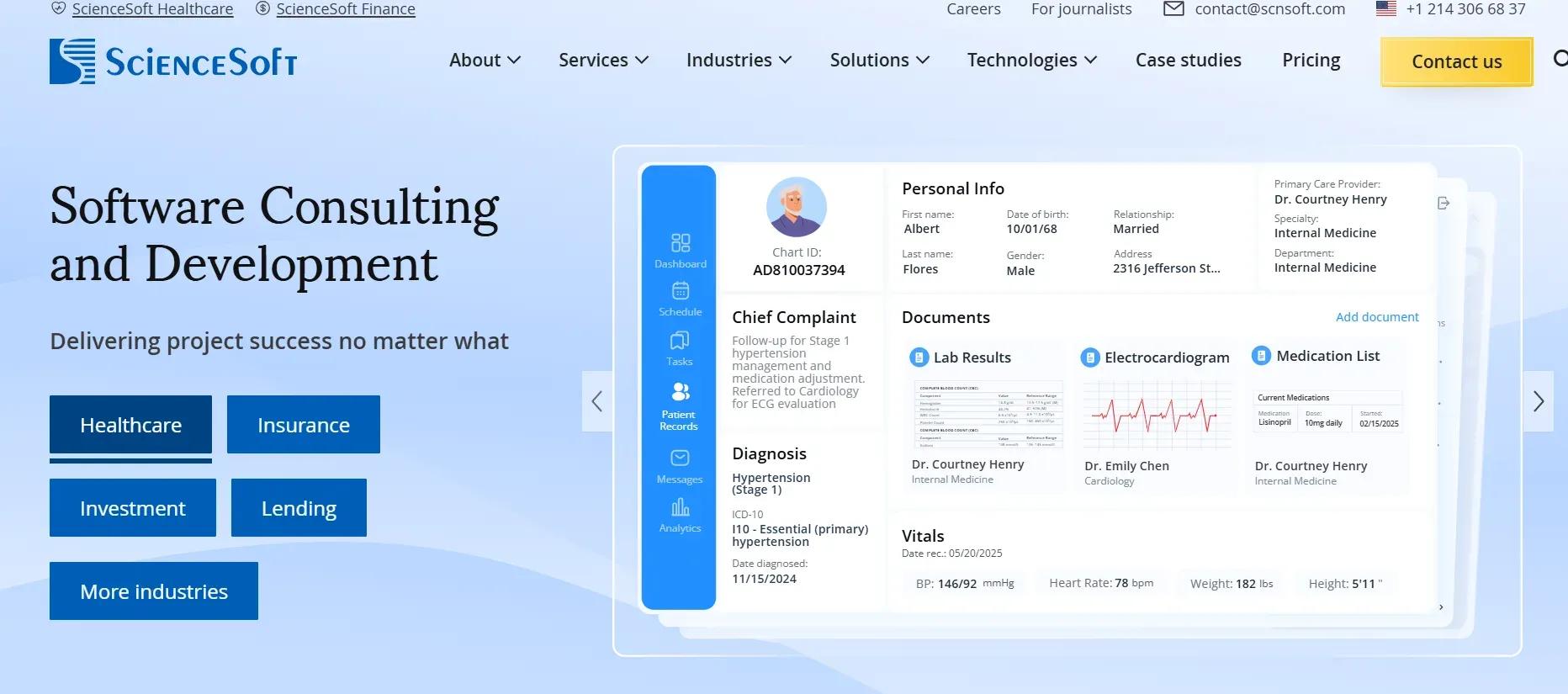
Headquarters: McKinney, Texas.
ScienceSoft is a Texas-headquartered software firm with more than 35 years in IT and a mature data science practice. It brings formal processes, documented quality management, and deep regulated-sector experience. In particular, it excels at compliance-heavy ML like HIPAA-bound health data and financial risk models. So it suits regulated healthcare and finance work.
Key services: ML consulting, data science, and enterprise software.
Industries: healthcare, banking, and retail.
Why choose them: process maturity that regulated projects genuinely need. Its long track record reduces delivery risk.
4. Quantiphi
Headquarters: Marlborough, Massachusetts.
Quantiphi is an applied AI and data science firm known for cloud-native ML. It is a recognised Google Cloud partner with strong engineering depth. Furthermore, it builds production ML across analytics, vision, and language. So it suits cloud-native ML at scale.
Key services: applied AI, ML engineering, and cloud.
Industries: healthcare, financial services, and retail.
Why choose them: deep cloud-ML expertise and strong partnerships. Its work spans large, data-rich enterprises, and its cloud focus suits teams already on Google Cloud or AWS.
5. NineTwoThree AI Studio
Headquarters: Boston, Massachusetts.
NineTwoThree is a senior-only AI and ML venture studio. It has delivered over 150 projects for clients like FanDuel and Consumer Reports. Notably, it turns pilots into scalable production systems. So it suits teams that want ML to reach real users.
Key services: custom ML, LLM apps, and product engineering.
Industries: finance, media, and consumer.
Why choose them: senior talent and a product-first mindset. It excels at moving pilots into production.
6. ThirdEye Data
Headquarters: Dallas, Texas.
ThirdEye Data grew from data engineering into machine learning and agentic AI. Its work centres on ML models, RAG, and MLOps-driven deployment. Notably, its Optira platform productises document processing. So it suits data-rich enterprise ML.
Key services: machine learning, agentic AI, and MLOps.
Industries: enterprise, finance, and manufacturing.
Why choose them: genuine production models and data-engineering roots. Its background reduces delivery risk.
7. RTS Labs
Headquarters: Richmond, Virginia.
RTS Labs focuses on building ML securely and operating it long term. It suits enterprises that need a partner to scale and run models reliably. Notably, its pricing is engagement-based and aligned to scope. So it suits secure, operated ML systems.
Key services: ML engineering, data engineering, and support.
Industries: logistics, finance, and healthcare.
Why choose them: a focus on secure, operated, long-term systems. Its model fits enterprises past the pilot stage.
8. Dogtown Media

Headquarters: Los Angeles, California.
Dogtown Media builds data-driven ML products for regulated sectors. In particular, it focuses on healthcare, finance, and IoT. It understands the full stack, from data pipelines to compliance. So it suits ML that handles sensitive data.
Key services: machine learning, mobile, and IoT.
Industries: mHealth, fintech, and IoT.
Why choose them: genuine regulated-sector depth and strong analytics. Its clients include Google and major healthcare institutions.
9. HatchWorks AI
Headquarters: Atlanta, Georgia.
HatchWorks AI builds modern AI-powered products using its Generative-Driven Development method. It integrates ML and GenAI into real software, with strong MLOps. Furthermore, it offers embedded engineering pods. So it suits companies building AI-powered products.
Key services: AI products, RAG systems, and MLOps.
Industries: enterprise, retail, and finance.
Why choose them: strong production discipline and product focus. However, delivery runs nearshore across the Americas, so confirm it.
10. Tribe AI

Headquarters: New York, New York.
Tribe AI operates as a network of vetted, senior ML engineers. It matches companies with proven talent for defined projects. As a result, clients get elite expertise without a permanent hire. So it suits teams that need deep ML skill on demand.
Key services: machine learning, ML engineering, and AI strategy.
Industries: finance, retail, and enterprise.
Why choose them: access to a curated network of senior ML engineers. Its model suits focused, high-skill engagements, so you gain elite capability without a permanent hire.
What Is a Machine Learning Development Company
A machine learning development company is a firm that designs, builds, and deploys models that learn from data. It goes far beyond training a model in a notebook. Instead, it owns the full pipeline, from data preparation to production deployment and monitoring.
That work spans data engineering, feature design, and model selection. On top of that, it covers evaluation, deployment, and MLOps to keep models accurate over time. So the effort reaches well beyond the modelling step itself.
Good partners also treat launch as a beginning, not an end. Afterwards, they retrain on fresh data, watch for drift, and tune performance. As a result, the system keeps delivering rather than quietly decaying.
Machine Learning Development Services
No two ML projects are identical. Depending on your goal, you may need any of the services below. Each one solves a different problem.
Custom model development. Engineers build models tuned to your data and task. Consequently, you gain accuracy a generic tool cannot match.
Deep learning and computer vision. Neural networks handle images, video, and complex patterns. So you can automate visual and perceptual tasks.
Natural language processing. NLP and generative AI extract meaning from text and speech. In addition, they power search, summaries, and assistants.
Predictive analytics. Models forecast demand, risk, and behaviour from history. Therefore, decisions rest on evidence, not guesswork.
LLM fine-tuning and RAG. Fine-tuning and retrieval adapt foundation models to your data. As a result, answers stay accurate and grounded.
MLOps and deployment. Pipelines deploy, monitor, and retrain models in production. Meanwhile, they catch drift before users notice.
Onshore, Nearshore, or Offshore Delivery
Where your team sits shapes cost, speed, and communication. So the delivery model deserves as much scrutiny as the logo. The machine learning development companies here span three broad models, and each has trade-offs.
Onshore US. The whole team works in the United States. As a result, you get full time-zone overlap and simple contracting, at a premium rate.
Nearshore. Engineers work a few time zones away, often in Latin America. Therefore, you keep good overlap at a lower cost. HatchWorks uses this model.
Offshore. Delivery runs from lower-cost regions. So the rate falls, though you should confirm oversight and data handling.
Softaims removes the guesswork here. You choose each developer and see exactly where they work. Its 24 US offices also add local accountability whenever a stakeholder or procurement team needs it.
Machine Learning vs Generative AI: What Is the Difference
The terms overlap, but they are not the same. Traditional machine learning learns patterns from your data to predict or classify. Generative AI, by contrast, produces new content from foundation models. So the two solve different problems, and many machine learning development companies now do both.
Classic ML shines at forecasting, fraud detection, recommendations, and computer vision. Meanwhile, generative AI shines at text, images, and conversational assistants. In practice, the strongest projects combine them. For example, a fraud model might flag risk, while a generative assistant explains it to an analyst.
So when scoping a project, be clear about which you need. A prediction problem calls for classic ML, while a content problem calls for generative AI. Therefore, a good partner helps you pick the right tool, not the trendiest one.
Industries Adopting Machine Learning in the USA
Adoption is uneven across sectors. The machine learning development companies in the USA see the deepest demand in a few industries. Each brings its own drivers and rules.
Financial services. Banks use ML for fraud, risk, and credit decisions. Notably, regulation makes explainability essential.
Healthcare. Providers use ML for diagnostics, imaging, and operations. Meanwhile, HIPAA shapes every build.
Retail and eCommerce. Retailers use ML for recommendations, forecasting, and pricing. As a result, margins and service improve.
Logistics and manufacturing. Firms use ML for routing, maintenance, and quality control. So efficiency and uptime climb.
Media and marketing. Teams use ML for personalisation and content analysis. Therefore, engagement rises without extra headcount.
How to Choose the Right Machine Learning Partner
Choosing among the many machine learning development companies takes more than a polished portfolio. You are judging data engineering, deployment, and operations, not just modelling. So work through these checks before you sign.
Confirm production evidence. Ask for live models in real systems, not demos. Because most pilots never ship, insist on deployed proof.
Check MLOps maturity. Ask how the team deploys, monitors, and retrains models. In addition, confirm they handle drift and versioning.
Review domain experience. Regulated ML needs security and compliance. Therefore, favour firms with relevant case studies.
Verify the delivery model. Confirm whether work is onshore or nearshore. So you understand time zones and data handling.
Clarify ownership. You should own the model, the code, and the data. Moreover, confirm there is no vendor lock-in.
How Much Does It Cost to Hire Machine Learning Engineers
Knowing what ML engineers cost is central to planning a machine learning development budget. Salaries swing widely with location, experience, and specialisation. So companies need a clear view of the going rates before they commit.
In 2026, those rates still track demand for skilled people. The table below shows average salaries by country, a useful benchmark for planning.
Country | Average Salary (USD) |
| United States | $120,000 - $170,000 |
| United Kingdom | $95,000 - $135,000 |
| Canada | $85,000 - $125,000 |
| Germany | $90,000 - $130,000 |
| India | $25,000 - $45,000 |
| Poland | $60,000 - $95,000 |
| Ukraine | $45,000 - $80,000 |
| Singapore | $80,000 - $120,000 |
Source: Levels.fyi and Salary.com (2024). Figures are indicative and shift with demand.
A full in-house US team is therefore costly to build and retain. That is why many teams hire a partner or a vetted marketplace instead. Softaims offers vetted ML engineers, dedicated or freelance, matched within 48 hours. As a result, you pay for the exact skills you need, when you need them.
Dedicated or Freelance ML Engineers
Your roadmap should shape this choice. For ongoing model work and long-term upkeep, dedicated engineers usually win. They bring consistency, integrate with your team, and learn your data over time.
Freelancers, by contrast, suit short projects or niche skills you do not need full-time. They add flexibility and broad experience. However, they take more managing, since alignment and steady communication demand effort. In the end, weigh scale, complexity, and duration, since a hybrid mix often works best.
Machine Learning Development Cost in the USA (2026)
Cost is where most guides on machine learning development companies go quiet, so here is the detail. US pricing depends on complexity, data readiness, and infrastructure. A scoped project costs far less than a multi-year programme. So it helps to see the ranges before you brief a firm.
Engagement | Typical scope | Estimated cost |
| Scoped ML project | One use case, mid-market | $50,000 – $150,000 |
| Multi-model program | Several models, integration | $150,000 – $300,000 |
| Enterprise program | Many models, governance | $300,000+ |
The biggest cost variable is data. If your data needs collecting, cleaning, and labelling, expect real time and budget. In addition, infrastructure, MLOps, and compliance all add cost. Mid-market projects often reach production in 8 to 20 weeks, while enterprise programmes run longer. So plan for a total cost of ownership, not just the build. Enterprise consultancies usually start well above these figures, since programme overhead is priced in. Therefore, a focused specialist often delivers more value for a mid-market budget.
For a broader look at the market, we’ve also covered machine learning development companies worldwide and machine learning development companies in the UK. These guides provide more insights into leading providers, their delivery models, areas of expertise, and how to choose the right partner for your project.
Why Machine Learning Projects Fail (and How to Avoid It)
Most ML projects deliver nothing measurable. MIT found that 95% of enterprise AI deployments produced no measurable return. The causes repeat, which means each one is avoidable.
Nobody owns the outcome. A pilot wins applause at a demo, then loses attention. So name a business owner and one metric before anything starts.
The data was never ready. Demos run on clean data, while production holds messy data. Therefore, treat data preparation as a real phase with its own budget.
Nobody planned for MLOps. A model without deployment and monitoring decays fast. Meanwhile, drift quietly erodes accuracy.
It never reached a workflow. A model in a notebook gets forgotten. Systems that succeed live inside the tools people already use every day. So integration into a real workflow is as important as model accuracy itself. The strongest US partners design for that adoption layer from the very first sprint.
Machine Learning Trends for 2026
The machine learning development companies in the USA set trends the market follows. A few clear shifts stand out this year.
Agents are going mainstream. Systems now complete multi-step tasks, not just predictions. As a result, they deliver far more value.
Foundation models meet custom data. RAG and fine-tuning adapt big models to your content. So teams get accuracy without training from scratch.
MLOps is now essential. Buyers expect monitoring, retraining, and versioning. Therefore, operational discipline separates serious firms.
Smaller models are rising. Focused models often beat giant ones on narrow tasks. Consequently, they cut cost and latency.
Governance is central. Enterprises expect explainability and safety controls. In addition, regulated sectors demand auditable models.
What a Typical Machine Learning Project Looks Like
With the best machine learning development companies, most projects follow a clear arc. It runs from a scoped pilot to a running system. Knowing the shape helps you plan budget and timelines. Each stage should end in a decision or a deliverable.
Discovery and use-case selection. The team picks one high-value problem and names its success metric. So the project starts with a clear owner and goal.
Data preparation. Engineers gather, clean, label, and validate the data. Therefore, the model has solid foundations to learn from.
Modelling and evaluation. The team builds, trains, and tests the model against real cases. Meanwhile, it measures accuracy, bias, and edge-case behaviour.
Deployment and MLOps. The model ships behind monitoring, with pipelines for retraining and rollback. As a result, issues surface before users feel them.
Operate and improve. After launch, the team retrains on fresh data and tracks drift. Consequently, the system keeps performing over time.
A focused first project usually reaches production in 8 to 20 weeks. So you prove value on one use case before scaling to the next.
Questions to Ask a Machine Learning Partner
When evaluating machine learning development companies, the right questions can reveal the difference between genuine engineering expertise and a polished sales pitch. Before signing a contract, ask each potential partner:
- Can you demonstrate a machine learning model you have deployed to production?
- How do you collect, prepare, clean, and label data for projects like ours?
- Which MLOps tools and processes do you use for deployment, monitoring, and maintenance?
- How do you evaluate model performance, bias, and drift after deployment?
- Who owns the model, source code, training data, and other project assets after delivery?
- How do you protect sensitive data and meet relevant security and compliance requirements?
- What post-launch support do you provide, and how are monitoring, maintenance, and retraining priced?
Strong partners should provide specific, evidence-based answers backed by relevant experience. Vague responses, unclear ownership terms, or limited post-launch support can indicate potential risks in delivery, maintenance, and long-term scalability.
Frequently Asked Questions
Which are the best machine learning development companies in the USA?
ScienceSoft, Quantiphi, NineTwoThree, and ThirdEye Data lead among specialists. RTS Labs, Dogtown Media, HatchWorks AI, and Tribe AI round out strong options. Softaims and Devaims suit teams that want to build fast and own the result.
How much does machine learning development cost in the USA?
A scoped project runs $50,000 to $150,000, and a multi-model program $150,000 to $300,000. Enterprise programs exceed $300,000. Data readiness drives most of the variation.
How long does machine learning development take?
A mid-market project often reaches production in 8 to 20 weeks. Enterprise programs run longer. Clear scope and ready data speed things up.
What is MLOps, and why does it matter?
MLOps covers deploying, monitoring, and retraining models in production. As a result, models stay accurate as data changes. Without it, performance quietly decays.
Should I choose an onshore or nearshore partner?
Onshore gives full time-zone overlap and simple contracting. Nearshore lowers cost while keeping decent overlap. Your budget and oversight needs decide the fit.
Who owns the model and the data?
You should own all of it. Confirm ownership of the code, the model, and the data in the contract. This avoids vendor lock-in later.
Conclusion
Machine learning has evolved into core business infrastructure rather than a standalone experiment. Leading machine learning development companies focus on building production-ready systems supported by robust data practices, scalable architectures, and mature MLOps processes.
The right development partner does more than develop models. They help translate business objectives into reliable, scalable ML solutions that deliver measurable value and support long-term growth.
Before selecting a partner, evaluate their production experience, MLOps capabilities, technical expertise, and delivery model. A thoroughly vetted shortlist can help protect your budget, data, and project timeline while reducing implementation risks.
If you prefer to skip the lengthy search process, Softaims can connect you with vetted machine learning developers within 48 hours, whether you operate in the USA or internationally.


 GitHub
Pavlo F.

 Verified Expert in Engineering
My name is Pavlo F. and I have over 5 years of experience in the tech industry. I specialize in the following technologies: React, Next.js, TypeScript, GraphQL, RESTful API, etc.. I hold a degree in Bachelor of Science in Information Technology, Master of Computer Applications (MCA). Some of the notable projects I’ve worked on include: Marketing Website Rebuild in Next.js with CMS Integration, Aura Chat AI, CircuitNFT Marketplace, ProdStat React Dashboard, Next.js MongoDB LiveChat, etc.. I am based in Manchester, United Kingdom. I've successfully completed 13 projects while developing at Softaims.
Information integrity and application security are my highest priorities in development. I implement robust validation, encryption, and authorization mechanisms to protect sensitive data and ensure compliance. I am experienced in identifying and mitigating common security vulnerabilities in both new and existing applications.
My work methodology involves rigorous testing—at the unit, integration, and security levels—to guarantee the stability and trustworthiness of the solutions I build. At Softaims, this dedication to security forms the basis for client trust and platform reliability.
I consistently monitor and improve system performance, utilizing metrics to drive optimization efforts. I’m motivated by the challenge of creating ultra-reliable systems that safeguard client assets and user data.

Leave a Comment
Need help building your team? Let's discuss your project requirements.
Get matched with top-tier developers within 24 hours and start your project with no pressure of long-term commitment.