Node.js Microservices Architecture in 2026: Patterns That Actually Work at Scale
Most Node.js microservices tutorials show you how to split a monolith. This one shows you when to, how to communicate between services reliably, and what the failure modes look like in production.
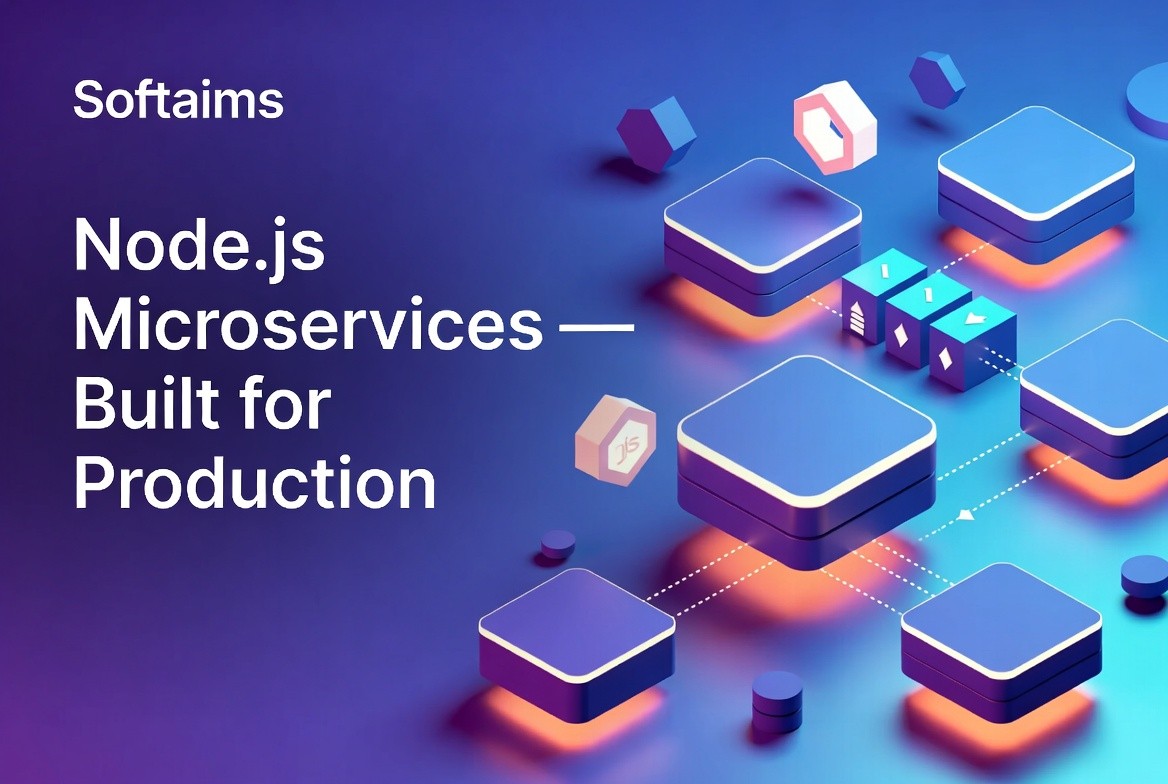
Table of contents
Key Takeaways
- Microservices are a solution to organizational and deployment scaling, not a solution to code quality — a badly structured monolith becomes a badly structured distributed system with network failures added.
- Async messaging (BullMQ, RabbitMQ, Kafka) between services is more resilient than synchronous HTTP calls — if a downstream service is down, the message queues until it recovers instead of failing the entire request.
- The Saga pattern is the only correct way to handle distributed transactions across microservices — two-phase commit is too complex and brittle; Saga with compensating transactions is the production standard.
- Every Node.js microservice needs structured logging with a correlation ID that traces a single user request across all services — without it, debugging production issues across 10 services is close to impossible.
- Start with a modular monolith, not microservices — extract services only when you have a clear, proven need (team ownership boundaries, independent deployment requirements, extreme scale differences between components).
The microservices hype peaked around 2018. The graveyard of failed microservices migrations is now large enough to draw lessons from. The pattern that emerges: teams that succeeded had a specific scaling problem that microservices solved. Teams that failed were chasing architecture for its own sake.
This guide is about Node.js microservices the way they work in production — not the hello-world version with two services and one HTTP call, but the architecture that handles partial failures, distributed transactions, and a dozen services with different deployment cadences.
1. When Microservices Are the Right Answer (and When They're Not)
Valid reasons to split into services:
- Team ownership: Team A owns the payment service, Team B owns the notification service. Independent deployments, independent on-call, clear interfaces.
- Wildly different scaling requirements: Your search service needs 50x more compute during peak hours than your user profile service. Horizontal scaling is much simpler when they're separate.
- Technology isolation: Your ML inference component needs Python/TensorFlow; the rest of your stack is Node.js. One service boundary solves this cleanly.
- Blast radius reduction: A crash in the recommendations service should not take down the checkout flow.
Bad reasons: "microservices are the modern way," wanting a cleaner codebase (use modules), the monolith is slow (profile and optimize first).
The modular monolith as the right default: Build your Node.js application as a single deployable with clearly bounded modules first. Each module has its own database schema, its own service layer, and a public API surface. When you have a proven reason to extract a service, the module boundary makes it straightforward. Without that preparation, microservices extraction is a rewrite.
2. Service Communication: HTTP vs Message Queues
Most microservices tutorials default to REST over HTTP for inter-service communication. This is often the wrong choice.
Synchronous HTTP (REST/gRPC): Use for operations that need an immediate response. User-facing reads, real-time lookups, anything where the caller must wait for the result before proceeding.
Async messaging (queues/events): Use for writes, notifications, and side effects. The caller fires and forgets; the consumer processes when ready. If the consumer is down, the message waits in the queue.
2. Service Communication: HTTP vs Message Queues — what the listing was illustrating. Instead of copying a long snippet, treat the next few paragraphs as the contract you should enforce in review: what must be true for this to be safe, observable, and maintainable in 2026-era production.
The original example spanned roughly 1 substantive lines. Walk it mentally as a sequence: initialization, the happy path, then the failure surfaces (validation errors, network faults, partial writes). Cross-check the official release notes for your exact framework minor version—defaults and deprecations move faster than blog posts.
Translate to your codebase. Rename types, align with your router or ORM version, and wire the same invariants—idempotency keys where retries exist, structured logs with correlation IDs, and metrics that prove the path is actually exercised.
Opening line pattern (for orientation only): // BullMQ — Redis-backed job queue for Node.js import { Queue, Worker } from 'bullmq'; import { Redis } from 'ioredis'; const connection = new Redis({ host: pro…. Use your formatter, linter, and type checker to keep drift visible; do not rely on visually diffing pasted samples.
3. The Saga Pattern: Distributed Transactions Without Two-Phase Commit
When a user action spans multiple services (create order → charge payment → update inventory → send confirmation), you need either all steps to succeed or all to roll back. Distributed transactions break constantly. The Saga pattern is the production solution.
Choreography Saga (event-driven, simpler): each service publishes an event when it completes; downstream services listen and react. If a step fails, the service publishes a failure event and upstream services run compensating transactions.
3. The Saga Pattern: Distributed Transactions Without Two-Phase Commit — what the listing was illustrating. Instead of copying a long snippet, treat the next few paragraphs as the contract you should enforce in review: what must be true for this to be safe, observable, and maintainable in 2026-era production.
Teams ship faster when they separate mechanics from policy. Mechanics are API names and boilerplate; policy is who may call what, what gets logged, and what guarantees callers get. Cross-check the official release notes for your exact framework minor version—defaults and deprecations move faster than blog posts.
Re-implement the policy in your repo with your conventions—environment-based config, feature flags for risky paths, and tests that lock the behavior you care about. The old snippet is a sketch of mechanics, not a universal patch.
First concrete line in the removed listing looked like: // Order Saga — choreography style with BullMQ // Step 1: Order Service creates order and emits event async function createOrder(input: OrderInput) { const orde…. Verify that still matches your stack before you mirror the structure.
4. Service Discovery and API Gateway
With 10+ services, hardcoding service URLs in each service is a maintenance nightmare. Two approaches work in 2026:
Kubernetes-native service discovery: Each service gets a stable DNS name within the cluster (payment-service.default.svc.cluster.local). Services call each other by name; Kubernetes resolves to the current pod IP. Zero additional tooling required.
API Gateway pattern: External clients (web, mobile) call a single gateway. The gateway routes to internal services, handles auth, rate limiting, and request/response transformation.
4. Service Discovery and API Gateway — what the listing was illustrating. Instead of copying a long snippet, treat the next few paragraphs as the contract you should enforce in review: what must be true for this to be safe, observable, and maintainable in 2026-era production.
Read this as a checklist, not a transcript. For each external dependency in the old example, ask: timeouts? retries with jitter? circuit breaking? What is the worst partial failure, and how would an operator detect it within minutes? Cross-check the official release notes for your exact framework minor version—defaults and deprecations move faster than blog posts.
Add integration coverage that hits the real adapter—not only mocks—at least on a smoke schedule. Mocks hide version skew between your code and the service you call.
Structural anchor from the removed code (abbreviated): // Simple API Gateway with Fastify import { createProxyMiddleware } from 'http-proxy-middleware'; const SERVICES = { users: process.env.USER_SERVICE_URL, orders….
5. Observability: Correlation IDs and Distributed Tracing
In a monolith, a stack trace tells you exactly what happened. In microservices, a user action touches 8 services and the error is in service 6. Without distributed tracing, debugging this takes hours.
5. Observability: Correlation IDs and Distributed Tracing — what the listing was illustrating. Instead of copying a long snippet, treat the next few paragraphs as the contract you should enforce in review: what must be true for this to be safe, observable, and maintainable in 2026-era production.
Production incidents rarely come from “unknown syntax”; they come from implicit assumptions baked into examples: small payloads, warm caches, single-region deployments, and friendly error payloads. Cross-check the official release notes for your exact framework minor version—defaults and deprecations move faster than blog posts.
Expand the narrative: document expected throughput, cardinality, and blast radius if this path misbehaves. Add dashboards that show error rate and latency percentiles, not just averages.
The listing began with: // Middleware: generate or propagate correlation ID import { randomUUID } from 'node:crypto'; app.addHook('onRequest', (request, reply, done) => { // Accept cor…—use that as a mental bookmark while you re-create the flow with your modules and paths.
For production, use OpenTelemetry to automatically instrument all HTTP calls and database queries. Traces flow through all services and appear as a single waterfall in Jaeger, Zipkin, or Grafana Tempo.
Same section, another listing: Use the same review checklist as above—policy, observability, failure handling, and version drift—this block only illustrated a different slice of the same workflow.
Security and ergonomics move together. If the sample touched credentials, cookies, headers, or user input, re-validate against your org’s baseline: secret scanning, SSRF rules, SSR-safe patterns, and least-privilege IAM. Cross-check the official release notes for your exact framework minor version—defaults and deprecations move faster than blog posts.
Where the example used shorthand (“fetch user”, “save model”), spell out authorization checks and audit events you actually need for compliance.
Code lead-in was: import { NodeSDK } from '@opentelemetry/sdk-node'; import { getNodeAutoInstrumentations } from '@opentelemetry/auto-instrumentations-node'; const sdk = new Node….
6. Health Checks and Circuit Breakers
6. Health Checks and Circuit Breakers — what the listing was illustrating. Instead of copying a long snippet, treat the next few paragraphs as the contract you should enforce in review: what must be true for this to be safe, observable, and maintainable in 2026-era production.
Performance work belongs in context. Note allocation patterns, N+1 queries, and accidental serialization hot loops. Cross-check the official release notes for your exact framework minor version—defaults and deprecations move faster than blog posts.
Profile with production-like data volumes; optimize the top frame, then re-measure. Caching should have explicit TTLs and invalidation stories—otherwise you debug “stale data” tickets for quarters.
Snippet started with: // Health check endpoint every service must expose app.get('/health', async (req, reply) => { const dbOk = await db.$queryRaw`SELECT 1`.then(() => true).catch((….
Frequently Asked Questions
How many microservices is too many?
The right size for a service is "can be owned by one small team." Amazon's famous two-pizza rule (a team that can be fed by two pizzas) is a useful heuristic. If a service is so small that maintaining it costs more than the benefit of separation, merge it. If a service is so large that no single person understands all of it, split it.
Should every microservice have its own database?
Yes — this is the key property that makes services truly independent. A shared database creates invisible coupling: one team's schema change breaks another team's queries. Database-per-service forces clean interfaces. If you need data from another service's domain, call its API or consume its events.
How do I handle authentication across services?
The standard 2026 approach: JWT tokens validated at the API Gateway or at each service individually using the shared public key. The token carries user claims (ID, role, scopes). Services trust the token without calling an auth service on every request. Revocation works via short token expiry (15 minutes) + refresh tokens.
What's the difference between BullMQ, RabbitMQ, and Kafka?
BullMQ (Redis-backed) is the easiest to operate — if you already have Redis, zero new infrastructure. Best for job queues, scheduled tasks, and lightweight event processing. RabbitMQ is a full message broker with routing, exchanges, and durable queues. Better for complex routing patterns. Kafka is a distributed log — designed for high-throughput event streaming, event replay, and event sourcing. Kafka is significant infrastructure overhead; use it only when you need its specific properties.
How do I deploy Node.js microservices in 2026?
Docker containers orchestrated by Kubernetes is the standard. Each service is a Docker image, deployed as a Kubernetes Deployment with a Service and Ingress. For simpler setups, AWS ECS or Railway can deploy containers without full Kubernetes complexity. The key: each service should be independently deployable without coordinating with other services.
Should I use gRPC instead of REST for inter-service communication?
gRPC makes sense when you have high-frequency internal service calls that benefit from binary serialization and HTTP/2 multiplexing. It's faster than REST/JSON for internal traffic. The trade-off: more tooling complexity (protobuf schemas, code generation), harder to debug (not human-readable). For most teams, REST/JSON between services is fine. Use gRPC when profiling shows it's actually needed.
Conclusion
Node.js is well-suited for microservices — its non-blocking I/O model makes it efficient as both a service and a gateway, and its fast startup time works well with container-based scaling. But the language doesn't make the architecture decisions for you.
The teams that succeed with Node.js microservices start with clear service boundaries driven by team ownership and deployment requirements — not by technical elegance. They instrument everything, handle partial failures by design, and resist the urge to keep splitting services until there's a reason to.
If you need Node.js engineers who've built and maintained distributed systems at scale, Softaims Node.js developers are pre-vetted with a focus on system design depth, not just CRUD API skills.
Looking to build with this stack?
Hire Node.js Developers →

 GitHub
Marek D.

 Verified Expert in Engineering
My name is Marek D. and I have over 18 years of experience in the tech industry. I specialize in the following technologies: Amazon Web Services, TypeScript, MySQL, React, node.js, etc.. I hold a degree in Diploma, Masters. Some of the notable projects I’ve worked on include: Cardano NFT Minting, Jounce.com Email marketing & automation platform, Google Cloud Next '17 presentation, The Off Suty Shopp, Gaudaur - Magento Ecommerce, etc.. I am based in Białystok, Poland. I've successfully completed 21 projects while developing at Softaims.
I possess comprehensive technical expertise across the entire solution lifecycle, from user interfaces and information management to system architecture and deployment pipelines. This end-to-end perspective allows me to build solutions that are harmonious and efficient across all functional layers.
I excel at managing technical health and ensuring that every component of the system adheres to the highest standards of performance and security. Working at Softaims, I ensure that integration is seamless and the overall architecture is sound and well-defined.
My commitment is to taking full ownership of project delivery, moving quickly and decisively to resolve issues and deliver high-quality features that meet or exceed the client's commercial objectives.

Leave a Comment
Need help building your team? Let's discuss your project requirements.
Get matched with top-tier developers within 24 hours and start your project with no pressure of long-term commitment.