Top 10 eLearning App Development Companies (2027)
Building a scalable learning app requires smooth video delivery, adaptive quizzes, and SCORM/xAPI support. This guide shortlists 2027’s top eLearning developers, evaluating firms on learning-tech depth and vetted talent.
Technically reviewed by:
Amanullah T.|Stas B.
Table of contents
Key Takeaways
- Unlike standard mobile applications, learning apps demand robust handling of video streaming at scale, offline lesson caching, push engagement strategies, and adaptive quiz engines.
- Integrating industry standards like SCORM, xAPI, and LTI ensures that course materials can seamlessly track completion, share data, and plug into institutional LMS platforms (such as Moodle or Canvas).
- Market pricing typically ranges from $30,000–$80,000 for basic learning MVPs, $80,000–$150,000 for mid-level platforms, and $150,000–$400,000+ for complex, enterprise-grade EdTech solutions.
- Sourcing pre-vetted mobile engineers and backend specialists on demand (e.g., via Softaims within 48 hours) enables course teams to retain complete code ownership, control burn rates, and scale velocity flexibly.
Top 10 eLearning App Development Companies (2027)
Building a learning app is harder than it looks. A course team can have brilliant material and a clear vision, and still get stuck the moment the real engineering starts: video that plays smoothly for thousands of learners at once, content that works offline, quizzes that adapt to each person, certificates that generate on their own, SCORM and xAPI files that import into other systems, and the app store review that can send you back to the start. Plenty of studios can build a generic mobile app. Far fewer have shipped a real learning product and kept it running. This guide compares the top eLearning app development companies for 2027 by what they can actually build, what they charge, the content standards they handle, and who they suit, so you can shortlist the right partner and avoid an expensive rebuild later.
Top 10 eLearning App Development Companies at a Glance
Here is a quick view of the ten eLearning app development companies we compared, so you can see where each one is based, how deep its learning-tech skills go, and roughly where its pricing sits before you read the full write-ups.
Rank | Company | Best for | Learning-tech depth | Where based | Starting price |
| 1 | Softaims | Flexible, vetted learning-app teams | High, app to platform | US-aligned, global engineers | Flexible, pay for hours |
| 2 | Devaims | End-to-end learning app builds | High, full product | US-aligned delivery | Flexible, project or team |
| 3 | SweetRush | Immersive and award-winning content | High on design | US | Premium |
| 4 | AllenComm | Large corporate training programs | High on L&D | US | Custom quote |
| 5 | Appinventiv | Feature-rich mobile MVPs | High on mobile | India | Competitive |
| 6 | Intellectsoft | Enterprise learning platforms | High | US and Europe | Custom quote |
| 7 | ScienceSoft | Compliance-heavy LMS and apps | High | US | Custom quote |
| 8 | Netguru | Product strategy for EdTech startups | Medium to high | Poland | Premium |
| 9 | DataArt | Data and AI in learning at scale | Very high | Global | Custom quote |
| 10 | Cheesecake Labs | Design-led consumer learning apps | Medium to high | Brazil and US | Custom quote |
Which one should you shortlist? Want flexible engineers you can embed and scale? Look at Softaims. Need award-winning instructional design? SweetRush and AllenComm lead there. Building a mobile-first app on a startup budget? Appinventiv is worth a look. Need enterprise integrations or heavy compliance? Intellectsoft and ScienceSoft have the depth. Want sharp product strategy or design-led consumer apps? Netguru and Cheesecake Labs stand out. The rest of this guide shows the evidence behind each of these eLearning app development companies.
How We Picked the Best eLearning App Development Companies
We did not just rank the loudest names. To compare these eLearning app development companies properly, we looked at live apps in the App Store and Google Play, each company's own case studies, public reviews, and the technical skills that actually decide whether a learning app succeeds. We checked this in November 2026, and since details change, confirm the current ones before you commit. Four things carried the most weight.
Shipping record for real learning apps
We looked for studios that have launched learning products people use every day, not just slide decks of concepts or white-label wrappers dressed up as custom work.
Content standards experience
SCORM, xAPI, and LTI decide whether your content can move between systems. We favoured teams that have actually built to these standards, because a studio that has never touched SCORM will underestimate the work badly.
Mobile engineering depth
We weighed skill across iOS, Android, and cross-platform Flutter and React Native, plus the backend work that video streaming, offline mode, and adaptive quizzes really need.
Support after launch
A learning app lives or dies on what happens after day one. We valued partners that keep improving the product, tuning onboarding, and shipping new content types, over ones that disappear after delivery.
On our own involvement. Softaims publishes this guide and appears in it, and Devaims is a sister Softaims brand. The two do different jobs: Softaims supplies vetted engineers you embed in your own team, while Devaims runs full product builds. We have held both to the same test as every other name here, and we point you to the others' own sites so you can check them for yourself.
The 10 Best eLearning App Development Companies for 2027, Reviewed
Each profile below follows the same shape so you can compare these eLearning app development companies fairly: what the firm is best for, a short overview, its learning-app services, the key facts, who it suits, and an honest trade-off.
1. Softaims
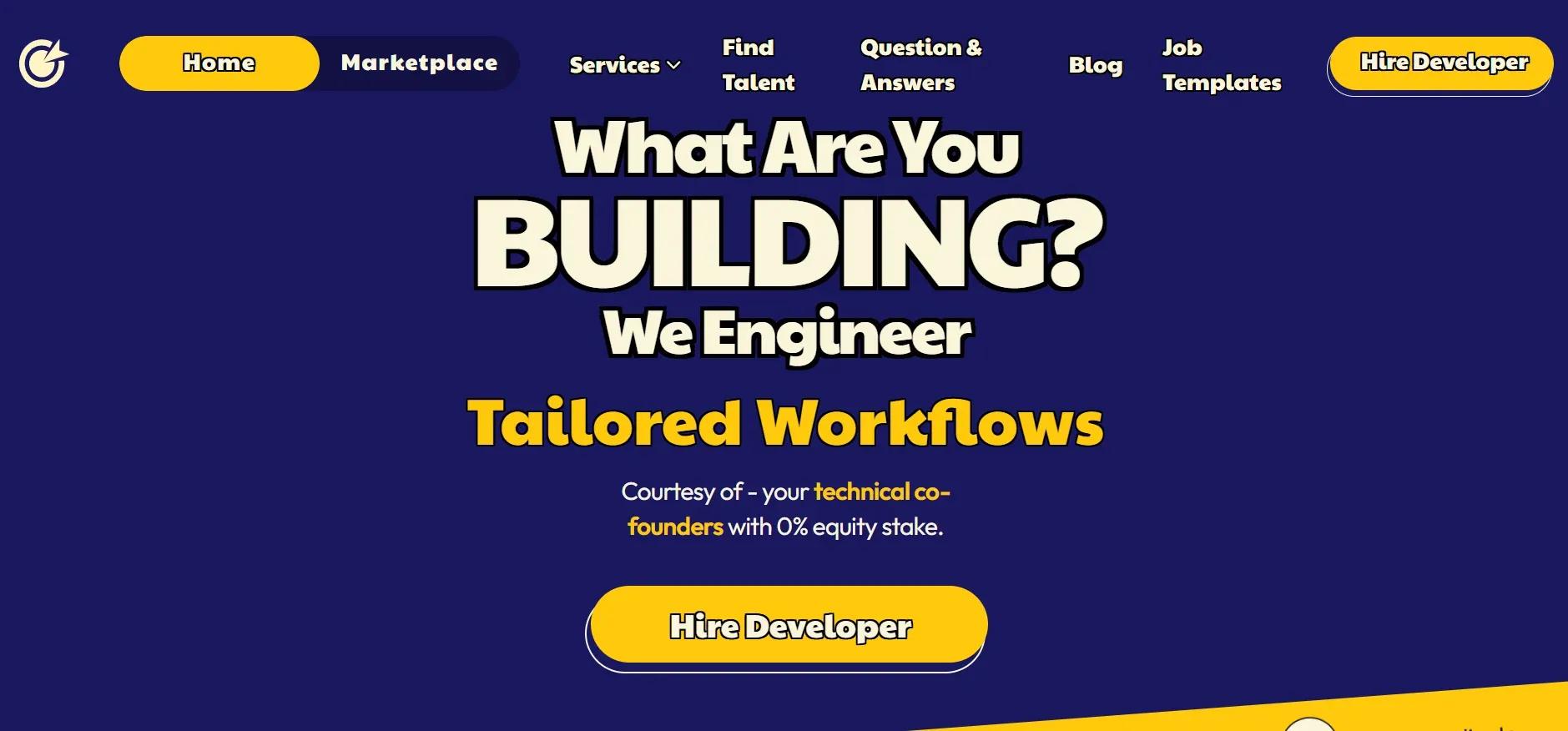
Best for: Teams who want flexible, vetted learning-app engineers they can plug into their own project.
Softaims hands you a ready pool of pre-vetted mobile engineers, backend developers, and designers you bring onto your own team, usually within a couple of days. Instead of posting your learning app out to an agency and hoping, you get people who sit in your sprints and leave you owning every line of code. The same team can carry you from a first version with video and quizzes to a full platform with live classes, adaptive learning, and SCORM or xAPI support, which avoids the hand-off that forces so many course teams into an early rebuild. You scale the team up and down as the product grows.
eLearning app services:
- Native and cross-platform learning apps (Flutter, React Native)
- Video streaming, offline content, and push strategy
- Adaptive quizzes, progress tracking, and certificates
- SCORM, xAPI, and LTI content standards
- Full-stack developers for learning platforms and backend developers
- AI personalization through AI and ML services
- Support and scaling after launch
Key facts: US-aligned delivery backed by a global engineering network. Flexible pricing, you pay for hours used. A team can be reviewing your project in roughly 48 hours.
Why choose Softaims? If you expect the app to grow and want one team from first version to full platform, with full ownership and no lock-in, it is the most flexible of all the eLearning app development companies on this list. You can hire developers for your learning app and size the team to your stage.
Considerations: It is a talent and engineering partner, not a fixed-price product shop, so if you want a single quoted figure for a locked scope with no day-to-day involvement, a fixed-scope studio may suit you better.
2. Devaims
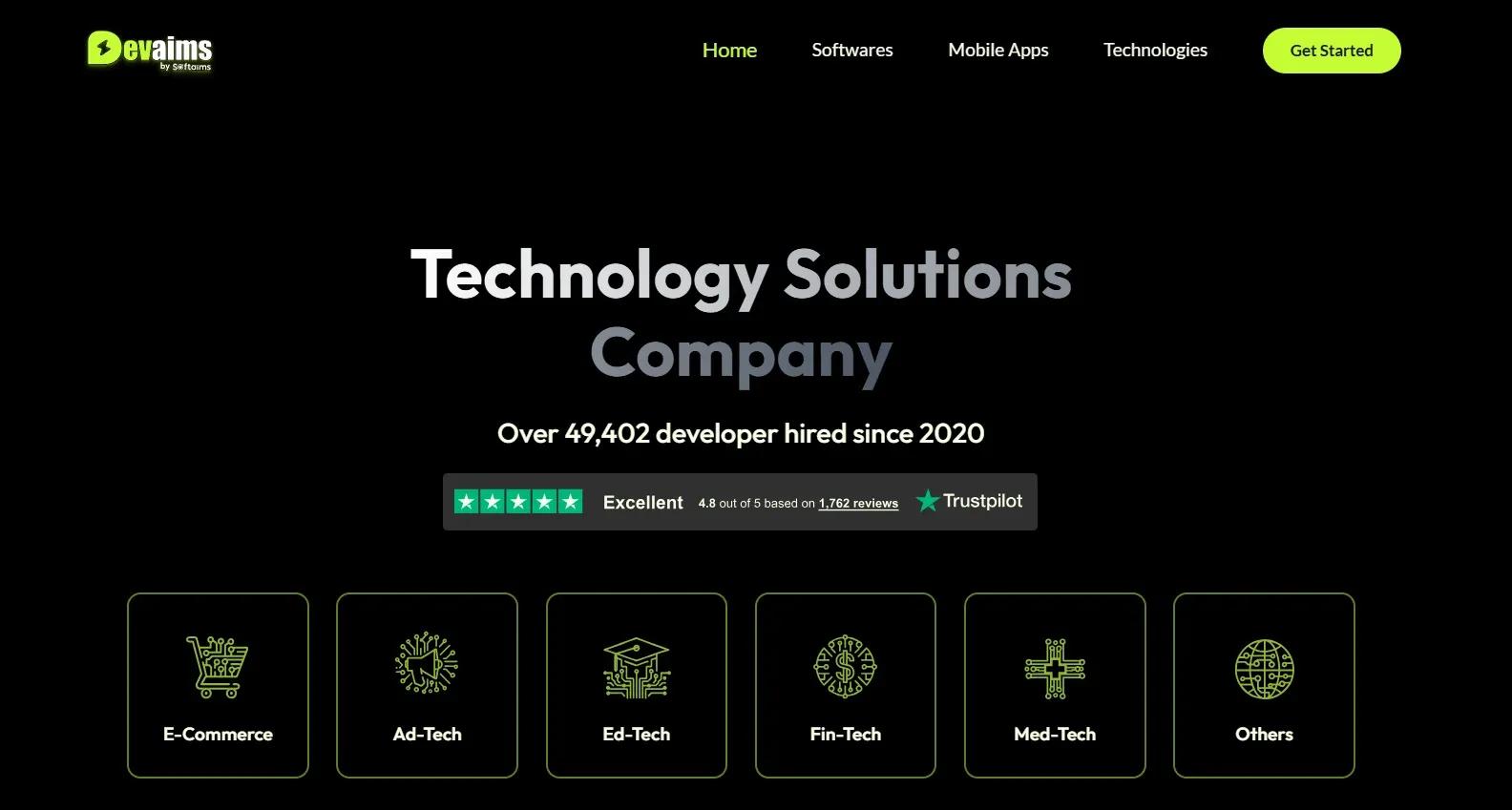
Best for: Course teams who want a full learning app handled start to finish.
Devaims, a Softaims brand, takes a learning product from idea through a working app and into a platform built to grow, owning the whole delivery rather than just adding engineers. You get design, mobile build, backend, the content pipeline, and deployment from one team that stays with the project. It suits founders and L&D teams who would rather hand over a clear brief and get a finished, growth-ready app back.
eLearning app services:
- End-to-end learning app design and build
- iOS, Android, and cross-platform delivery
- Video, quizzes, certificates, and analytics
- SCORM, xAPI, and LMS integrations
- Cloud, deployment, and DevOps
- Ongoing support and scaling
Key facts: US-aligned delivery with a distributed team. Flexible pricing by project or team. A sister brand of Softaims.
Why choose Devaims? If you want a single team to own the whole build and stay with it as the app grows, rather than managing people yourself, Devaims fits.
Considerations: It works best with a reasonably clear brief, so a very early idea that still needs heavy exploration may want a discovery-led studio first.
3. SweetRush
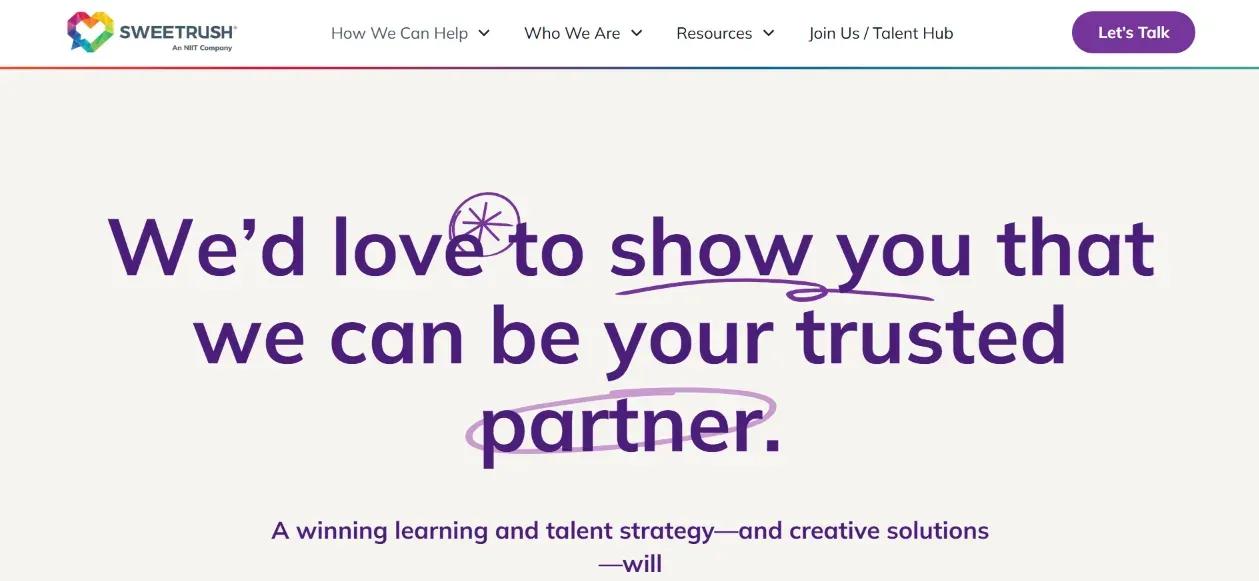
Best for: Immersive, award-winning learning experiences.
SweetRush is a long-standing name in learning design, known for human-centred work that goes well beyond standard online courses. It pairs strong instructional design with modern technology, including gamification and AR and VR, and has worked with major global brands. If the quality of the learning experience matters as much as the engineering, SweetRush is one of the most respected eLearning app development companies for that kind of work.
eLearning app services:
- Immersive and experiential learning
- Gamification and AR or VR modules
- Instructional design and strategy
- Performance and learning consulting
Key facts: US-based. Premium pricing. Repeatedly recognised for instructional design quality.
Why choose SweetRush? If you want learning that genuinely changes behaviour and looks superb, its design pedigree is the draw.
Considerations: It leads with design and experience, so for a purely technical mobile build you may want to confirm the engineering scope up front.
4. AllenComm
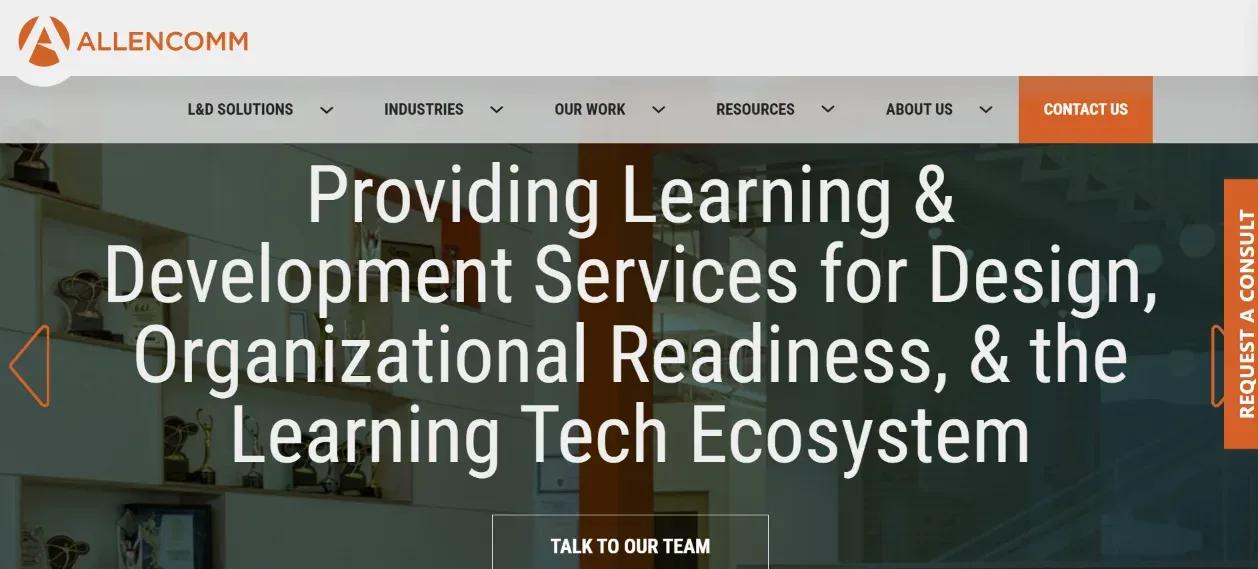
Best for: Large corporate training programs with complex needs.
AllenComm has spent two decades building custom corporate training and performance-focused learning, which makes it a safe pair of hands for big, complicated programs. It blends structured learning design with practical delivery, strong on leadership and compliance training, adaptive mobile learning, and the reporting that large organisations expect. For enterprise L&D teams, that track record counts.
eLearning app services:
- Custom corporate training programs
- Leadership and compliance learning
- Adaptive mobile learning
- Analytics and reporting
Key facts: US-based. Custom pricing by quote. Deep instructional design frameworks.
Why choose AllenComm? If you are a large organisation with layered training needs, its experience with complex programs lowers the risk.
Considerations: Its enterprise focus suits bigger budgets, so a small startup app may find it more than it needs.
5. Appinventiv
Best for: Feature-rich mobile MVPs at a competitive price.
Appinventiv is a large India-based mobile app firm with a substantial EdTech portfolio, including learning apps, quiz platforms, live tutoring, and corporate training tools. It suits teams that want a feature-rich first version delivered quickly without a premium agency bill. Its cross-platform work in Flutter has matured, and iOS and Android parity is reliable across its learning projects.
eLearning app services:
- Mobile-first learning apps
- Quiz and live tutoring platforms
- Cross-platform Flutter delivery
- Corporate training tools
Key facts: India-based with a global client list. Competitive pricing. Strong mobile track record.
Why choose Appinventiv? If you want a lot of features for your budget and a fast mobile build, it is a strong option among the more affordable eLearning app development companies.
Considerations: For deep enterprise LMS integrations or strict data-residency rules, confirm the systems architecture skill of the specific team you are assigned.
6. Intellectsoft
Best for: Enterprise learning platforms inside a larger tech stack.
Intellectsoft is a full-cycle software firm with offices in Europe and North America and a steady record in EdTech and corporate training. Its work includes custom LMS builds, enterprise mobile learning apps, and integrations with systems like Cornerstone, SAP SuccessFactors, and Workday Learning. It is a solid choice when a learning app has to live inside a bigger enterprise setup. Expect thorough discovery and a methodical process.
eLearning app services:
- Custom LMS and learning platforms
- Enterprise mobile learning apps
- HR and learning system integrations
- Discovery and structured delivery
Key facts: Offices in the US and Europe. Custom pricing. Strong enterprise integration experience.
Why choose Intellectsoft? If your learning app must connect to enterprise HR and learning systems, its integration depth is the reason to shortlist it.
Considerations: Its careful process pays off at enterprise scale but can feel slow for an early-stage startup.
7. ScienceSoft
Best for: Compliance-heavy LMS and learning apps.
ScienceSoft is a US-based IT consulting firm with a long history in eLearning software, from custom LMS builds and mobile learning apps to SCORM authoring integrations and content migration. It has delivered platforms for healthcare training, where compliance evidence is critical, as well as K to 12 adaptive systems and corporate onboarding. It also handles accessibility requirements and multi-region deployments, which matters when documentation and compliance come first.
eLearning app services:
- Custom LMS and mobile learning apps
- SCORM and content migration
- Accessibility (WCAG) and compliance
- Multi-region deployment
Key facts: US-based. Custom pricing. Strong on documented, compliant delivery.
Why choose ScienceSoft? If you need compliance evidence and accessibility more than raw speed, its process-first approach fits.
Considerations: That same thoroughness means it is better matched to compliance-driven projects than to a quick consumer launch.
8. Netguru
Best for: Product strategy for EdTech startups.
Netguru is a Polish product design and development studio known for well-designed mobile apps and sharp product thinking. Its EdTech clients include course marketplaces, skill-building apps, and B2B training platforms. What it does particularly well is strategy: its team runs workshops and tests prototypes before writing code, which helps founders check that the learning mechanics work before they become expensive backend features. It is strongest on iOS and React Native.
eLearning app services:
- Product strategy and discovery
- Mobile app design and build
- Prototype testing
- iOS and React Native delivery
Key facts: Poland-based with a global client list. Premium pricing. Strong product and design focus.
Why choose Netguru? If you want help deciding what to build, not just how, its product-first process earns its place.
Considerations: For deep SCORM compliance or complex LMS integrations, expect more systems-integration work than its product-first model emphasises.
9. DataArt
Best for: Data and AI in learning at institution scale.
DataArt is a global technology consultancy with a dedicated education practice. It has built adaptive learning platforms, content recommendation engines, and analytics dashboards for major publishers and online learning platforms. Its strength is engineering depth: AI-powered personalization, large-scale video infrastructure, and the data pipelines that make real learning analytics possible. For scale-stage EdTech or traditional publishers going digital, that depth is the draw.
eLearning app services:
- Adaptive learning platforms
- AI personalization and recommendations
- Large-scale video and data pipelines
- Learning analytics
Key facts: Global delivery with thousands of engineers. Custom pricing. Very strong data and AI capability.
Why choose DataArt? If learning analytics and AI personalization at scale are central to your product, its engineering depth is hard to match.
Considerations: For a small early app it may be more engineering, and more cost, than you need right now.
10. Cheesecake Labs
Best for: Design-led consumer learning apps.
Cheesecake Labs is a Brazilian mobile product studio with a strong design sense and a growing EdTech portfolio. It specialises in consumer-facing learning apps where engagement matters as much as content, think streaks, gamified progress, and social features. Its iOS and React Native work is polished, and it brings genuine user research, which many development-only shops lack. For edutainment, self-improvement, or learning products aimed at everyday consumers, its design-forward approach tends to produce better results.
eLearning app services:
- Consumer learning app design and build
- Gamification and engagement features
- iOS and React Native delivery
- UX research
Key facts: Brazil and US presence. Custom pricing. Strong design and engagement focus.
Why choose Cheesecake Labs? If retention and engagement will make or break your consumer app, its design-led work is the reason to consider it.
Considerations: Confirm its depth on the heavier parts you need, such as enterprise integrations, alongside its design strength.
eLearning Content Standards in Plain Words: SCORM, xAPI, and LTI
This is the part most course teams skip, and it costs them later. It is also where experienced eLearning app development companies earn their fee. Content standards decide whether your app can share content with other systems, and whether universities or enterprises will even buy it. Here is what they mean without the jargon.
SCORM
SCORM is the old but still common way of packaging a course so it can be dropped into almost any learning system and track basic things like completion and score. If you want to sell content that plugs into other platforms, SCORM support is often expected.
xAPI
xAPI, sometimes called Tin Can, is the newer standard. It tracks far more than completion, including what a learner did inside and even outside the app, and sends it to a learning record store. If you care about real learning data, xAPI is the one to plan for.
LTI
LTI is what lets your app slot into a university or enterprise learning system like Canvas, Moodle, or Blackboard, so a learner signs in once and your tool appears inside their existing platform. If you sell to schools or big companies, you will likely need it.
A studio that has built to these standards before will scope the work correctly. One that has not will often underestimate it by a third or more, which is exactly the kind of surprise that blows a budget. When you talk to eLearning app development companies, ask which of these they have shipped, not just which they have heard of.
What Does It Cost to Build an eLearning App in 2027?
Pricing across eLearning app development companies covers a wide range, because a quiz app and a full adaptive platform are different animals. The figures below pull from recent 2026 industry cost guides, and they are starting points to plan against, not quotes. Your real number depends on features, integrations, and the team you choose.
Basic learning app or MVP
A first version with a course catalogue, video playback, quizzes, and progress tracking typically runs about $30,000 to $80,000. Some vendor guides put a lean MVP at $50,000 to $100,000 once you add basic AI features and dashboards.
Mid-level platform
Add subscriptions, certificates, role-based access, and basic analytics and you are generally looking at roughly $80,000 to $150,000.
Complex or enterprise platform
A platform with live classes, AI-personalized learning, multi-tenancy, SCORM or xAPI, and enterprise integrations can reach $150,000 to $400,000 or more, and a custom LMS often sits in the $120,000 to $300,000-plus range.
What drives the price
The big levers are the number of features, video streaming at scale, offline mode, live classes, adaptive quizzes, and content standards. As a rough guide from recent cost breakdowns, SCORM or xAPI support often adds about $5,000 to $15,000, video conferencing integration $8,000 to $20,000, and single sign-on $5,000 to $12,000. Regulated projects, such as healthcare training, tend to cost 15 to 30 percent more. Remember the running costs too: hosting, video delivery, and maintenance, which is often 15 to 20 percent of the build cost each year.
Project type | Typical cost (2027) | Typical timeline |
| Basic learning app or MVP | $30,000 to $80,000 | 3 to 4 months |
| Mid-level platform | $80,000 to $150,000 | 5 to 8 months |
| Complex or enterprise platform | $150,000 to $400,000+ | 6 to 12+ months |
Developer rates shape all of this. Recent guides put senior Eastern European engineers around $50 to $80 an hour and US engineers at $100 to $200 or more, which is why the blended, US-aligned model that firms like Softaims run can bring a strong team in at a competitive rate. Most eLearning app development companies will give you a firmer figure once the feature list is clear.
How Long Does It Take to Build an eLearning App?
Timelines vary between eLearning app development companies, but most well-scoped learning apps take four to six months with a small team, with simple ones faster and complex ones longer. Here is where the time tends to go.
Discovery and planning
Two to four weeks to agree the audience, the core learning flow, the content standards you need, and what belongs in version one. Rushing this is where most projects go wrong.
Design and prototyping
Three to five weeks to turn the plan into a design and a clickable prototype you can test with real learners before building.
Build and integrations
Eight to fourteen weeks for the main work: the app, the backend, video, quizzes, certificates, and any SCORM, xAPI, or LMS integrations.
Testing, app store review, and launch
Two to three weeks for testing, fixes, and submission. Budget extra for app store review, since Apple usually takes one to three days and a rejection adds more. Timelines under three months usually mean cutting scope, not moving faster.
What Features Should an eLearning App Include?
These are features to weigh, not a checklist every app must tick. The right scope depends on what you are trying to achieve, and the strongest eLearning app development companies will help you decide what belongs in version one rather than building everything at once.
Course catalogue and video playback
Learners need to browse courses and watch video that plays smoothly, which means proper streaming and a content delivery setup rather than raw video files.
Offline mode
Many learners study on the move with patchy signal, so caching lessons for offline use is often a make-or-break feature, and it is harder to build than it sounds.
Adaptive quizzes and progress tracking
Quizzes that respond to how a learner is doing, plus clear progress and streaks, are what keep people coming back and actually finishing.
Certificates and gamification
Automatic certificates on completion and light gamification, such as points and badges, boost motivation and give learners something to show for their effort.
Push notifications that help, not annoy
Well-timed reminders lift completion rates, but clumsy ones get muted or flagged, so this deserves real thought rather than a default setting.
Analytics and content standards
Track completion and outcomes so you can improve the app, and plan for SCORM or xAPI early if your content ever needs to move between systems.
How to Choose the Right eLearning App Development Partner
Once you have a shortlist of eLearning app development companies, five checks separate a safe pick from a risky one.
Ask to see live learning apps
The single best filter: ask every shortlisted firm to show you two or three learning apps live in the App Store or Google Play today, with real ratings and at least six months of history. Many have impressive decks; fewer have shipped and kept a learning app running.
Check content standards experience
If you sell to enterprises or universities, SCORM or xAPI is not optional, and LTI may be required. Confirm the team has actually built to these, because a studio that has not will underestimate the scope.
Judge the mobile and backend depth
Video at scale, offline mode, and adaptive quizzes are backend-heavy. Make sure your partner is strong on both the app and the engine behind it, not just the screens.
Match the pricing model to your project
Fixed price suits a tightly defined scope. A dedicated team or time-and-materials fits work that will change and grow, which most learning products do. Know which one you are buying.
Confirm ownership and post-launch support
You should own the code, the app store accounts, and the content, in writing, and know who keeps improving the product after launch, since engagement depends on steady iteration.
Common Mistakes to Avoid When Building an eLearning App
A few mistakes catch most first builds. Treating it as a generic app ignores the learning-specific engineering, from video to adaptive quizzes, that decides whether it works. Skipping content standards means your content cannot move between systems, which blocks enterprise and university deals. Underestimating video and offline mode leads to an app that stutters or fails without signal. Ignoring engagement leaves you with features nobody finishes, since retention, not launch, is what matters. And optimising only on launch cost backfires when a studio disappears after delivery and charges a fortune for each small change. The better eLearning app development companies steer you clear of these, because their reputation rides on the app working once it is live.
Frequently Asked Questions
What is the best eLearning app development company?
There is no single best one; it depends on your product. For flexible embedded engineers, Softaims fits. For award-winning instructional design, SweetRush and AllenComm lead. For a mobile-first MVP on a budget, Appinventiv is strong. For enterprise integrations or heavy compliance, Intellectsoft and ScienceSoft have the depth. Match the firm to your goals rather than a ranking.
How much does it cost to build an eLearning app?
A basic learning app or MVP usually runs about $30,000 to $80,000. A mid-level platform sits around $80,000 to $150,000, and a complex or enterprise platform can reach $150,000 to $400,000 or more. Add running costs for hosting, video delivery, and maintenance.
How long does it take to build an eLearning app?
Most well-scoped apps take four to six months with a small team. A simple app can launch faster, while a complex platform with live classes and integrations can take six to twelve months or more. Budget extra for app store review, and most eLearning app development companies will give you a stage-by-stage timeline once the scope is agreed.
Should I build in Flutter or React Native?
Both are strong. Flutter often performs better for animation-heavy learning screens, while React Native fits more easily with existing JavaScript code. The team's depth in a framework matters more than the framework itself.
What are SCORM and xAPI, and do I need them?
They are content standards that let your courses move between systems. SCORM tracks basics like completion; xAPI tracks far more detail. If you sell to enterprises or universities, you will likely need one of them, so plan for it early.
What features should an eLearning app have?
Most need a course catalogue, smooth video, quizzes, progress tracking, certificates, and sensible push notifications, plus offline mode for mobile learners. Content standards and analytics matter if your content needs to travel or you want real learning data.
Can I build an eLearning app without a technical co-founder?
Yes, but you need a clear product owner to make decisions and keep the scope honest. Many eLearning app development companies work with non-technical founders and L&D teams and can provide product guidance to fill that gap.
Who owns the app and the code after it is built?
You should, in full, and it must be in the contract, covering the code, the app store accounts, and the content. Confirm this before signing anything.
What happens after an eLearning app launches?
You gather real feedback, fix what breaks, and keep improving, since engagement depends on steady iteration. Agree up front who handles support, new content, and scaling, and whether the same team stays on.
Final Thoughts
The right partner here is the one that fits your product, not the one with the biggest logo wall. Want the learning experience itself to shine? SweetRush and AllenComm bring the design pedigree. Building a mobile-first app on a tight budget? Appinventiv moves fast. Need enterprise integrations, compliance, or serious data and AI? Intellectsoft, ScienceSoft, and DataArt have the depth, while Netguru and Cheesecake Labs shine on product strategy and consumer design. For teams who want to move quickly and keep full control, Softaims is our own pick among the eLearning app development companies here: vetted engineers on your team who build the app, wire up the content standards, and scale it, with the code yours from day one, and Devaims if you would rather hand the whole build over. Whichever way you lean, write down your must-have features and talk to Softaims about your learning app to see who fits.


 GitHub
Alexei S.

 Verified Expert in Engineering
My name is Alexei S. and I have over 15 years of experience in the tech industry. I specialize in the following technologies: React, SQL, Next.js, PostgreSQL, Tailwind CSS, etc.. I hold a degree in Masters, Bachelors. Some of the notable projects I’ve worked on include: Edge — Online Arbitrage platform, WeAlert — Retail Store SMS Marketing platform, Give and Get Fundraising — NFT fundraising marketplace, showd.me, GoLance, etc.. I am based in Karagandy, Kazakhstan. I've successfully completed 11 projects while developing at Softaims.
Information integrity and application security are my highest priorities in development. I implement robust validation, encryption, and authorization mechanisms to protect sensitive data and ensure compliance. I am experienced in identifying and mitigating common security vulnerabilities in both new and existing applications.
My work methodology involves rigorous testing—at the unit, integration, and security levels—to guarantee the stability and trustworthiness of the solutions I build. At Softaims, this dedication to security forms the basis for client trust and platform reliability.
I consistently monitor and improve system performance, utilizing metrics to drive optimization efforts. I’m motivated by the challenge of creating ultra-reliable systems that safeguard client assets and user data.

Leave a Comment
Need help building your team? Let's discuss your project requirements.
Get matched with top-tier developers within 24 hours and start your project with no pressure of long-term commitment.