Top 10 Generative AI Development Companies in the World (2026)
Explore the top generative AI development companies in the world for 2026. Compare leading providers based on AI expertise, LLM capabilities, RAG, fine-tuning, and production-ready enterprise solutions.
Technically reviewed by:
Sairam C.|Jyotsna S.
Table of contents
Key Takeaways
- The best generative AI development companies focus on production-ready solutions, not just AI demos.
- RAG is the preferred approach for most enterprise AI projects because it improves accuracy and reduces hallucinations.
- Fine-tuning is valuable for specialized use cases but isn't necessary for every project.
- Softaims is our top choice for custom generative AI solutions with full ownership and no vendor lock-in.
- Devaims is ideal for businesses that need generative AI integrated into web, mobile, and enterprise applications.
- Strong vendors prioritize data security, governance, evaluation, and cost optimization from the start.
- Compare providers based on real production experience, integration capabilities, and long-term support rather than marketing claims.
Choosing between generative AI development companies is harder than it looks. Most lists rank vendors on team size, star ratings, and how often they say "LLM." None of that tells you whether they can get a system into production.
That matters, because most projects never make it. When MIT's NANDA initiative reviewed 300 public deployments, it found that 95% of enterprise generative AI pilots produced no measurable return. The model is rarely the problem. Messy data, weak integration, and unclear ownership are.
Meanwhile the money keeps flowing. Grand View Research expects the generative AI market to reach $109.37 billion by 2030, growing 37.6% a year. This guide ranks the top generative AI development companies in 2026. You also get the architectures, the real costs, and the questions that expose a weak vendor fast.
What generative AI development actually involves
Generative AI development companies build systems that create something new, whether that is text, code, images, or structured data. Most business projects are built on a foundation model such as GPT, Claude, Gemini, or Llama, then shaped to your data and your rules.
The strongest generative AI development companies work across three layers, and a vendor that only touches the top one is usually just reselling someone else's model.
Layer | What it covers | Why it matters |
| Model layer | Fine-tuning, RAG, multimodal systems | Grounds the AI in your data, not the public internet |
| Platform layer | Orchestration, vector databases, MLOps, guardrails | Keeps the system reliable, safe, and affordable at scale |
| Application layer | Copilots, chatbots, document processing, search | The part your users actually touch |
Prompting, RAG, fine-tuning, or a custom model
Most budgets get wasted here, because teams reach for the most expensive option when a simpler one would do. Good generative AI development companies steer you away from that. The table below sets out the real trade-offs.
Approach | What it means | Effort and cost | Best for |
| Prompt engineering | Careful instructions to a ready model | Lowest | Tone, format, simple tasks |
| RAG | Connects a model to your own data | Low to medium | Private, current knowledge and search |
| Fine-tuning | Trains a model on your examples | Medium | A set style, format, or narrow task |
| Custom model | Builds a model from scratch | Highest | Rare problems with huge proprietary data |
Here is the rule most experienced teams follow. If the AI needs facts from your documents, use RAG. If it needs to answer in a specific way, start with prompt engineering, then fine-tune only if that falls short. And treat any vendor who opens with "we will train you a model from scratch" with real caution, because that is usually the priciest path rather than the right one.
How we ranked the top generative AI development companies
We judged these generative AI development companies on what separates a shipped system from a stalled pilot.
- Production record. They have systems running live, not just proofs of concept sitting in a demo environment.
- Data and integration skill. They can wire the AI into your actual workflows, which is where most projects fail.
- Guardrails and evaluation. They test for hallucination, measure output quality, and build safety in from the first sprint.
- Security and compliance. They handle data isolation, encryption, and regulated environments properly.
- Ownership and cost control. They are clear about who owns the system, and they manage token and inference costs rather than ignoring them.
Comparison of the top 10 generative AI development companies
# | Company | Best for | Focus | Rating |
| 1 | Softaims | Custom GenAI you own outright | LLM apps, RAG, prompt engineering | ★ Top pick |
| 2 | Devaims | GenAI inside a working product | Backend, web, and mobile delivery | ★ Top pick |
| 3 | LeewayHertz | Enterprise LLM platforms | Fine-tuning, agents, ZBrain | 4.8★ |
| 4 | N-iX | Large-scale engineering muscle | RAG, agents, MLOps, fine-tuning | 4.9★ |
| 5 | Markovate | GenAI products and MVPs | Custom LLM apps, automation | 4.9★ |
| 6 | Simform | Embedded co-engineering pods | GenAI, data engineering, Azure | 4.8★ |
| 7 | Master of Code | Conversational AI at brand scale | Chatbots, copilots, assistants | 4.9★ |
| 8 | Globant | Enterprise AI transformation | AI-native delivery, design | 4.6★ |
| 9 | MobiDev | Mid-market GenAI builds | LLM integration, applied ML | 4.9★ |
| 10 | Persistent Systems | Regulated enterprise AI | Platform engineering, governance | 4.7★ |
Ratings reflect public review profiles as of early 2026 and can change, so verify before publishing. Softaims and Devaims are our two top picks for 2026.
The 10 best generative AI development companies
1. Softaims
Best for: Companies that want a generative AI system built on their own data, shipped into production, and fully owned by them.
Most generative AI projects do not fail on the model. They fail on the work around it: scattered data, no evaluation process, no guardrails, and a pilot nobody owns once the excitement fades. Softaims is built for exactly that gap, with one team handling the data, the model layer, the guardrails, and the product your users actually open.
What you get: The same team covers generative AI end to end, from generative AI software development through to prompt engineering that makes outputs consistent instead of unpredictable. That means RAG pipelines grounded in your documents, fine-tuning where it genuinely earns its cost, and evaluation harnesses so you can prove the system works before it reaches customers. You can hire vetted AI developers for the exact skill you need and check rates by skill and seniority before you commit.
Why teams pick them:
- One team for the data, the model, the guardrails, and the app around it.
- Honest advice on approach, so you do not pay for fine-tuning when RAG would do.
- You own the code, the prompts, the pipelines, and the data, with no lock-in.
- Built for production from day one, not another pilot that stalls.
2. Devaims
Best for: Companies that want the generative AI feature and the product it lives inside built by one team.
A model is not a product. It has to sit inside a real app, connect to live data, and stay reliable once actual users get hold of it. Devaims closes that gap by building the software around the intelligence, so your GenAI feature ships as a working product rather than a clever demo.
What you get: Alongside the AI work, Devaims handles software development and mobile app development, so the people designing the AI behavior are the same people building the interface, the integrations, and the reporting around it. Because one team owns both sides, changes after launch do not turn into a negotiation between vendors. You can see their full range at Devaims.
Why teams pick them:
- The AI feature and the product around it come from one team.
- Full delivery across backend, web, and mobile.
- Faster iteration after launch, since nothing crosses a vendor line.
- Interfaces designed for the people who use them every day.
3. LeewayHertz
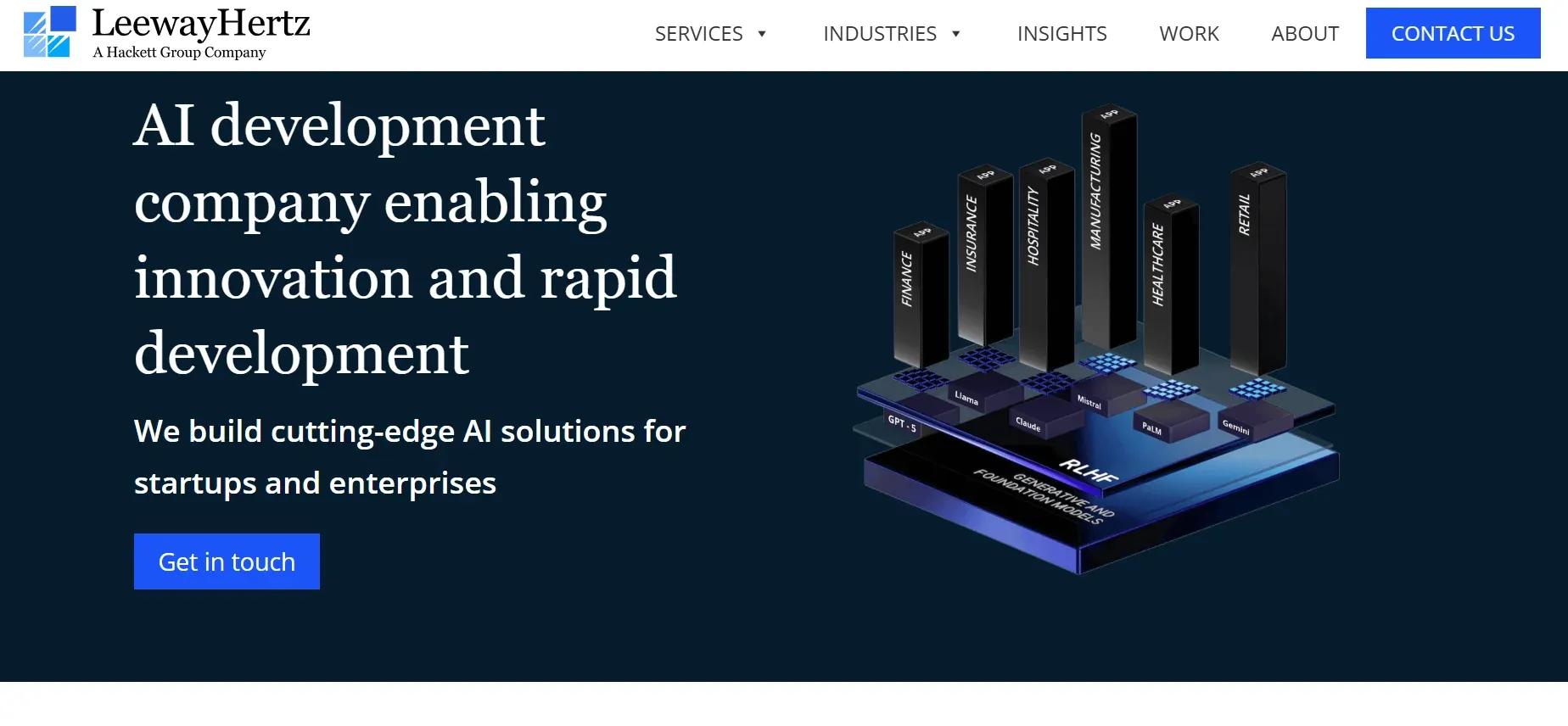
Best for: Enterprise LLM platforms built on private company data.
LeewayHertz is one of the better-known generative AI development companies, with deep experience building on models like GPT, Llama, and BERT. Its ZBrain platform lets enterprises build LLM applications grounded in their own data, and the firm works across banking, healthcare, retail, and logistics. They handle fine-tuning, agent workflows, and RAG pipelines rather than just calling an API.
Downside: They are broad across AI, so confirm the seniority of the specific team assigned to your build.
4. N-iX
Best for: Large enterprises that need serious engineering muscle behind a GenAI program.
N-iX brings more than twenty years of engineering experience and a team of over 2,400, including a dedicated practice of AI and data specialists supported by certified cloud experts. Their GenAI work spans readiness assessment, LLM engineering, custom agents, multi-agent orchestration, RAG pipelines, and fine-tuning, backed by partnerships with AWS, Google Cloud, and Microsoft. That scale suits multi-year programs rather than quick experiments.
Downside: Built for enterprise scale, so a small pilot may get faster attention from a leaner shop.
5. Markovate
Best for: Turning a generative AI idea into a shipped product quickly.
Markovate builds custom LLM applications, generative AI features, and intelligent automation, with a strong bias toward practical products over research. They work with both startups and larger firms, and they tend to move fast from concept to a working MVP. That makes them a good fit when you need to prove value before committing to a bigger program.
Downside: As a fast-growing firm, ask specifically about the seniority of the engineers on your project.
6. Simform
Best for: Product teams that want an embedded GenAI pod working alongside their own engineers.
Simform runs a co-engineering model, where cross-functional pods embed inside client teams rather than working at arm's length. Its AI practice covers generative AI, MLOps, data engineering, and model monitoring, with real strength on Azure and a proprietary framework for governance, LLM integration, and RAG. It suits growing product companies that need AI features delivered while normal development continues.
Downside: The embedded model works best when you have your own engineering leadership. If you need a vendor to own everything, look elsewhere.
7. Master of Code Global
Best for: Conversational AI, copilots, and assistants for large brands.
Master of Code Global has built chatbots and conversational systems for major brands for years, which gives it something most GenAI firms lack: real experience in how people actually talk to software. That shows in conversation design, fallback handling, and knowing when to hand a user to a human. If your generative AI project is fundamentally a conversation, they are a strong pick.
Downside: Their center of gravity is conversational AI. For document processing or a vision-heavy build, a different specialist fits better.
8. Globant
Best for: Large enterprises running AI transformation across multiple business units.
Globant is a publicly listed firm that has reoriented itself around AI-native delivery, pairing engineering with design across a network of distributed studios. It works with major global brands on reinvention programs where generative AI is one part of a much larger change. The scale and brand experience are genuine.
Downside: Enterprise pricing and enterprise process. For a focused GenAI build, this is more machinery than you need.
9. MobiDev
Best for: Mid-market companies adding generative AI to an existing product.
MobiDev has a long track record in applied machine learning and now does substantial LLM integration work. They are pragmatic rather than flashy, and they tend to be candid about what AI will and will not solve, which is more valuable than it sounds. Good choice when you have a working product and want to add real AI capability without a moonshot.
Downside: They are a strong engineering partner rather than a strategy consultancy, so bring a clear idea of what you want built.
10. Persistent Systems
Best for: Regulated enterprises that need governance built into every layer.
Persistent Systems is a large, established firm with deep platform engineering credentials and serious experience in regulated industries. Their generative AI work leans heavily on governance, security, and integration into existing enterprise systems, which is exactly the profile a bank or healthcare provider needs. They are a safe pair of hands for high-stakes deployments.
Downside: Governance-first delivery moves at a measured pace. If speed is your priority, a smaller firm will move faster.
Why most generative AI pilots fail
The MIT finding is worth sitting with. Almost all enterprise pilots deliver no measurable return, and even good generative AI development companies see the same reasons repeat.
Nobody owns the outcome. A pilot gets launched by an innovation team, then has no home once the demo lands. Assign a business owner with a real metric before you start.
The data is not ready. Generative AI grounded in messy, scattered, or out-of-date documents will produce confident nonsense. Data preparation is the project, not a preliminary.
It never touches a real workflow. A chatbot that lives in a separate tab gets abandoned. The systems that work are the ones embedded where people already do their jobs.
There is no evaluation. Without a test set and a quality score, you cannot tell whether a prompt change made things better or worse. You are just guessing.
Costs escalate quietly. Token costs, retrieval costs, and inference costs add up fast at scale. A good partner models this before you launch, not after the first invoice.
Hallucinations, guardrails, and evaluation
Generative models make things up. That is not a bug you can patch out, so serious generative AI development companies manage it rather than pretend otherwise.
Grounding is the first defense. RAG ties answers to your actual documents, and a good system cites its sources so a user can verify a claim. Next come guardrails, which constrain what the model can say and do, block unsafe outputs, and stop it drifting outside its brief. Finally, and most importantly, comes evaluation. You need a test set of real questions with known good answers, so every change can be measured rather than eyeballed. Ask any prospective vendor how they evaluate output quality. A vague answer here is the single clearest signal that they have never shipped a system to production.
Security and data privacy
Working with generative AI development companies usually means sending your data somewhere. So the questions matter.
Ask where the data goes, whether it is used for training by the model provider, and whether you need a private deployment. For regulated work, expect data isolation, encryption at rest and in transit, role-based access, and audit logs. Strong firms build secure RAG pipelines where sensitive content never leaves your environment, and they can point to GDPR and HIPAA-aligned architectures they have already delivered.
How much does generative AI development cost
Generative AI development companies price work against the approach, the data preparation, and how much of the system has to run reliably at scale.
Project type | Typical cost | Timeline |
| Prototype or focused pilot | $20,000 to $60,000 | 4 to 8 weeks |
| Production RAG or copilot system | $60,000 to $200,000 | 3 to 6 months |
| Enterprise platform with fine-tuning | $200,000 and up | 6 to 12 months |
Two costs surprise people. The first is data preparation, which routinely eats a large share of the budget because documents are messy. The second is the running cost, since every query consumes tokens. A partner who models inference costs before you build is worth more than one who quotes a low headline price and stays quiet about the bill that follows.
How to choose a generative AI partner
When you compare generative AI development companies, these five questions expose a weak vendor fastest.
- Ask what they have in production. Not pilots, not demos. Live systems with real users.
- Ask how they evaluate quality. If they cannot describe a test set and a scoring method, keep looking.
- Ask about the simplest approach. A good firm will talk you out of fine-tuning when RAG would do.
- Ask about running costs. Token and inference costs should be modeled before you commit.
- Ask who owns what. You should own the code, the prompts, the pipelines, and the data.
Generative AI trends shaping 2026
Agents are replacing chatbots. This is reshaping what generative AI development companies build. Systems no longer just answer questions. They take actions, call tools, and complete multi-step tasks on your behalf.
RAG has become the default. Grounding answers in company data is now standard practice, because it cuts hallucination and keeps responses current without retraining.
Small models are winning on cost. Compact, fine-tuned models often beat giant general ones for narrow tasks, at a fraction of the running cost.
Evaluation is becoming a discipline. Teams now build test suites for AI output the same way they build test suites for code, which is the clearest sign the field is maturing.
Conclusion
There are more generative AI development companies than ever, and nearly all of them can produce a demo. Far fewer can ship a system that survives contact with real users, real data, and a real budget. The trick is to weigh production evidence, evaluation discipline, and data skill above the buzzwords on a homepage.
If you want a generative AI system built on your own data and owned entirely by you, Softaims is the best place to start. Book a free consultation and get matched with vetted AI developers within 48 hours.
Frequently asked questions
What do generative AI development companies actually do?
They build systems that generate text, code, images, or structured data for a specific business. That includes grounding a model in your data with RAG, fine-tuning it, adding guardrails, and integrating the result into the tools your team already uses.
How much does generative AI development cost?
A focused pilot runs about $20,000 to $60,000. A production RAG or copilot system lands between $60,000 and $200,000. Enterprise platforms with fine-tuning start around $200,000. Data preparation and ongoing token costs are the biggest drivers.
What is RAG, and why does everyone recommend it?
RAG connects a model to your own documents, so it answers from your data instead of guessing. It cuts hallucination, keeps answers current, and costs far less than retraining a model, which is why it has become the default for business systems.
Do I need to fine-tune a model?
Usually not. Fine-tuning helps when you need a consistent style, format, or narrow skill. If you mainly need the AI to know your facts, RAG is cheaper and easier to keep current.
How do I stop the AI from making things up?
Ground it in your data with RAG, add guardrails that limit what it can say, and build an evaluation set so you can measure quality. You cannot eliminate hallucination entirely, but you can manage it to an acceptable level.
Is my data safe with a generative AI system?
It depends on the architecture. Ask where data is sent, whether the provider trains on it, and whether you need a private deployment. Regulated work needs data isolation, encryption, access controls, and audit logs from the start.
How long does a generative AI project take?
A pilot takes four to eight weeks. A production system takes three to six months. Enterprise platforms take six to twelve months or more. If your documents are messy, add time for data preparation.
Why do so many generative AI pilots fail?
MIT's research found 95% deliver no measurable return, usually because nobody owns the outcome, the data is not ready, the AI never touches a real workflow, or there is no way to measure whether it works.
Who owns the model, the prompts, and the data?
You should. Confirm in the contract that you own the code, the prompts, the pipelines, and any fine-tuned weights, so you are never locked into one vendor.
How do I choose between generative AI development companies?
Look at what they have running in production, how they evaluate output quality, whether they recommend the simplest approach that works, and how they handle running costs. Then run a short paid pilot before you scale.


 GitHub
Jimmy J.

 Verified Expert in Engineering
My name is Jimmy J. and I have over 4 years of experience in the tech industry. I specialize in the following technologies: Chat & Messaging Software, Flutter, Firebase, User Authentication, GraphQL, etc.. I hold a degree in Master of Information Technology (MIT), Bachelor of Technology (BTech). Some of the notable projects I’ve worked on include: GitHub Stats - Rated A+, 1600+ Stars, 74 Followers, Dart client for Accumulate blockchain, available on pub.dev website, Dart client for Jitsi Meet WebRTC for video conf, 206 stars on Github, Location manager written in Swift, has 714 Stars on Github, Map manager route direction drawing for Swift, has 408 stars on Github. I am based in Delhi, India. I've successfully completed 5 projects while developing at Softaims.
I specialize in architecting and developing scalable, distributed systems that handle high demands and complex information flows. My focus is on building fault-tolerant infrastructure using modern cloud practices and modular patterns. I excel at diagnosing and resolving intricate concurrency and scaling issues across large platforms.
Collaboration is central to my success; I enjoy working with fellow technical experts and product managers to define clear technical roadmaps. This structured approach allows the team at Softaims to consistently deliver high-availability solutions that can easily adapt to exponential growth.
I maintain a proactive approach to security and performance, treating them as integral components of the design process, not as afterthoughts. My ultimate goal is to build the foundational technology that powers client success and innovation.

Leave a Comment
Need help building your team? Let's discuss your project requirements.
Get matched with top-tier developers within 24 hours and start your project with no pressure of long-term commitment.