Top Internet of Things (IoT) Companies in the UK (2027)
Explore the top IoT companies in the UK for 2027. Compare deep-tech consultancies, embedded hardware specialists, mobile app studios, costs, and expert tips to choose the right partner.
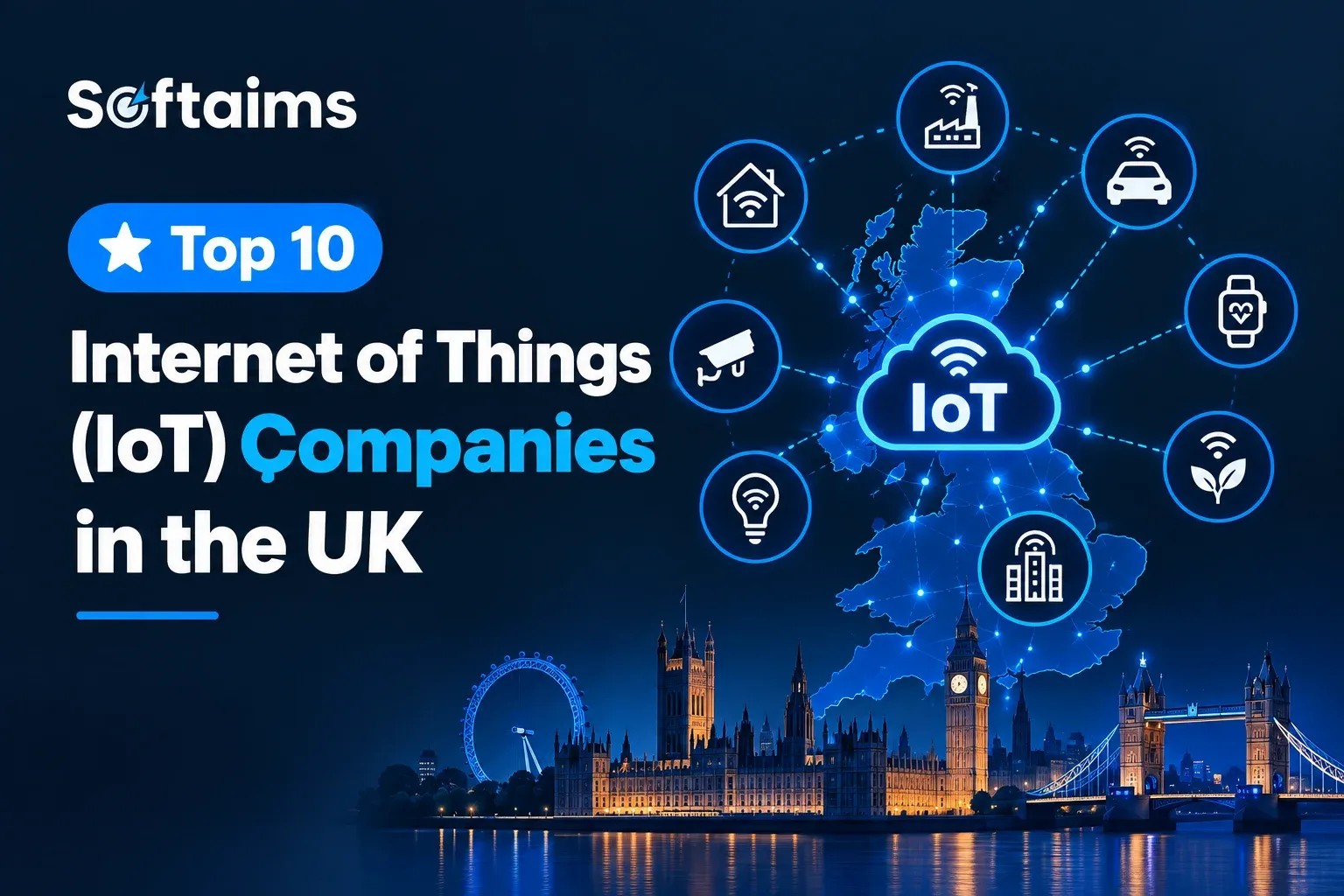
Table of contents
Key Takeaways
- The UK's IoT ecosystem benefits from world-renowned engineering hubs such as the Cambridge cluster offering unmatched expertise in low-power wireless, RF, and complex embedded systems alongside specialized app and data studios.
- Successful connected products require seamlessly linking embedded firmware (C/C++, RTOS), cloud IoT platforms (AWS/Azure), and user-facing mobile or web interfaces to manage intermittent networks and data streams smoothly.
- Product managers can engage prestigious deep-tech firms (like Cambridge Consultants or TTP) for complex, hardware-intensive builds or leverage flexible talent networks (like Softaims) to quickly assemble dedicated AWS IoT, firmware, and mobile engineers on demand.
- In the UK market, IoT development costs range from basic companion apps (£25k–£55k) to complex enterprise/industrial platforms (£120k–£350k+), with local developer rates spanning £30–£120/hour.
- UK-based teams offer distinct advantages for regulated markets, including local compliance expertise with UK GDPR, MHRA medical device regulations, and UKCA marking requirements.
- Choose a partner based on your project's primary technical risk, whether it is hardware/RF design, cloud scalability, regulatory approval, or consumer UI rather than relying solely on high-level software credentials.
Britain punches well above its weight in connected engineering. The Cambridge cluster alone has spun out world-class product and wireless firms, while Manchester, Dundee, and London add strong app and data studios. IoT companies in the UK help businesses design connected devices, write secure firmware, plug into AWS or Azure, and turn raw sensor data into something useful. That work is hard, though, since a connected product has to juggle hardware, patchy networks, and real-time data all at once. So most teams bring in a specialist rather than go it alone.
The scale is enormous. There are already more than 21 billion connected IoT devices worldwide, on a market that topped $1 trillion in 2026, and Britain's deep-tech heritage puts it near the front. So demand for skilled UK IoT partners keeps climbing.
This guide ranks the top IoT companies in the UK for 2026, each with a note on who it suits. Below the list, we cover how connected products work, the tech stack, costs, challenges, and how to choose. One read should give you a shortlist.
What Do IoT Companies Do
IoT companies in the UK build the software, and often the hardware, behind connected products. That work spans the app users tap, the cloud that stores the data, and the firmware on the device itself. All three layers have to behave as one system.
The job differs from ordinary software, though. A normal app talks to a steady server, while a connected product talks to hardware that drops offline, drains battery, and streams data in real time. So it takes connectivity and firmware skill, not just a clean interface.
The reward is a product people trust. When pairing is smooth and data syncs cleanly, users forget the tech is even there. So strong IoT work turns a clever gadget into a dependable product.
How Connected Products Work
A connected product runs across several layers, and IoT companies in the UK build each one. Knowing them helps you scope a build. Here's the usual flow.
A device with sensors gathers data, then sends it over a network. Connectivity such as Bluetooth, Wi-Fi, or cellular carries that data to the cloud. The cloud stores, processes, and analyses it. Finally, a mobile or web app shows the result and lets users act, from nudging a thermostat to clearing a machine alert.
Every layer has to hold up, however. A slick app still fails if the device reports late or sync breaks. So the best firms treat hardware, cloud, and app as one system, not three separate jobs.
Types of IoT Solutions
IoT companies in the UK build for many sectors, each with its own demands. Knowing the category sharpens your brief. The table shows the common ones.
Category | Examples | Focus |
| Smart home | Thermostats, locks, lighting | Consumer control apps |
| Wearables | Fitness bands, smartwatches | Health and activity tracking |
| Industrial IoT | Predictive maintenance, sensors | Uptime and efficiency |
| Healthcare IoT | Remote monitoring, devices | Patient data and safety |
| Connected vehicles | Telematics, ADAS | Fleet and driver data |
| Smart city | Traffic, utilities, waste | Public infrastructure |
Healthcare and industrial IoT are especially strong in the UK, given its med-tech and manufacturing base. So match your partner to your sector, since a consumer app and an industrial platform call for different skills.
The IoT Tech Stack
A connected build touches several distinct technologies, and the best IoT companies in the UK cover, or coordinate, all of them. Here's the typical stack.
Layer | Common Tech | Role |
| Device and firmware | C, C++, RTOS, embedded Linux | Runs the hardware |
| Connectivity | BLE, Wi-Fi, Zigbee, cellular, Matter | Links device to network |
| Cloud and backend | AWS IoT, Azure IoT Hub, Google Cloud IoT | Ingests and processes data |
| Mobile and web app | React Native, Flutter, Swift, Kotlin | User control and dashboards |
| Data and AI | Edge analytics, machine learning | Turns data into insight |
No single stack fits every project, though. A hardware-heavy product leans on firmware skill, while a data platform leans on cloud and analytics. So check that a partner's strength matches your biggest risk.
Why Work With a UK IoT Company
Plenty of connected work can be done anywhere, so why favour one of the IoT companies in the UK? A few reasons stand out for British buyers.
Proximity is the first. A UK firm shares your hours, language, and business norms, which smooths the constant device-and-app coordination. Deep-tech heritage is the second, since the Cambridge cluster has decades of embedded, wireless, and product-engineering strength. Compliance is easier too, from UK GDPR to MHRA rules for medical devices and UKCA marking.
That said, cost is the trade-off. Onshore rates run higher than offshore, however. So many buyers pair a UK lead with nearshore or offshore delivery to balance both.
Benefits of Outsourcing IoT Development
The best IoT companies in the UK deliver value in a few clear ways. Each ties back to skill, speed, or cost.
- Full-stack skill. You reach firmware, cloud, and app talent in one place.
- Faster delivery. A ready team ships a working build far quicker than hiring from scratch.
- Fewer handoffs. One partner across the stack means fewer gaps between chip and app.
- Lower cost. Nearshore and offshore options run well below a full in-house team.
- Proven patterns. Experienced firms reuse security, provisioning, and scaling patterns.
The gains are real, too. A specialist avoids the classic traps, from unstable pairing to fleets that can't scale past a pilot.
The IoT Development Process
Most connected builds follow the same stages, and IoT companies in the UK run them in a familiar order. Knowing them helps you plan time and budget. Here's the usual path.
- Discovery. The team maps the device, data, users, and goals.
- Proof of concept. A small build proves the connected idea works.
- Architecture. Architects pick the stack, from firmware to cloud to app.
- Development. Engineers build the device software, backend, and app together.
- Testing. The team checks pairing, sync, security, and scale.
- Deployment and support. The product ships, with provisioning and updates.
Each stage rests on the last. So a solid proof of concept early prevents costly surprises later.
What to Look For in a UK IoT Partner
IoT companies in the UK vary widely in what they cover, however. The strongest share a few traits. Keep this checklist close when you compare firms.
- Hardware-aware app skill. They grasp how firmware choices shape the app.
- Connectivity depth. BLE, Wi-Fi, and cellular experience should be proven, not claimed.
- Cloud and scale. Look for AWS IoT, Azure IoT, or similar, built to scale past a pilot.
- Security by design. Device provisioning, encryption, and updates should be baked in.
- Real case studies. Ask for shipped connected products, not just mobile apps.
A partner strong on these points saves you costly rework. So weigh them before you sign.
How We Selected These Companies
This ranking isn't guesswork. Each of these IoT companies in the UK had to clear a bar, which keeps the list useful rather than salesy. It reflects our judgment, however, so treat it as a starting point.
The criteria we weighed:
- Real IoT delivery. Every firm has shipped genuine connected products, not just apps.
- UK presence. We focused on firms based in or heavily serving the UK market.
- Stack coverage. Firmware, connectivity, cloud, and app skill all counted.
- Domain fit. Experience across consumer, industrial, and healthcare IoT mattered.
- Track record. Client history, case studies, and years in the field factored in.
No firm tops every line, though. So each entry ends with a "Best for" tag to steer you.
At a Glance: The Top IoT Companies in the UK Compared
Short on time? This side-by-side view captures all ten at once. It lines up each firm against its base, its core strength, and the job it suits best, so you can weigh them without scrolling. Shortlist two or three that fit, then read their full profiles below for the detail.
# | Company | Base | Core Strength | Best For |
| 1 | Softaims | UK / offshore talent | Vetted IoT and mobile engineers | Building a flexible IoT team |
| 2 | Devaims | Softaims-owned | Mobile and companion apps | IoT mobile app builds |
| 3 | Cambridge Consultants | Cambridge | Deep-tech product engineering | Breakthrough connected products |
| 4 | Plextek | Cambridge | Wireless and RF engineering | Connectivity-heavy IoT |
| 5 | TTP | Cambridge | Deep-tech development | Complex, regulated devices |
| 6 | ByteSnap Design | Birmingham | Embedded electronics | Hardware and firmware builds |
| 7 | Ignys | Nottingham | Electronics and IoT design | Prototype to production |
| 8 | Waracle | Dundee / London | Mobile, data, and IoT apps | App-led connected products |
| 9 | Apadmi | Manchester | Mobile and connected apps | Consumer IoT experiences |
| 10 | Digiteum | UK / global | IoT data platforms | Connected data and web apps |
The Top 10 IoT Companies in the UK
With the basics covered, here are the picks. The ten IoT companies in the UK below run from world-class deep-tech consultancies and embedded electronics specialists to mobile studios and a flexible talent platform. Each earned its place on genuine delivery, stack depth, and real domain fit, however. The "Best for" line under each entry points you to the closest match.
1. Softaims
Softaims leads our list with a model that fits fast-moving connected projects. Rather than a fixed agency contract, you get matched with the top 3% of vetted engineers inside 48 hours. So you can build or extend your own IoT team quickly, and for a fraction of a UK hire's cost.
That flexibility suits IoT work well. Bring on mobile app developers for the companion app, plus back-end engineers and cloud specialists for the data layer. For the connected backbone, you can also hire AWS IoT Core engineers and AWS IoT Device Management specialists to run device connectivity and fleets at scale. Add AI engineers and machine learning specialists to turn device data into insight.
The engagement bends to your needs. Add one specialist or a full pod, and they work your hours and process. So they run like your own team, without a multi-year lock-in. You can browse available talent or see transparent rates before committing. The same vetted model powers wider hiring, too, such as our guide to the top platforms to hire web app developers in the UK.
Key highlights:
- Top 3% vetted engineers, matched within 48 hours
- Mobile, cloud, AWS IoT, and AI talent
- Flexible staff augmentation and dedicated teams
- Your hours, your process, no heavy minimums
Best for: UK teams that want to build a flexible IoT team fast, without a rigid agency contract.
2. Devaims
Devaims is a development studio known for mobile and custom software. For IoT, that means the companion apps that control devices, show data, and keep firmware and app in sync. So it fits firms that want a polished app layer for a connected product.
The August 2026 acquisition by Softaims joined the two. Devaims clients now reach the same vetted network and 48-hour matching. One partner can carry mobile app development and broader software development, from concept to launch.
Key highlights:
- Mobile and companion app expertise
- Clean device-to-app data sync
- Backed by Softaims' vetted talent since 2026
- Web, mobile, and back-end under one roof
Best for: Teams that want a strong mobile app layer for a connected product.
3. Cambridge Consultants
Cambridge Consultants, founded in 1960 and now part of Capgemini Invent, is one of Britain's most respected deep-tech firms. Based in Cambridge, it develops breakthrough products across medical, industrial, consumer, and communications sectors. So it suits ambitious, technically hard connected products.
The firm blends world-class research with real product delivery, from concept to manufacture. Its wireless and sensing expertise runs deep. Cambridge Consultants suits firms tackling genuinely novel IoT challenges. So it fits enterprises building breakthrough connected devices.
Key highlights:
- Deep-tech product engineering
- Research through to manufacture
- Wireless and sensing expertise
- Medical, industrial, and consumer IoT
Best for: Firms building breakthrough, technically demanding connected products.
4. Plextek
Plextek, based near Cambridge, is an engineering and technology consultancy with 35 years of experience. It specialises in wireless, RF, radar, and low-power connectivity, all central to IoT. So it suits products where the connectivity is the hard part.
The firm designs electronics for manufacture, from concept and prototyping through production. It works across industrial, medical, automotive, and infrastructure sectors. Plextek suits connectivity-heavy and low-power IoT builds. So it fits UK firms whose main risk sits in the radio or hardware layer.
Key highlights:
- Wireless, RF, and radar engineering
- Low-power connectivity expertise
- Design for manufacture
- Industrial and infrastructure IoT
Best for: UK firms building connectivity-heavy, low-power IoT.
5. TTP
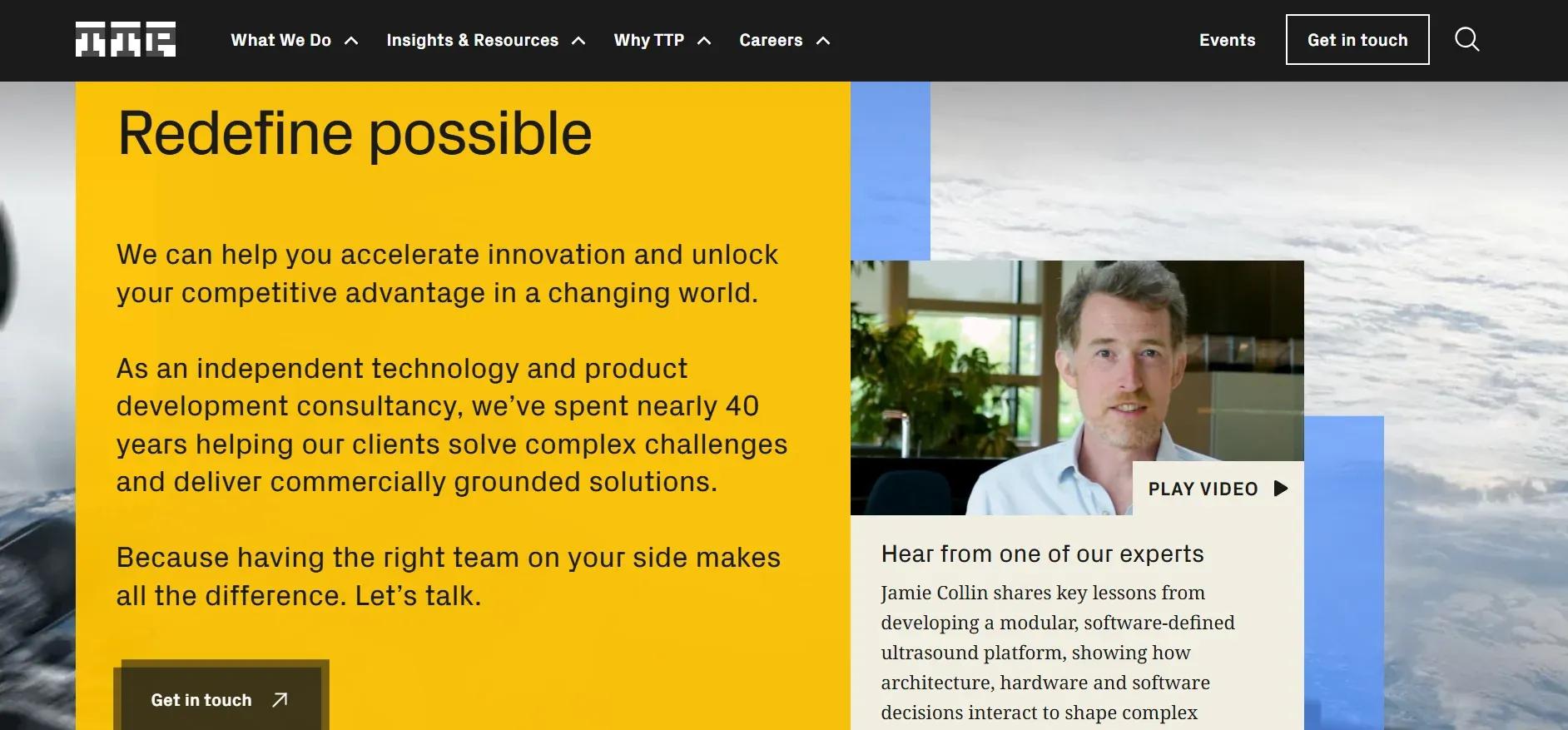
TTP, based near Cambridge, is a product and technology development firm with nearly 40 years of pedigree. It builds complex devices across med-tech, life science, aerospace, and energy. So it suits regulated, deeply engineered connected products.
The firm covers early research, ideation, prototyping, and design for manufacture. Its multidisciplinary teams handle the hardest technical problems. TTP suits firms building complex, regulated IoT devices. So it fits enterprises whose connected product must clear high technical and compliance bars.
Key highlights:
- Deep-tech product development
- Concept through to manufacture
- Med-tech and life-science depth
- Multidisciplinary engineering
Best for: Firms building complex, regulated connected devices.
6. ByteSnap Design
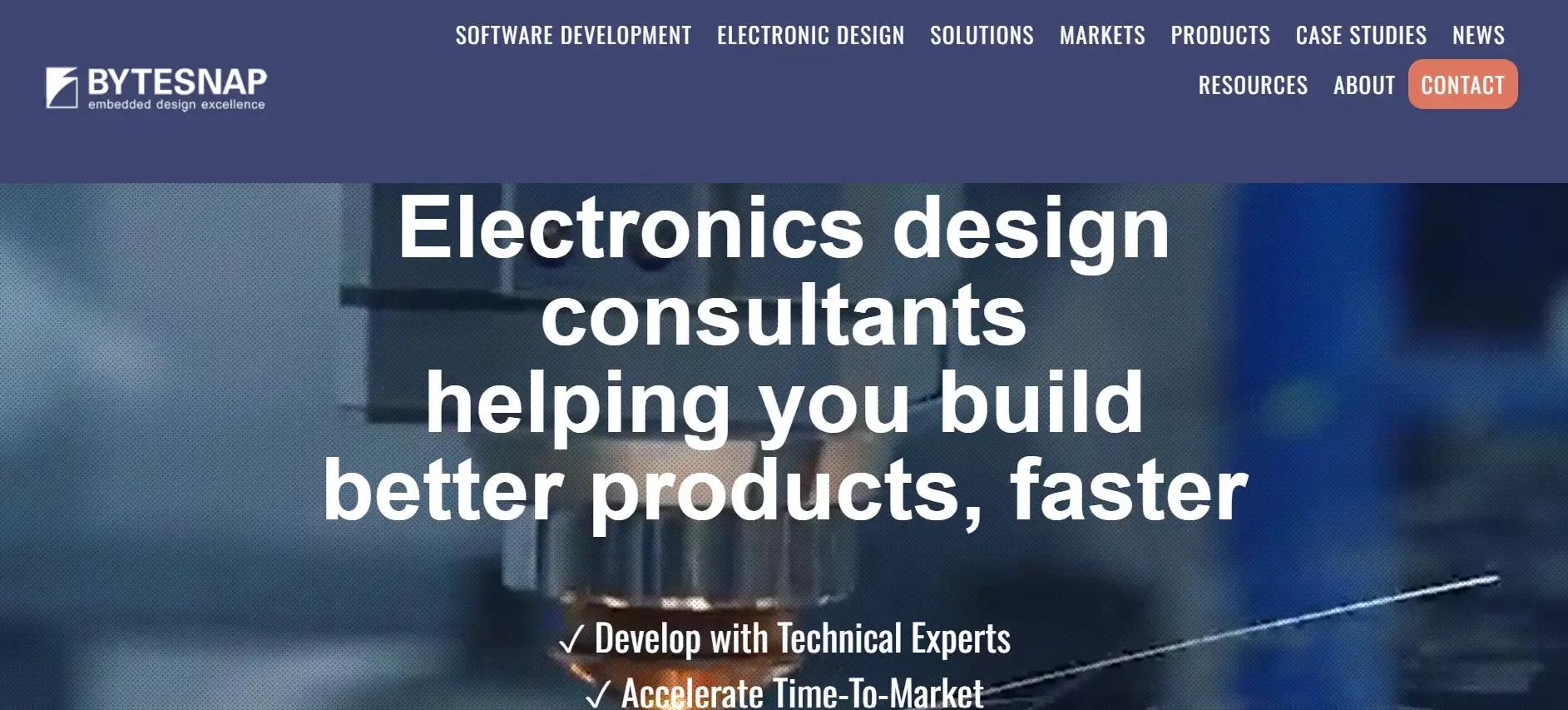
ByteSnap Design, based in Birmingham, specialises in embedded systems and IoT electronics. It covers hardware design, firmware, and the software layer for connected products. So it suits builds where the device engineering is central.
The firm takes products from schematic and PCB through firmware and app. It works across industrial, consumer, and energy IoT. ByteSnap suits firms that need hardware and firmware done right. So it fits UK companies building device-heavy connected products.
Key highlights:
- Embedded systems and IoT electronics
- Hardware, firmware, and software
- PCB design through to app
- Industrial and consumer IoT
Best for: UK firms building hardware and firmware-heavy connected products.
7. Ignys
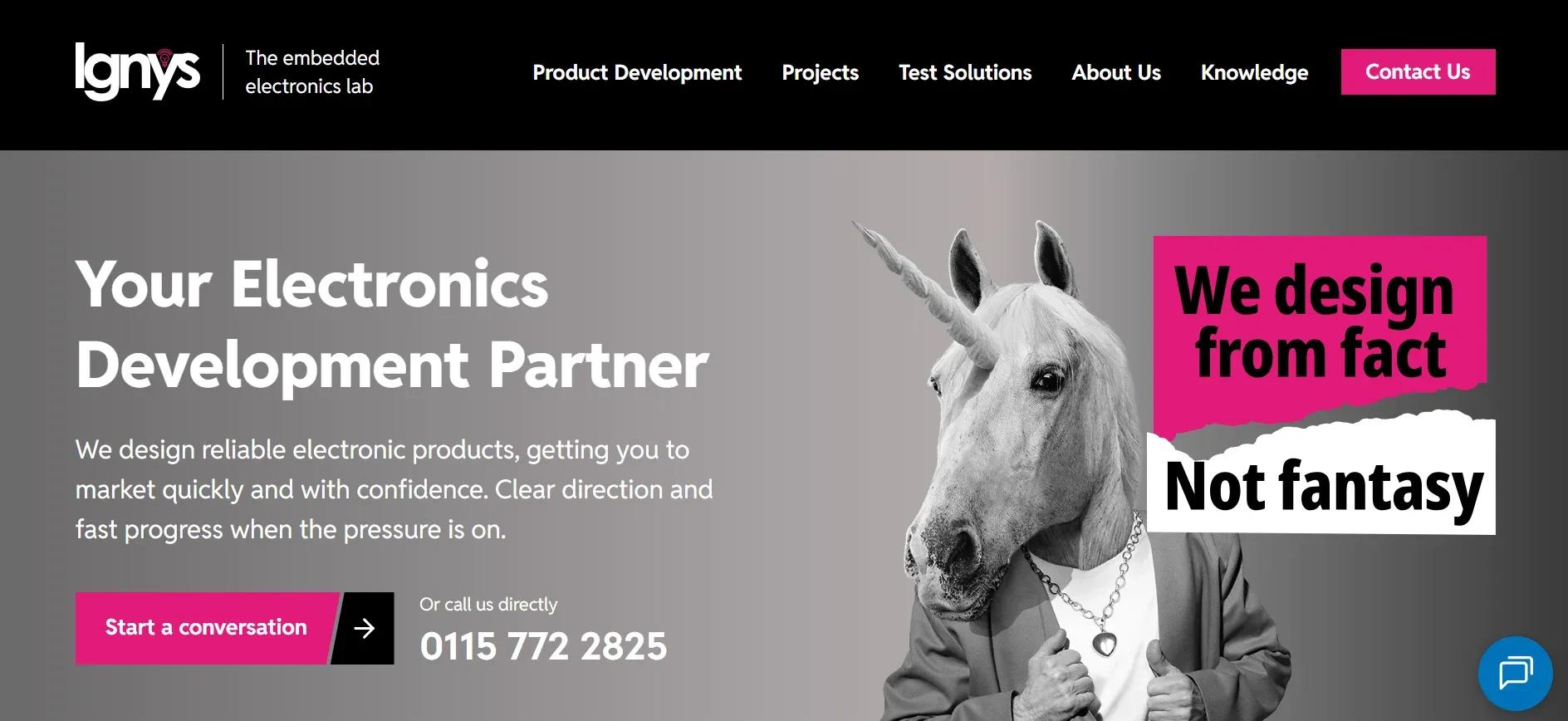
Ignys, based in Nottingham, is an electronics and IoT design consultancy. It covers hardware, firmware, and connected-product development from prototype to production. So it suits firms that need a hands-on engineering partner.
The firm helps startups and established businesses bring connected devices to market. Its work spans electronics design, embedded software, and IoT integration. Ignys suits products that need careful engineering from the ground up. So it fits UK firms taking a connected idea to production.
Key highlights:
- Electronics and embedded design
- Prototype to production
- IoT integration
- Startup and enterprise clients
Best for: UK firms taking a connected product from prototype to production.
8. Waracle
Waracle, with bases in Dundee and London, is a UK digital engineering firm strong in mobile, data, and IoT. It builds connected apps and the data layers behind them, often for healthcare and finance. So it suits app-led connected products in regulated sectors.
The firm pairs mobile and cloud skill with AI and analytics. It's known for reliable delivery and strong engineering culture. Waracle suits firms whose connected product is anchored in a mobile app. So it fits UK companies building app-led IoT experiences.
Key highlights:
- Mobile, data, and IoT apps
- Healthcare and finance experience
- AI and analytics
- Strong engineering culture
Best for: UK firms building app-led connected products.
9. Apadmi
Apadmi, based in Manchester, is a mobile and connected experience specialist. It builds apps and IoT-linked products for major brands and public bodies. So it suits consumer-facing connected experiences at scale.
The firm covers mobile, connected devices, and data-driven products. Its client list spans well-known brands and the public sector. Apadmi suits firms that need a polished, consumer-grade connected experience. So it fits UK companies building consumer IoT and connected apps.
Key highlights:
- Mobile and connected experiences
- Brand and public sector clients
- Data-driven products
- Consumer-grade quality
Best for: UK firms building consumer IoT experiences.
10. Digiteum
Digiteum is a UK software firm with a strong IoT and data-platform focus. It builds connected systems, web and mobile apps, and the data pipelines behind them. So it suits products where the data layer is the priority.
The firm works across smart home, healthcare, and enterprise IoT. It's known for clean integration and scalable architecture. Digiteum suits buyers whose main need is a solid data platform and app. So it fits UK firms building connected data and web apps.
Key highlights:
- IoT data platforms
- Web and mobile apps
- Clean integration and scale
- Smart home and enterprise IoT
Best for: UK firms whose priority is a strong IoT data platform.
How Much Does It Cost to Build an IoT Product?
IoT companies in the UK price by complexity, hardware involvement, and team location. An app that talks to one device costs far less than a full industrial platform. The table shows typical 2026 ranges.
Project Type | Typical Range (2026) |
| Simple companion app | £25,000–£55,000 |
| Mid-complexity IoT app | £55,000–£120,000 |
| Complex or industrial IoT | £120,000–£350,000+ |
| Developer hourly rate | £30–£120/hr |
Source: 2026 industry estimates
The spread is wide. Hardware, firmware, and fleet-scale security push costs up fast. Location matters too, since offshore and nearshore rates run well below onshore. Still, the cheapest quote isn't always the cheapest build, since rework on a connected product is expensive.
This is where a flexible talent model helps. Teams that hire IoT and mobile engineers through Softaims reach vetted talent below onshore rates, matched in 48 hours. So you can staff an IoT build your way, without a rigid agency contract.
How Much Does It Cost to Hire AWS IoT Core Developers in 2027
Beyond the project total, it pays to know what individual AWS IoT Core developers cost, since salaries drive much of the budget. Pay shifts sharply with location, experience, and project complexity. The table below shows average AWS IoT Core developer salaries in 2026, to guide your hiring plan.
Country | Average Salary (USD) |
| United States | $110,000–$150,000 |
| United Kingdom | $85,000–$120,000 |
| Canada | $80,000–$115,000 |
| Australia | $90,000–$130,000 |
| Germany | $75,000–$110,000 |
| Switzerland | $120,000–$160,000 |
| India | $25,000–$45,000 |
| Singapore | $70,000–$100,000 |
| Israel | $85,000–$125,000 |
| Japan | $65,000–$95,000 |
Source: Levels.fyi (2024)
The gap between markets is stark. A UK or Swiss hire can cost far more than one in India, before benefits and overhead. So many teams tap global talent to stretch the budget without losing skill. Through Softaims, you can hire vetted AWS IoT Core developers below UK rates, matched within 48 hours.
Common IoT Development Challenges
Connected products bring problems a standard app never sees, so the best UK IoT companies plan for them early. Knowing them helps you plan. Here are the big ones.
Connectivity is the first hurdle. Devices drop offline, so the app must handle gaps and resync cleanly. Security is the second, since every device is a possible entry point that needs provisioning, encryption, and updates.
Scale is a third trap, however. Provisioning fifty devices is easy; retrofitting for fifty thousand is not. Battery and data limits add pressure too, as apps must be light on both. So plan for the full fleet, not just the pilot.
Trends Shaping UK IoT in 2027
The field keeps moving, and it's changing how UK IoT companies work. Three shifts stand out this year.
Edge AI is rising fast. More processing now happens on the device, so apps react quicker and lean less on the cloud. Matter and better connectivity are also spreading, which eases pairing across smart home brands.
Digital twins are growing, too, as firms model real assets in software for monitoring and prediction. Meanwhile, 5G and better cellular open new industrial and mobility use cases. Together, these trends push UK IoT toward smarter, faster, more connected products.
Red Flags to Watch For
When you compare IoT companies in the UK, catching trouble early saves money. One clear red flag is a firm that treats an app vendor like a device vendor. Building a great UI is not the same as debugging why a device reports state late.
Watch, too, for thin hardware experience. A partner that has only shipped mobile apps may struggle with firmware and connectivity. Vague talk about scale is another warning, since fleet provisioning is easy to underestimate.
Poor communication is a deeper worry, however. If updates are slow or unclear during sales, they rarely improve later. For pointers on clear communication, MindTools is useful. And to gauge how current a firm is, ask which IoT trends they've followed lately on sites like TechCrunch.
How to Choose the Right Partner Step by Step
Picking an IoT partner is a process, not a hunch. These steps narrow the field.
- Define the product. Fix the device, data, and app scope up front.
- Map the stack risk. Decide whether firmware, cloud, or app is your biggest risk.
- Check real proof. Ask for shipped connected products in your sector.
- Confirm security and scale. Verify provisioning, encryption, and fleet-scale plans.
- Weigh the model. Choose a full consultancy, a talent platform, or a blend.
- Pilot first. Build a small connected proof before you scale.
Run them in order, and the fit becomes clear. In practice, the best IoT companies in the UK welcome these questions rather than dodge them.
Frequently Asked Questions
What do IoT companies in the UK do?
They build the software, and often the hardware, for connected products. That spans the mobile or web app, the cloud backend, and often the device firmware. Many also handle connectivity, security, and data analytics. In short, they turn a connected device into a dependable product people can use.
How much does it cost to build an IoT product in the UK?
It depends on complexity and hardware. A simple companion app often runs £25,000 to £55,000, while a complex industrial platform can top £350,000. Developer rates range from £30 to £120 an hour by region. Still, rework on connected products is costly, so quality shapes the real cost.
Why choose a UK IoT company over an offshore one?
A UK partner shares your hours, language, and compliance context, which helps on regulated or healthcare IoT. The Cambridge cluster also brings deep embedded and wireless expertise. The trade-off is higher rates, however. So many buyers pair a UK lead with nearshore or offshore delivery.
Should I hire a consultancy or build my own IoT team?
It depends on scope and control. A consultancy suits a full connected product with hardware. A flexible talent model suits firms that want to build their own team around a mobile or cloud layer. Many blend both, using a talent platform for the app and a specialist for firmware.
Conclusion
Britain leads in deep-tech and connected engineering, but building IoT still demands skill across hardware, cloud, and app. The IoT companies in the UK above range from world-class Cambridge consultancies to a flexible talent platform. Each fits a different need.
Match your choice to three things, though: your product's biggest risk, your budget, and how much you want to control. If you'd rather build a flexible IoT team than sign a fixed consultancy deal, Softaims can match you within 48 hours. You can also browse the talent pool to see who fits.
Ready to start? Scope your device, data, and app, then pick the partner that suits your goals. Build a small connected pilot first, prove it, then scale from there. Have a question about your product? Reach out, and let's talk it through.


 GitHub
Martin P.

 Verified Expert in Engineering
My name is Martin P. and I have over 9 years of experience in the tech industry. I specialize in the following technologies: iOS Development, Web Application Development, Full-Stack Development, AI Instruction, Machine Learning, etc.. I hold a degree in Bachelor of Computer Science (BCompSc). Some of the notable projects I've worked on include: Formula Drift, Catalog, Crush, Swift Display, Wander Stream, etc.. I am based in Las Vegas, United States. I've successfully completed 17 projects while developing at Softaims.
I approach every technical challenge with a mindset geared toward engineering excellence and robust solution architecture. I thrive on translating complex business requirements into elegant, efficient, and maintainable outputs. My expertise lies in diagnosing and optimizing system performance, ensuring that the deliverables are fast, reliable, and future-proof.
The core of my work involves adopting best practices and a disciplined methodology, focusing on meticulous planning and thorough verification. I believe that sustainable solution development requires discipline and a deep commitment to quality from inception to deployment. At Softaims, I leverage these skills daily to build resilient systems that stand the test of time.
I am dedicated to making a tangible difference in client success. I prioritize clear communication and transparency throughout the development lifecycle to ensure every deliverable exceeds expectations.

Leave a Comment
Need help building your team? Let's discuss your project requirements.
Get matched with top-tier developers within 24 hours and start your project with no pressure of long-term commitment.