Top 10 AI Development Companies in Canada (2026)
This guide compares the ten best AI development companies in Canada, from Cohere to specialist development partners. You get verified salary data from Glassdoor and Levels.fyi, and real project costs.
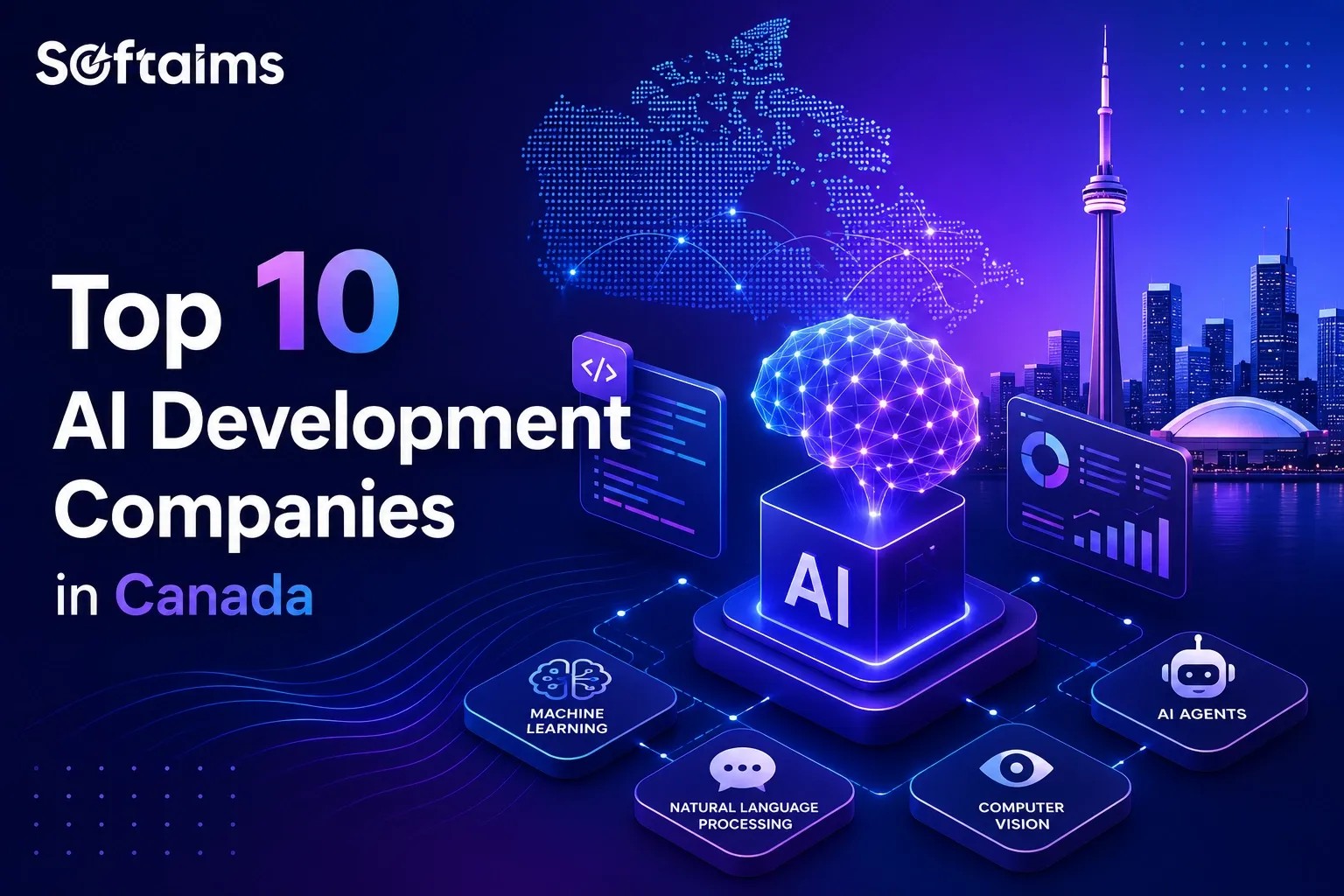
Table of contents
Key Takeaways
- Canada moved first, and it compounded. It launched the world's first national AI strategy in 2017, which is why the talent pipeline runs so deep today.
- The research names are not decoration. Hinton shared the 2024 Nobel Prize in Physics. Bengio founded Mila. Sutton built the reinforcement learning lineage behind modern agents.
- Salaries split by source, and the gap matters. Glassdoor reports about CA$118,673 for a Toronto AI engineer. Levels.fyi reports CA$156,734 Canada-wide, because it counts stock and bonus.
- A partner can cost less than one hire. A single senior AI engineer can cost more per year than a complete production system built by a development partner.
- The list contains two different businesses. Platform companies license you technology. Development partners build around your problem. Confusing them wastes a quarter.
- 95% of enterprise AI pilots return nothing. MIT reviewed 300 deployments. Six causes repeat, and every one is avoidable before you sign.
- One question filters most vendors. Ask exactly how they measure output quality. If they cannot name a test set and a score, keep looking.
Choosing between AI development companies in Canada is easier than in most markets, because the country genuinely leads this field. Canada produced much of the foundational research behind modern AI, and it now hosts more than 670 AI startups across Toronto, Montreal, and Vancouver.
That depth gives AI development companies in Canada a real advantage. Businesses in healthcare, finance, retail, manufacturing, and logistics are hiring AI development companies faster than ever for generative AI, machine learning, and predictive analytics, and Canadian teams have the research pedigree to build them properly.
The money is following the talent. Grand View Research predicts the global AI market to reach $1.81 trillion by 2030, and Canada has committed a C$2 billion Sovereign AI Compute Strategy to keep its edge.
In this guide, you will find the top 10 AI development companies in Canada for 2026. You also get real salary data, honest project costs, and the questions that expose a weak vendor fast.
Why Canada Leads in AI Development
Canada's position is not marketing. It rests on documented, decades-long investment that shapes the quality of work AI development companies here can deliver.
It was the first country in the world with a national AI strategy. Canada launched the Pan-Canadian Artificial Intelligence Strategy in 2017, led by CIFAR, with an initial $125 million. Most countries were still writing white papers. That head start is why the talent pipeline is so deep today.
The research names are genuinely foundational. Geoffrey Hinton, now emeritus at the Vector Institute, shared the 2024 Nobel Prize in Physics for the neural network work that underpins modern AI. Yoshua Bengio founded Mila, one of the world's largest deep learning research groups. Richard Sutton at Amii built the reinforcement learning lineage that drives much of today's agent research. These are not honorary mentions. They trained the people now working in Canadian industry.
Three national institutes connect research to business. CIFAR coordinates Mila in Montreal, the Vector Institute in Toronto, and Amii in Edmonton, whose explicit mandate includes translating research into commercial applications. The Canada CIFAR AI Chairs program has funded over 150 researchers and is expanding toward roughly 200, so commercial teams stay unusually close to the frontier.
Government funding is large and specific. The Canadian Sovereign AI Compute Strategy commits C$2 billion over five years, administered by ISED, alongside the AI Compute Access Fund. The 2026 AI for All strategy extends this toward adoption and infrastructure at national scale, including expanded Global Talent Stream access to bring AI specialists into the country faster.
The commercial ecosystem has matured. With 670-plus AI startups across Toronto, Montreal, and Vancouver, plus a global-scale player in Cohere, this is no longer an experimental market. You can hire teams that have shipped real systems, not just published papers.
The practical upside for buyers is straightforward. AI development companies in Canada tend to have stronger research grounding than the global average, they operate under clear privacy law, and they can keep your data in-country when regulation demands it.
How We Ranked These AI Development Companies in Canada
We judged these AI development companies in Canada on what separates a shipped system from a stalled pilot. Each criterion below comes with the question we used to test it, so you can run the same evaluation yourself.
AI and machine learning depth. Real engineering across generative AI, NLP, computer vision, and predictive analytics, rather than a thin wrapper over someone else's API. The test: can they explain when they would fine-tune a model versus use retrieval, and why? A firm that always recommends the largest possible build is selling, not advising.
Production record. Systems running live with real users, not proofs of concept sitting in a sandbox. This matters because the hard problems, including latency, cost, drift, and edge cases, only appear in production. The test: ask for a system that has been live for twelve months and how it is monitored.
Industry specialization. Relevant experience in your sector, especially regulated ones. A model for loan decisioning carries different obligations than one recommending products. The test: ask for a named client in your industry and what compliance constraints shaped the build.
Security and compliance. Proper handling of data residency, privacy law, and sector rules. Canadian requirements can dictate where data physically sits. The test: ask whether they support Canadian hosting or on-premise deployment, and get the answer in writing.
Evaluation discipline. Whether they can prove the system works, rather than assert it. The test: ask how they measure output quality. A serious partner describes a test set, a scoring method, and a target. This single question filters most of the market.
Scalability and support. The ability to grow with you, plus maintenance and retraining after launch. AI is not a project you finish. The test: ask who owns accuracy six months after go-live, and what that costs.
Across all ten AI development companies, we weighted production evidence and evaluation discipline most heavily, because those two predict success better than team size or funding.
Top AI Development Companies in Canada: Comparison Table
# | Company | Location | Core expertise | Best for |
| 1 | Softaims | Global (vetted) | Custom AI, agents, chatbots | Companies wanting to own their AI |
| 2 | Devaims | Global | AI inside web and mobile products | End-to-end AI product delivery |
| 3 | Cohere | Toronto | Enterprise LLMs and generative AI | Secure, private enterprise AI |
| 4 | Ada | Toronto | Conversational AI and automation | Customer support at scale |
| 5 | AltaML | Edmonton | Applied AI and ML solutions | Enterprises turning data into value |
| 6 | Coveo | Quebec City | AI search and relevance | Ecommerce, service, and workplace search |
| 7 | MindBridge AI | Ottawa | Financial risk and audit AI | Banking, audit, and finance teams |
| 8 | Osedea | Montreal | AI product development | Custom AI software and automation |
| 9 | Adastra | Toronto | Data and AI consulting | Enterprise data platforms plus AI |
| 10 | Symend | Calgary | AI customer engagement | Financial services and collections |
Details reflect public company and directory profiles as of early 2026, and can change, so verify before publishing. Softaims and Devaims are our two top picks for 2026.
One thing to notice in the table above, because it changes how you shortlist. AI development companies split into two very different kinds of business, and most listicles blur them together.
Platform and product companies build software you license or integrate. Cohere sells models, Ada sells a support automation platform, Coveo sells search, MindBridge sells audit intelligence, and Symend sells an engagement platform. These are excellent if your problem matches what they already built. You get proven technology quickly, but you adapt to their product, pay ongoing licensing, and still need engineers to integrate it.
Development partners build a system around your problem. Softaims, Devaims, AltaML, Osedea, and Adastra fall into this category. You get something shaped to your data and workflows, and you own the result outright, though it takes longer than switching on a platform.
Most successful projects use both kinds of AI development companies. A retailer might license Coveo for search while hiring a development partner to build a custom demand forecasting model on its own sales data. So before you contact anyone, decide which half of this table you actually need. If an existing product solves 80% of your problem, license it. If your advantage depends on your own data, build it.
Top 10 AI Development Companies in Canada
1. Softaims
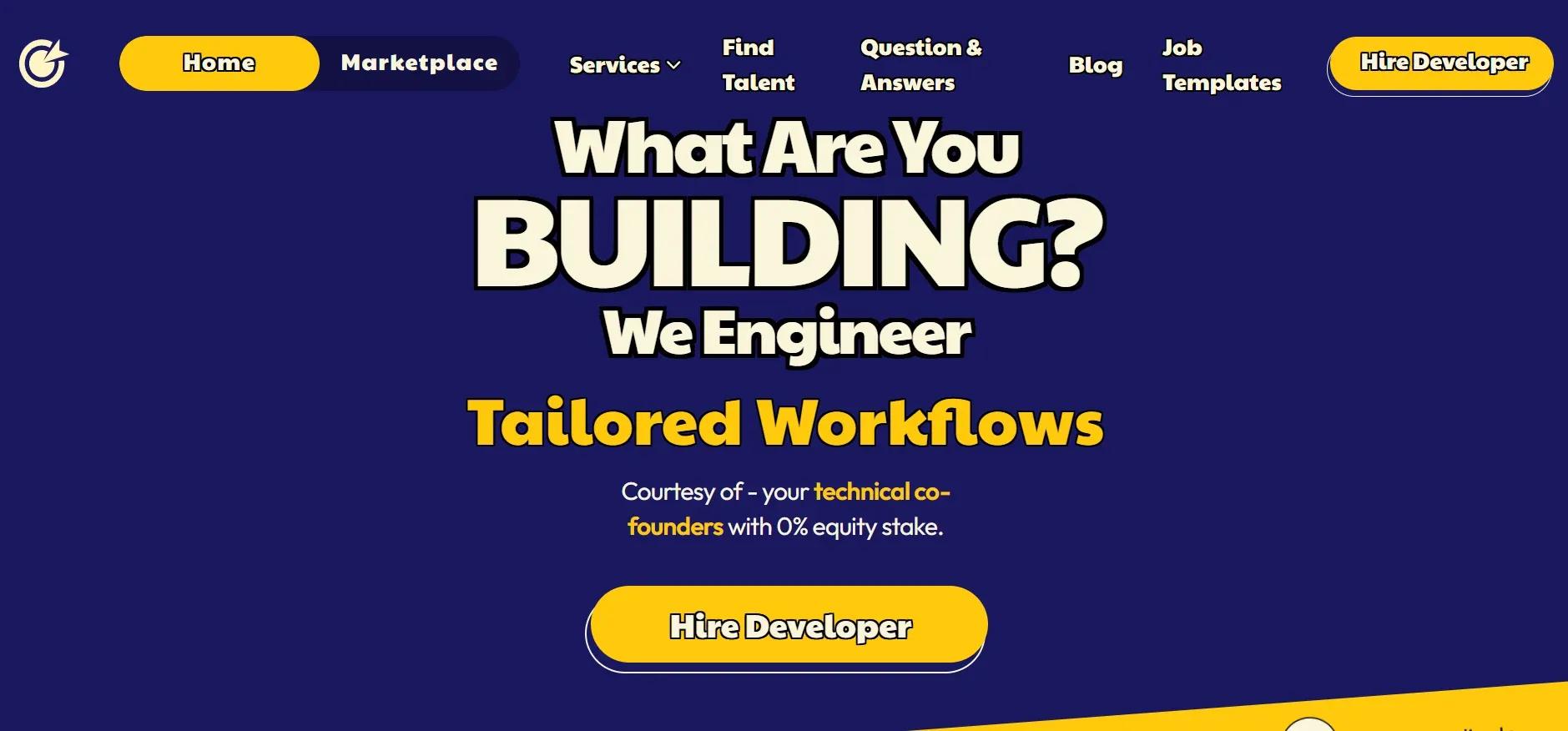
Best for: Companies that want a custom AI system built on their own data, shipped into production, and fully owned by them.
AI projects rarely fail on the model. They fail on the work around it: scattered data, no evaluation, weak guardrails, and a pilot nobody owns once the excitement fades. Softaims is built for that gap, with one team handling the data, the model, the guardrails, and the product your users actually open.
What you get: The same team covers the full AI stack, from custom AI model development through AI agent development, AI chatbots, and AI app development. You can hire vetted AI developers for the exact skill you need, browse the AI talent pool to see who would build it, and check rates by skill and seniority before you commit.
Why teams pick Softaims:
- One team for the data, the model, the guardrails, and the app around it.
- Straight advice on approach, so you do not overbuild what a simple integration solves.
- You own the model, the code, and the data, with no lock-in.
- Built for production from day one, not another pilot that stalls.
2. Devaims
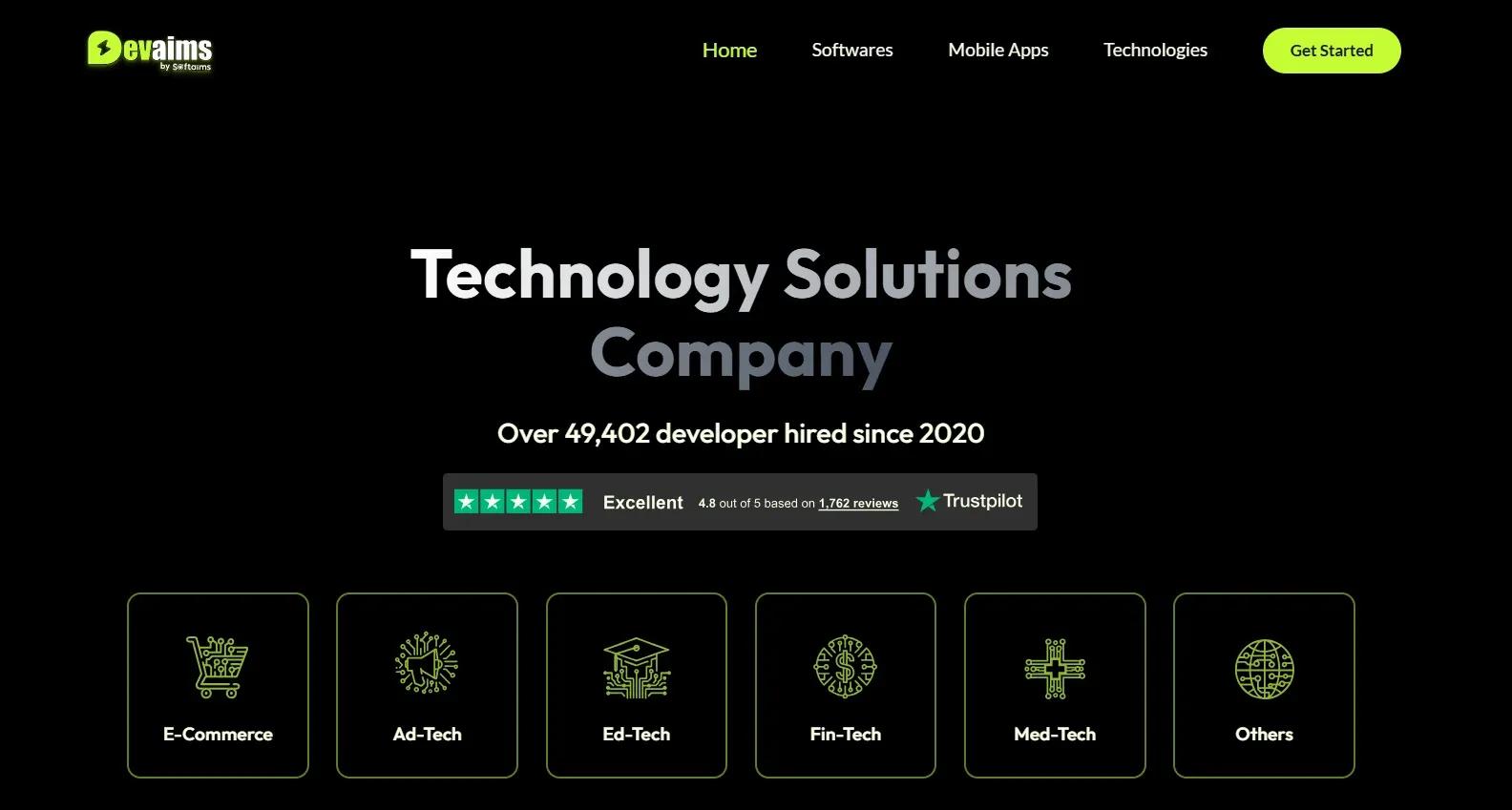
Best for: Companies that want the AI feature and the product it lives inside built by one team.
A model is not a product. It has to sit inside a real app, connect to live data, and stay reliable once actual users arrive. Devaims closes that gap by building the software around the intelligence, so your AI feature ships as a working product rather than a clever demo.
What you get: Alongside the AI work, Devaims handles software development and mobile app development, so the people designing the AI behaviour are the same people building the interface and the integrations. Because one team owns both sides, changes after launch stay simple.
Why teams pick Devaims:
- The AI feature and the product around it come from one team.
- Full delivery across backend, web, and mobile.
- Faster iteration after launch, with no vendor handoffs.
- Interfaces designed for the people who use them every day.
3. Cohere
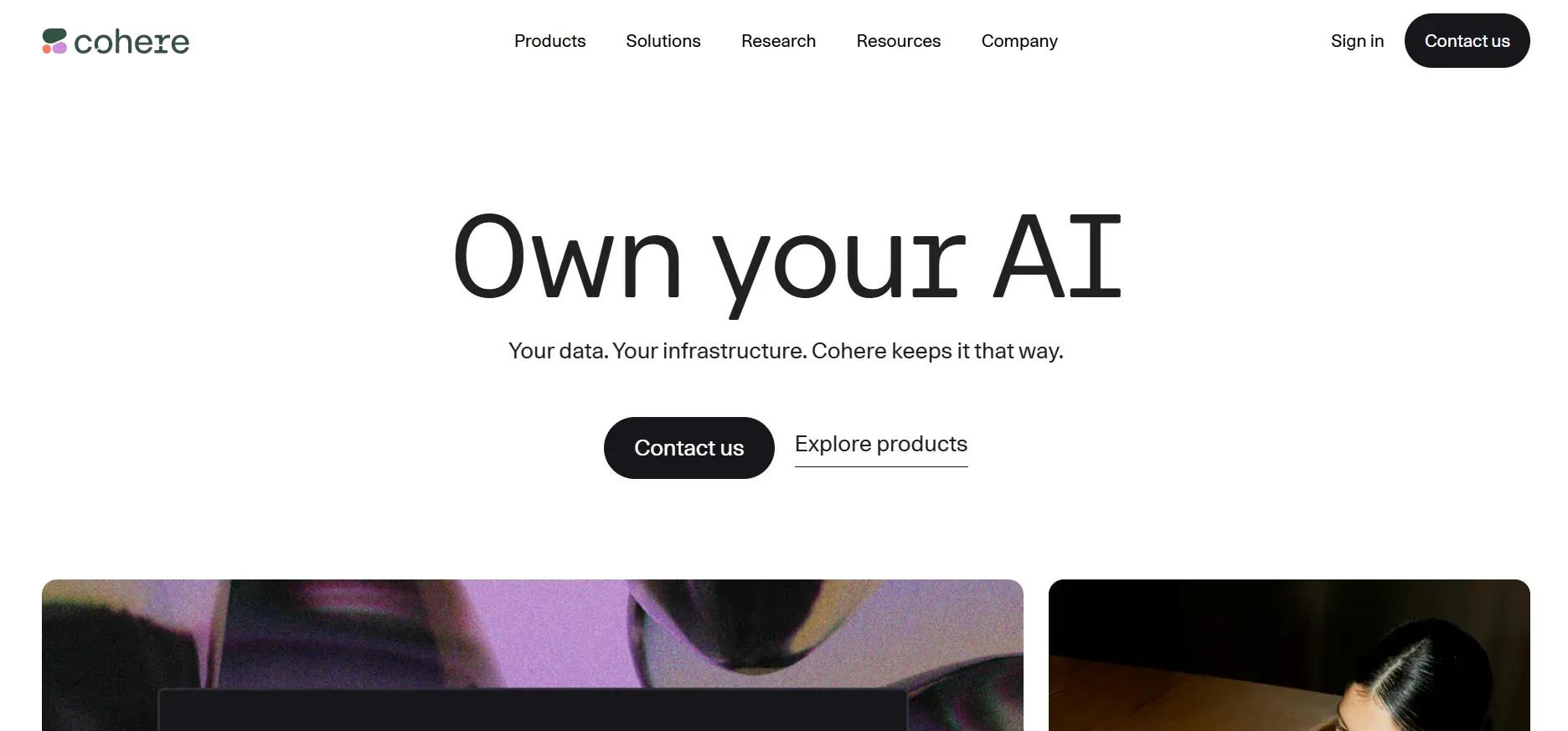
Best for: Enterprise generative AI where security and privacy come first.
Cohere is Canada's flagship AI company, founded in Toronto in 2019 by Aidan Gomez, Ivan Zhang, and Nick Frosst. It builds large language models for enterprise use rather than consumer chatbots, with a clear focus on data privacy, control, and customization. Its Command models handle text generation, reasoning, and multimodal tasks, while Cohere North runs as a security-first workspace that can operate privately or fully air-gapped. The Canadian government backs it with up to C$240 million under the national compute strategy.
Downside: It is a model provider, not a services agency. You get powerful models and APIs, but you still need a team to build around them.
4. Ada
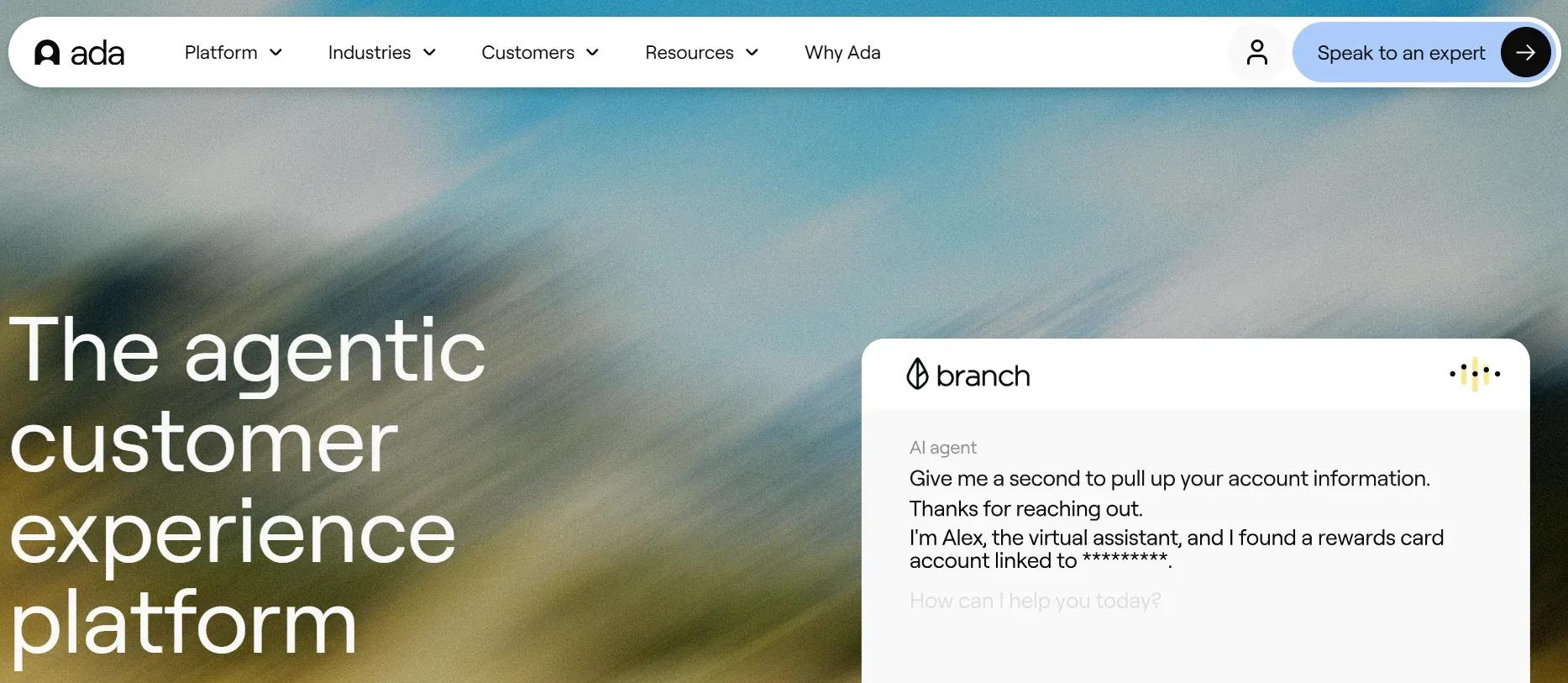
Best for: Automating customer support with conversational AI.
Ada is a Toronto company that automates customer and internal support through conversational AI, resolving large volumes of interactions without human agents. Its platform is built to scale across high-volume support operations while keeping responses personalized, and it is widely used in ecommerce, SaaS, fintech, and telecoms.
Downside: It is a specialized platform for customer service. For a different AI use case, you need a different partner.
5. AltaML
Best for: Applied AI that turns existing company data into measurable value.
AltaML is an Edmonton-based applied AI company that helps organizations unlock the value sitting in their data. It focuses on practical machine learning that reduces risk and opens new revenue, backed by deep ecosystem partnerships and a strong record of rapid, measurable results. Of the product-led firms here, it is closest to a true AI development services partner.
Downside: Its applied, enterprise-first model suits organizations with real data already, less so a startup beginning from scratch.
6. Coveo
Best for: AI-powered search, recommendations, and relevance.
Coveo is a Quebec City company and one of Canada's established AI names, specializing in AI-driven search and relevance across ecommerce, customer service, and workplace applications. If your problem is helping people find the right thing quickly, whether a product, an answer, or a document, this is a deep specialization.
Downside: Its focus is search and relevance, so a broad custom AI build sits outside its lane.
7. MindBridge AI
Best for: Financial risk intelligence and audit automation.
MindBridge is an Ottawa-based company focused on AI for financial risk and audit. Its platform analyses financial data to surface anomalies and risk that manual review misses, which makes it valuable for banks, auditors, and finance teams working under regulatory scrutiny.
Downside: It is purpose-built for finance and audit. Outside those functions, there is little here for you.
8. Osedea
Best for: Custom AI software and automation built as a real product.
Osedea is a Montreal-based development firm that builds custom software with AI and automation woven in, rather than treating AI as a bolt-on. It works across web, mobile, and industrial applications, and it appears consistently in Canadian AI development rankings. It suits companies that want a hands-on partner to design and build the whole thing.
Downside: As a mid-sized studio, a very large multi-team enterprise program may need a bigger firm.
9. Adastra
Best for: Enterprise data platforms with AI layered on top.
Adastra is a Toronto-headquartered data and AI consultancy that helps large organizations modernize their data foundations, then build AI on them. That order matters, because AI grounded in messy data fails. It serves banking, insurance, retail, and public sector clients, with strong governance credentials.
Downside: Its consulting-led model comes with enterprise process, which can feel heavy for a small project.
10. Symend
Best for: AI-driven customer engagement in financial services.
Symend is a Calgary company that combines behavioural science with AI to improve customer communication, collections, and retention. Its predictive engagement platform is aimed squarely at banks, telecoms, and lenders that need to reach customers more effectively without damaging the relationship.
Downside: Its focus on financial services engagement means it is not a general-purpose AI partner.
AI Services Offered by Canadian Companies
AI development companies in Canada offer a few common service types. Knowing which one you need keeps your scope tight and your budget honest.
Service | What it does | Where it helps |
| Generative AI | Creates text, code, or content | Support, marketing, documents |
| AI agents | Completes multi-step tasks with tools | Operations, workflow automation |
| Machine learning | Predicts outcomes from data | Forecasting, risk, churn |
| NLP | Reads and understands language | Search, document processing |
| Computer vision | Reads images and video | Inspection, healthcare, security |
| Predictive analytics | Anticipates what happens next | Demand, maintenance, retention |
Why AI Projects Fail (and How to Avoid It)
Even in a strong ecosystem, most AI pilots go nowhere. When MIT's NANDA initiative reviewed 300 deployments, it found 95% of enterprise generative AI pilots produced no measurable return. That number is worth sitting with, because even good AI development companies see the same causes repeat, and every one is avoidable.
Nobody owns the outcome. This is the most common failure. A pilot gets launched by an innovation team, wins applause at a demo, then has no home once attention moves on. There is no one to push adoption, defend the budget, or judge success. Fix it by naming a business owner and a single metric before a line of code is written, such as hours saved, tickets deflected, or forecast accuracy improved. If nobody will put their name against a number, the project is not ready.
The data was never ready. Teams routinely underestimate this, because the demo ran on ten clean documents while production has ten thousand messy ones, full of duplicates, outdated records, and inconsistent formats. AI grounded in that produces fluent, confident errors. Fix it by treating data preparation as the first real phase of the project, with its own budget and timeline, not as a warm-up before the interesting work.
It never reaches a real workflow. A tool that lives in a separate tab gets opened twice and forgotten. The systems that succeed appear inside the CRM, the inbox, or the ticket queue where people already spend their day. Fix it by integrating into existing software rather than building a standalone app and hoping people change their habits.
There is no way to measure quality. Without a test set and a score, you cannot tell whether a change helped or hurt, so you are guessing. Fix it by insisting on an evaluation set of real questions with known good answers from the start. This single practice separates teams who have shipped production AI from those who have not.
Costs escalate quietly. Every query consumes tokens, retrieval multiplies the count, and a system that felt cheap with ten test users gets expensive with ten thousand real ones. Fix it by asking a partner to model inference cost per user before launch, and to explain how they will control it through caching, smaller models for easy tasks, and trimmed context.
Nobody planned for drift. Models degrade as the world changes. Prices shift, products change, language moves on, and accuracy quietly slides. Fix it by agreeing a monitoring and retraining plan before go-live, not after someone notices the output has gone stale.
AI Developer Salaries in Canada in 2026
Whether you hire in-house or through one of the AI development companies above, salary data sets the floor for what AI work costs. The figures below come from Glassdoor and Levels.fyi.
Role and source | Median or average | Typical range |
| AI Engineer, Toronto (Glassdoor) | CA$118,673 | CA$92K to CA$159K |
| ML Engineer, Toronto (Glassdoor) | CA$124,044 | CA$96K to CA$165K |
| ML Engineer, Toronto (Levels.fyi) | CA$139,115 | Varies by company |
| ML Engineer, Greater Toronto (Levels.fyi) | CA$154,258 | Varies by company |
| ML Engineer, Canada-wide (Levels.fyi) | CA$156,734 | Varies by company |
Sources: Glassdoor and Levels.fyi. Glassdoor's Toronto machine learning figures are based on 357 reported salaries, with top earners around CA$223,372 at the 90th percentile.
The gap between the two sources is instructive. Glassdoor reflects broad base salaries, while Levels.fyi captures total compensation at tech-forward employers, including stock and bonus. At the top end of the Canadian market, packages climb well past those medians. Levels.fyi reports a median total compensation package of around CA$187,000 for a machine learning engineer at Borealis AI, with the highest reported package near CA$348,000.
The practical takeaway is simple. A single senior AI hire in Canada costs six figures before benefits, recruitment, and the four to eight weeks it takes to find them. That is why many companies compare an in-house hire against vetted AI development companies before committing.
How Much Does AI Development Cost in Canada?
AI development companies in Canada price work against the approach, the state of your data, and how much of the system must run reliably at scale.
Project type | Typical cost | Timeline |
| Prototype or focused pilot | $25,000 to $75,000 | 4 to 8 weeks |
| Production AI system | $75,000 to $250,000 | 3 to 6 months |
| Enterprise AI platform | $250,000 and up | 6 to 12 months |
Canadian hourly rates typically run from about $50 to $150, depending on seniority and firm size, with vetted global delivery available below that.
Three costs catch people out, and a good partner is upfront about all three.
Data preparation. Cleaning, structuring, and labelling real records routinely takes a large share of the budget, because production data is far messier than a demo. A quote that ignores this is a quote that will grow.
Inference and running costs. Every query costs money, and those costs continue for as long as the system runs. Ask for a cost-per-user model before you build.
Monitoring and retraining. Models drift, so budget for ongoing maintenance rather than treating launch as the finish line.
Set against those Canadian salaries, the maths gets clearer. One senior in-house AI engineer can cost more per year than a focused production system built by a partner, which is why many teams start with a partner and hire internally once the system proves its value.
How to Choose an AI Development Company in Canada
The best AI development companies in Canada fit your problem, your data, and your regulatory position. Use the questions below to separate real capability from a polished pitch.
Ask what they have running in production. Not pilots, not demos. Live systems with real users, ideally in your industry, plus a reference you can actually call. Past performance predicts future delivery better than any deck.
Ask exactly how they measure output quality. A serious partner describes a test set, a scoring method, and a target accuracy. A weak one talks about how advanced their model is. This question alone filters most of the market.
Ask where your data will live. Canadian privacy law, provincial requirements, and sector rules can dictate data residency. Confirm they support Canadian hosting, on-premise, or private cloud, and get it in writing before any data moves.
Ask them to recommend the simplest approach. A good firm will talk you out of a custom model when retrieval or a straightforward integration would do the job. A vendor who reaches for the biggest possible build is optimizing for their revenue, not your outcome.
Ask who owns the model, the code, and the data. You should own all three, stated clearly in the contract, so you are never dependent on one vendor to make a change.
Ask what happens after launch. Find out who monitors accuracy, who retrains the model, and what that costs. A partner with no answer here has not run a system long term.
Check the fit, not just the skills. Time zones, communication style, and whether they push back on bad ideas matter as much as technical depth. A team that says "that will not work, here is why" is worth more than one that agrees with everything.
Finally, start small. A short paid discovery phase or pilot on your real data tells you more about a partner than any proposal, and it surfaces the hard problems while the stakes are still low. For a broader view of vendors, our guides to the top custom software development companies and the top software development companies in the USA are useful companion reads.
AI Trends in Canada for 2026
Sovereign AI has become a buying requirement. This is reshaping what AI development companies in Canada build. With a C$2 billion national compute strategy and rising concern about where data sits, more organizations now require that models and data stay on Canadian infrastructure. Cohere North's air-gapped deployment is a direct answer to that demand, and expect more private and on-premise builds to follow.
Agents are replacing chatbots. Systems no longer just answer questions. They call tools, query databases, and complete multi-step tasks, such as pulling an invoice, checking it against a purchase order, and routing it for approval. The catch is that agents need a tightly scoped job, so a good partner narrows the task rather than promising autonomy across the business.
Regulated industries are leading adoption. This is where AI development companies see the most demand. Banking, insurance, and healthcare are moving fastest, because the return on automating document-heavy work is easy to measure and Canada's institutional AI base gives those sectors confidence. That is also why compliance-ready firms like MindBridge and Symend have found strong footing.
Evaluation is becoming a discipline. Leading AI development companies now treat it as standard. Teams now build test suites for AI output the same way they test code. It is the clearest sign the market is maturing, and it is quickly becoming a standard procurement question.
Vision and language are converging. More Canadian projects now combine both, from reading documents to inspecting images. If that is your direction, our guide to the top computer vision development companies is a useful companion read.
Conclusion
Canada has genuine depth in artificial intelligence, from foundational research to commercial leaders like Cohere. Still, most AI development companies can produce a demo, and far fewer can ship a system that survives real users, real data, and a real budget. The trick is to weigh production evidence, data skill, and ownership above the buzzwords on a homepage. If your product also needs a mobile app, our guide to the top mobile app development companies is worth a look.
If you want an AI system built on your own data and owned entirely by you, Softaims is the best place to start. Book a free consultation and get matched with vetted AI developers within 48 hours.
Frequently Asked Questions
What do AI development companies in Canada do?
They design, build, and deploy AI-powered software, including machine learning models, generative AI applications, AI agents, chatbots, computer vision, and predictive analytics. Good ones also handle data preparation, integration, evaluation, and ongoing monitoring.
Why is Canada a leader in AI?
Canada produced much of the foundational deep learning research, hosts three national AI institutes in Mila, Vector, and Amii, backs the sector with a C$2 billion compute strategy, and has more than 670 AI startups across Toronto, Montreal, and Vancouver.
How much does AI development cost in Canada?
A focused pilot runs about $25,000 to $75,000. A production system lands between $75,000 and $250,000. Enterprise platforms start around $250,000. Canadian rates typically run $50 to $150 an hour, and data preparation is usually the biggest cost driver.
What is the average AI engineer salary in Canada?
Glassdoor puts the average AI engineer salary in Toronto at about CA$118,673, with machine learning engineers around CA$124,044. Levels.fyi reports a higher Canada-wide median of roughly CA$156,734 for machine learning engineers, since it includes stock and bonus.
Which industries use AI most in Canada?
Healthcare, financial services, retail, manufacturing, logistics, energy, and telecommunications lead adoption, because each has document-heavy or prediction-heavy work where AI delivers measurable returns.
How long does an AI project take?
A pilot takes four to eight weeks. A production system takes three to six months. An enterprise platform takes six to twelve months or more. Messy data adds time, since preparation is usually the longest phase.
Do Canadian AI companies handle data residency requirements?
Reputable ones do. Canadian privacy law and provincial rules can require data to stay in-country, so confirm a partner supports Canadian hosting or on-premise deployment before you sign.
Should I hire in-house or use an AI development partner?
A senior in-house AI hire costs six figures plus benefits and takes weeks to recruit. A partner delivers faster and costs less upfront. Many teams start with a partner, then hire internally once the system proves its value.
Who owns the model and the data?
You should. Confirm in the contract that you own the model, the code, and any training data, so you are never locked into one vendor for future changes.
How do I choose between AI development companies in Canada?
Look at what they run in production, how they evaluate output quality, their data residency capability, and who owns the result. Then run a short paid pilot on your real data before you scale.


 Stackoverflow
Georgios M.

 Verified Expert in Engineering
My name is Georgios M. and I have over 4 years of experience in the tech industry. I specialize in the following technologies: React Native, TypeScript, JavaScript, node.js, React, etc.. I hold a degree in . Some of the notable projects I’ve worked on include: 💻 ByteBuddy – A Dating App for Developers, OnlyPaws – A Full-Stack Social Platform for Pet Lovers. I am based in Volos, Greece. I've successfully completed 2 projects while developing at Softaims.
I possess comprehensive technical expertise across the entire solution lifecycle, from user interfaces and information management to system architecture and deployment pipelines. This end-to-end perspective allows me to build solutions that are harmonious and efficient across all functional layers.
I excel at managing technical health and ensuring that every component of the system adheres to the highest standards of performance and security. Working at Softaims, I ensure that integration is seamless and the overall architecture is sound and well-defined.
My commitment is to taking full ownership of project delivery, moving quickly and decisively to resolve issues and deliver high-quality features that meet or exceed the client's commercial objectives.

Leave a Comment
Need help building your team? Let's discuss your project requirements.
Get matched with top-tier developers within 24 hours and start your project with no pressure of long-term commitment.