Top 10 LLM Development Companies in the USA (2026)
Find the leading LLM development companies in the USA for 2026. Learn how the top providers compare in RAG, fine-tuning, security, and enterprise AI development.
Technically reviewed by:
Aliaksandr C.|Cody R.
Table of contents
Key Takeaways
- The US is home to many of the world's leading LLM development companies.
- RAG is the preferred approach for most enterprise AI applications because it improves accuracy and reduces hallucinations.
- Fine-tuning is only necessary for specialized workflows that require consistent outputs.
- Softaims is our top choice for businesses that want custom LLM solutions with full ownership and no vendor lock-in.
- Devaims is ideal for companies that need AI integrated directly into web, mobile, or enterprise software.
- Data preparation, security, and evaluation matter more than choosing the latest language model.
- Always evaluate vendors based on production experience, integration capabilities, governance, and long-term support rather than marketing claims.
Choosing between LLM development companies is harder than it looks. Most lists rank vendors on team size and star ratings. None of that tells you whether they can get a language model working inside your systems, under your security rules, without making things up.
That gap is real. MIT's NANDA initiative reviewed 300 deployments and found 95% of enterprise generative AI pilots produced no measurable return. The model is rarely the problem. Weak data, poor integration, and no evaluation are.
The US leads this market. Grand View Research values the global LLM market at $5.6 billion in 2024, rising to $35.4 billion by 2030 at 36.9% annually, with the US holding the largest single-country share.
In this guide, you will learn about the top LLM development companies in the USA for 2026. You also get the approaches, the real costs, and the questions that quickly expose a weak vendor.
What is LLM development
LLM development companies turn a language model into a working business system. Most projects start from a foundation model like GPT, Claude, or Llama, then shape it to your data, your workflows, and your rules. The model is the easy part. The hard part is everything that turns it from a clever demo into something your team can trust every day.
A credible partner in 2026 works across six layers, and a weakness in any one of them can sink the project.
- Data. They collect, clean, and structure the documents and records the model will rely on. This is usually the largest and most overlooked part of the job.
- Model choice and tuning. They pick the right base model and decide whether to prompt it, ground it with retrieval, or fine-tune it. More on that below.
- Retrieval. They connect the model to your knowledge so it answers from your facts instead of guessing.
- Orchestration. They wire the model to tools, APIs, and databases, and coordinate multi-step tasks when an agent is involved.
- Evaluation and guardrails. They test output quality, block unsafe answers, and measure whether a change helped or hurt.
- Deployment and monitoring. They ship the system, watch it in production, and retrain it as your data and needs change.
An LLM development company that only touches the model layer is really just reselling someone else's API. The value lives in the other five layers, and that is where you should focus your questions.
Prompting vs RAG vs fine-tuning: which one you need
Most LLM budgets get wasted right here, because teams reach for the most expensive option first. Good LLM development companies steer you away from that. The table below sets out the real trade-offs.
Approach | What it means | Effort and cost | Best for |
| Prompt engineering | Careful instructions to a ready model | Lowest | Tone, format, simple tasks |
| RAG | Connects a model to your own data | Low to medium | Grounded answers from company knowledge |
| Fine-tuning | Trains a model on your examples | Medium | A set style, format, or narrow skill |
| Custom model | Builds or heavily adapts a model | Highest | Rare problems with large proprietary data |
Here is the rule most experienced teams follow. If the model needs facts from your documents, use RAG. If it needs to answer in a set style or format, start with prompt engineering, then fine-tune only if that falls short. And treat "we will build you a model from scratch" as a warning sign, because that is almost never the right first move.
Think of it as a ladder. You climb only as high as the problem demands, and good LLM development companies help you stop at the right rung.
Start with prompt engineering. It costs almost nothing and solves more than people expect. Clear instructions, examples, and a defined output format can take a general model a long way. Many "we need a custom model" requests turn out to be prompt problems in disguise.
Add RAG when the model needs your knowledge. Retrieval-augmented generation feeds the model relevant chunks of your own documents at the moment of the question. So the answer comes from your policies, your product docs, or your records, not the public internet. RAG also cites its sources, which lets a user verify a claim, and it stays current the moment you update a document. For most business use cases, this is the sweet spot.
Fine-tune when behavior must be consistent. Fine-tuning teaches the model a fixed style, tone, or narrow skill by training it on your examples. It is the right call when you need every answer in a specific format, or when the task is repetitive and well defined. It does not, however, teach the model new facts reliably. That is what RAG is for. Teams often combine the two: RAG for knowledge, a light fine-tune for tone.
Build a custom model only in rare cases. Training from scratch needs enormous data, budget, and time, and very few businesses actually need it. It makes sense when you own a huge proprietary dataset and your problem is genuinely unlike anything a foundation model was trained on. For almost everyone else, it is the priciest path to the same result. The best LLM development companies will tell you that honestly, even though the bigger build would earn them more.
How we ranked the top LLM development companies
We judged these LLM development companies on what separates a shipped system from a stalled pilot.
- Production record. They have LLM systems running live, not just demos.
- Fine-tuning and RAG depth. They can adapt a model to your domain and ground it in your data.
- Integration skill. They wire the model into your real systems, which is where most projects fail.
- Governance and evaluation. They test for hallucination, measure quality, and build safety in early.
- Security and support. They protect proprietary data and maintain the system after launch.
Comparison of the top 10 LLM development companies in the USA
# | Company | Best for | Focus | Rating |
| 1 | Softaims | Custom LLM systems you own | Fine-tuning, RAG, prompt engineering | ★ Top pick |
| 2 | Devaims | LLM inside a working product | Backend, web, and mobile delivery | ★ Top pick |
| 3 | EffectiveSoft | Governed LLMs in complex stacks | Full-lifecycle, ISO 27001 | 4.8★ |
| 4 | LeewayHertz | Enterprise LLM platforms | RAG, agents, private deployment | 4.8★ |
| 5 | Azati | Secure, production-ready LLMs | Fine-tuning, NLP, data engineering | 4.8★ |
| 6 | SoluLab | Domain-specific LLMs | Custom models, RAG, ERP and CRM | 4.8★ |
| 7 | Intellectyx | Production-grade LLM systems | Fine-tuning, RLHF, deployment | 4.7★ |
| 8 | InData Labs | Data prep for fine-tuning | Data science, domain datasets | 4.9★ |
| 9 | Signity Solutions | Conversational and document AI | Chatbots, NLU, workflow automation | 4.8★ |
| 10 | Addepto | Responsible and compliant LLMs | Ethical AI, regulated sectors | 4.9★ |
Ratings reflect public review profiles as of early 2026 and can change, so verify before publishing. Softaims and Devaims are our two top picks for 2026.
The 10 best LLM development companies in the USA
1. Softaims
Best for: Companies that want an LLM system built on their own data, shipped into production, and fully owned by them.
Most LLM projects do not fail on the model. They fail on the workaround: scattered data, no evaluation, weak guardrails, and a pilot nobody owns once the buzz fades. Softaims is built for that gap, with one team handling the data, the model, the guardrails, and the product your users actually open.
What you get: The same team covers the whole LLM stack, from grounding a model in your documents with RAG to LLM prompt engineering that makes outputs consistent rather than unpredictable. They fine-tune where it earns its cost, build evaluation harnesses so you can prove the system works before it ships, and keep it monitored afterward. You can hire top LLM engineers for the exact skill you need and check rates by skill and seniority before committing.
Why teams pick them:
- One team for the data, the model, the guardrails, and the app around it.
- Straight advice on approach, so you do not pay for fine-tuning when RAG would do.
- You own the code, the prompts, the pipelines, and the data, with no lock-in.
- Built for production from day one, not another pilot that stalls.
2. Devaims
Best for: Companies that want the LLM feature and the product it lives inside, built by one team.
A model is not a product. It has to sit inside a real app, connect to live data, and stay reliable once actual users arrive. Devaims closes that gap by building the software around the intelligence, so your LLM feature ships as a working product rather than a clever demo.
What you get: Alongside the AI work, Devaims handles software and mobile app development, so the people designing the model's behavior are the same people building the interface and integrations. Because one team owns both sides, changes after launch stay simple. Their full range is at Devaims.
Why teams pick them:
- The LLM feature and the product around it come from one team.
- Full delivery across backend, web, and mobile.
- Faster iteration after launch, with no vendor handoffs.
- Interfaces designed for the people who use them daily.
3. EffectiveSoft
Best for: Governed LLM systems inside complex, regulated stacks.
EffectiveSoft is a US-headquartered firm founded in 2003, based in San Diego. It treats language models as one part of a larger system, so projects start with workflow analysis and data assessment rather than a model. It holds ISO 27001 certification and puts real weight on governance, which suits fintech, healthcare, and logistics clients that cannot afford a loose deployment.
Downside: The measured, governance-first approach is deliberate. For a quick experiment, a learner's shop moves faster.
4. LeewayHertz
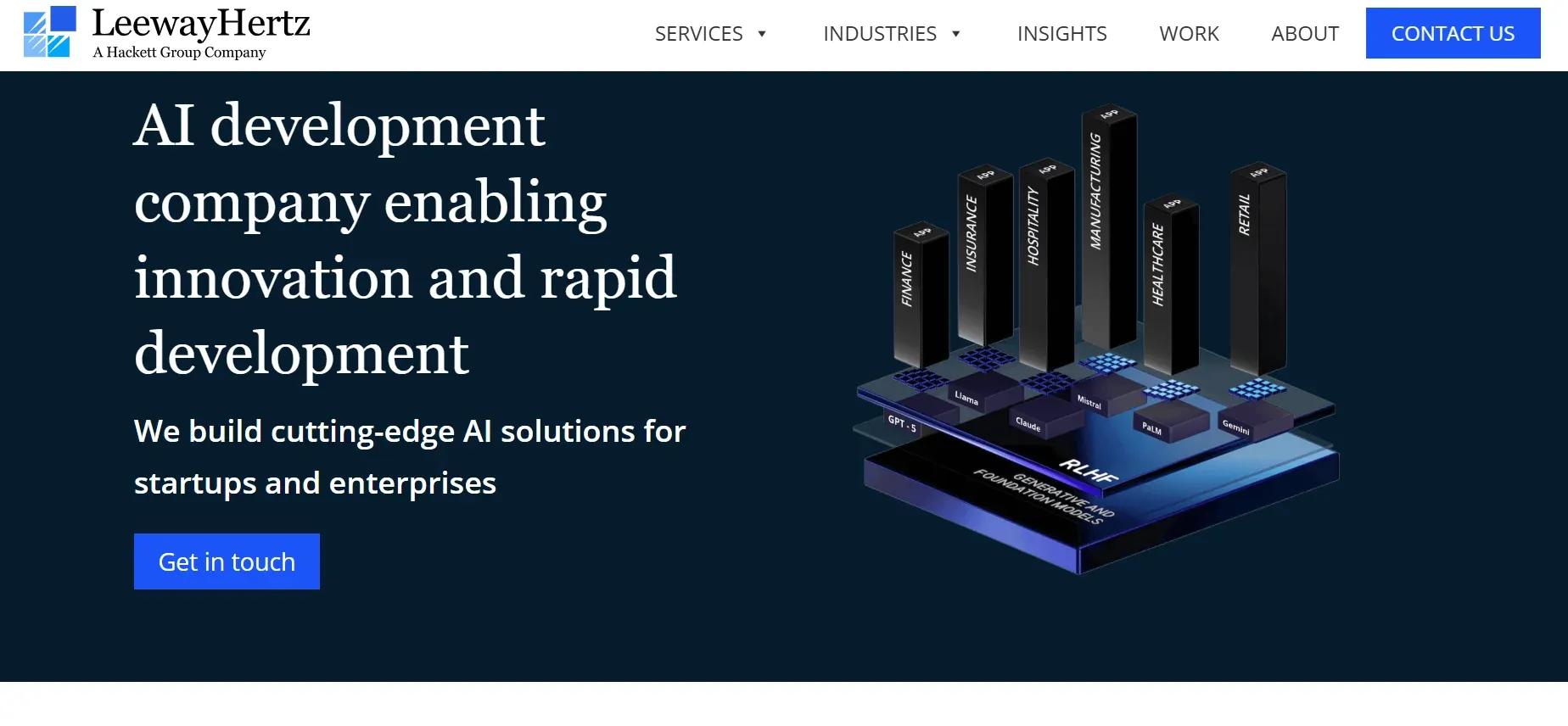
Best for: Enterprise LLM platforms built on private company data.
LeewayHertz works extensively with models like GPT and Llama, and its ZBrain platform grounds LLM applications in enterprise data. It has built AI assistants for supply chains, automated insurance processing, and internal knowledge copilots, with a focus on scalable, production-grade delivery rather than experiments.
Downside: It is broad across AI, so confirm the seniority of the team assigned to your build.
5. Azati
Best for: Secure, production-ready LLMs backed by strong engineering.
Azati brings more than two decades of software engineering to LLM work, spanning fine-tuning, NLP, generative AI, and data engineering. Its emphasis on security and comprehensive delivery suits enterprises that need a language model handled carefully from concept to production.
Downside: Its enterprise focus can be more than a small pilot needs.
6. SoluLab
Best for: Domain-specific LLMs connected to core business systems.
SoluLab focuses on custom LLM development, private model deployment, and RAG pipelines that plug directly into CRMs, ERPs, and internal knowledge bases. It has built domain-specific models that unify scattered documents into a single conversational interface, where much of the enterprise value lies.
Downside: As a broad firm, confirm the specific team and their record in your industry.
7. Intellectyx
Best for: Production-grade LLM systems with full lifecycle support.
Intellectyx specializes in designing, developing, deploying, and maintaining enterprise LLM systems, rather than only advising on strategy. Its work covers fine-tuning on proprietary data, RAG, and RLHF, where applicable, as well as the monitoring and retraining that keep a system reliable over time.
Downside: Its strength is enterprise delivery, so a lightweight feature build may be more than you need.
8. InData Labs
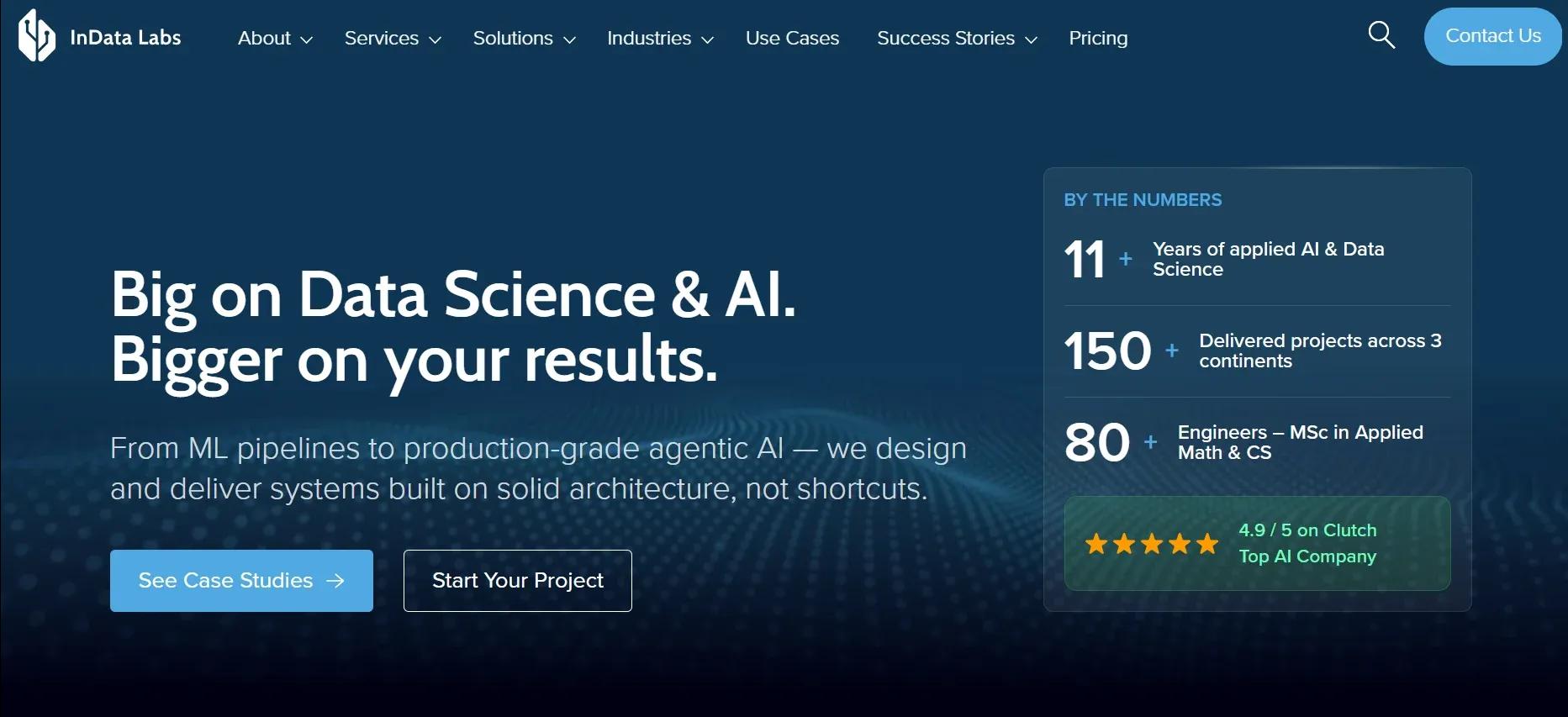
Best for: Preparing and structuring data for LLM fine-tuning.
InData Labs has a decade of applied AI work and does the unglamorous groundwork really well. It helps enterprises turn raw, messy datasets into domain-specific knowledge a model can learn from, which is often the real bottleneck in an LLM project.
Downside: It is a data science specialist, so pair it with a product team if you also need heavy application work.
9. Signity Solutions
Best for: Conversational AI, chatbots, and document workflows.
Signity Solutions focuses on practical business uses of LLMs, particularly conversational systems and intelligent document processing. It is a strong choice when the goal is to automate support or streamline document-heavy work rather than build a research-grade model.
Downside: Its center of gravity is conversational and document AI, so a complex custom model may need a different specialist.
10. Addepto
Best for: Responsible, compliance-focused LLM development.
Addepto differentiates itself through responsible AI, ethical implementation, and compliance, which matter most in regulated sectors. It suits organizations that need an LLM system built with governance and risk management front of mind rather than bolted on later.
Downside: Its careful, compliance-first style is not built for a move-fast prototype.
Why most LLM projects fail (and how to avoid it)
The MIT finding is worth sitting with. Even good LLM development companies see the same failures repeat, and almost all enterprise pilots deliver nothing measurable. The good news is that the reasons are predictable, so the right LLM development companies plan for each of them.
The model hallucinates on real data. Without grounding, an LLM invents confident, wrong answers, and one bad answer in a customer-facing tool destroys trust in the whole system. The fix is not a bigger model. It is RAG to ground answers in your documents plus evaluation to catch errors before users do. Avoid it by insisting on grounding and a test set from day one.
Nobody owns the outcome. A pilot launched by an innovation team with no business owner quietly dies after the demo. There is no one to push adoption, defend the budget, or judge success. Avoid it by naming a business owner and a single metric, such as hours saved or tickets deflected, before a line of code is written.
It never touches a real workflow. A chatbot living in a separate tab opens twice and then gets forgotten. The systems that succeed appear inside the CRM, the inbox, or the ticket queue, where people already work. Avoid it by integrating into existing tools instead of building a standalone app nobody asked for.
The data was not ready. An LLM grounded in scattered, stale, or duplicated records produces fluent nonsense. Teams underestimate this constantly because the demo used ten clean documents, while production has ten thousand messy ones. Avoid it by treating data preparation as the first real phase of the project, not a warm-up.
Costs escalate quietly. Every query consumes tokens, and retrieval multiplies the count. A system that looked cheap in testing becomes expensive at scale, sometimes overnight. Avoid it by asking a partner to model inference costs before launch, not after the first invoice arrives.
The pattern is clear. LLM projects rarely fail on the model. They fail on ownership, data, integration, and cost control, which are exactly the things a strong partner handles before the interesting part begins.
How to keep an LLM accurate and safe
Language models make things up. That is not a bug you can patch out, so serious LLM development companies manage it rather than pretend otherwise. Three layers of defense do the work, and the best LLM development companies use all three.
Grounding cuts most errors. RAG ties every answer to your actual documents, so the model quotes your policy instead of inventing one. A well-built system also cites its sources, allowing a user to click through and verify a claim in seconds. Grounding alone removes the majority of hallucinations in a typical business system.
Guardrails set the boundaries. These are rules that control what the model can and cannot do. They block unsafe or off-topic answers, stop the model from revealing sensitive data, and keep it inside its brief. For a banking assistant, a guardrail is what stops it from offering financial advice it is not allowed to give.
Evaluation is what separates pros from amateurs. This is the single most important and most skipped part of LLM work. You build a test set of real questions with known correct answers, then score the system against it whenever you change a prompt or a model. Without that, you are guessing whether an update helped or hurt. With it, quality becomes a number you can track and improve.
Here is the test that cuts through any sales pitch. Ask a vendor exactly how they measure output quality. If they describe a test set, a scoring method, and a target accuracy, they have shipped real systems. If they wave their hands and talk about how advanced their model is, keep looking at other LLM development companies.
Data security and privacy in LLM projects
Working with LLM development companies usually means exposing your data to a model, so a few questions decide whether the project stays safe. Get clear answers before any data moves.
Where does the data go? Some setups send your prompts and documents to a third-party model provider. Ask whether that happens and whether the provider trains on your data. Many enterprise plans promise not to, but you need it in writing.
Do you need a private deployment? For sensitive or regulated data, the safest option is to run the model in your own environment, either on-premises or in a private cloud, so nothing ever leaves your control. Ask whether a partner supports this, because not all of them do.
How is the data protected in transit and at rest? Expect encryption everywhere, role-based access so people only see what they should, and audit logs that record who asked what. These are table stakes for regulated work, not extras.
Can they prove compliance? For healthcare, finance, or government work, ask for evidence of GDPR, HIPAA, or SOC 2-aligned systems they have already delivered. A firm that has done it before can show you the artifacts. A firm that has not will talk in generalities.
Strong partners build secure RAG pipelines where sensitive content stays within your environment, and only the minimum necessary reaches the model. If your program also touches broader systems, our guide to the top custom software development companies is a useful companion read.
How much does LLM development cost in 2026
LLM development companies price work based on the approach, data preparation, and how reliably the system must run at scale. Use the table below as a starting guide.
Project type | Typical cost | Timeline |
| Prototype or focused pilot | $20,000 to $60,000 | 4 to 8 weeks |
| Production RAG or copilot system | $60,000 to $200,000 | 3 to 6 months |
| Enterprise platform with fine-tuning | $200,000 and up | 6 to 12 months |
The build price quoted by LLM development companies, though, is only half the story. There are two ongoing costs that catch people out, and a good partner is upfront about both.
Data preparation eats the budget. Cleaning, structuring, and labeling enterprise documents routinely takes a large share of the total, because production data is far messier than a demo. This is real, skilled work, and a quote that ignores it is a quote that will grow later.
Running costs never stop. Every query consumes tokens, and RAG adds retrieval calls on top. A system that felt cheap with ten test users can get expensive with ten thousand real ones. So ask a partner to model inference cost per user before you build. There are ways to control it, such as caching common answers, using a smaller model for easy tasks, and limiting the amount of context each query sends.
The takeaway is simple. The cheapest quote is rarely the cheapest system once you count data work and monthly token bills. A partner who models both honestly saves you more than one who wins on the headline price.
How to choose the right LLM development partner
When you compare LLM development companies, a handful of questions expose a weak vendor faster than any brochure. Ask each of these, and pay attention to how specific the answer is.
- What do you have running in production? Not pilots, not demos. Live systems with real users. Ask for a reference you can call.
- How do you measure output quality? If they cannot describe a test set, a scoring method, and a target, they have never shipped a serious system.
- What is the simplest approach that would work here? A good firm will happily talk you out of fine-tuning when RAG would do. A weak one pushes the biggest build.
- How will you handle our data and security? Expect clear answers on where data goes, private deployment, and compliance, not reassurance.
- What will this cost to run each month? They should be able to model token and inference costs before you commit.
- Who owns the result? You should own the code, the prompts, the pipelines, and any fine-tuned weights, with no lock-in.
One more test that works every time: start with a small paid pilot on your real data before you sign a large contract. It shows you how the team actually works, and it surfaces the hard problems while the stakes are still low.
LLM trends to watch in 2026
The field moves fast, so the leading LLM development companies build with the near future in mind. Five shifts are worth planning around.
Agents are replacing chatbots. Systems no longer just answer questions. They use tools to complete multi-step tasks, such as pulling an invoice, checking it against a purchase order, and routing it for approval. The catch is that agents need a tightly scoped job to work well, so a good partner narrows the task rather than promising an agent that does everything.
RAG is now the default. Grounding answers in your own data has become standard practice because it cuts hallucination and keeps responses current without retraining. If a vendor is not leading with RAG for a knowledge task, they are behind.
Small models are winning on cost. Compact, fine-tuned models increasingly beat giant general ones for narrow tasks, at a fraction of the running cost. Expect more systems to route easy work to a small model and save the expensive one for hard cases.
Multimodal is spreading. Models now handle images and audio alongside text, so many teams pair an LLM with vision for tasks like reading documents or inspecting photos. If that is your direction, our guide to the top computer vision development companies is a useful companion read.
Evaluation is becoming a real discipline. Teams now build test suites for LLM output the same way they test code. This is the clearest sign the field is maturing, and it is the practice that separates systems you can trust from ones you simply hope are working.
Conclusion
There are more LLM development companies than ever, and most of these LLM development companies can produce a demo. Far fewer can ship a system that survives real users, real data, and a real budget. The trick is to weigh production evidence, evaluation discipline, and data skill above the buzzwords on a homepage. For teams weighing US delivery against other regions, our guides to the top software development companies in the USA and the top software development companies in the UK are worth a read.
If you want an LLM system built on your own data and owned entirely by you, Softaims is the best place to start. Book a free consultation and get matched with vetted LLM engineers within 48 hours.
Frequently asked questions
What do LLM development companies actually do?
They turn a language model into a working business system. That includes grounding a model in your data with RAG, fine-tuning it, adding guardrails, and integrating the result into the tools your team already uses.
How much does LLM development cost?
A focused pilot runs about $20,000 to $60,000. A production RAG or copilot system lands between $60,000 and $200,000. Enterprise platforms with fine-tuning start around $200,000. Data preparation and token costs are the biggest drivers.
What is RAG, and why does everyone recommend it?
RAG connects a model to your own documents, so it answers from your data instead of guessing. It cuts hallucination, keeps answers current, and costs far less than retraining, which is why it is the default for business systems.
Do I need to fine-tune a model?
Usually not. Fine-tuning helps when you need a consistent style, format, or narrow skill. If you mainly need the model to know your facts, RAG is cheaper and easier to keep current.
How do I stop an LLM from making things up?
Ground it in your data with RAG, add guardrails that limit what it can say, and build an evaluation set so you can measure quality. You cannot remove hallucination entirely, but you can manage it to an acceptable level.
Is my data safe with an LLM system?
It depends on the architecture. Ask where data is sent, whether the provider trains on it, and whether you need a private deployment. Regulated work needs data isolation, encryption, access controls, and audit logs from the start.
How long does an LLM project take?
A pilot takes four to eight weeks. A production system takes three to six months. Enterprise platforms take six to twelve months or more. If your documents are messy, add time for data preparation.
What is an LLM agent?
An agent uses a language model as its reasoning engine, connected to tools and data, to complete multi-step tasks on its own. Agents work best when the task is clearly scoped, such as one specific workflow rather than a whole department.
Who owns the model, the prompts, and the data?
You should. Confirm in the contract that you own the code, the prompts, the pipelines, and any fine-tuned weights, so you are never locked into one vendor.
How do I choose between LLM development companies?
Look at what they run in production, how they evaluate output quality, whether they recommend the simplest approach, and how they handle running costs. Then run a short paid pilot before you scale.


 GitHub
 Stackoverflow
Burak O.

 Verified Expert in Engineering
My name is Burak O. and I have over 13 years of experience in the tech industry. I specialize in the following technologies: RESTful Architecture, PostgreSQL, C#, Microsoft SQL Server, API Integration, etc.. I hold a degree in Bachelor of Engineering (BEng), Associate's degree. Some of the notable projects I’ve worked on include: Kartelam Mobile Application, Workforce Management. I am based in Istanbul, Turkey. I've successfully completed 2 projects while developing at Softaims.
I specialize in architecting and developing scalable, distributed systems that handle high demands and complex information flows. My focus is on building fault-tolerant infrastructure using modern cloud practices and modular patterns. I excel at diagnosing and resolving intricate concurrency and scaling issues across large platforms.
Collaboration is central to my success; I enjoy working with fellow technical experts and product managers to define clear technical roadmaps. This structured approach allows the team at Softaims to consistently deliver high-availability solutions that can easily adapt to exponential growth.
I maintain a proactive approach to security and performance, treating them as integral components of the design process, not as afterthoughts. My ultimate goal is to build the foundational technology that powers client success and innovation.

Leave a Comment
Need help building your team? Let's discuss your project requirements.
Get matched with top-tier developers within 24 hours and start your project with no pressure of long-term commitment.