Top 10 AI Integration Services Companies in the USA
AI integration helps businesses turn AI models into practical, scalable solutions. In this guide, we cover the top 10 AI integration services companies in the USA for 2026, including Softaims, Devaims, Markovate, and Intellectsoft.
Technically reviewed by:
Jonathan R.|Manish J.
Table of contents
Key Takeaways
- Integration is the hard part. A powerful model means little if it cannot work reliably in production.
- The US leads the AI market. Global AI spending is projected to push the market past $1.8 trillion by 2030.
- Data drives results. Even the best models depend on reliable, relevant data.
- Talent is the bottleneck. Skilled AI engineers are in high demand and expensive to hire.
- Ownership matters. Put ownership of your models, code, and data in writing before development starts.
- Softaims helps fill the gap. Hire vetted AI engineers quickly and keep control of the work and final result.
American businesses are pouring billions of dollars into AI, yet a stubborn truth keeps surfacing. Simply buying a model is easy. Making it work inside your own systems, at scale and in production, is where most US projects quietly stall. That distance separates the companies pulling ahead from those stuck in pilot purgatory. It is the gap between a slick demo and a shipped product. The right AI integration companies are what carry you across it.
The numbers explain the urgency. The US commands the largest slice of a global AI market heading past $1.8 trillion by 2030. American enterprises are sprinting to claim their share. Still, McKinsey finds that many American organizations struggle to convert AI pilots into measurable profit. So the choice of which AI integration companies handle your build has become a genuine competitive lever.
This guide ranks the top 10 AI integration companies in the USA for 2026. It spans the enterprise consultancies, the specialized US AI firms, and the talent partners who turn models into working products. Softaims and Devaims open the list, followed by eight recognized American leaders. If your real bottleneck is talent, you can hire vetted AI engineers in 48 hours and stay fully in control.
How We Ranked These AI Integration Companies
We ranked these AI integration companies on production evidence, US delivery, and technical depth. A firm had to show shipped AI systems, not just polished pitches. Each measure below reflects what an American buyer should demand.
Production results. Live, scaled systems beat proofs of concept. So we favored firms with deployed, working AI.
US delivery. Time zones, contracts, and data rules reward a domestic footprint. Consequently, we valued genuine US operations.
Technical range. Real skill spans data, models, and MLOps. So we scored full, end-to-end capability highly.
Domain credibility. Reference clients and certifications matter. Meanwhile, we prized proven, trusted delivery.
People and delivery. AI talent is scarce and pricey. Therefore, we valued firms that make that talent reachable.
Top US AI Integration Companies: Comparison Table
The top AI integration companies in the USA for 2026 include Softaims, Devaims, Intellectsoft, and Markovate. Accenture, Cognizant, Simform, Azumo, Kodexo Labs, and InData Labs complete the list. This table gives the fast overview.
Company | Base | Focus | Best for |
| Softaims | US and global | Hiring vetted AI engineers | Building and staffing AI |
| Devaims | US and global | Full AI product delivery | Accountable AI builds |
| Intellectsoft | Miami, FL | Full AI lifecycle | Enterprise pedigree |
| Markovate | San Francisco, CA | Rapid POC to production | Fast AI validation |
| Accenture | New York, NY | AI at enterprise scale | National transformation |
| Cognizant | Teaneck, NJ | AI-led modernization | Large-scale integration |
| Simform | Orlando, FL | AI product engineering | Cloud-native AI |
| Azumo | San Francisco, CA | AI and ML development | Nearshore AI teams |
| Kodexo Labs | USA | Cost-effective AI | Budget-conscious builds |
| InData Labs | Boston, MA | Data science and AI | Data-heavy AI |
Details reflect public profiles and market data as of 2026 and can change, so confirm each firm before you engage.
The Top 10 AI Integration Companies in the USA
This section profiles the top AI integration companies in the USA for 2026. It begins with Softaims and Devaims, the partners that help you build and resource AI. It then covers the consultancies and specialists shaping the American market. So you can pair a firm with your specific project and budget.
1. Softaims
Here is the part of AI adoption that often gets overlooked: having a strong model is only the beginning. Businesses also need skilled engineers to integrate it with existing systems, fine-tune it, and keep it running in production. AI talent is in high demand across the US, making the right engineering expertise difficult and expensive to find. Softaims helps businesses fill that gap with vetted AI and machine learning talent.
Softaims gives businesses access to pre-vetted AI engineers based on their skills, experience, and project requirements. Teams can review specialists, assess their expertise, and build a team around the work they need to deliver. Shortlists can be provided within 48 hours, helping businesses move from searching for talent to getting an AI project underway faster.
The model also gives businesses more control over how they build their AI systems. Teams can work with specialists who fit their technical and time-zone requirements while maintaining ownership of their code, models, data, and deliverables.
Key services of Softaims
- AI implementation: Get help with AI architecture, integration, and production deployment.
- Model integration: Connect AI models with existing applications, data, APIs, and workflows.
- AI development: Build custom AI features, agents, and copilots with experienced engineers.
- AI consulting: Get support with AI strategy, use cases, technical planning, and roadmaps.
- Model training: Train and fine-tune models using business-specific data.
Why they stand out
Softaims focuses on one of the biggest challenges in AI adoption: finding skilled engineering talent. Businesses can bring in vetted specialists when needed, scale their teams as projects grow, and maintain control over the work and deliverables. To get started, hire vetted AI engineers, check pricing, or contact the team.
2. Devaims
Not every business wants to assemble and manage an AI engineering team. Some would rather have one partner take an idea from concept to a working product. That is where Devaims fits. As a managed delivery company and Softaims brand, it helps businesses build and deliver AI-powered products from planning through deployment.
Devaims brings software development, AI engineering, integration, and delivery under one team. It can help define the technical approach, design the architecture, build the required AI components, connect them with existing systems, and prepare the product for launch. Having one team across these stages can make delivery simpler and reduce the gaps that often arise when different vendors handle different parts of a project.
The offering became part of the wider Softaims ecosystem following the August 2026 acquisition. Devaims continues as a Softaims brand, while its teams can draw on Softaims' wider pool of vetted technical talent when a project needs additional expertise.
Key services of Devaims
- Software development: Build custom software around specific business needs.
- Mobile app development: Develop mobile applications for iOS, Android, or both.
- AI development and integration: Build AI features and connect them with existing applications, APIs, data, and workflows.
- Managed delivery: Handle planning, development, testing, integration, and deployment with one team.
- Ongoing support: Maintain, improve, and scale AI systems after launch.
Why they stand out
Devaims is a good fit for businesses that want a managed team to handle the technical delivery of an AI project without coordinating multiple vendors. Its delivery model brings development and integration under one team, while the wider Softaims talent pool provides additional expertise when needed. Learn more at Devaims or contact the team.
3. Intellectsoft
Base: Miami, Florida.
Intellectsoft serves household names like Universal Pictures, Jaguar Land Rover, Qualcomm, and Harley-Davidson. Its IS360 framework runs the full AI lifecycle, from strategy through governance and optimization. With strong verified review volume, it carries real enterprise weight. So it suits mid-to-large US enterprises needing a partner with procurement-friendly enterprise pedigree.
Why they matter: a household-name client base and a full-lifecycle framework. Among AI integration companies, its verified review volume leads its enterprise peer group.
4. Markovate
Base: San Francisco, California.
Markovate holds a rare perfect Clutch rating across verified reviews. Its certified AI engineers build rapid proofs of concept in weeks, then push them into production. One client cut quote-generation time by 70%. So it suits US teams needing fast, high-quality AI validation before a full-scale build.
Why they matter: a rare perfect rating and swift POC-to-production delivery. Among AI integration companies, its speed to a working prototype stands out.
5. Accenture
Base: New York, New York.
Accenture delivers AI at enterprise scale across the US, from strategy to managed operations. It blends deep consulting with vast engineering and data teams. So it suits large American enterprises running AI transformation across many divisions.
Why they matter: unmatched scale and end-to-end capability. Its consulting, data, and engineering depth suit the largest, most complex US programs.
6. Cognizant
Base: Teaneck, New Jersey.
Cognizant pairs AI with large-scale modernization for US enterprise clients. Its Neuro AI platform helps embed AI into core systems and processes. So it suits large US enterprises integrating AI into complex, legacy technology estates.
Why they matter: deep modernization and integration experience. Its Neuro AI platform and scale suit complex, system-wide American rollouts.
7. Simform
Base: Orlando, Florida.
Simform is a product-engineering firm strong in AI and cloud-native builds. It weaves AI into custom applications with real engineering rigor. So it suits US companies building scalable, cloud-native, AI-powered products from scratch.
Why they matter: strong product engineering and genuine cloud depth. Its disciplined approach suits scalable, custom, AI-powered US applications.
8. Azumo
Base: San Francisco, California.
Azumo delivers AI and machine-learning development through a nearshore model. It supplies dedicated, time-zone-aligned AI teams for US clients. So it suits US businesses wanting flexible, cost-aware, time-zone-aligned AI teams.
Why they matter: a strong nearshore model and real ML depth. Its dedicated, time-aligned teams fit ongoing, iterative AI work for American clients.
9. Kodexo Labs
Base: United States.
Kodexo Labs focuses on cost-effective AI development and integration. It offers accessible pricing for US startups and mid-market firms. So it suits budget-conscious US startups and teams making their first move into AI.
Why they matter: accessible pricing without cutting core quality. Its lean model suits early-stage American builds.
10. InData Labs
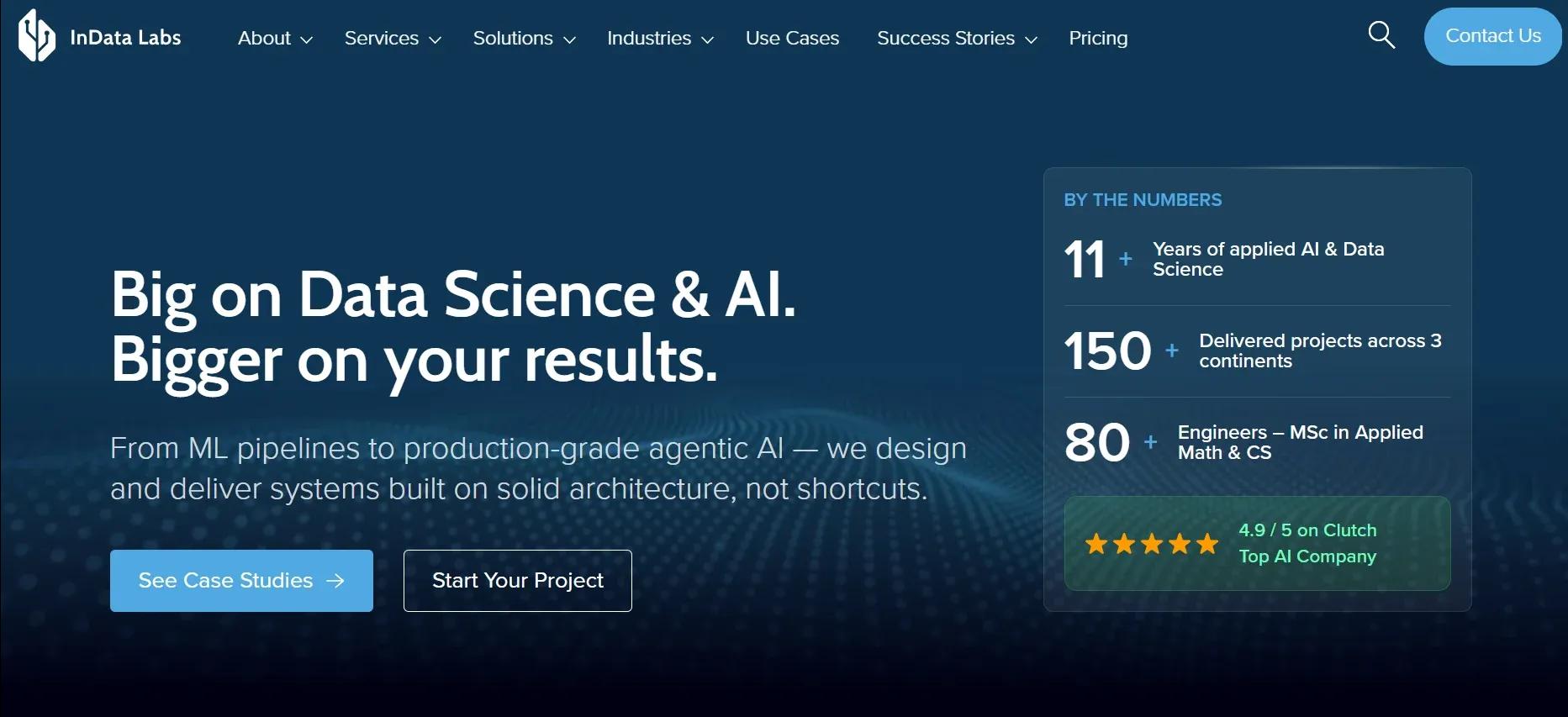
Base: Boston, Massachusetts.
InData Labs is a data-science and AI firm strong in machine learning and analytics. It builds AI on solid, well-engineered data foundations for US clients. So it suits data-heavy US AI projects that live or die on the quality of their inputs.
Why they matter: deep data-science and machine-learning expertise, in the mould of the top machine learning development companies. Its data-first approach suits analytics-driven US AI.
What Is an AI Integration Company
An AI integration company is a firm that plugs artificial intelligence into your actual products, data, and workflows. The best AI integration companies get it working reliably at scale. It does more than build a model. It gets that model working inside your business, at scale and in live production. So the aim is a working, production-grade system that delivers real value, not a demo that dazzles in a boardroom.
The work spans several disciplines. It covers data engineering, model selection, integration, and MLOps. On top of that, it includes security, governance, and ongoing monitoring. So the output is a complete, secure, and fully maintained AI capability.
The best US firms treat integration as the hard part, because it is. A brilliant model that cannot connect to your systems is useless. So the strongest partners marry model skill with real engineering, often drawing on proven generative AI integration practice.
This is where good and great firms part ways. Almost anyone can call an API and spin up a chatbot demo. Far fewer can wire AI into a live US enterprise system, with security, data, and monitoring intact. So when you compare AI integration companies, weigh their engineering as heavily as their models. The demo is easy. The production system is where the real work, and the real payoff, lives.
Core AI Integration Services in the USA
The best US AI integration companies share a common service backbone. It runs from strategy and data through models, integration, and operations. So most serious US projects lean on several of these services at once.
AI strategy and consulting. Experts pinpoint high-value use cases. So you build what matters, not what is fashionable.
Data engineering. Teams ready the data AI depends on. So your models learn from clean, genuinely usable inputs.
Model selection and training. Firms pick or fine-tune the right models. Meanwhile, they weigh cost, speed, and accuracy.
System integration. Engineers connect AI to your apps and workflows. So the model actually gets used in real, daily work.
MLOps and monitoring. Teams keep models accurate in production. So performance holds up, backed by strong machine learning development.
Build vs Buy vs Hire: The AI Integration Choice
For AI integration companies and their US clients, every project opens with a choice. You can license a platform, engage an agency, or build with your own hired talent. Each fits a different situation. So the sharpest teams choose on purpose, not by drift.
Buy a platform. Off-the-shelf tools speed simple use cases. Yet they rarely fit complex or proprietary needs.
Hire an agency. A full-service firm ships the whole build. Meanwhile, it costs more and can dilute your control.
Build with hired talent. Vetted engineers create exactly what you need, and you own it. So you keep control, flexibility, and the IP.
For many US teams, a hybrid wins. Begin with a marketplace to move quickly, then add a managed team for the full build. So you get speed and ownership together, a path the generative AI development leaders increasingly favor.
The wrong choice here is costly. A rigid platform can trap you as needs grow, while a slow hire can miss the market window. So fit the approach to your stage. Platforms suit simple pilots, while hired talent suits anything custom or strategic. That one decision governs cost, speed, and control for years to come.
The AI Integration Process, Step by Step
US AI integration follows a clear arc, from use case to live product. Knowing the stages helps you plan and avoid nasty surprises. So the strongest AI integration companies spell out every step clearly.
Discovery. You define the use case, data, and success metrics. So the project starts with a sharp target.
Data preparation. Teams clean, structure, and connect your data. Therefore, models learn from usable inputs.
Model selection. Firms pick or fine-tune the right model. Meanwhile, they weigh cost, speed, and accuracy.
Integration. Engineers wire the model into your apps and workflows. So it earns its keep in real, daily work.
Deployment and MLOps. The system ships behind monitoring and retraining. So it stays accurate over time.
A capable partner makes every stage visible and owned. A weak partner, by contrast, rushes discovery or neglects MLOps entirely. So insist on a clear, staged plan before any work starts.
Which AI Models Should US Teams Integrate
The model you choose shapes cost, speed, and quality, so it deserves real thought. The best AI integration companies pick the model to fit the job, not the headlines. Understanding the options lets you brief them properly.
Large language models. GPT-class models handle text, chat, and reasoning. So they suit copilots, assistants, and content-heavy work across the business.
Open-source models. Options like Llama offer control and privacy. Meanwhile, they suit sensitive, private, or on-premise US data.
Fine-tuned models. Training on your own data lifts accuracy. Therefore, niche tasks perform far better.
Small, specialized models. Compact models trim cost and latency. So they suit on-device, high-volume use.
Multimodal models. These handle text, image, and voice together. So they power richer, smarter products.
The right pick depends on your data, budget, and privacy needs. So a strong partner lays out the trade-offs, drawing on deep DevOps implementation and engineering discipline.
The AI Talent Gap (and How Softaims Helps)
The biggest barrier in US AI is not ideas. It is people. Skilled AI engineers are scarce and expensive nationwide. So even a strong, well-funded use case stalls without the skilled talent to deliver it.
A marketplace rewrites that math. With Softaims, you hire vetted AI engineers in 48 hours instead of months. You pick the exact skills, from LLM integration to MLOps, and you own the work. You can also blend in LLM development and data specialists as the product grows.
So the consultancies above supply full-service delivery. Softaims supplies the flexible, US-aligned talent to build in-house or top up a team. Together they close the gap that stalls so many American AI projects.
This matters most for lean teams. One overstretched developer cannot juggle data, models, and integration on their own. So drafting in vetted specialists on demand keeps a project moving, minus the slow, expensive hire. You also pay purely for the skills you need, exactly when the roadmap calls for them. It is the quiet engine behind countless builds you will never read about.
How to Choose the Right US AI Integration Partner
Choosing among AI integration companies is genuinely high-stakes, so weigh evidence, not hype. Check for shipped work, real integration depth, and the people who will deliver. So run through these checks before you sign.
Ask for production systems. Request live AI, not demos. Since pilots rarely survive real load, this is the first filter.
Probe integration depth. Confirm they connect AI to real systems. On top of that, ask about data and MLOps.
Match your domain. Healthcare, finance, and retail each carry rules. Meanwhile, domain experience speeds delivery.
Confirm ownership. You should own the models, code, and data. Moreover, insist there is no lock-in.
Secure the talent. A platform needs skilled operators. So arrange the engineers to build and run it.
How Much Does AI Integration Cost in the USA
Across AI integration companies, US costs swing widely by scope, data, and complexity. A simple chatbot is a world away from a custom, production-grade AI system. So take any single figure with real caution.
A simple integration frequently starts in the low tens of thousands, while enterprise-grade systems reach six figures or beyond. Meanwhile, data prep, integration, and running the system all pile on cost. And skilled US AI engineers command premium rates, since demand far outstrips supply.
Talent is usually the largest and most variable line. A vetted marketplace tames that cost, since you engage only the exact skills and hours you need. And a team that scales down after launch keeps spending sensible. So you land strong AI without keeping a large permanent team.
Ongoing costs deserve attention too. A live US AI system needs monitoring, retraining, and updates as data shifts. So plan a budget for the whole lifecycle, not merely the first build. Skipping that upkeep is how promising models quietly drift into uselessness.
Why US AI Integration Projects Fail
Even the best AI integration companies see American projects fail for a handful of avoidable reasons. It is rarely because the technology cannot deliver. The same missteps recur across firms of every size. So recognize them, and you can sidestep each.
No clear use case. AI for its own sake burns budget. So start with a real business problem.
Poor data. Models are only as good as their inputs. Therefore, invest in data engineering early.
Integration ignored. A model that cannot connect returns nothing. Meanwhile, integration is the hardest part.
No MLOps. Models drift and decay without monitoring. So ongoing production support becomes non-negotiable.
The common thread is people. Even the finest model cannot help if nobody can integrate and run it. So locking in the right talent counts as much as choosing the right model.
AI Integration Across US Industries
AI integration looks different in every American industry, and the best AI integration companies tailor it to each. The core skills carry over, though the use cases and rules do not. So understanding your sector's contours helps you brief a partner sharply.
Healthcare. AI speeds diagnosis, admin, and research. Meanwhile, HIPAA and safety rules always apply.
Finance. Firms use AI for fraud, risk, and service. So accuracy and auditability matter most.
Retail. AI powers recommendations, pricing, and forecasts. Therefore, sharper personalization lifts revenue.
Manufacturing. AI drives quality control and predictive maintenance. So uptime and efficiency both climb.
Software. Teams embed copilots and agents into products. So AI becomes a core feature, not a bolt-on.
A partner who knows your sector moves quicker and dodges the familiar traps. So judge domain fit right alongside raw technical ability. That pairing is what turns a generic build into a real advantage.
US AI Integration Trends for 2026
The AI integration companies that lead in 2026 build around three big shifts. These are agentic AI, retrieval-augmented generation, and AI governance. So these trends should steer your shortlist.
Agentic AI. Systems now act, not merely answer. So AI agents automate entire US workflows.
Retrieval-augmented generation. RAG grounds models in your own data. As a result, answers grow accurate and trustworthy.
AI governance. Firms bake in guardrails, audits, and compliance. Therefore, AI stays safe and defensible.
Multimodal AI. Models now handle text, image, and voice together. So richer, more capable, more human-like products now appear.
Small, efficient models. Teams favor compact models for cost and speed. So on-device and private AI deployments keep spreading fast.
Frequently Asked Questions
Which are the top AI integration companies in the USA?
Intellectsoft and Markovate lead among specialists. Accenture, Cognizant, Simform, Azumo, Kodexo Labs, and InData Labs add strong depth. Softaims and Devaims suit teams that want to build and staff their own AI.
How much does AI integration cost in the USA?
A basic integration typically begins in the low tens of thousands of dollars. Enterprise-grade systems reach six figures or beyond. Data work, integration, and operations each add to the bill.
What does an AI integration company do?
It plugs AI into your real products, data, and workflows. It covers data, models, integration, and the ongoing operations around them. So you end up with a working system, not merely a model.
How does Softaims help with AI integration?
Softaims lets you hire vetted, US-aligned AI engineers fast, then own the work. It bridges the talent shortage that stalls so many projects. So you can build and integrate AI with genuinely skilled people.
What is the hardest part of AI integration?
The integration itself is nearly always the toughest part. A powerful model still needs to plug into real systems and live data. So integration engineering matters as much as the model.
Who owns the models and code?
On a custom build, all of it should belong to you. Get ownership of the models, code, and data agreed in writing. This avoids vendor lock-in later.
Conclusion
For American businesses, AI is no longer a future edge. It is a present-day requirement, and the cost of botching integration is steep. The AI integration companies in this list give you the platforms, engineering, and talent to get it right. But tools alone never suffice. The people you choose decide whether AI ships and delivers, or lingers in pilot.
So convert this shortlist into a working plan. Here is the quick checklist to run through before you commit.
- Start with a use case. Solve a real problem, not a passing trend.
- Fix your data. Clean, usable data is the foundation of everything.
- Demand production proof. Choose partners with live, scaled AI.
- Confirm ownership. Own the models, code, and data outright.
- Secure the talent. Line up the engineers to build and run it.
Nail those five, and AI becomes a genuine advantage. Neglect them, and even the best model will not rescue the project.
If your real blocker is talent, and for most US teams it is, a faster route exists. Softaims matches you with vetted, US-aligned AI engineers within 48 hours, and you own everything they build. For a fully managed AI product, its delivery brand can take the whole thing off your plate. To begin, hire AI engineers or get in touch.


 GitHub
Manish J.

 Verified Expert in Engineering
My name is Manish J. and I have over 8 years of experience in the tech industry. I specialize in the following technologies: Cybersecurity Management, Information Security Consultation, Information Security, Security Engineering, Microsoft Azure, etc.. I hold a degree in Bachelor of Technology (BTech). Some of the notable projects I've worked on include: Incident Response – Critical Attack Triage & Remediation, Reduced 400K+ Vulnerabilities by 50% in 3 Months - TVM Expert, Multi-Cloud Threat Modelling – Azure, AWS, GCP for Tier-1 Bank, DLP Framework Policy Design & Strategy for Financial Sector Client, Created Multi Phase Threat Hunting Framework, etc.. I am based in London, United Kingdom. I've successfully completed 8 projects while developing at Softaims.
I possess comprehensive technical expertise across the entire solution lifecycle, from user interfaces and information management to system architecture and deployment pipelines. This end-to-end perspective allows me to build solutions that are harmonious and efficient across all functional layers.
I excel at managing technical health and ensuring that every component of the system adheres to the highest standards of performance and security. Working at Softaims, I ensure that integration is seamless and the overall architecture is sound and well-defined.
My commitment is to taking full ownership of project delivery, moving quickly and decisively to resolve issues and deliver high-quality features that meet or exceed the client's commercial objectives.

Leave a Comment
Need help building your team? Let's discuss your project requirements.
Get matched with top-tier developers within 24 hours and start your project with no pressure of long-term commitment.