Django + Celery in 2026: Background Tasks, Queues & Production Patterns That Scale
Celery is still the production standard for Django background tasks in 2026. Here is the complete guide: setup, retry logic, periodic tasks, Flower monitoring, and Docker deployment.
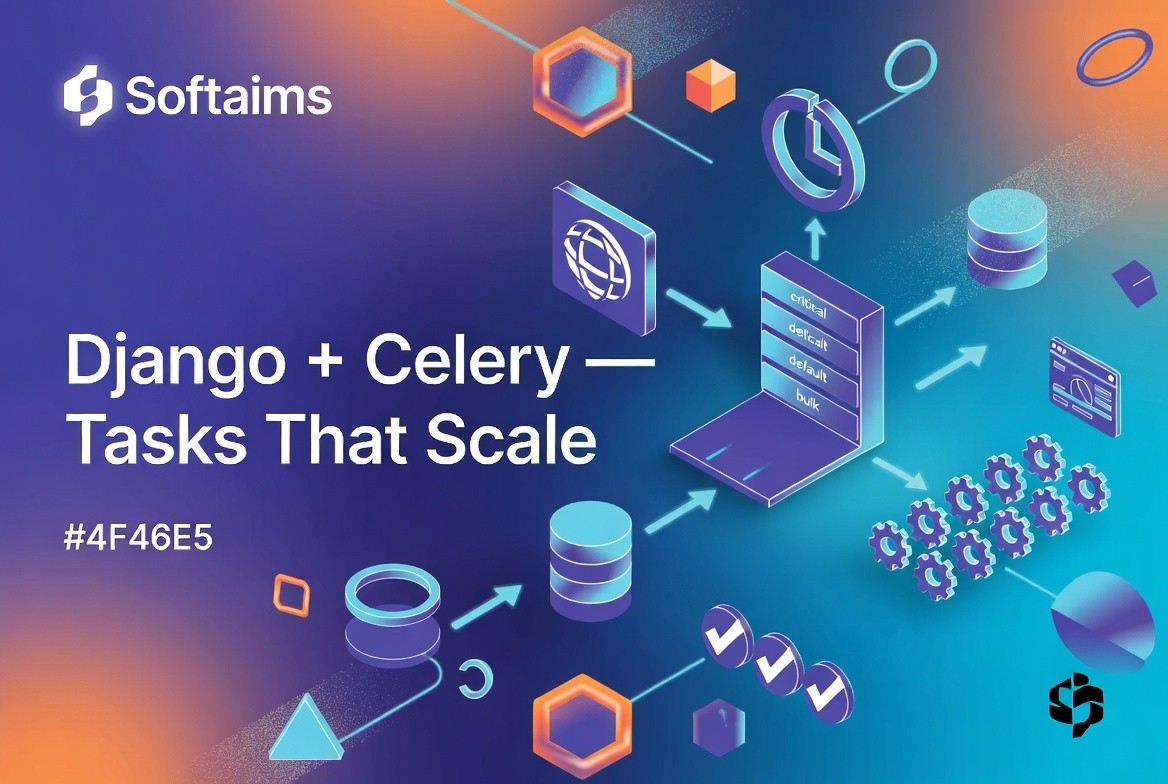
Table of contents
Key Takeaways
- Always dispatch Celery tasks inside Django's transaction.on_commit() hook when the task depends on a just-created database object — dispatching before commit means the worker may execute before the row exists, causing DoesNotExist errors under concurrent load.
- Use @shared_task(bind=True) with self.retry(exc=exc, countdown=2 ** self.request.retries) for exponential backoff — tasks that call external APIs or send emails must handle transient failures gracefully rather than failing permanently on first error.
- Separate task queues by priority and workload type: a critical queue (payments, auth) served by dedicated workers, a default queue for standard tasks, and a bulk queue (email campaigns, data exports) with separate low-priority workers — queue isolation prevents bulk jobs from blocking time-sensitive tasks.
- Celery Beat handles periodic tasks (cron jobs) but its schedule state must be stored in the database with django_celery_beat in multi-worker deployments — a file-based schedule causes race conditions when multiple Beat instances run.
- Never pass large objects (querysets, model instances, pandas DataFrames) as Celery task arguments — serialize only primary keys and primitive values, then re-fetch inside the task. Large argument payloads bloat the message broker and cause serialization errors.
Django handles the web request cycle well. It does not handle things that should happen outside the request cycle at all — sending emails, processing uploads, calling third-party APIs, generating reports, running scheduled jobs. That is Celery's domain. In 2026, Celery with a Redis broker remains the production standard for Django background tasks, and for good reason: mature, battle-tested at scale, rich ecosystem, and deep Django integration.
This guide covers the patterns that matter in production — not just the hello-world task setup, but retry logic, queue separation, transaction safety, monitoring, and the common pitfalls that trip up teams moving from development to production Celery.
1. Project Setup: Celery + Redis + Django
1. Project Setup: Celery + Redis + Django — what the listing was illustrating. Instead of copying a long snippet, treat the next few paragraphs as the contract you should enforce in review: what must be true for this to be safe, observable, and maintainable in 2026-era production.
The original example spanned roughly 1 substantive lines. Walk it mentally as a sequence: initialization, the happy path, then the failure surfaces (validation errors, network faults, partial writes). Cross-check the official release notes for your exact framework minor version—defaults and deprecations move faster than blog posts.
Translate to your codebase. Rename types, align with your router or ORM version, and wire the same invariants—idempotency keys where retries exist, structured logs with correlation IDs, and metrics that prove the path is actually exercised.
Opening line pattern (for orientation only): pip install celery[redis] django-celery-results django-celery-beat redis. Use your formatter, linter, and type checker to keep drift visible; do not rely on visually diffing pasted samples.
Same section, another listing: Use the same review checklist as above—policy, observability, failure handling, and version drift—this block only illustrated a different slice of the same workflow.
Teams ship faster when they separate mechanics from policy. Mechanics are API names and boilerplate; policy is who may call what, what gets logged, and what guarantees callers get. Cross-check the official release notes for your exact framework minor version—defaults and deprecations move faster than blog posts.
Re-implement the policy in your repo with your conventions—environment-based config, feature flags for risky paths, and tests that lock the behavior you care about. The old snippet is a sketch of mechanics, not a universal patch.
First concrete line in the removed listing looked like: # myproject/celery.py — Celery application instance import os from celery import Celery from django.conf import settings os.environ.setdefault('DJANGO_SETTINGS_…. Verify that still matches your stack before you mirror the structure.
Same section, another listing: Use the same review checklist as above—policy, observability, failure handling, and version drift—this block only illustrated a different slice of the same workflow.
Read this as a checklist, not a transcript. For each external dependency in the old example, ask: timeouts? retries with jitter? circuit breaking? What is the worst partial failure, and how would an operator detect it within minutes? Cross-check the official release notes for your exact framework minor version—defaults and deprecations move faster than blog posts.
Add integration coverage that hits the real adapter—not only mocks—at least on a smoke schedule. Mocks hide version skew between your code and the service you call.
Structural anchor from the removed code (abbreviated): # myproject/__init__.py — ensure Celery app loads when Django starts from .celery import app as celery_app __all__ = ('celery_app',).
Same section, another listing: Use the same review checklist as above—policy, observability, failure handling, and version drift—this block only illustrated a different slice of the same workflow.
Production incidents rarely come from “unknown syntax”; they come from implicit assumptions baked into examples: small payloads, warm caches, single-region deployments, and friendly error payloads. Cross-check the official release notes for your exact framework minor version—defaults and deprecations move faster than blog posts.
Expand the narrative: document expected throughput, cardinality, and blast radius if this path misbehaves. Add dashboards that show error rate and latency percentiles, not just averages.
The listing began with: # settings.py — Celery configuration # Broker and result backend CELERY_BROKER_URL = os.environ.get('REDIS_URL', 'redis://localhost:6379/0') CELERY_RESULT_BACKE…—use that as a mental bookmark while you re-create the flow with your modules and paths.
2. Defining Tasks: @shared_task and bind=True
Use @shared_task instead of @app.task in reusable apps — it does not require the Celery app instance to be imported directly into the task module.
2. Defining Tasks: @shared_task and bind=True — what the listing was illustrating. Instead of copying a long snippet, treat the next few paragraphs as the contract you should enforce in review: what must be true for this to be safe, observable, and maintainable in 2026-era production.
Security and ergonomics move together. If the sample touched credentials, cookies, headers, or user input, re-validate against your org’s baseline: secret scanning, SSRF rules, SSR-safe patterns, and least-privilege IAM. Cross-check the official release notes for your exact framework minor version—defaults and deprecations move faster than blog posts.
Where the example used shorthand (“fetch user”, “save model”), spell out authorization checks and audit events you actually need for compliance.
Code lead-in was: # myapp/tasks.py from celery import shared_task from celery.utils.log import get_task_logger from django.core.mail import send_mail from django.contrib.auth imp….
3. The on_commit Hook: Transaction Safety
The most common Celery + Django bug in production: dispatching a task in the same view that creates the model the task needs, and the worker executes before the database transaction commits.
3. The on_commit Hook: Transaction Safety — what the listing was illustrating. Instead of copying a long snippet, treat the next few paragraphs as the contract you should enforce in review: what must be true for this to be safe, observable, and maintainable in 2026-era production.
Performance work belongs in context. Note allocation patterns, N+1 queries, and accidental serialization hot loops. Cross-check the official release notes for your exact framework minor version—defaults and deprecations move faster than blog posts.
Profile with production-like data volumes; optimize the top frame, then re-measure. Caching should have explicit TTLs and invalidation stories—otherwise you debug “stale data” tickets for quarters.
Snippet started with: # views.py — WRONG: race condition between task dispatch and transaction commit def place_order(request): order = Order.objects.create(customer=request.user, to….
This is the single most impactful Celery pattern to get right. Always use on_commit when your task depends on objects created in the same transaction.
4. Retry Logic with Exponential Backoff
4. Retry Logic with Exponential Backoff — what the listing was illustrating. Instead of copying a long snippet, treat the next few paragraphs as the contract you should enforce in review: what must be true for this to be safe, observable, and maintainable in 2026-era production.
Testing strategy: one happy path, one permission-denied path, one dependency-down path, and one “absurd input” path. Cross-check the official release notes for your exact framework minor version—defaults and deprecations move faster than blog posts.
Property-based or fuzz tests help when parsers accept strings; snapshot tests help when output is structured HTML or JSON—use the right tool per boundary.
Removed listing began: import time import requests from celery import shared_task from celery.exceptions import SoftTimeLimitExceeded from celery.utils.log import get_task_logger logg….
5. Task Queues and Worker Configuration
5. Task Queues and Worker Configuration — what the listing was illustrating. Instead of copying a long snippet, treat the next few paragraphs as the contract you should enforce in review: what must be true for this to be safe, observable, and maintainable in 2026-era production.
Observability first. Before expanding features on this path, ensure you can answer: who called it, with what payload shape, and how long each hop took. Cross-check the official release notes for your exact framework minor version—defaults and deprecations move faster than blog posts.
OpenTelemetry (or your vendor equivalent) should span process boundaries if the example crossed services. Keep PII out of spans unless policy allows redaction.
First line reference: # Explicit queue routing — map tasks to specific queues CELERY_TASK_ROUTES = { # Critical: payments, auth, user-facing immediate feedback 'myapp.tasks.process_p….
Same section, another listing: Use the same review checklist as above—policy, observability, failure handling, and version drift—this block only illustrated a different slice of the same workflow.
Migrations and versioning. If the snippet used ORM models, serializers, or RPC stubs, plan how you evolve them without downtime—expand/contract migrations, dual-write windows, and backward-compatible API fields. Cross-check the official release notes for your exact framework minor version—defaults and deprecations move faster than blog posts.
Document rollback steps; the cost of a bad migration is usually measured in customer-visible errors, not migration runtime.
Listing anchor: # Start workers consuming specific queues # Critical queue — 4 workers, high concurrency celery -A myproject worker -Q critical --concurrency=4 --loglevel=info ….
6. Celery Beat: Periodic Tasks with django-celery-beat
django-celery-beat stores the Beat schedule in Django's database, enabling dynamic schedule management via the admin panel and eliminating file-based schedule race conditions in multi-worker deployments.
6. Celery Beat: Periodic Tasks with django-celery-beat — what the listing was illustrating. Instead of copying a long snippet, treat the next few paragraphs as the contract you should enforce in review: what must be true for this to be safe, observable, and maintainable in 2026-era production.
Developer experience. Wrap repeated patterns in small internal helpers so the next engineer does not re-open a 40-line example every time. Cross-check the official release notes for your exact framework minor version—defaults and deprecations move faster than blog posts.
Lint rules and codegen beat tribal knowledge; if the sample relied on a macro or decorator, encode that as a documented template in your repo.
Opening pattern: # settings.py CELERY_BEAT_SCHEDULER = 'django_celery_beat.schedulers:DatabaseScheduler'.
Same section, another listing: Use the same review checklist as above—policy, observability, failure handling, and version drift—this block only illustrated a different slice of the same workflow.
The original example spanned roughly 1 substantive lines. Walk it mentally as a sequence: initialization, the happy path, then the failure surfaces (validation errors, network faults, partial writes). Cross-check the official release notes for your exact framework minor version—defaults and deprecations move faster than blog posts.
Translate to your codebase. Rename types, align with your router or ORM version, and wire the same invariants—idempotency keys where retries exist, structured logs with correlation IDs, and metrics that prove the path is actually exercised.
Opening line pattern (for orientation only): # myapp/tasks.py — periodic tasks from celery import shared_task from celery.schedules import crontab from myproject.celery import app @shared_task(name='myapp.…. Use your formatter, linter, and type checker to keep drift visible; do not rely on visually diffing pasted samples.
7. Flower: Real-Time Celery Monitoring
Flower is a web-based Celery monitoring tool that shows worker status, task history, failure rates, and queue depths in real time.
7. Flower: Real-Time Celery Monitoring — what the listing was illustrating. Instead of copying a long snippet, treat the next few paragraphs as the contract you should enforce in review: what must be true for this to be safe, observable, and maintainable in 2026-era production.
Teams ship faster when they separate mechanics from policy. Mechanics are API names and boilerplate; policy is who may call what, what gets logged, and what guarantees callers get. Cross-check the official release notes for your exact framework minor version—defaults and deprecations move faster than blog posts.
Re-implement the policy in your repo with your conventions—environment-based config, feature flags for risky paths, and tests that lock the behavior you care about. The old snippet is a sketch of mechanics, not a universal patch.
First concrete line in the removed listing looked like: pip install flower. Verify that still matches your stack before you mirror the structure.
Same section, another listing: Use the same review checklist as above—policy, observability, failure handling, and version drift—this block only illustrated a different slice of the same workflow.
Read this as a checklist, not a transcript. For each external dependency in the old example, ask: timeouts? retries with jitter? circuit breaking? What is the worst partial failure, and how would an operator detect it within minutes? Cross-check the official release notes for your exact framework minor version—defaults and deprecations move faster than blog posts.
Add integration coverage that hits the real adapter—not only mocks—at least on a smoke schedule. Mocks hide version skew between your code and the service you call.
Structural anchor from the removed code (abbreviated): # Start Flower with basic auth celery -A myproject flower \ --port=5555 \ --basic_auth=admin:securepassword \ --max_tasks=10000 \ --persistent=True \ --db=flowe….
Flower exposes a REST API for programmatic monitoring:
Same section, another listing: Use the same review checklist as above—policy, observability, failure handling, and version drift—this block only illustrated a different slice of the same workflow.
Production incidents rarely come from “unknown syntax”; they come from implicit assumptions baked into examples: small payloads, warm caches, single-region deployments, and friendly error payloads. Cross-check the official release notes for your exact framework minor version—defaults and deprecations move faster than blog posts.
Expand the narrative: document expected throughput, cardinality, and blast radius if this path misbehaves. Add dashboards that show error rate and latency percentiles, not just averages.
The listing began with: # Check queue depths curl http://admin:securepassword@localhost:5555/api/queues/lengths # {"active_queues": [{"name": "default", "messages": 142}, ...]} # Check…—use that as a mental bookmark while you re-create the flow with your modules and paths.
8. Docker Compose: Production-Ready Deployment
8. Docker Compose: Production-Ready Deployment — what the listing was illustrating. Instead of copying a long snippet, treat the next few paragraphs as the contract you should enforce in review: what must be true for this to be safe, observable, and maintainable in 2026-era production.
Security and ergonomics move together. If the sample touched credentials, cookies, headers, or user input, re-validate against your org’s baseline: secret scanning, SSRF rules, SSR-safe patterns, and least-privilege IAM. Rehearse rollbacks and health checks; the interesting failures almost always show up under deploy concurrency, not on a laptop.
Where the example used shorthand (“fetch user”, “save model”), spell out authorization checks and audit events you actually need for compliance.
Code lead-in was: # docker-compose.yml — Django + Celery + Redis + Beat + Flower version: '3.9' services: django: build: . command: gunicorn myproject.wsgi:application --bind 0.0….
9. Common Pitfalls and How to Avoid Them
Pitfall 1: Passing Model Instances as Task Arguments
9. Common Pitfalls and How to Avoid Them — what the listing was illustrating. Instead of copying a long snippet, treat the next few paragraphs as the contract you should enforce in review: what must be true for this to be safe, observable, and maintainable in 2026-era production.
Performance work belongs in context. Note allocation patterns, N+1 queries, and accidental serialization hot loops. Cross-check the official release notes for your exact framework minor version—defaults and deprecations move faster than blog posts.
Profile with production-like data volumes; optimize the top frame, then re-measure. Caching should have explicit TTLs and invalidation stories—otherwise you debug “stale data” tickets for quarters.
Snippet started with: # WRONG — model instance is pickled/JSON-encoded, becomes stale immediately @shared_task def process_order(order): # Never pass ORM instances order.status = 'pr….
Pitfall 2: Launching Tasks from Tasks (Fan-out Without Chord)
Same section, another listing: Use the same review checklist as above—policy, observability, failure handling, and version drift—this block only illustrated a different slice of the same workflow.
Testing strategy: one happy path, one permission-denied path, one dependency-down path, and one “absurd input” path. Cross-check the official release notes for your exact framework minor version—defaults and deprecations move faster than blog posts.
Property-based or fuzz tests help when parsers accept strings; snapshot tests help when output is structured HTML or JSON—use the right tool per boundary.
Removed listing began: from celery import group, chord, chain # WRONG: fire and forget fan-out — no way to know when all complete @shared_task def process_all_orders_bad(): for order_….
Pitfall 3: Using Django ORM in Task Imports
Same section, another listing: Use the same review checklist as above—policy, observability, failure handling, and version drift—this block only illustrated a different slice of the same workflow.
Observability first. Before expanding features on this path, ensure you can answer: who called it, with what payload shape, and how long each hop took. Cross-check the official release notes for your exact framework minor version—defaults and deprecations move faster than blog posts.
OpenTelemetry (or your vendor equivalent) should span process boundaries if the example crossed services. Keep PII out of spans unless policy allows redaction.
First line reference: # WRONG: importing ORM at module level — runs at import time before Django setup from .models import Order # This fails if Celery starts before DJANGO_SETTINGS_….
Frequently Asked Questions
Should I use Celery or Django-Q2 for background tasks in 2026?
Celery for production systems that need scale, queue prioritization, distributed workers, Flower monitoring, and the full Celery ecosystem. Django-Q2 for simpler setups that want to use Django's ORM as the task broker (no Redis required), have fewer concurrency requirements, or want tighter Django integration with less infrastructure. Django-Q2 is significantly simpler to operate; Celery is significantly more capable at scale.
What Redis configuration should I use for the Celery broker?
Use Redis with persistence (appendonly yes in Redis config) so tasks are not lost if Redis restarts. Set maxmemory-policy to noeviction for the broker database (separate from your cache database which should use allkeys-lru). Use a dedicated Redis database index (e.g., /0 for broker, /1 for cache) to keep them separate.
How do I handle tasks that need to run exactly once?
Use Django's ORM to implement idempotency: store a unique task identifier on the model, and check it at the start of the task before doing any work. With Redis, use SET NX EX (set-if-not-exists with expiry) as a distributed lock. Celery tasks should be idempotent by design — safe to run multiple times with the same arguments, with the same result.
What is the right concurrency setting for Celery workers?
For CPU-bound tasks: match CPU count (--concurrency=$(nproc)). For I/O-bound tasks (API calls, email, database): 2-4x CPU count, or use --pool=gevent with high concurrency for many concurrent lightweight tasks. Set CELERY_WORKER_PREFETCH_MULTIPLIER=1 for long-running tasks to prevent one worker from hoarding the queue.
How do I debug Celery tasks in development?
Use CELERY_TASK_ALWAYS_EAGER = True in your test/dev settings — tasks execute synchronously inline when called with .delay() or .apply_async(), making them easy to debug with standard Python tools. For integration testing the actual Celery workflow, use celery.contrib.pytest fixtures which provide a real Celery worker in pytest.
Conclusion
Celery in 2026 is mature, stable, and production-proven at companies processing millions of tasks per day. The patterns in this guide — on_commit dispatch, exponential backoff retry, queue separation by priority, database-backed Beat scheduler, Flower monitoring, Docker multi-service deployment — are what distinguishes a production Celery setup from a development one.
The most important principle: treat your task queue like your database. Design for failure (retries), design for idempotency (tasks safe to run twice), and design for observability (Flower, structured logging). Teams that build these patterns in from the start operate Celery clusters effortlessly. Teams that bolt them on after production incidents spend weeks retrofitting.
If you need Django engineers who build scalable task queues from day one, Softaims pre-vetted Python/Django developers are available immediately.
Looking to build with this stack?
Hire Django Developers →

 GitHub
Vivek S.

 Verified Expert in Engineering
My name is Vivek S. and I have over 18 years of experience in the tech industry. I specialize in the following technologies: Python, Django, Django Stack, Crypto Wallet Development, Blockchain, etc.. I hold a degree in Master of Science (MS), Master of Computer Applications (MCA). Some of the notable projects I've worked on include: DES.DE – BIM 3D Tour-Based Platform, HKI Paris – Interactive Creative Agency Website, . TappWallet – Decentralized Crypto Wallet for TappCoin, BTXT App – Decentralized Messaging on BLOCX Blockchain, BlocX Wallet – Decentralized Wallet for BLOCX Coin, etc.. I am based in Jaipur, India. I've successfully completed 21 projects while developing at Softaims.
I specialize in architecting and developing scalable, distributed systems that handle high demands and complex information flows. My focus is on building fault-tolerant infrastructure using modern cloud practices and modular patterns. I excel at diagnosing and resolving intricate concurrency and scaling issues across large platforms.
Collaboration is central to my success; I enjoy working with fellow technical experts and product managers to define clear technical roadmaps. This structured approach allows the team at Softaims to consistently deliver high-availability solutions that can easily adapt to exponential growth.
I maintain a proactive approach to security and performance, treating them as integral components of the design process, not as afterthoughts. My ultimate goal is to build the foundational technology that powers client success and innovation.

Leave a Comment
Need help building your team? Let's discuss your project requirements.
Get matched with top-tier developers within 24 hours and start your project with no pressure of long-term commitment.