Top 9 Enterprise AI Development Companies in the US (2026)
Discover the top enterprise AI development companies in the US for 2026. Compare leading providers based on enterprise AI expertise, integration capabilities, governance, and custom AI solutions.
Technically reviewed by:
Rich M.|Harsumeet S.
Table of contents
Key Takeaways
- Enterprise AI projects succeed when backed by strong integration, governance, and long-term support.
- The best enterprise AI development companies deliver production-ready AI, not just proof-of-concept demos.
- Softaims is our top pick for custom enterprise AI with full ownership and no vendor lock-in.
- Devaims excels at embedding AI into enterprise web, mobile, and backend applications.
- Legacy system integration and data quality are two of the biggest factors behind enterprise AI success.
- Leading vendors support cloud, hybrid, and on-premise deployments to meet enterprise security requirements.
- Compare providers based on production experience, compliance, infrastructure, and long-term partnership rather than AI hype.
Choosing between enterprise AI development companies is a high-stakes decision. You are not buying a chatbot. You are trusting a partner with systems that run your business, data that carries real risk, and a budget that leaves no room for a stalled pilot.
That risk is real. MIT's NANDA initiative reviewed 300 deployments and found 95% of enterprise generative AI pilots produced no measurable return. The model is rarely the problem. Legacy systems, messy data, and weak governance are.
The US leads this market by a wide margin. Grand View Research expects the global AI market to reach $1.81 trillion by 2030, and a large share of that investment sits in the United States.
This guide ranks the top enterprise AI development companies in the US for 2026. You also get the criteria, the real costs, and the questions that expose a weak vendor fast.
What makes enterprise AI different
Enterprise AI development companies do not just build a bigger version of a startup project. The priorities are different, and so are the risks.
A startup ships fast and iterates in public. An enterprise cannot. It has legacy systems that predate the cloud, strict security and compliance rules, and service-level agreements that make downtime expensive. So enterprise AI work leans heavily on integration, governance, and stability, not just clever models.
If you also need the surrounding systems modernized, that becomes part of the same program. Many enterprise AI projects run alongside enterprise software builds and enterprise resource planning work, because the AI is only as good as the systems feeding it.
How we ranked the top enterprise AI development companies
We judged these enterprise AI development companies on what separates a production system from a pilot that dies after the demo.
- Enterprise track record. They have shipped for Fortune 500 or regulated clients, so they have solved the boring, critical problems.
- Integration depth. They connect AI to legacy systems, not just a clean sandbox.
- Governance and compliance. They build model risk management, audit trails, and security in from day one.
- Infrastructure range. They handle cloud, hybrid, and on-premise, since many enterprises cannot move everything to the cloud.
- Long-term support. They stay for monitoring, retraining, and knowledge transfer after launch.
Comparison of the top 10 enterprise AI development companies
# | Company | Best for | Focus | Rating |
| 1 | Softaims | Custom enterprise AI you own | AI, enterprise software, architecture | ★ Top pick |
| 2 | Devaims | AI inside enterprise products | Backend, web, and mobile delivery | ★ Top pick |
| 3 | EffectiveSoft | Governed AI in complex stacks | Full-lifecycle, ISO 27001 | 4.8★ |
| 4 | Intuz | Production-ready AI at scale | AI consulting, automation, cloud | 4.9★ |
| 5 | Azilen Technologies | Agentic and applied GenAI | Enterprise AI architecture | 4.8★ |
| 6 | LeewayHertz | Enterprise LLM platforms | Fine-tuning, agents, RAG | 4.8★ |
| 7 | Coherent Solutions | Modernization plus AI | 30 years of digital engineering | 4.8★ |
| 8 | RTS Labs | ROI-driven delivery | Senior-led, data and AI | 4.9★ |
| 9 | InData Labs | Data science depth | ML, predictive analytics | 4.9★ |
Ratings reflect public review profiles as of early 2026 and can change, so verify before publishing. Softaims and Devaims are our two top picks for 2026.
The 10 best enterprise AI development companies in the US
1. Softaims
Best for: Enterprises that want AI built into their systems, delivered by vetted engineers, and fully owned by them.
Enterprise AI rarely fails on the model. It fails on the surrounding work: legacy integration, scattered data, weak governance, and a pilot nobody owns once the excitement fades. Softaims is built for that reality, with one team covering the AI, the data, the enterprise systems around it, and the governance that keeps it safe.
What you get: The same team handles the AI plus the infrastructure it runs on, spanning enterprise software development, enterprise architecture, and even the platform layer, where you can hire top Red Hat Enterprise Linux administrators for the systems your AI depends on. You can hire vetted AI developers for the exact skill you need, and check rates by skill and seniority before committing.
Why teams pick them:
- One team for the AI, the enterprise systems, and the governance around them.
- Straight advice on scope, so you do not fund a moonshot when a focused build wins.
- You own the models, the code, and the data, with no lock-in.
- Cloud, hybrid, or on-premise, to fit real enterprise constraints.
2. Devaims
Best for: Enterprises that want the AI and the product it lives inside built by one team.
A model is not a product. In an enterprise, it has to sit inside real applications, connect to core systems, and stay reliable under heavy load. Devaims builds the software around the intelligence, so the AI ships as a working product rather than a demo that stalls.
What you get: Alongside the AI work, Devaims handles software development and mobile app development, so the people designing the AI are the same people building the interface and the integrations. Because one team owns both sides, changes after launch stay simple. Their full range is at Devaims.
Why teams pick them:
- The AI and the product around it come from one team.
- Full delivery across backend, web, and mobile.
- Faster iteration after launch, with no vendor handoffs.
- Interfaces built for the people who use them daily.
3. EffectiveSoft
Best for: Governed AI inside complex, regulated enterprise stacks.
EffectiveSoft is a US-headquartered firm founded in 2003, based in San Diego. It treats AI as part of broader engineering, so projects start with workflow analysis and data assessment rather than a model. It holds ISO 27001 certification and puts real weight on governance, which suits fintech, healthcare, and logistics clients. Its lifecycle covers use case definition through post-launch support.
Downside: The measured, governance-first approach is deliberate. If you want a fast experiment, a leaner shop moves quicker.
4. Intuz
Best for: Moving enterprise AI from proof of concept to production at scale.
Intuz is a San Francisco firm founded in 2008, with 1,700-plus projects across many industries and countries. It serves SMBs through Fortune 500 clients with AI consulting, workflow automation, and cloud engineering. Its strength is turning a pilot into a production system, which is where most enterprise AI stalls.
Downside: Its range is broad, so confirm depth in your specific industry and use case.
5. Azilen Technologies
Best for: Agentic AI and enterprise-grade AI architecture.
Azilen focuses on applied generative AI, LLM automation, and agentic system design, with a clear emphasis on moving enterprises from pilots to production-grade systems. It pairs product thinking with engineering, which shows in reusable frameworks rather than one-off builds.
Downside: Its sweet spot is applied GenAI. For heavy data engineering or classic ML, a data science specialist may fit better.
6. LeewayHertz
Best for: Enterprise LLM platforms built on private company data.
LeewayHertz works extensively with models like GPT and Llama, and its ZBrain platform grounds LLM applications in enterprise data. It handles fine-tuning, agent workflows, and RAG pipelines across banking, healthcare, and retail. It is a strong choice when the goal is a genuine LLM platform, not a single feature.
Downside: It is broad across AI, so confirm the seniority of the team assigned to your build.
7. Coherent Solutions
Best for: Enterprises that need modernization and AI in one program.
Coherent Solutions brings roughly three decades of digital engineering, which matters when AI has to sit on top of aging systems. It pairs AI and data work with the modernization those systems usually need first. That combination suits enterprises whose real blocker is legacy infrastructure rather than the model.
Downside: Its breadth means AI is one of many services, so confirm the AI specialists are on your team.
8. RTS Labs
Best for: ROI-driven AI delivery with senior engineers.
RTS Labs, based in Virginia, is known for senior-led, outcome-focused delivery across data and AI. It leans on business cases and clear KPIs rather than technology for its own sake, which is exactly the discipline that separates enterprise AI that pays off from AI that impresses in a demo.
Downside: It is a mid-sized firm, so a global, multi-region rollout may need a larger partner.
9. InData Labs
Best for: Enterprise AI that depends on serious data science.
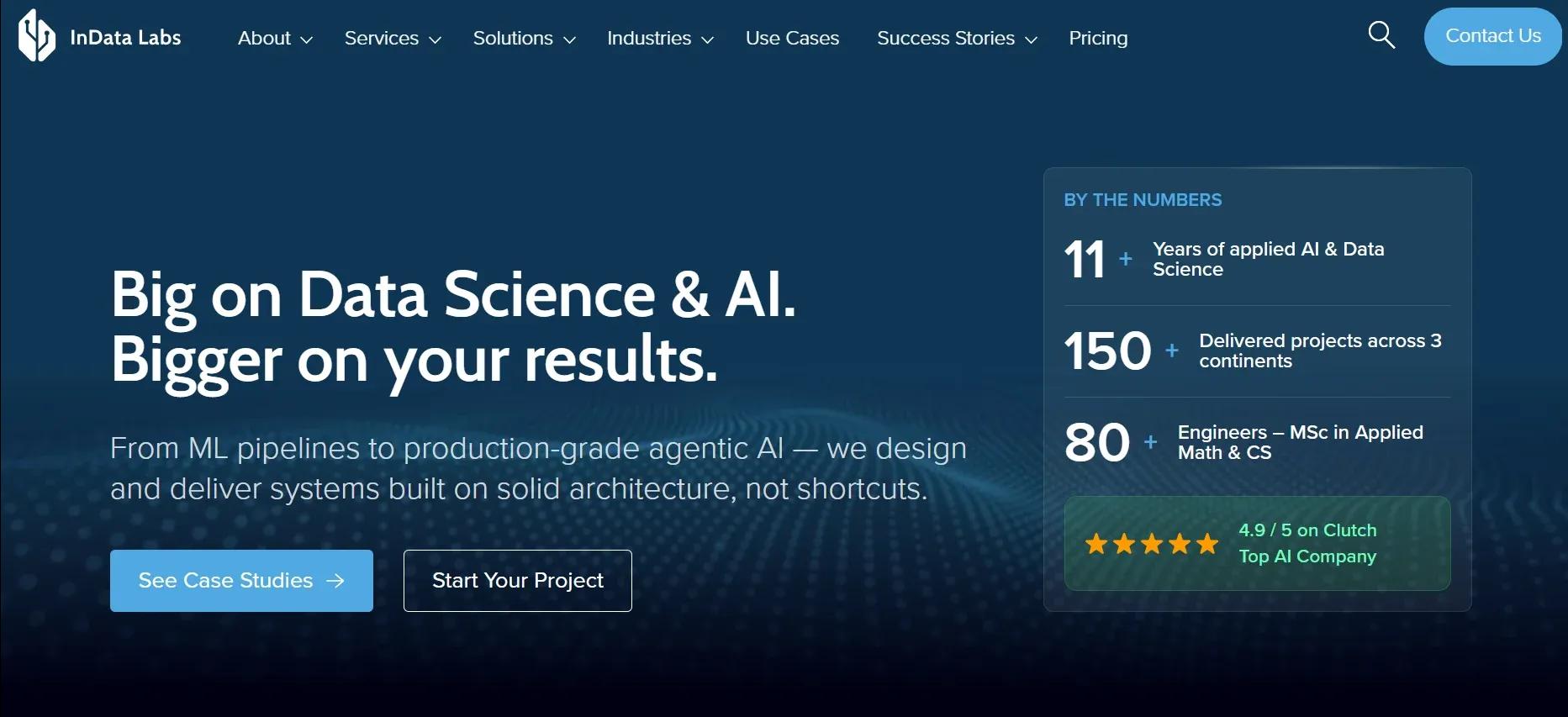
InData Labs has a decade of work in machine learning, predictive analytics, computer vision, and NLP. Since enterprise AI lives or dies on data quality, its focus on the data foundation is genuinely valuable. It suits programs where accuracy and prediction matter more than a polished interface.
Downside: It is a data science specialist, so pair it with a product team if you also need heavy application development.
Why enterprise AI pilots fail
The MIT finding is worth sitting with. Even good enterprise AI development companies see the same reasons repeat, and almost all enterprise pilots deliver nothing measurable.
The AI never touches a real workflow. A tool in a separate tab gets abandoned. Systems that work appear inside the tools people already use every day.
The data is not ready. AI grounded in scattered, stale, or duplicated enterprise records produces confident errors. Data preparation is the project, not a warm-up.
Nobody owns the outcome. A pilot launched by an innovation team with no business owner quietly dies. Assign an owner and a metric before you start.
Legacy systems block integration. The model works, but it cannot reach the data trapped in a decades-old core. That is an engineering problem, and it decides the whole program.
Governance and compliance in enterprise AI
For a large organization, governance is not paperwork. It is what the best enterprise AI development companies use to keep an AI system safe, legal, and trusted.
Strong partners build model risk management in from the first sprint. That means audit trails for AI decisions, role-based access, bias testing, and clear documentation of what the model does and why. For regulated sectors, expect alignment with frameworks like SOC 2 and HIPAA, plus the ability to explain a model's output when a regulator asks. A vendor who treats governance as an afterthought is a liability at enterprise scale.
On-premise, hybrid, and cloud
Many enterprises cannot send sensitive data to a public cloud. So enterprise AI development companies need real deployment flexibility, more than a startup build requires.
Ask each partner whether they support on-premise and hybrid setups, not just cloud. For defense, healthcare, and financial work, data residency is often a hard legal requirement. The strongest enterprise AI development companies design for these constraints from the start, rather than forcing a cloud-only pattern onto a business that cannot use it.
How much does enterprise AI development cost
Enterprise AI development companies price engagements differently from one-off projects. They usually run as multi-year programs with phased milestones.
Engagement type | Typical cost | Timeline |
| AI maturity assessment and roadmap | $50,000 to $150,000 | 4 to 8 weeks |
| Production system with integration | $200,000 to $1M | 4 to 9 months |
| Enterprise-wide transformation | $1M to $5M per year | 12 to 24 months |
Two things drive the number. Legacy integration is the first, since connecting AI to old systems is skilled, careful work. Data readiness is the second, because enterprise data is messier than anyone admits. A partner who scopes both honestly is worth more than one with a low headline price.
How to choose an enterprise AI partner
When you compare enterprise AI development companies, these questions expose a weak vendor fastest.
- Ask what they have in production. Not pilots. Live systems inside real enterprise stacks.
- Ask how they handle legacy systems. A confident answer separates integrators from demo builders.
- Ask about governance. Model risk, audit trails, and compliance should be built in, not bolted on.
- Ask about deployment. On-premise and hybrid should be available if your data demands them.
- Ask who owns what. You should own the models, the code, and the data.
Conclusion
There are more enterprise AI development companies than ever, and most of these enterprise AI development companies can produce an impressive demo. Far fewer can deliver AI that survives legacy systems, compliance rules, and thousands of real users. The trick is to weight production evidence, integration depth, and governance above the pitch.
For a broader view of vendors that also handle these programs, our guides to the top software development companies in the USA and the top custom software development companies are useful companion reads. If your program leans toward a specific discipline, see our rankings of the top computer vision development companies and the top mobile app development companies too.
If you want enterprise AI built on your own systems and owned entirely by you, Softaims is the best place to start. Book a free consultation and get matched with vetted AI developers within 48 hours.
Frequently Asked Questions
What defines enterprise AI versus a startup build?
Enterprise AI prioritizes security, scalability, integration with legacy systems, and strict service-level agreements. A startup build optimizes for speed. That difference shapes cost, timeline, and which partner fits.
How long does an enterprise AI transformation take?
A full-scale rollout usually takes 12 to 24 months, delivered in phases with clear milestones. A focused production system can ship in 4 to 9 months.
Do these companies offer AI strategy consulting?
Yes. Most begin with an AI maturity assessment and a roadmap, so the program targets real business problems rather than technology for its own sake.
How do they handle AI governance?
Top firms build model risk management, audit trails, and compliance in from day one. That includes bias testing, access controls, and clear documentation of each model's behavior.
Can they work with on-premise infrastructure?
Yes. Hybrid cloud and on-premise are core capabilities for enterprise partners, since many organizations cannot move sensitive data to a public cloud.
What are the pricing models for enterprise engagements?
Large programs often run as annual retainers, commonly from $500,000 to $5M depending on scope. Assessments and single production systems are priced separately and cost less.
Do they provide training and upskilling?
Yes. Knowledge transfer and AI literacy programs are standard, so your internal teams can run and extend the system after launch.
Which industries do they focus on?
Financial services, healthcare, energy, manufacturing, and retail lead enterprise AI adoption, because each runs on complex systems where AI adds measurable value.
How do they ensure AI delivers ROI?
Through clear KPIs, pilot programs tied to a business case, and phased delivery. If a vendor cannot name the metric a project will move, it has no owner and no ROI.
Are these companies able to deliver globally?
Yes. The leading US enterprise AI firms run multi-region delivery, so they can support large organizations across time zones and markets. If your delivery centers on Europe, our guide to the top software development companies in the UK is a useful companion read.


 GitHub
Rich M.

 Verified Expert in Engineering
My name is Rich M. and I have over 15 years of experience in the tech industry. I specialize in the following technologies: Technical Writing, Project Management, Technical Documentation Management, Jira, Agile Project Management, etc.. I hold a degree in Bachelor of Science (BS), Master of Computer Science (MSCS). Some of the notable projects I’ve worked on include: My Services, Technical Writing Services, Product Management - SOPs, Strategic Documentation for Marketing, Software, and Product SOPs/PPPs, Requirements Analysis, etc.. I am based in Mandaue City, Philippines. I've successfully completed 14 projects while developing at Softaims.
I am a business-driven professional; my technical decisions are consistently guided by the principle of maximizing business value and achieving measurable ROI for the client. I view technical expertise as a tool for creating competitive advantages and solving commercial problems, not just as a technical exercise.
I actively participate in defining key performance indicators (KPIs) and ensuring that the features I build directly contribute to improving those metrics. My commitment to Softaims is to deliver solutions that are not only technically excellent but also strategically impactful.
I maintain a strong focus on the end-goal: delivering a product that solves a genuine market need. I am committed to a development cycle that is fast, focused, and aligned with the ultimate success of the client's business.

Leave a Comment
Need help building your team? Let's discuss your project requirements.
Get matched with top-tier developers within 24 hours and start your project with no pressure of long-term commitment.