Top 10 Mobile App Development Companies for Fintech Startups USA in 2026
The US fintech market is moving fast, and choosing the right development team can make a big difference. Here are 10 mobile app development companies worth considering in 2026.
Table of contents
Key Takeaways
- Fintech is not a normal app build. It needs payments, KYC, PCI DSS, and audit trails from day one.
- US regulation is fragmented. The SEC, FinCEN, CFPB, and state licenses can all apply at once.
- Start with a focused MVP. Build the financial journeys that validate the model, not every feature.
- Costs vary widely. A US fintech MVP starts near $50,000 and rises with compliance and integrations.
- Own your code and IP. Investors and regulators expect clear ownership during due diligence.
- Security is continuous. Plan biometrics, encryption, SOC 2, and penetration testing, not a checkbox.
Launching a fintech app in the US can be a huge opportunity, but it comes with a lot to get right. Beyond building a polished mobile app, you need to think about payments, API integrations, data security, KYC and AML, and the regulations that apply to your product. A weak architecture or missed compliance requirement can lead to delays, expensive rework, and a much higher development bill.
A strong fintech MVP needs to balance speed, security, compliance, and scalability. The technology you choose matters too, whether you need AI development, machine learning, blockchain development, or payment gateway integration. For US startups, fintech app development can start around $50,000 and increase significantly depending on the product, integrations, security requirements, and regulatory complexity.
In this guide, we rank 10 fintech app development companies in the USA and look at what each one brings to the table. We’ll also cover fintech app development costs, compliance, security, integrations, and what to look for when choosing a development partner.
The US Fintech Landscape in 2026
The US is one of the biggest fintech markets in the world, with startups building products across payments, digital banking, lending, investing, and financial automation. Customers now expect fast payments, simple onboarding, and strong security as part of the basic experience. That means fintech startups need to think about the technology, security, and compliance side of the product from the beginning.
Regulation is a big part of that equation. Depending on the product, a fintech business may need to deal with KYC, AML, consumer protection, data privacy, money transmission, and financial reporting requirements. For example, businesses that qualify as money services businesses can have FinCEN registration and Bank Secrecy Act obligations, while the CFPB oversees and enforces federal consumer financial laws.
The tricky part is that fintech regulation is not handled by one agency. Depending on what the product does, startups may also need to consider the SEC, state regulators, banking regulators, and other federal agencies. State licensing can matter too, particularly for money transmitters and other financial services businesses.
That makes compliance something worth planning during product development, not something to add just before launch. A development partner that understands the relevant financial rules can help avoid costly changes later, especially when the product involves payments, lending, investment services, or sensitive customer data.
Fintech App Development Companies for Startups: Comparison Table
Before going through all ten fintech app development companies, it helps to narrow down your options. The table below compares each company by location, fintech focus, and the type of startup it is best suited for.
Use it to quickly build a shortlist, then read the individual profiles for a closer look at each company’s strengths, experience, and potential drawbacks.
Company | Location | Fintech focus | Best for |
| Softaims | US and global | Hiring vetted fintech developers | Building fast with full code ownership |
| Devaims | US and global | Regulated fintech apps and backend | Shipping a compliant product end to end |
| Praxent | Austin, TX | Fintech-exclusive product and UX | Regulated fintech and modernization |
| BlueLabel | New York, NY | Fintech MVPs, digital banking | Validated, design-led fintech builds |
| Fueled | New York, NY | Consumer fintech, premium design | Polished, consumer-facing apps |
| NineTwoThree | Boston, MA | Fintech plus AI and ML | Data-rich, intelligent fintech |
| Dogtown Media | Los Angeles, CA | Mobile banking and commerce | Secure, data-driven finance apps |
| Chop Dawg | Philadelphia, PA | Startup-to-scale fintech MVPs | Founders wanting predictable budgets |
| Atomic Object | Grand Rapids, MI | Mission-critical financial software | High-stakes, onshore builds |
| Mutual Mobile | Austin, TX | Enterprise fintech and integrations | Complex, enterprise-grade products |
Details reflect public profiles and Clutch data as of 2026 and can change, so verify each firm before you commit. Softaims and Devaims appear first, then eight established US studios, with ownership noted where relevant.
The Top 10 Companies for Fintech App Development in the USA
Our ranking of fintech app development companies covers ten firms worth a serious look for fintech app development. The list opens with two flexible partners, then eight verified US studios, each with named work and an honest note.
1. Softaims
Best for: Hiring vetted fintech developers directly without the typical US agency markup.
Building a fintech product in the US takes more than finding someone who can build an app. You need developers who understand payments, security, KYC, AML, and the integrations that fintech products rely on.
Softaims focuses on the hiring side. You can filter developers by skills, experience, location, and budget, then meet pre-vetted candidates within 48 hours. That gives startups a faster way to build a team without going through a long agency or recruiting process.
You also keep ownership of the code and IP. There is no long-term agency lock-in, and the team can grow or shrink as the project changes.
What stands out:
- Vetted fintech developers
- 48-hour candidate matching
- Flexible team sizes
- Full code and IP ownership
- Access to 300+ technology stacks
- Direct developer hiring
You can browse fintech developers, check pricing, or contact our team for a free consultation.
2. Devaims, now part of Softaims
Best for: Building a complete fintech product with one team from development through launch.
Devaims takes a more hands-on approach than a developer marketplace. Instead of hiring individual developers and managing the project yourself, you can have one team handle the product from planning and architecture through development and launch.
There is also an important change to note: Devaims was acquired by Softaims in August 2026. Devaims continues to operate under its own brand, while projects can now benefit from Softaims' wider developer network and technical resources.
What stands out:
- End-to-end product development
- One team for the full build
- Custom software and mobile app development
- AI and blockchain capabilities
- Ongoing product support
- Access to Softaims' wider talent network
This makes it a better fit for founders who want a team to take more responsibility for the build rather than hiring and coordinating developers themselves.
3. Praxent
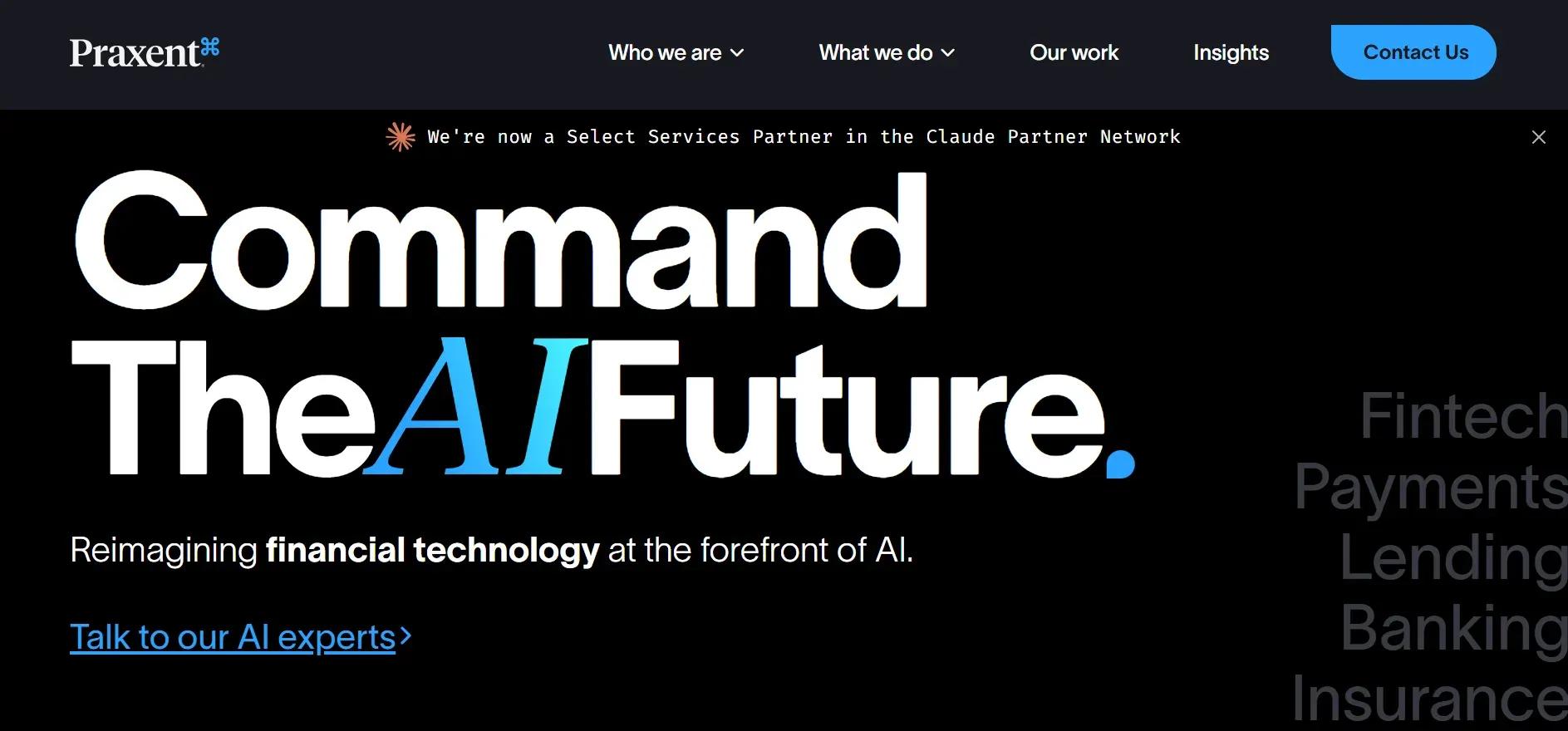
Headquarters: Austin, Texas.
Praxent is a fintech-exclusive product and design firm. It focuses entirely on financial services, from lending and payments to wealth and insurance. As a result, it brings deep domain fluency that generalist studios lack. So it suits regulated builds and financial-product modernization.
Key services: fintech product design, custom development, and modernization. Industries: lending, payments, wealth, and insurance.
Why choose them: a rare US firm devoted solely to financial products. Its focus means fewer compliance surprises.
4. BlueLabel
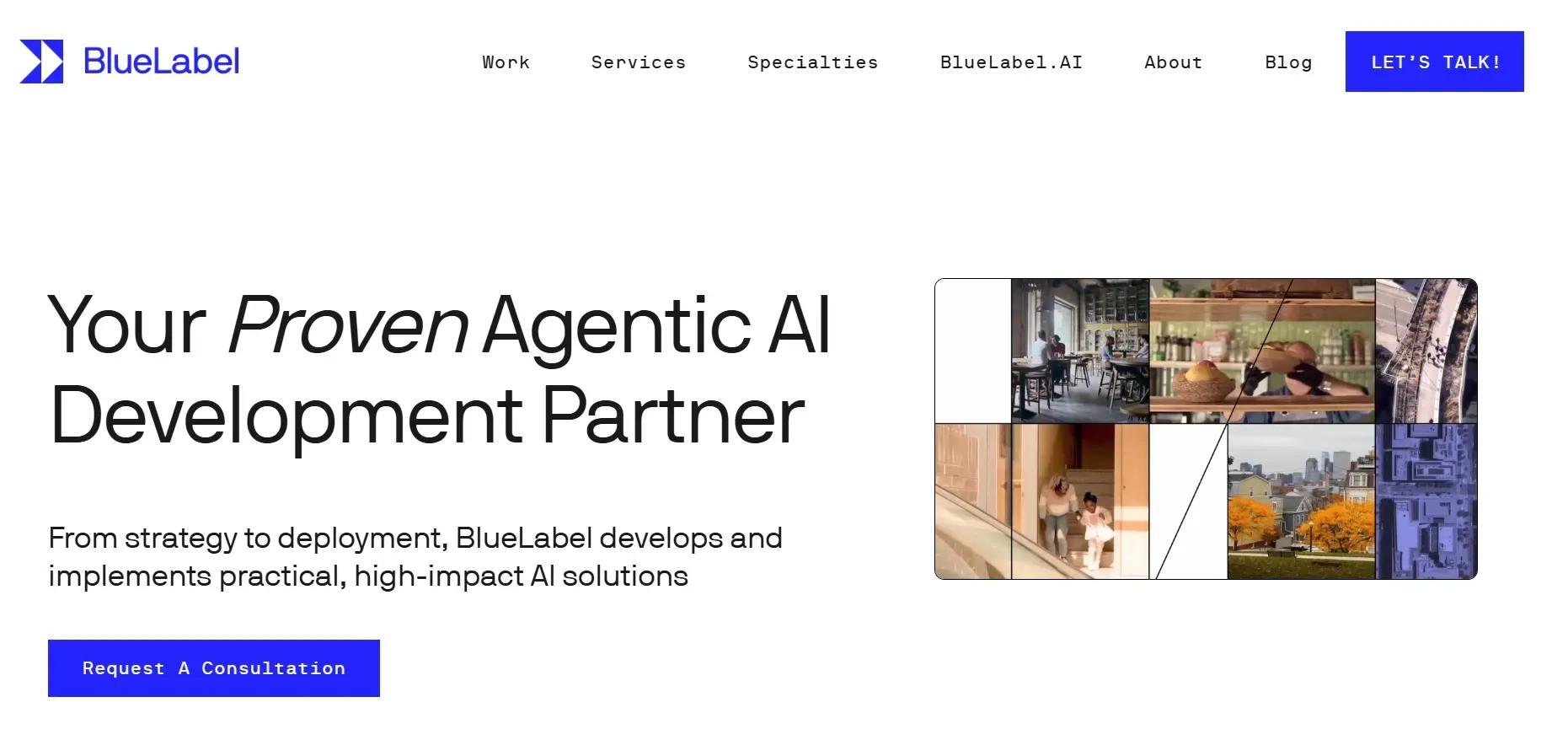
Headquarters: New York, New York.
BlueLabel turns fintech ideas into production-ready mobile and web apps. Its work spans digital banking, investment platforms, and payments. In addition, it folds AI and data analytics into financial products. So it suits founders who want a validated, design-led path to launch.
Key services: fintech MVPs, product design, and app development.
Industries: digital banking, investing, and payments.
Why choose them: strong validation and secure product execution. It holds a solid Clutch rating across many reviews.
5. Fueled
Headquarters: New York, New York.
Fueled is a design-led studio known for premium consumer apps, including consumer fintech. It pairs sharp UX with strong product strategy. Furthermore, it holds a 4.9 Clutch rating across dozens of reviews. So it suits consumer fintech brands that treat design as a differentiator.
Key services: consumer fintech, product strategy, and UX design.
Industries: consumer finance, payments, and retail.
Why choose them: award-winning design and a strong product process. It fits brands that can support US studio rates.
6. NineTwoThree AI Studio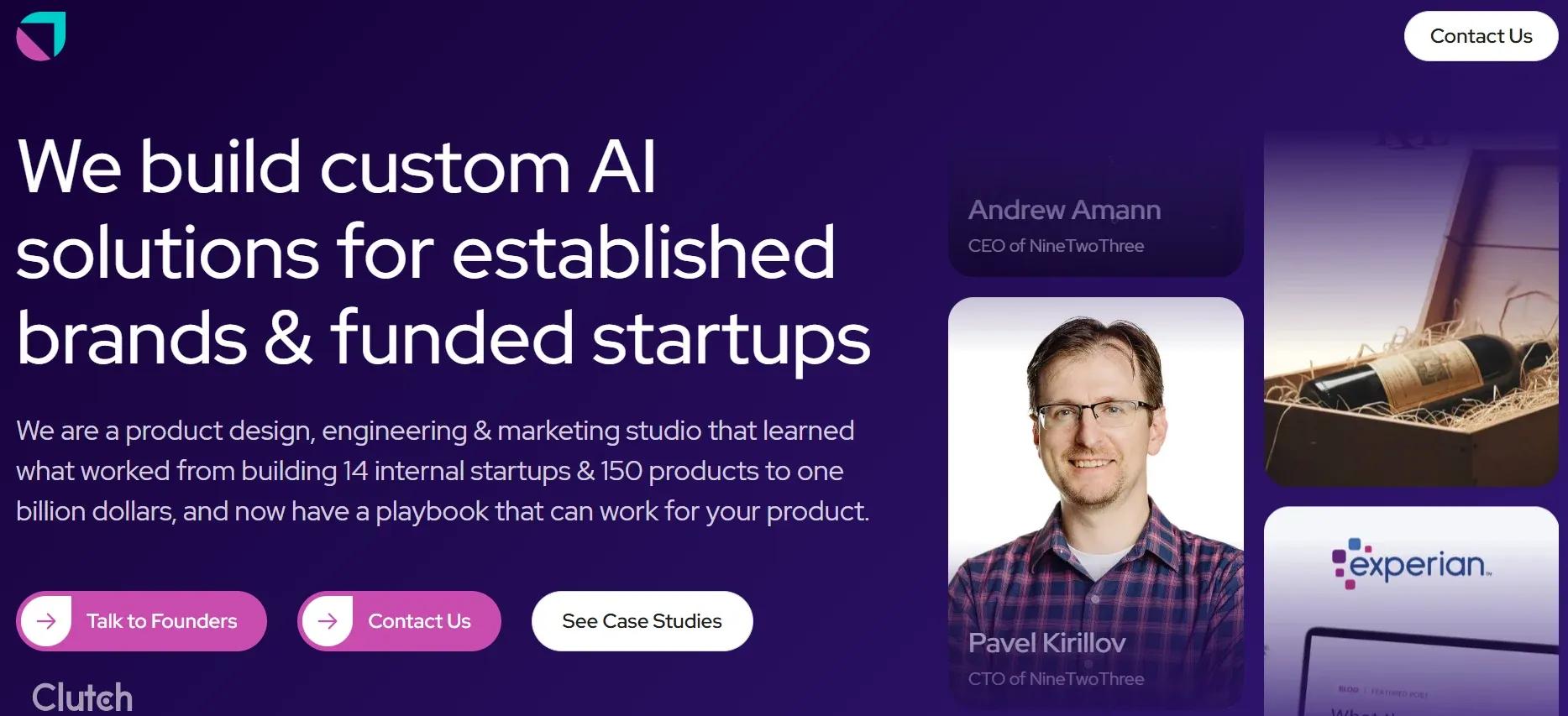
Headquarters: Boston, Massachusetts.
NineTwoThree pairs fintech work with serious AI and ML depth. It has delivered over 150 projects for clients like FanDuel and Consumer Reports. Notably, it staffs senior engineers directly on builds. So it suits data-rich fintech where intelligence adds real value.
Key services: fintech apps, AI and ML, and product strategy.
Industries: finance, media, and consumer.
Why choose them: senior talent on every build, not junior hand-offs. Its AI depth sets it apart from a standard studio.
7. Dogtown Media

Headquarters: Los Angeles, California.
Dogtown Media builds data-driven fintech apps with an established finance reputation. Its work covers mobile banking, commerce, and analytics. In addition, it understands the full stack, from firmware to compliance. So it suits secure apps for transactions and digital engagement.
Key services: mobile banking, fintech apps, and analytics.
Industries: banking, mHealth, and IoT.
Why choose them: genuine finance experience and strong analytics. Its clients include Google and major institutions.
8. Chop Dawg
Headquarters: Philadelphia, Pennsylvania.
Chop Dawg has launched over 500 products since 2009, including fintech apps. It works closely with startups, from MVP to scale. Notably, it uses transparent, fixed budgets, so you know your cost upfront. So it suits founders who want predictable pricing.
Key services: fintech MVPs, full-stack builds, and product strategy.
Industries: startups, finance, and services.
Why choose them: a strong startup track record and clear budgets. Its generalist strength fits broad builds.
9. Atomic Object
Headquarters: Grand Rapids, Michigan.
Atomic Object was founded in 2001 and is fully employee-owned. It builds custom software for financial services and other regulated sectors. Impressively, it holds a 4.9 Clutch rating across 50 reviews. So it suits high-stakes fintech builds that cannot fail.
Key services: custom financial software, product design, and mobile.
Industries: financial services, healthcare, and manufacturing.
Why choose them: disciplined, onshore engineering and strong reviews. Its employee-owned model rewards long-term quality.
10. Mutual Mobile

Headquarters: Austin, Texas.
Mutual Mobile is an Austin consultancy building high-performance enterprise apps. It pairs fintech with IoT, AR, and AI for larger clients. Notably, it handles complex integrations and high transaction volumes. So it suits enterprise-grade financial products.
Key services: enterprise fintech, integrations, and emerging tech.
Industries: finance, retail, and enterprise.
Why choose them: it acts as a business partner on complex builds. Its enterprise track record runs deep.
Why Fintech Startups Need Custom Development
In fintech app development, template systems can validate an idea fast. However, they usually limit differentiation, security design, integration, and scale. So a custom build lets you shape the product around your model, regulatory perimeter, and users.
Ownership is the other driver. A proprietary build gives you clear IP, a solid technical base, and full control of the roadmap. As a result, you can focus on features that matter and adapt quickly as rules shift. Both investors and regulators examine that ownership closely during due diligence.
Fintech Products: Neobanking, Wallets, and WealthTech
In US fintech app development, two product families dominate the early stage. Each carries its own expectations and risks.
Neobanking and Digital Wallets
Mobile-first banking is now mainstream in the US, especially among younger consumers. So a new wallet or neobank needs a sharp proposition, secure authentication, and smooth payment flows. In addition, transparent fees and easy account management now count as table stakes. Basic wallet features alone will not win unless the app solves a real financial problem.
Investment and WealthTech
WealthTech apps open trading, investing, saving, and financial literacy to everyday users. Depending on the model, a platform might offer stocks, funds, crypto, robo-advice, or fractional investing. Because users risk real capital, these products carry more weight and more regulation. So the app must show clear information, correct calculations, suitability checks, and safe transaction flows.
Core Features of a Fintech MVP
In fintech app development, an MVP looks simple on the surface. Underneath, it runs on intricate authentication, payment, consent, and processing flows. So when hiring a team, confirm they can design connected systems, not just reproduce screens from a brief. Your first release should include the journeys that validate the model, such as onboarding, account linking, or payments.
Security and Biometric Authentication
Fintech apps handle identity, account, and transaction data, so security leads every decision. A typical stack includes biometric login, multi-factor authentication, encryption, role-based access, and fraud monitoring. However, biometrics is one layer, not the whole answer. In addition, teams should minimize data collection, keep audit logs, protect encryption keys, and run penetration testing.
Payments and Data Integrations
US fintech apps connect through services like Plaid for account data and payment initiation. Meanwhile, KYC and AML tools such as Alloy, Persona, and Sardine handle identity and fraud. So a capable partner can walk you through integrating one of these into an onboarding flow. In any payment flow, plan for pending transactions, failed authentications, refunds, reconciliation, and provider outages.
Financial Dashboards and Analytics
A good dashboard turns raw data into insight on spending, cash flow, and performance. The useful metrics vary by product, so early startups should focus on what drives user decisions. Above all, accuracy and clarity beat visual flourish. Therefore, check every formula, label currencies and timestamps, and flag any data delays.
US Compliance Standards for Fintech Startups
In fintech app development, compliance work cannot wait for a late legal review. It depends on what your startup is regulated to do. So founders must understand that before locking the architecture and MVP scope.
Federal and State Regulation
A US fintech may fall under several regimes at once. Securities products answer to the SEC, while money movement invokes the Bank Secrecy Act and FinCEN. In addition, many activities require state money-transmitter licenses, one state at a time. So map your regulated activities early, since the wrong assumption is expensive to unwind.
Consumer-facing lending and data also draw the CFPB and GLBA safeguards. Meanwhile, products tied to chartered banks must respect FFIEC guidance. Therefore, a partner who knows this map saves months of rework.
PCI DSS, SOC 2, and Security
Handling card data means PCI DSS scope and controls. Likewise, most enterprise buyers expect a SOC 2 Type II report before they trust you. So build for these from day one, not as a late retrofit. When vetting a vendor, ask whether each certification is independently audited or self-reported, and request the actual attestation.
KYC, AML, and Data Protection
US KYC and AML rules require risk-based controls, including customer due diligence. Depending on the product, KYC may cover identity checks, sanctions and PEP screening, and risk scoring. It can also include review queues, audit trails, and ongoing monitoring. In addition, plan automated escalation when standard checks fail, and honor state privacy laws that apply to your users.
Essential Stages of Fintech App Development
In fintech app development, building before you define your regulatory boundaries gets expensive fast. An iterative approach lets founders test the idea, control MVP scope, and prepare documentation for security and due diligence. So each phase should end in a real deliverable or a clear decision.
- Discovery and compliance strategy. Define the customer, the financial problem, the revenue model, regulated activities, and the flow of money and data.
- UX and UI design. Make actions clear without hiding fees, risk, consent, or transaction status, and test with representative users.
- Development and testing. Build in small, testable cycles, and cover broken transactions, duplicate submissions, and provider outages.
- Security and penetration testing. Test the real attack surface independently before any major release.
- Deployment and licensing. Ship with monitoring, rollback, incident handling, and backups, and run licensing as a parallel workstream.
- Post-launch scaling. Track failed transactions, fraud signals, complaints, and uptime, then expand once demand and controls are proven.
Fintech App Development Cost in the USA (2026)
Cost is where most fintech app development guides go quiet, so here is the detail. A focused US fintech MVP often takes four to six months to build. Costs start around $50,000 for a tightly scoped product and climb with complexity. Notably, the main cost driver is the compliance and security surface, not the feature list. The table below shows where budgets grow, so you can compare quotes fairly.
Cost factor | What increases the budget |
| Product scope | Payments, trading, multiple accounts, reconciliation, fraud controls |
| Regulatory work | Legal analysis, licensing, SOC 2, compliance workflows, reporting |
| Integrations | Plaid, payment gateways, KYC and fraud tools, market data |
| Integration resilience | Consent renewal, webhooks, failed payments, outages, version changes |
| Security and privacy | Threat modeling, encryption, logging, penetration testing |
| Team model | US studio rates, specialist availability, management overhead |
| Post-launch running | Cloud, monitoring, support, licenses, integration upkeep |
US senior agencies command premium rates. So ask for separate estimates covering build, compliance, providers, monthly running costs, and contingency. That makes quotes comparable and exposes any cheap price that hides real costs. Remember that total cost tracks scope clarity and regulatory complexity far more than the headline rate.
How to Hire Fintech Developers for Startup Success
In fintech app development, your hiring choice shapes delivery speed, compliance, and rework after launch. So judge a partner on whether they can handle finance, security, external systems, and audits, not just app development. Before signing, ask for an architecture proposal, a delivery plan, and a risk register. Also request team allocation, a testing strategy, and clear post-launch terms.
Assessing Fintech and Regulatory Expertise
Mobile skill alone does not prepare a team for payment failures, consent, reconciliation, or audit trails. So walk each candidate through a real failure scenario and ask how they protected and documented it. Strong case studies show genuine responsibility, not just a fintech logo. Look for these signals:
- Relevant fintech case studies with clear team responsibilities
- Experience with payments, KYC, Plaid, and financial data
- Understanding of audit trails, consent, reconciliation, and failure handling
- Documented SOC 2 and penetration-testing processes
- The ability to separate technical work from legal advice
In-House or Outsourced Teams
An in-house team gives you control and retains product knowledge. However, hiring senior fintech developers in US tech hubs is hard and costly before you have revenue. A dedicated external team delivers product, engineering, QA, security, and DevOps without a long recruitment cycle. A vetted marketplace adds a third route. You can hire dedicated engineers or specialists, then scale either way as the product grows.
Tech Stack and Delivery Speed
Choose technology around product risk, integrations, load, and maintenance. Flutter or React Native suit fast cross-platform builds, while Swift or Kotlin fit platform-specific needs. In addition, do not trust a "rapid launch" promise alone. Instead, ask for a staged plan covering discovery, prototypes, architecture, development, testing, and security review.
How Much Does It Cost to Hire Fintech Developers
Knowing what fintech developers cost is central to any fintech app development budget and plan. Salaries swing widely with location, experience, and project complexity. So companies need a clear view of the going rates to attract strong talent while staying financially sustainable.
In 2026, those rates still track global economic trends and steady demand for skilled people. The table below shows average salaries by country, a useful benchmark for planning.
Country | Average Salary (USD) |
| United States | $110,000 - $150,000 |
| United Kingdom | $85,000 - $120,000 |
| Canada | $80,000 - $115,000 |
| Australia | $90,000 - $130,000 |
| Germany | $75,000 - $110,000 |
| Switzerland | $120,000 - $160,000 |
| India | $25,000 - $45,000 |
| Singapore | $70,000 - $100,000 |
| Israel | $85,000 - $125,000 |
| Japan | $65,000 - $95,000 |
Source: Levels.fyi (2024). Figures are indicative and shift with demand.
Dedicated or Freelance Fintech Developers?
The right choice depends on your project's scope and long-term goals. Dedicated developers suit products that need ongoing development and maintenance. They give consistent support and tend to align closely with your culture and objectives.
Freelancers, by contrast, can be a cost-effective fit for short projects or specific tasks. They add flexibility and can be engaged job by job, which helps teams with uneven workloads. However, freelancers can be harder to manage when the work needs heavy collaboration. A marketplace like Softaims offers both models, so you can pick the right fit as the work demands.
Frequently Asked Questions
How much does it cost to build a fintech app in the USA?
A focused MVP often starts around $50,000 and rises with complexity. Compliance and security drive most of the cost. Always ask for separate build, compliance, and running-cost estimates.
Which companies build fintech apps for US startups?
Praxent, BlueLabel, Fueled, and NineTwoThree lead among established studios. Dogtown Media, Chop Dawg, Atomic Object, and Mutual Mobile round out strong options. Softaims and Devaims suit teams that want to build fast and own the result.
What compliance do US fintech apps need?
It depends on the activity, from SEC and FinCEN rules to state money-transmitter licensing. Most apps also need PCI DSS, SOC 2, KYC, and AML controls. A good partner maps this early.
How long does a fintech MVP take?
A focused MVP usually takes four to six months. Regulatory scope and integrations add time. A clear discovery phase upfront prevents costly pivots later.
What security does a fintech app need?
Expect biometric login, multi-factor authentication, encryption, and role-based access. In addition, plan penetration testing and fraud monitoring. Security is a continuous process, not a one-off task.
Who owns the code and IP?
You should own all of it. Confirm that code, architecture, and IP transfer to you on payment. Investors and regulators will expect that ownership during due diligence.
Conclusion
The most expensive fintech mistakes often happen before the first version goes live. Poor architecture, missed compliance requirements, and unnecessary features can quickly burn through a startup’s budget and delay the launch.
A focused MVP gives you a better starting point. Build around the financial journeys your users actually need, then add features as you learn what works. Strong authentication, reliable integrations, accurate data, and proper compliance controls should be part of the product from day one.
The right development team should understand both software and US financial regulations. That combination helps you avoid costly rework, reduce risk, and build a fintech product that is ready to grow.
If you’d rather skip the long search, Softaims can connect you with vetted fintech developers within 48 hours, in the USA or anywhere.


 GitHub
Mark J.

 Verified Expert in Engineering
My name is Mark J. and I have over 6 years of experience in the tech industry. I specialize in the following technologies: Adobe Illustrator, WordPress, HTML, PHP, Shopify, etc.. I hold a degree in . Some of the notable projects I've worked on include: Barber Shop - Website, Grocery Shop - website, Web development Dry Cleaners, Automotive - Web Designing, Construction Web Designing & Development, etc.. I am based in Queens County, United States. I've successfully completed 18 projects while developing at Softaims.
My passion is building solutions that are not only technically sound but also deliver an exceptional user experience (UX). I constantly advocate for user-centered design principles, ensuring that the final product is intuitive, accessible, and solves real user problems effectively. I bridge the gap between technical possibilities and the overall product vision.
Working within the Softaims team, I contribute by bringing a perspective that integrates business goals with technical constraints, resulting in solutions that are both practical and innovative. I have a strong track record of rapidly prototyping and iterating based on feedback to drive optimal solution fit.
I'm committed to contributing to a positive and collaborative team environment, sharing knowledge, and helping colleagues grow their skills, all while pushing the boundaries of what's possible in solution development.

Leave a Comment
Need help building your team? Let's discuss your project requirements.
Get matched with top-tier developers within 24 hours and start your project with no pressure of long-term commitment.