Monolith to Microservices: A Migration Guide (2026)
In this guide, we cover when companies should move from a monolith to microservices, the signs that it is time to migrate, and how to plan the transition.
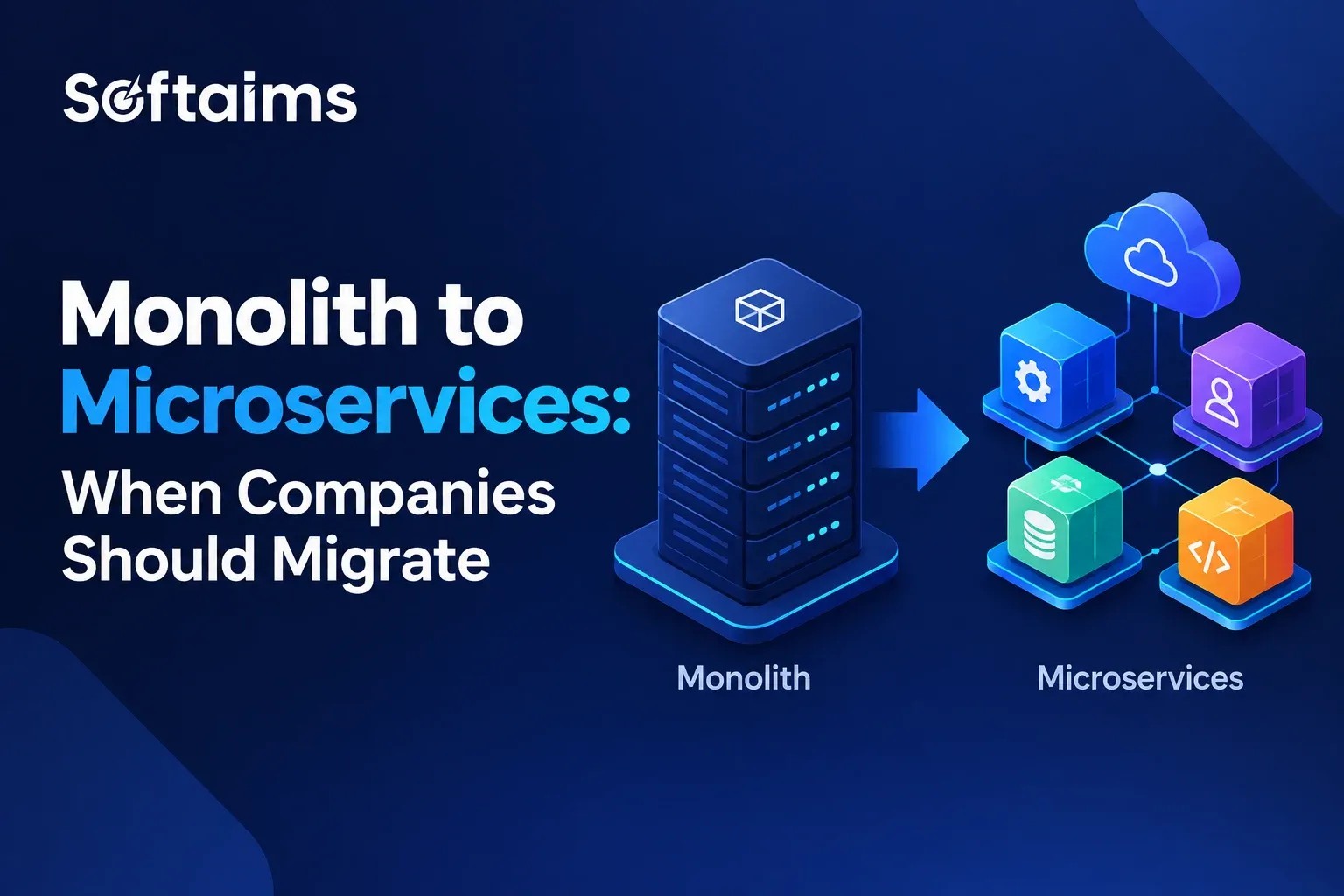
Table of contents
Key Takeaways
- Microservices are a trade-off. They bring flexibility, isolation, and independent scaling, but they also add complexity.
- Keep the monolith if it works. Small teams and many growing products do not need microservices.
- Start with a modular monolith. You can get many of the benefits without the extra operational cost.
- Migrate step by step. Move one service at a time, measure the results, and continue by domain.
- Build the foundation first. Strong CI/CD, monitoring, and observability should come before the migration.
- Bridge the engineering gap. SoftAims can help you hire vetted backend and DevOps engineers within 48 hours.
Slow releases, ballooning cloud bills, and outages that take down the whole app at once. These are the warning signs that a monolithic architecture has stopped helping your business and started holding it back. For most companies, the monolith to microservices question becomes urgent when a single codebase forces every team to deploy together. It also forces you to scale the entire application and absorb one another's failures.
Yet microservices are not a cure-all, and chasing them too early is its own expensive mistake. The real skill is knowing when to migrate, when to stay put, and how to move without breaking what works. The US software talent shortage makes that harder still, with the country short more than a million developers. So the stakes of getting the monolith to microservices decision right have never been higher.
In this guide, we covered when microservices make sense and when a monolith is still the better choice. We also covered migration options, costs, common mistakes, and how to choose the right partner.
The goal is to move to microservices without adding unnecessary complexity. If you need the right engineers for the job, you can hire vetted backend and DevOps engineers within 48 hours.
Monolith to Microservices Migration: Quick Overview
Before diving into technical planning, it helps to see the whole monolith to microservices migration at a glance. This overview gives decision-makers a realistic sense of scale, timeline, and cost. So you can weigh the effort before committing to a direction.
Aspect | Key details |
| Core objective | Decompose a monolith into independently deployable services |
| Best migration pattern | Strangler Fig, with gradual traffic shifting |
| Recommended first step | Build a modular monolith |
| Typical timeline | 2 to 4 months for a pilot; 12 to 24+ months for enterprise |
| Estimated US cost | $50K to $3M+, depending on scope and complexity |
| Key technologies | Docker, Kubernetes, API gateway, CI/CD |
| Main risk | Building a distributed monolith instead of true services |
Figures are planning estimates and should be refined during discovery. Every migration differs by scope, data, and infrastructure.
What Is Monolith to Microservices Migration
Monolith to microservices migration gradually splits one large application into smaller services. Each service then runs and deploys independently. A monolith keeps most of its functionality inside a single codebase. Microservices break that same functionality into focused, self-contained pieces.
The shift matters most for growing businesses. As a company scales, a monolith can force teams to coordinate every release. It also makes you scale the whole app for one busy feature, and share the blast radius of every failure. So decoupling those parts can speed releases and reduce risk.
One point deserves emphasis. A monolith to microservices strategy is not a full rebuild. In most cases, you extract selected functionality one piece at a time, while the rest keeps running as a monolith. This evolutionary approach limits disruption, tests each decision, and contains risk, much as strong DevOps implementation does for releases.
Monolith vs Microservices: When to Use Each
Here is the question most articles skip. Microservices are not automatically better than a monolith. They are a trade: you add operational complexity in exchange for independent deployment, fault isolation, and precise scaling. Industry research like the DORA reports shows both the upside and the operational cost. So the honest answer is that each architecture wins in different situations.
A monolith is often the right call in these cases:
- You are early-stage or pre-product-market fit. A monolith is faster to build, test, and ship with a small team.
- Your team is small and centralized. Fewer than roughly 15 to 20 engineers rarely need service boundaries.
- Your releases are simple and your scaling is even. If the whole app scales fine, splitting it adds cost for little gain.
- Your domain is still changing fast. Premature service boundaries harden decisions you are not ready to lock in.
Microservices start to earn their keep when:
- Teams block each other on deploys. Independent services let autonomous teams ship on their own schedule.
- One feature drives most of your scaling cost. You can scale just the checkout or search service, not the whole app.
- One failure keeps taking down everything. Service isolation contains faults instead of spreading them.
- You have many teams and clear domain ownership. Services map cleanly to teams and business capabilities.
So the decision is not architectural fashion. It is whether your current pain lives in delivery speed, scaling cost, reliability, or team coordination. If a monolith still serves those needs, stay. If it actively blocks them, migrate. The rest of this guide assumes the pain is real.
Monolith vs Microservices Architecture: Key Business Differences
This comparison looks at the business impact of moving from monolith to microservices, not just the theory. So you can weigh the trade-offs in terms your leadership will recognize.
Feature | Monolith | Microservices |
| Deployment | The whole app usually ships together | Services deploy independently |
| Scalability | Scaling often affects the whole app | Individual services scale separately |
| Team structure | Suits smaller, centralized teams | Suits autonomous teams with clear ownership |
| Tech stack | Usually one shared stack | Services can use different technologies |
| Time to market | Often faster for early products | Faster releases once teams mature |
| Fault isolation | One failure can hit a large area | Failures can be contained per service |
| Cost at scale | Simpler early, but scaling gets pricey | Higher overhead, but precise resource use |
The monolith becomes a constraint when teams cannot independently deploy, scale, and debug parts of the system. Microservices then justify their added complexity by cutting deployment dependencies, isolating failures, and scaling resources to real demand. Until that point, the monolith is usually the cheaper, simpler choice.
Signs Your Business Needs Migration
A monolith to microservices migration is worth considering when releases slow down or infrastructure costs climb. It also helps when changes get risky to make. These signals help leaders spot when technical constraints start hurting delivery. So watch for the four below.
Slow release cycles. When updates take weeks to ship, tight internal coupling is often the cause. Every change forces a full retest and redeploy of the whole app. So new features stall, and the pace that fast DevOps implementation should deliver disappears.
Rising infrastructure costs. A monolith scales as one block. If only checkout or search spikes, you still pay to scale everything. Therefore, cloud bills climb faster than usage, and cloud services spend gets hard to control.
Coordination overhead. As teams grow, a shared codebase gets crowded. Developers wait on each other, fight merge conflicts, and lose time to release coordination. Meanwhile, velocity drops.
System-wide failures. When a bug in one area takes down the whole product, architecture becomes a business risk. So fault isolation and recovery move up the priority list, a concern the top cloud security companies also stress.
Fault isolation is not automatic, though. Tightly coupled dependencies, shared resources, or cascading calls can still let one service failure spread. So isolation must be designed in, not assumed.
Monolith to Microservices Migration Strategies and Patterns
Different monolith to microservices tactics suit different systems, risks, and business needs. The right one depends on how interconnected your system is and how critical uptime is. It also depends on which functions split off cleanly. So match the pattern to the constraint, not the trend.
Strangler Fig pattern. This approach slowly replaces the monolith by extracting one function at a time into a separate service, while the existing app stays live. Traffic routes through an API gateway, enabling gradual migration without downtime. So it suits revenue-generating, customer-facing apps where outages cost money. The main risk is letting the transitional state drag on too long.
Branch by abstraction. This fits complex business logic buried inside the monolith that external routing cannot reach. You create an abstraction layer, build a new implementation behind it, and retire the old one. So it suits swapping internal models or libraries without a big-bang release. The risk is architectural mess during a long overlap.
Parallel run. Here you run the old and new systems side by side on the same inputs, then compare outputs before switching over. So it suits billing, accounting, and other accuracy-critical systems. The downside is higher short-term cost, since you run two systems at once.
Full rewrite vs incremental migration. A full rewrite promises a clean slate, but it concentrates all risk into one program with no production validation until late. Incremental migration gives more control: you ship, measure, and refine small changes before scaling up. So the incremental path wins in nearly every case. A full rewrite makes sense only in rare, exceptional circumstances.
How to Migrate from Monolith to Microservices: Step by Step
In a monolith to microservices migration, order matters, because early decisions shape later ones. Extracting services before laying the groundwork usually causes rework. The resulting risks get harder to fix once many services are live. So follow the sequence below.
Stage | Description | Outcome |
| Audit the monolith | Review the code, dependencies, data flows, and domains | A clear map of the system and its risks |
| Define service boundaries | Group functionality around business capabilities | Logical service borders and ownership |
| Build a modular monolith | Separate modules internally before extracting services | Lower-risk preparation for decomposition |
| Prepare infrastructure | Set up CI/CD, containers, monitoring, and recovery | Reliable delivery and operational visibility |
| Extract the first service | Choose a low-dependency function and migrate it | A tested process and practical lessons |
| Decompose iteratively | Repeat per bounded context, shrinking the monolith | Controlled migration with lower cumulative risk |
Step 1: Audit the monolith and map dependencies. Map how modules depend on each other, where data is shared, which integrations are mission-critical, and which changes cause defects elsewhere. So you learn what can safely be decoupled. In regulated US sectors, also map security controls, data retention, and compliance to specific functions before moving anything. The leading information security companies treat this mapping as step zero.
Step 2: Define service boundaries with domain-driven design. Domain-driven design splits the system by business capability, not technical layer. So payments, authentication, catalog, and orders each become a domain with its own logic, data, and owner. Draw the borders around business logic, not folder structure. Weak boundaries create services that still deploy and fail together.
Step 3: Build a modular monolith first. You can split a codebase into clear modules with defined responsibilities and APIs without extracting services yet. So hidden dependencies surface while you still run everything as one app. If developers still need constant access across modules, the system is not ready to split. Fix that inside the monolith first.
Step 4: Set up CI/CD, containers, and observability. Independent services multiply deployments, runtimes, logs, and failure points. So CI/CD, containerization, centralized logging, monitoring, alerting, and rollback must be in place before service counts grow. Containers like Docker and Kubernetes provide the runtime, but they do not replace process discipline. This is exactly where seasoned DevOps engineers earn their keep. Without cross-service tracing, debugging gets much harder as components multiply.
Step 5: Extract the first service. Pick a function with clear business value and manageable dependencies. So a highly interconnected module is a poor first choice. Before launch, define success in numbers: deployment time, failure rate, response time, recovery time, or team ownership. Test rollbacks, then fix any issues before repeating the process.
Step 6: Iterate context by context. Once the first service is stable, monitored, and owned, pick the next bounded context by the same criteria. So each iteration builds on the last and shrinks the monolith. Do not turn this into a race to add services. If further extraction does not improve release independence, scaling, fault tolerance, or ownership, leave that code in the monolith.
The Modular Monolith: The Step Most Migrations Skip
The smartest migrations pause at a modular monolith before splitting anything. A modular monolith keeps the app in one deployable package but organizes it into clean internal modules. So you get clearer ownership and boundaries without the operational cost of distributed services.
Often, a modular monolith is enough on its own. If one release cycle is easy to manage and infrastructure costs stay proportional, you may not need microservices. The same holds if teams rarely coordinate to change modules. In that case, adding services buys complexity with no real gain.
The decision comes down to team structure and scale. Smaller US teams often gain little from microservices when a modular monolith already delivers clear ownership and manageable releases. So migrate only where the current architecture creates real friction in delivery, scaling, reliability, or ownership. As long as the modular monolith meets your growth goals, you can delay decomposition with a clear conscience.
When to Stay a Monolith and When to Go Microservices
Since this is the heart of the decision, it is worth a simple framework. Run your situation through these questions before you commit either way. So the choice rests on evidence, not hype.
Stay a monolith (or modular monolith) if:
- Your team is small and ships without blocking each other.
- Your whole app scales fine on current infrastructure.
- Your releases are manageable and outages are rare.
- Your domain is still evolving quickly.
Move to microservices if:
- Multiple teams block each other on shared deploys.
- One or two features drive most of your scaling cost.
- Single failures repeatedly take down the whole system.
- You have clear domain ownership across many teams.
If you land in the middle, start with a modular monolith. So you capture most of the benefit at a fraction of the cost. You also keep the option to decompose later. The worst outcome is splitting a monolith you did not need to split, then paying for that complexity forever.
Monolith to Microservices Migration Cost for a US Business in 2026
Monolith to microservices budgets vary widely, because you fund architecture, engineering, DevOps, testing, and data work, not just service extraction. So treat the figures below as planning ranges, refined during discovery. US costs run higher than many expect, largely because of premium engineering rates.
Scope | What it covers | Timeline | Estimated US cost |
| Pilot extraction | First service, CI/CD, gateway, monitoring, rollback | 2 to 4 months | From $50K |
| Mid-scope migration | Several bounded contexts, infrastructure, integrations, data separation, testing | 6 to 12 months | $150K to $500K |
| Enterprise migration | Large-scale decomposition, multiple teams, complex data, security, compliance, platform engineering | 12 to 24+ months | $500K to $3M+ |
Talent is usually the largest and most variable line. Skilled US backend, DevOps, and cloud engineers command premium rates, since demand far outstrips supply. So a vetted marketplace can control that cost. It supplies only the exact skills and hours you need, when you need them.
Common Mistakes Businesses Make During Migration
Most monolith to microservices failures trace back to treating architecture, deployment, and readiness as separate problems. The four mistakes below show how that plays out, and how to avoid each without piling on technical debt. So learn them before you start.
Building a distributed monolith. The mistake is extracting services that still share one database, rely on synchronous calls, or need coordinated releases. So you get all the complexity of a network with none of the autonomy. The fix is to clarify ownership, separate data boundaries, and minimize interdependencies before decomposing.
Skipping the modular monolith. The mistake is extracting services before untangling the tightly coupled logic inside the monolith. So the old structural problems simply reappear in a harder-to-fix distributed form. The fix is to refactor internal modules and remove needless dependencies first.
Migrating without DevOps and observability. The mistake is extracting services before CI/CD, logging, monitoring, alerting, and tracing exist. So issues get harder to find and incidents take longer to resolve. The fix is to build deployment and operational visibility before scaling up services.
Extracting too many services too fast. The mistake is splitting many services before validating the process and the boundaries. So testing, coordination, and infrastructure overhead pile up quickly. The fix is to migrate in small batches, measure results, and correct boundaries as you go.
Real-World Monolith to Microservices Examples
Real migrations show that microservices can solve genuine architecture, traffic, and team problems, but they add operational cost too. So the best examples include both successful splits and deliberate consolidations. The table below compares four well-known cases.
Company | Problem | Solution | Result |
| Amazon | A monolithic platform slowed releases as the business scaled | Decomposed into independently deployable services with automated delivery | Faster, independent releases and precise scaling |
| Netflix | A monolith could not meet global streaming scale and reliability | Rebuilt around cloud-native microservices and heavy automation | Massive scale, strong resilience, and rapid deployment |
| Uber | A single codebase created coordination and scaling bottlenecks | Split into domain-owned services with clear boundaries | Faster team velocity and independent scaling |
| Segment | Many services and queues created heavy operational overhead | Consolidated processing back into fewer services | Lower complexity, proving fewer services can be better |
The lesson runs both ways. Amazon, Netflix, and Uber show microservices solving real scale and velocity problems. Segment shows that consolidating back to fewer services can be the smarter move when the overhead outweighs the benefit. So the right architecture is the one that fits your constraints, not the one with the best reputation.
The Migration Talent Gap (and How Softaims Helps)
Here is the barrier most US teams hit. A migration needs backend, DevOps, cloud, and platform engineers who have done it before. Those people are scarce and expensive. So even a well-planned migration stalls without the right hands. The same talent crunch shows up across cyber security companies and every other technical field.
This is where a marketplace changes the equation. With Softaims, you hire vetted backend and DevOps engineers in 48 hours, not months. You choose the exact skills, from domain-driven design to Kubernetes and CI/CD, and you own everything they build. So you can staff a migration precisely, then scale the team down once it stabilizes.
The ownership model matters as much as the speed. Everything your engineers build stays yours: the services, the pipelines, the infrastructure code. There is no lock-in and no black box. So you get an agency's speed with an in-house team's control. You can also fold in machine learning and generative AI specialists as your platform grows.
How to Choose a Monolith to Microservices Migration Partner
The right monolith to microservices partner understands both legacy architecture and the realities of distributed systems. The best candidates know complex codebases, domain-driven design, DevOps, and phased migration. Crucially, they also know when microservices are not the answer. So look for that honesty first.
Case studies matter only with real results: shorter deployment times, lower costs, higher resilience, and better scalability. So ask how a partner scoped services, handled data migration, managed dependencies, and avoided downtime. Claims of experience mean nothing without proof of delivery.
A strong partner runs a proper discovery exercise before proposing any plan or budget. The output should include a dependency map, proposed service boundaries, migration priorities, infrastructure gaps, technical risks, and cost estimates. Before you sign, ask these questions:
- Which part of our monolith would you extract first, and what evidence justifies that choice?
- How do you use domain-driven design to set service boundaries?
- What DevOps, observability, and rollback practices do you require before extraction?
- Can you show a migration where you improved specific business or engineering metrics?
For teams that want the whole build handled, Devaims fits well. As a managed delivery company and a Softaims brand, it can own the migration end to end. It works on a fixed timeline, backed by the Softaims vetted bench. Following an August 2026 acquisition, the two operate under one roof. So you can hire engineers, hand over a full migration, or blend both.
Frequently Asked Questions
When should a US company move from monolith to microservices?
Move when teams block each other on deploys or when one feature drives most of your scaling cost. Also move when single failures keep taking down the whole system. If none of these apply, a monolith or modular monolith is usually the better, cheaper choice.
How long does a monolith to microservices migration take?
A pilot extraction often takes 2 to 4 months. A full enterprise migration runs 12 to 24 months or more. Timelines depend on scope, data complexity, and team size.
How much does migration cost in the US?
A pilot often starts around $50K, and mid-scope migrations run $150K to $500K. Enterprise migrations reach $500K to $3M or more. Talent is usually the largest cost.
What is a modular monolith?
A modular monolith keeps the app in one deployable package but organizes it into clean internal modules. It delivers clearer ownership without the cost of distributed services, and is often enough on its own.
What is the biggest migration risk?
Building a distributed monolith, where services still share a database, rely on synchronous calls, or need coordinated releases. This adds complexity without delivering real autonomy.
How does Softaims help with migration?
Softaims lets you hire vetted backend, DevOps, and cloud engineers fast, then own the work. It closes the talent gap that stalls many migrations. So you can staff a migration precisely and scale down when it stabilizes.
Conclusion
A monolith is not a problem in itself. As long as it delivers stable releases, reasonable costs, and solid performance, it is doing its job. US companies should only reconsider it when scalability, release speed, coordination, or resilience become genuine obstacles.
So make the move for business reasons, not architectural fashion. Here is the short framework to work through before you commit.
- Name the pain. Is it delivery speed, scaling cost, reliability, or team coordination?
- Try modular first. A modular monolith often solves the pain at a fraction of the cost.
- Migrate incrementally. Extract one service, measure it, then repeat by bounded context.
- Build the foundation. Put CI/CD, containers, and observability in place before you split.
- Secure the talent. Line up the engineers who have done this before.
Get those five right, and a monolith to microservices migration becomes a controlled, business-driven upgrade rather than a risky rebuild. Skip them, and you risk trading a working monolith for an expensive distributed one.
If your real blocker is talent, and for most US teams it is, there is a faster path. Softaims matches you with vetted backend, DevOps, and cloud engineers within 48 hours, and you own everything they build. For a fully managed migration, its delivery brand can take the whole thing off your plate. To start, hire migration engineers or get in touch.


 Stackoverflow
Hendra N.

 Verified Expert in Engineering
My name is Hendra N. and I have over 17 years of experience in the tech industry. I specialize in the following technologies: Gatsby.js, Git, vue.js, React, node.js, etc.. I hold a degree in Bachelor of Computer Science (BCompSc), Associate's degree. Some of the notable projects I’ve worked on include: Paneco, Tpro, The Party Up, https://www.swimfitapp.com/, http://www.pricehub.com/, etc.. I am based in Bandung, Indonesia. I've successfully completed 12 projects while developing at Softaims.
My expertise lies in deeply understanding and optimizing solution performance. I have a proven ability to profile systems, analyze data access methods, and implement caching strategies that dramatically reduce latency and improve responsiveness under load. I turn slow systems into high-speed performers.
I focus on writing highly efficient, clean, and well-documented code that minimizes resource consumption without sacrificing functionality. This dedication to efficiency is how I contribute measurable value to Softaims’ clients by reducing infrastructure costs and improving user satisfaction.
I approach every project with a critical eye for potential bottlenecks, proactively designing systems that are efficient from the ground up. I am committed to delivering software that sets the standard for speed and reliability.

Leave a Comment
Need help building your team? Let's discuss your project requirements.
Get matched with top-tier developers within 24 hours and start your project with no pressure of long-term commitment.