Top 13 Custom CRM Development Companies Globally (2026)
Discover the top custom CRM development companies in 2026. Compare expertise, pricing, integrations, and services to choose the right CRM development partner for your business.
Technically reviewed by:
Steven W.|Oleksandr K.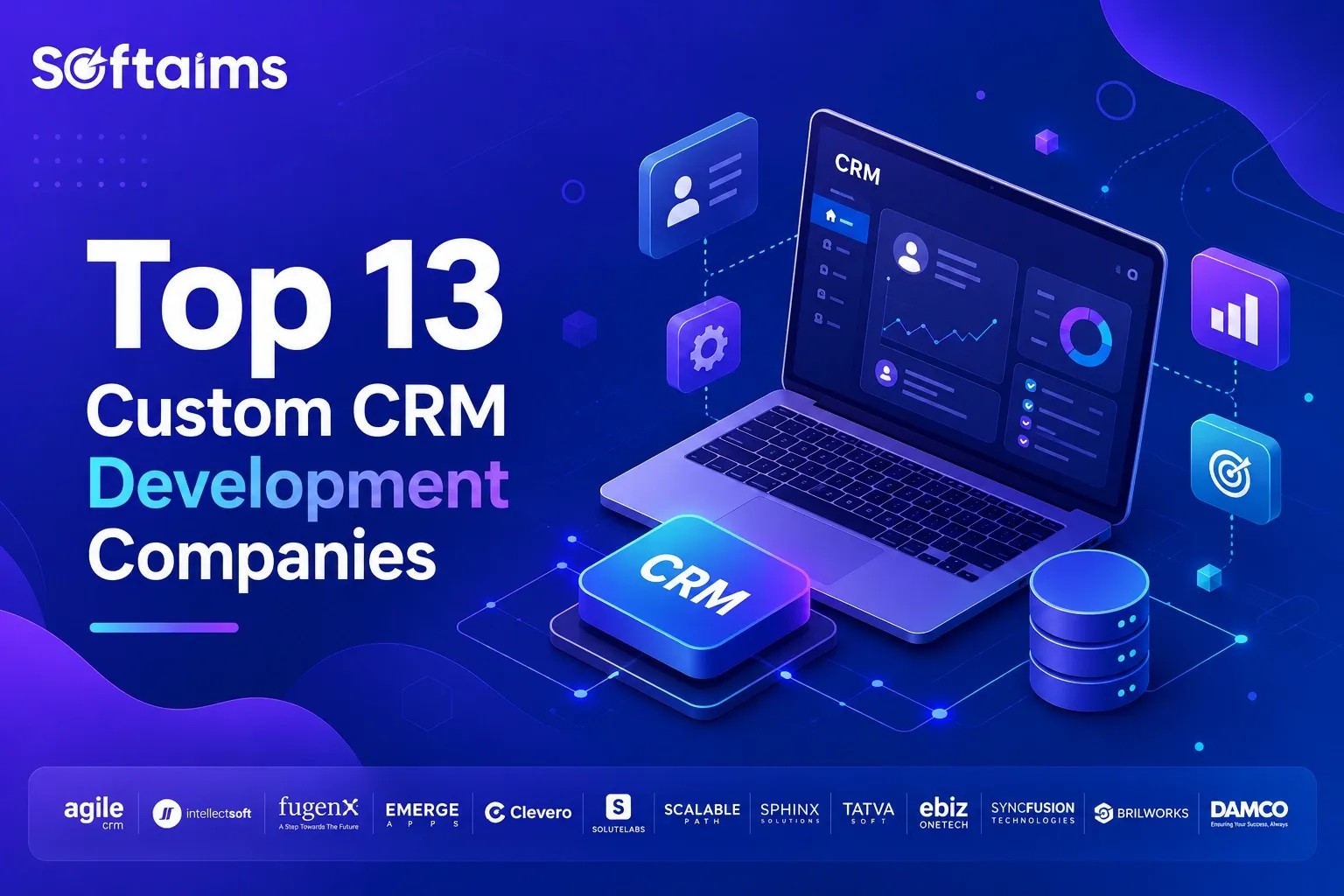
Table of contents
Key Takeaways
- Compare the top 13 custom CRM development companies for 2026.
- Learn when to choose a custom CRM instead of an off-the-shelf platform.
- Understand CRM development costs, timelines, and pricing models.
- Discover how integrations, security, and data migration impact project success.
- Learn the difference between custom-built CRMs and Salesforce or Dynamics customization.
- Use a practical checklist to choose the right CRM development partner.
- Avoid common mistakes that lead to failed CRM implementations.
When you're looking for a custom CRM development company, you're not just comparing vendors. You're trying to find a team that can build a system your salespeople actually use, connect it to the tools you already run, keep your customer data safe, and deliver it on time and on budget. The challenge is that there are so many options to choose from.
Off-the-shelf platforms like Salesforce, HubSpot, and Microsoft Dynamics work well for a standard sales process. But plenty of companies need something built around their own workflows, industry rules, and integrations, and that's where custom CRM development comes in. The market reflects it. The global CRM market is growing from about $73.4 billion in 2024 to a projected $163.16 billion by 2030, a compound annual growth rate of 14.6%, and custom CRM work is the fastest-growing part of it. With numbers like these, almost every firm claims CRM expertise, which makes it hard to know who's the right fit.
To make your search easier, this guide highlights 13 companies with a strong reputation for building custom CRM systems. For each one, you'll learn what they specialize in, who they're best for, and where they fall short, so you can pick the partner that matches your business.
Let’s get started!
The state of the custom CRM market in 2026
CRM has moved from a simple contact database to the system that runs sales, marketing, and customer service in one place. As companies push for more automation, tighter integrations, and better reporting, more of them are outgrowing generic tools.
There are two ways to go custom. The first is a fully bespoke build from the ground up, using tools like React or Vue on the front end and Node, Python, or .NET behind it, with a database such as PostgreSQL or MySQL. The second is taking a platform you already have, like Salesforce or Dynamics, and customizing it heavily with your own objects, automations, and integrations. Both approaches aim for the same result: a system that fits how you actually work.
The single most important thing to understand about this market is why CRM projects go wrong. According to Gartner, most CRM failures come from poor rollout, low team adoption, and unclear goals, not from bad software. That's why the best partners spend as much time on planning, integration, and training as they do on code. When you compare companies, weigh how they run a project at least as heavily as the features they list.
How we ranked the top custom CRM companies
Every company on this list was measured against the same practical criteria, the things that actually decide whether a CRM project succeeds.
CRM domain knowledge. We looked for teams that understand sales, marketing, and service workflows, not just general software development. A CRM specialist asks how your deals move and what your reps need at each stage, not just what fields you want.
Integration and data skill. A CRM is only useful when it connects to your ERP, marketing, and support tools and holds clean, well-structured data. This is the highest-value and riskiest part of any build, so we weighted proven integration experience heavily.
Track record and reviews. We favored firms with verifiable case studies, named clients, and consistent independent reviews on platforms like Clutch, G2, and GoodFirms over portfolios that are heavy on logos and light on detail.
Platform and technology depth. For platform work, that means certified Salesforce or Dynamics expertise. For bespoke builds, it means solid architecture, security, and a stack that scales.
Pricing clarity and support. Firms that explain their rates and offer a clear plan for maintenance and improvement after launch scored higher than those that hide pricing behind a long sales process.
Comparison of the top 13 custom CRM development companies
| # | Company | Best for | Approach |
| 1 | Softaims | Custom CRM + vetted talent | Custom build or deep customization |
| 2 | Devaims | One team, start to finish | End-to-end build + integration |
| 3 | Cynoteck | Salesforce & Dynamics | Platform customization + consulting |
| 4 | Ascendix | Salesforce & Dynamics, real estate/finance | CRM consulting + custom apps |
| 5 | ScienceSoft | Big or regulated companies | Consulting + custom development |
| 6 | Chetu | Tricky integrations | Custom CRM development |
| 7 | Simform | Cloud-based CRMs | Product engineering + upgrades |
| 8 | Fingent | Industry-specific needs | Tailored CRM development |
| 9 | Itransition | Enterprise cloud CRM | Consulting + delivery |
| 10 | CloudMasonry | Salesforce & Pardot | Salesforce consultancy |
| 11 | Radixweb | Large, complex systems | Enterprise CRM engineering |
| 12 | Grazitti Interactive | CRM + marketing together | CRM + marketing tech |
| 13 | Intellectsoft | Custom CRM apps | Consultancy + development |
The 13 custom CRM development companies
1. Softaims
Best for: Businesses that need a CRM built around their sales process instead of changing their process to fit off-the-shelf software.
Every business has a different sales process, and a generic CRM doesn't always fit. Softaims builds custom CRM solutions that match the way your team actually works. Instead of forcing you to adapt to predefined workflows, the team designs your CRM around your sales pipeline, custom fields, automations, reporting, and integrations with the tools you already use. Whether you need a completely custom CRM or want to customize an existing platform, Softaims assembles a dedicated team with the right technical expertise for your project.
A custom CRM also gives you more control over long-term costs. Unlike many CRM platforms that charge per user, you own the software, source code, and customer data from day one. As your business grows, you don't have to worry about rising license fees or being locked into a single vendor. Pricing is transparent and based on your project requirements, technology stack, and the experience of the developers working on your CRM.
Key advantages:
- CRM built around your sales process and business workflows.
- Custom automations, reporting, and third-party integrations.
- Full ownership of the source code, data, and intellectual property.
- Dedicated team selected based on your project's technology and requirements.
- Transparent pricing with no per-user licensing fees.
Limitation: Softaims is the best choice for businesses that need a custom CRM or extensive customization. If you only need basic contact management and standard CRM features, an off-the-shelf CRM platform may be a more affordable option.
2. Devaims
Best for: Companies that want one team to build the model and the product around it, then keep both running.
A model on its own isn't a solution. It has to live inside an app, connect to your data, and keep working after launch. Devaims handles that whole picture: the data pipeline, the model, the application that uses it, and the setup that keeps it accurate over time. If you want an AI feature shipped as a real, working product rather than a proof of concept that stalls, having one team own the model and the software around it is the real benefit.
The catch: They're a product-focused team, so they're a better fit for AI built into an application than for pure, research-heavy model work with no product attached.
3. Cynoteck
Best for: Getting most of what you need by customizing Salesforce or Dynamics 365.
Cynoteck is a certified Salesforce and Microsoft partner with more than 250 certified people, and they were named a Clutch Global Leader for 2026. They build custom objects, workflows, and automations on top of platforms you already have. A solid choice when you want to extend a platform rather than start over.
The catch: They're best at customizing platforms. If your process truly can't live on Salesforce or Dynamics, a from-scratch builder fits better.
4. Ascendix Technologies
Best for: Salesforce or Dynamics work with deep industry knowledge, especially real estate, capital markets, and finance.
Based in Dallas and a Salesforce and Dynamics partner since 1996, Ascendix has set up CRMs for more than 300 companies and even sells its own Salesforce-based products. Because they build products and provide services, their customization work tends to be practical and well thought out.
The catch: They aren't the cheapest, and their deepest experience sits in a few industries, so check that they know yours.
5. ScienceSoft
Best for: Large or regulated companies where security and compliance can't be an afterthought.
Around since 1989, ScienceSoft builds custom CRMs for healthcare, banking, and manufacturing, extends Salesforce and Dynamics, and builds security and compliance in from the start, backed by ISO certifications.
The catch: They do a lot of things, so make sure you're assigned their CRM and regulated-industry specialists, not a general team.
6. Chetu
Best for: CRMs that need to connect to unusual or older systems.
Chetu is a US-based custom software firm that builds tailored CRMs for many industries, and they're known for connecting CRMs to niche and legacy systems other shops avoid.
The catch: Their strength is range and integrations. If you want polished, consumer-grade design, a more design-focused studio may suit you better.
7. Simform
Best for: Cloud-based CRMs and modernizing an aging system.
Simform mixes cloud engineering with CRM work, turning outdated systems into scalable ones with plenty of automation, for everyone from startups to Fortune 500 companies.
The catch: They're strongest on cloud-based product work, so check their depth if your build is tied to one specific platform.
8. Fingent
Best for: Industry-specific CRMs built around unusual workflows.
Fingent builds CRMs shaped to each company's workflow, with all the customer data, automation, and reporting in one place, across healthcare, finance, logistics, and real estate.
The catch: They deliver from several regions, which is handy, but agree on how and when you'll communicate up front.
9. Itransition
Best for: Enterprise cloud CRM as part of a bigger technology overhaul.
Itransition is a global firm that handles CRM strategy, Salesforce and Dynamics work, and fully custom platforms, with a lot of experience connecting CRMs to the rest of your systems.
The catch: They're built for larger companies, so a small business build might get more attention from a smaller specialist.
10. CloudMasonry
Best for: Complex Salesforce and Pardot builds and integrations.
CloudMasonry is a US Salesforce firm focused on tricky Salesforce and Pardot setups and integrations for mid-size and large companies, with a strong record of keeping clients long-term.
The catch: They're Salesforce specialists. Outside that world, you'll want a different partner.
11. Radixweb
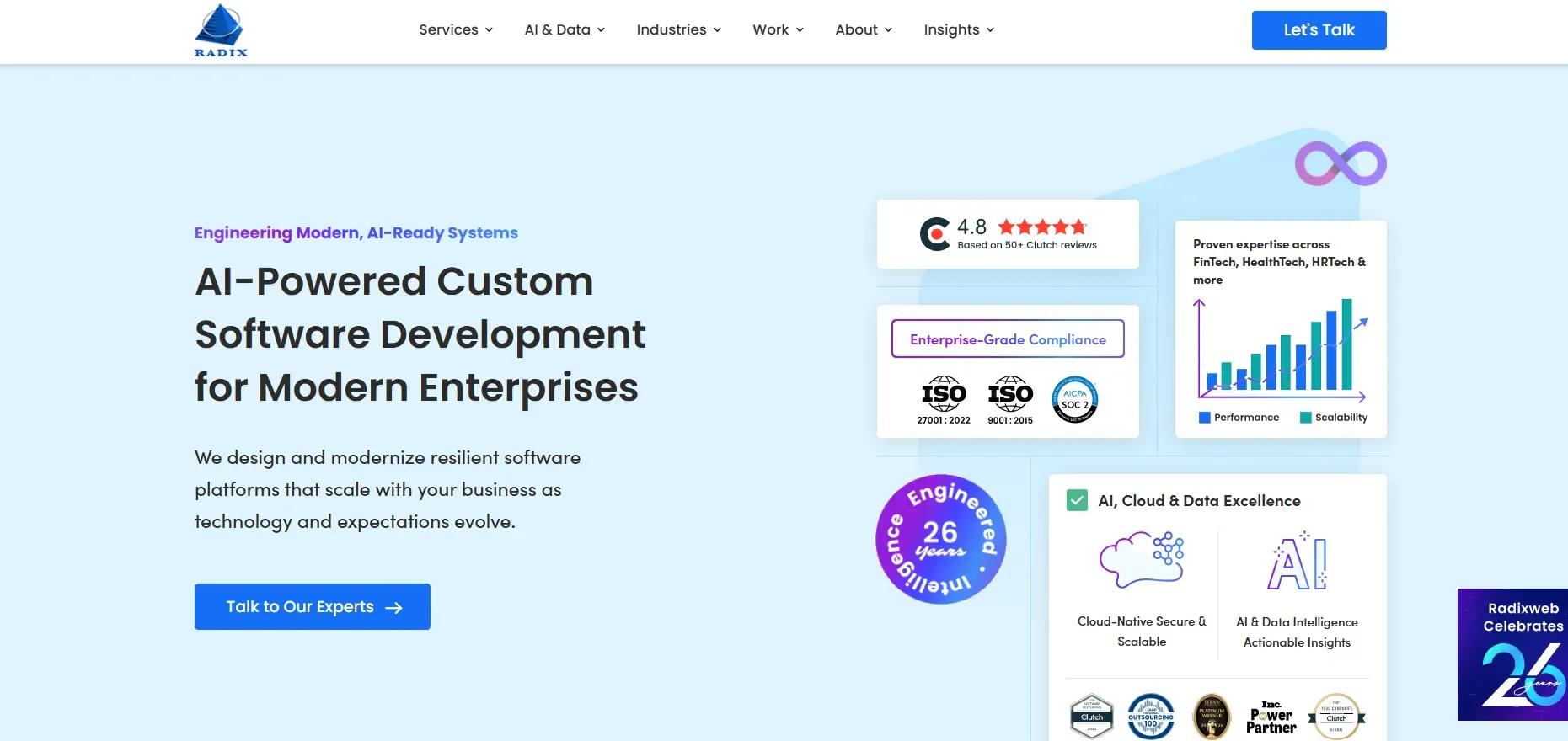
Best for: Large, complex CRM systems.
With 25 years in business and a team of more than 700, Radixweb builds enterprise CRMs, SaaS products, and complex integrations, and it consistently ranks near the top of independent agency lists for scale and delivery.
The catch: They're set up for big, complex projects, so a small first version may be more firepower than you need.
12. Grazitti Interactive
Best for: CRM and marketing working as one system.
Grazitti pairs custom CRM work with strong marketing-technology and AI skills, linking your CRM to marketing tools, analytics, and community platforms. A great fit when you care about the whole revenue engine, not just sales.
The catch: Their edge is the CRM-plus-marketing combination. A plain back-office CRM may not need that.
13. Intellectsoft
Best for: Custom CRM apps as part of a broader digital overhaul.
Intellectsoft builds custom CRM apps and pairs them with consulting and design, with a focus on newer technology alongside the usual development work.
The catch: They cover a lot of ground, so confirm you're getting CRM specialists for your project.
Why choosing a custom CRM company is hard in 2026
The CRM market has the same problem as the wider software market: there are far more firms than there are truly great ones. Hundreds of companies claim CRM expertise, and their websites look nearly identical.
That creates three headaches for buyers. It's hard to tell real depth from good marketing. It's hard to know whether a firm can handle your integrations, which is where most projects stall. And a wrong choice is expensive, because a failed CRM costs you the build, the wasted months, and the productivity you lose when your team quietly goes back to spreadsheets. This is exactly why a clear shortlist, and a close look at how each firm plans and integrates, beats browsing an open directory.
Which custom CRM company is best for you?
It really depends on what you're building.
If your sales process is unusual or you want to own your data and code outright, Softaims is a great fit. You get a vetted team built around your exact stack, transparent pricing, and no per-user lock-in.
If you want one team to build, connect, and migrate everything from start to finish, Devaims is a solid choice.
If you'd rather customize a platform you already have, Cynoteck, Ascendix, or CloudMasonry know Salesforce and Dynamics inside out.
If you're a large or regulated company, ScienceSoft, Itransition, or Radixweb have the depth and governance experience for it.
If your challenge is tricky integrations with older systems, Chetu is worth a look. And if your CRM and marketing really work as one motion, Grazitti Interactive is built for that.
How custom CRM development works
Good companies mostly follow the same steps, and knowing them helps you hold a vendor to a real plan.
Discovery and planning. They map how customers move through your pipeline, what each team needs at every stage, and where the gaps are. This is where scope, risks, and goals get set.
Design and building. They design the workflows, screens, data setup, and reports around your sales, marketing, and service, then build it, either as custom code or on top of a platform.
Connecting your tools. They link the CRM to your ERP, email, calendar, marketing, support, and phone systems, so it becomes the one place your data lives instead of another island.
Moving your data. They clean up your data, remove duplicates, and move it over from spreadsheets or your old CRM, with security and access rules handled from the start.
Training your team. They get your people using it, because a CRM nobody uses is a failed CRM, no matter how well it's built.
Support and improvements. They keep it running, fix issues, and add to it as your business changes.
What does it cost to build a custom CRM
The cost of a custom CRM depends mostly on the approach, the number of integrations, and how much of your data needs cleaning and moving. As a rough guide, customizing a platform like Salesforce or HubSpot usually runs about $30,000 to $100,000. A low-code custom CRM lands around $50,000 to $150,000. A fully custom build from scratch typically starts near $150,000 and can pass $500,000 for large systems with heavy integrations. On top of the build, plan for roughly 15 to 20% of the cost each year for maintenance and improvements.
What matters most is the total cost over time, not the sticker price. For a large team, a system you own can beat years of per-user subscription fees, while for a small team a ready-made CRM is usually cheaper. The things most likely to push the price up are deep integrations with your ERP or legacy tools, industry compliance like HIPAA or SOC 2, and moving large amounts of messy data. As with most software, the lowest quote often turns out to be the most expensive option once you factor in quality, adoption, and long-term support.
Demand keeps climbing, too. Grand View Research expects the CRM market to reach $163.16 billion by 2030, with cloud-based systems making up the majority of it. If you want to size your own project before you talk to vendors, see our pricing overview, and you can always book a free consultation to get a detailed estimate. You can also check our detailed guides on How Much Does It Cost to Hire a Developer in 2026 and Developer Hourly Rates by Country in 2026.
How do you choose the right custom CRM partner
Beyond price and team size, a few things consistently separate a smooth project from a painful one.
Start with your goals. Be clear on what success looks like, whether that's a shorter sales cycle, cleaner reporting, or fewer manual tasks, before you talk to vendors. A partner who understands your goal will build around your outcomes instead of a default template.
Check real integration experience. Ask how they've connected CRMs to ERPs, marketing tools, and support systems before, and how they'd handle yours. Vague answers here are a warning sign, because this is where projects most often break.
Look at adoption, not just features. A CRM only pays off if people use it, so ask how they design for ease of use and how they train your team. The best-built system fails if your reps avoid it.
Confirm security and ownership. For sensitive data, ask about access controls, encryption, and standards like GDPR, HIPAA, or SOC 2. And make sure you own the code, the data, and any accounts, with clear IP terms in the contract, so you're never locked to one vendor.
Platform customization or a build from scratch
One of the first big decisions is whether to customize a platform or build something new. Customizing Salesforce or Dynamics is faster, lower-risk, and covers most needs, so it's the right call for a lot of companies. You keep the platform's tooling and ecosystem and add your own workflows on top.
Building from scratch makes sense when your process is genuinely unique, when the platform's per-user pricing stops making sense at your size, or when you want to fully own the system with no vendor lock-in. Many companies land in the middle: they customize a platform for most of the work and build custom pieces only where they truly need them. A good partner will tell you which path fits your situation instead of pushing whichever one they prefer to sell.
Conclusion
There are more CRM companies out there than ever, and that's both an opportunity and a trap. Any firm on this list can do great work on the right project. The trick is matching the approach, customizing a platform or building from scratch, to how you actually sell, and caring more about integrations and team adoption than a long list of features.
If you want a CRM built around your process and fully owned by you, made by a team matched to your exact tools, Softaims is the strongest place to start. Book a free consultation and get matched with vetted developers within 48 hours.
Frequently Asked Questions
Why build a custom CRM instead of buying one?
When your sales process is unusual, you need deep connections to your own systems, per-user pricing is getting too expensive, or you want to fully own your data. Otherwise, a ready-made CRM is faster and cheaper to get going.
How much does a custom CRM cost in 2026?
Roughly $30,000 to $100,000 to customize a platform, $50,000 to $150,000 for a low-code custom CRM, and $150,000 or more for a fully custom build, plus about 15 to 20% of the build cost each year for upkeep.
How long does it take?
Customizing a platform usually takes two to four months. A low-code custom CRM takes three to five. A full build takes six to twelve. Complex integrations can add one to three months, so it's smart to launch the core first and add the rest later.
Can a custom CRM connect to my ERP?
Yes, through APIs, middleware, or direct connections, with two-way syncing for customers, orders, inventory, and invoices across systems like SAP, Oracle, NetSuite, and Dynamics. This is usually the most valuable and riskiest part of the job.
Should I build on Salesforce or from scratch?
Customizing Salesforce or Dynamics covers most needs faster and with less risk. Build from scratch only when the platform truly can't handle your process, or the per-user costs stop making sense at your size.
Why do so many CRM projects fail?
Gartner has found that most CRM failures come from a rushed rollout, low team buy-in, and unclear goals, not bad software. That's why a company's planning, integration skill, and training matter more than any feature list.
How do I move off spreadsheets or an old CRM?
Clean up the data first, remove duplicates, set up your data structure, move it with the right tools, then check it. Plan on a couple of weeks to prep the data and one to two weeks to move it.
What's the payoff of a custom CRM?
Teams usually aim for a 150 to 300% return over three years, from faster selling, less manual data entry, fewer subscription costs at scale, and workflows competitors can't copy. Measure your deal time, data accuracy, and sales cycle before and after.


 GitHub
Steven W.

 Verified Expert in Engineering
My name is Steven W. and I have over 10 years of experience in the tech industry. I specialize in the following technologies: TypeScript, Next.js, React, Supabase, SaaS Development, etc.. I hold a degree in Bachelor of Arts (BA), . Some of the notable projects I’ve worked on include: ESG Data Tracking and Compliance B2B SaaS Web Application, University International Student Placements Marketplace (B2B SaaS), ScyllaDB, Rico, imaginetees.ai, etc.. I am based in Kuala Lumpur, Malaysia. I've successfully completed 12 projects while developing at Softaims.
I am a dedicated innovator who constantly explores and integrates emerging technologies to give projects a competitive edge. I possess a forward-thinking mindset, always evaluating new tools and methodologies to optimize development workflows and enhance application capabilities. Staying ahead of the curve is my default setting.
At Softaims, I apply this innovative spirit to solve legacy system challenges and build greenfield solutions that define new industry standards. My commitment is to deliver cutting-edge solutions that are both reliable and groundbreaking.
My professional drive is fueled by a desire to automate, optimize, and create highly efficient processes. I thrive in dynamic environments where my ability to quickly master and deploy new skills directly impacts project delivery and client satisfaction.

Leave a Comment
Need help building your team? Let's discuss your project requirements.
Get matched with top-tier developers within 24 hours and start your project with no pressure of long-term commitment.