Top 10 IoT App Development Companies in the World (2027)
Find the top 10 IoT app development companies in the world for 2027 to connect devices, cloud backends, and companion apps into reliable end-to-end products.
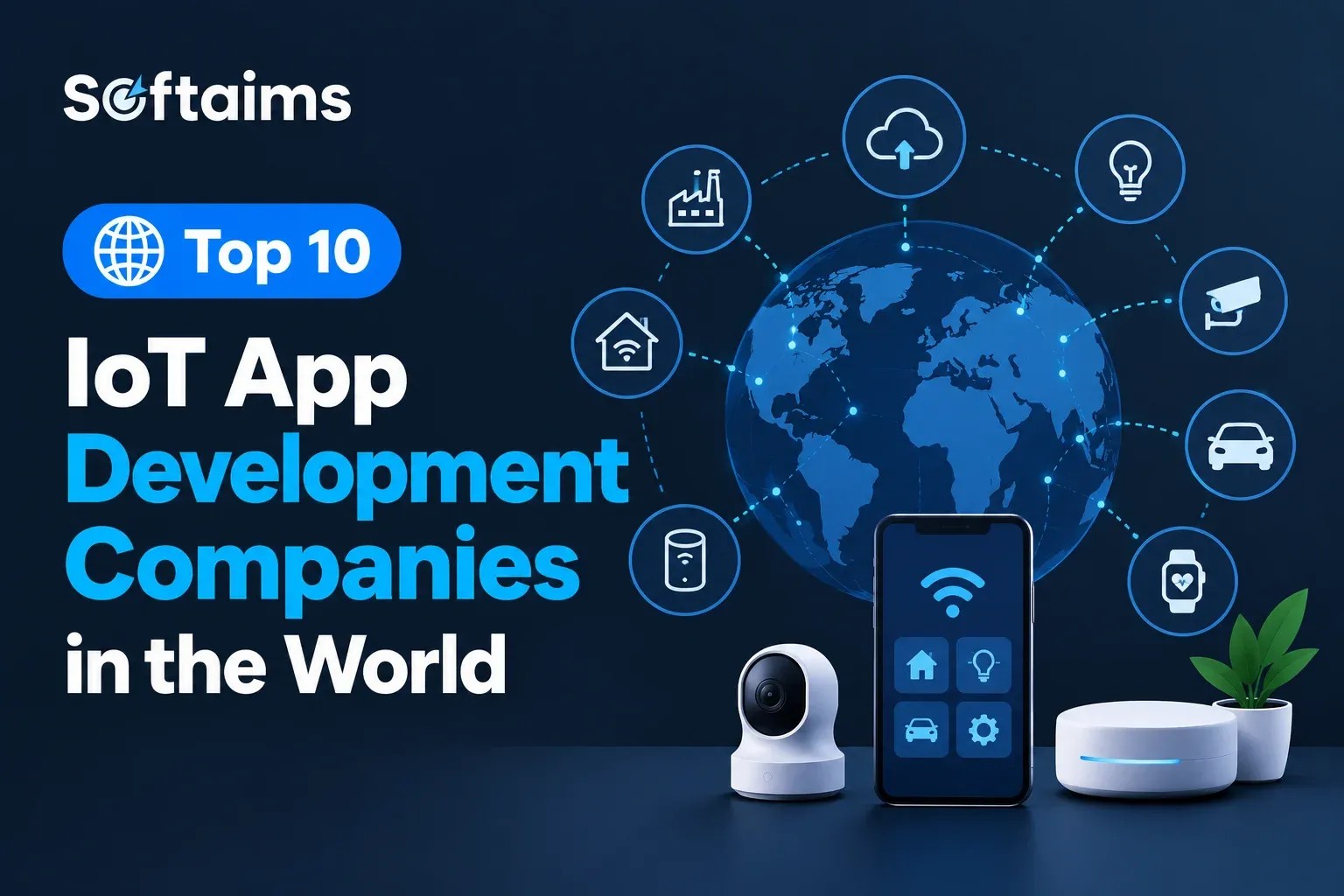
Table of contents
Key Takeaways
- Successful IoT app development requires unifying three distinct layers; device firmware, cloud infrastructure (AWS/Azure IoT), and mobile/web interfaces into a cohesive system that gracefully handles offline states and real-time data streaming.
- Product teams can choose between traditional full-service agencies for turnkey hardware-software builds or flexible talent platforms (like Softaims) to quickly assemble specialized IoT, AWS IoT Core, and mobile engineers on demand.
- Project investments scale with complexity and location; ranging from simple companion apps ($30k–$70k) to complex enterprise or industrial IoT platforms ($150k–$400k+), with developer rates varying from $30/hr offshore to $150/hr onshore.
- Modern IoT architecture is shifting toward Edge AI for faster local processing and lower latency, while unified connectivity standards (like Matter) and 5G simplify multi-brand pairing and fleet-scale management.
- While offshore teams offer maximum budget efficiency, nearshore engineering is rapidly growing for IoT projects due to real-time collaboration needs during complex hardware-firmware-app debugging.
- Evaluate partners on concrete capabilities such as hardware-level security, OTA (over-the-air) firmware updating, end-to-end encryption, and proven fleet scaling; rather than slick UI designs alone.
A smart lock that won't pair, a fitness band that loses its data, a factory sensor that reports a fault ten minutes late: connected products live or die on the app behind them. Building that app is harder than a normal one, though, because it has to talk to hardware, ride shaky connections, and handle a flood of real-time data. So most teams bring in a specialist. The right IoT app development companies pull device, cloud, and mobile together into one connected product that just works.
The scale is enormous. There are already more than 21 billion connected IoT devices worldwide, and the market topped $1 trillion in 2026, on its way past $5 trillion by 2034. So demand for people who can build reliable connected apps keeps climbing.
This guide ranks the top 10 IoT app development companies in the world for 2026, each with a note on who it suits. Below the list, we cover how IoT apps work, the tech stack, costs, challenges, and how to choose. One read should give you a shortlist.
What Is IoT App Development
IoT app development companies build the software that runs connected devices. In practice, that means the app, the cloud, and often the firmware, all working as one. That software spans the app users tap, the cloud that stores the data, and often the firmware on the device itself. All three layers have to work as one.
It differs from standard app work, though. A regular app talks to a stable server, while an IoT app talks to hardware that drops offline, drains battery, and streams data in real time. So the build demands connectivity know-how, not just a slick interface.
The payoff is a product people trust. When pairing is smooth and data syncs cleanly, users forget the tech is there. So strong IoT app development turns a clever gadget into a dependable product.
How IoT Apps Work
An IoT app runs across several layers that pass data up and down, and IoT app development companies build each one. Knowing them helps you scope a build. Here's the usual flow.
A device with sensors collects data, then sends it over a network. Connectivity like Bluetooth, Wi-Fi, or cellular carries that data to the cloud. The cloud stores, processes, and analyses it. Finally, a mobile or web app shows the result and lets users act, from adjusting a thermostat to acking a machine alert.
Each layer has to hold up, however. A polished app still fails if the device reports state late or sync breaks. So the best builds treat hardware, cloud, and app as one system, not three separate jobs.
Types of IoT Apps
IoT app development companies build for many sectors, each with its own demands. Knowing the category sharpens your brief. The table shows the common ones.
Category | Examples | Focus |
| Smart home | Thermostats, locks, lighting | Consumer control apps |
| Wearables | Fitness bands, smartwatches | Health and activity tracking |
| Industrial IoT | Predictive maintenance, sensors | Uptime and efficiency |
| Healthcare IoT | Remote monitoring, devices | Patient data and safety |
| Connected vehicles | Telematics, ADAS | Fleet and driver data |
| Smart city | Traffic, utilities, waste | Public infrastructure |
Healthcare leads the pack by market share, with smart home and wearables close behind. So match your partner to your sector, since a consumer app and an industrial platform need different skills.
The IoT App Tech Stack
An IoT build touches several distinct technologies, and IoT app development companies cover, or coordinate, all of them. Here's the typical stack.
Layer | Common Tech | Role |
| Device and firmware | C, C++, RTOS, embedded Linux | Runs the hardware |
| Connectivity | BLE, Wi-Fi, Zigbee, cellular, Matter | Links device to network |
| Cloud and backend | AWS IoT, Azure IoT Hub, Google Cloud IoT | Ingests and processes data |
| Mobile and web app | React Native, Flutter, Swift, Kotlin | User control and dashboards |
| Data and AI | Edge analytics, machine learning | Turns data into insight |
No single stack fits every project, though. A hardware-heavy product leans on firmware skill, while a data platform leans on cloud and analytics. So check that a partner's strength matches your biggest risk.
Benefits of Outsourcing IoT App Development
IoT app development companies deliver value in a few clear ways. Each ties back to skill, speed, or cost.
- Full-stack skill. You reach firmware, cloud, and app talent in one place.
- Faster delivery. A ready team ships a working build far quicker than hiring from scratch.
- Fewer handoffs. One partner across the stack means fewer gaps between chip and app.
- Lower cost. Offshore and nearshore rates run well below a full in-house team.
- Proven patterns. Experienced firms reuse security, provisioning, and scaling patterns.
The gains are real, too. A specialist avoids the classic traps, from unstable pairing to fleets that can't scale past a pilot.
What to Look For in an IoT App Development Partner
IoT app development companies vary widely in what they cover, however. The strongest share a few traits. Keep this checklist close when you compare firms.
- Hardware-aware app skill. They understand how firmware choices shape the app.
- Connectivity depth. BLE, Wi-Fi, and cellular experience should be proven, not claimed.
- Cloud and scale. Look for AWS IoT, Azure IoT, or similar, built to scale past a pilot.
- Security by design. Device provisioning, encryption, and updates should be baked in.
- Real case studies. Ask for shipped connected products, not just mobile apps.
A partner strong on these points saves you costly rework. So weigh them before you sign.
The IoT App Development Process
Most connected builds move through the same stages. Knowing them helps you plan time and budget. Here's the usual path IoT app development companies follow.
- Discovery. The team maps the device, data, users, and goals.
- Proof of concept. A small build proves the connected idea works.
- Architecture. Architects pick the stack, from firmware to cloud to app.
- Development. Engineers build the device software, backend, and app together.
- Testing. The team checks pairing, sync, security, and scale.
- Deployment and support. The product ships, with provisioning and updates.
Each stage rests on the last. So a solid proof of concept early prevents costly surprises later.
In-House vs Outsourced IoT App Development
Build the team yourself, or bring in a partner? Both work, and scope decides. Each has trade-offs.
An in-house team gives full control and deep product knowledge. It suits firms with a long connected roadmap and money to hire. The catch is time and cost, though, since firmware, cloud, and app skills are scarce and pricey.
Outsourcing suits most connected products, especially first builds. IoT app development companies bring firmware, cloud, and app talent from day one. You trade a little control, however. So many teams outsource the first build, then hire around it once the product proves out.
How We Selected These Companies
This ranking isn't guesswork. Each of these IoT app development companies had to clear a bar, which keeps the list useful rather than salesy. It reflects our judgment, however, so treat it as a starting point.
The criteria we weighed:
- Real IoT delivery. Every firm has shipped genuine connected products, not just apps.
- Stack coverage. Firmware, connectivity, cloud, and app skill all counted.
- Domain fit. Experience across consumer, industrial, and healthcare IoT mattered.
- Security and scale. Provisioning, security, and fleet-scale delivery added weight.
- Track record. Client history, case studies, and years in the field factored in.
No firm tops every line, though. So each entry ends with a "Best for" tag to steer you.
At a Glance: The Top IoT App Development Companies Compared
Short on time? This side-by-side view captures all ten at once. It lines up each firm against its base, its core strength, and the job it suits best, so you can weigh them without scrolling. Shortlist two or three that fit, then read their full profiles below for the detail.
# | Company | Base | Core Strength | Best For |
| 1 | Softaims | Global / offshore talent | Vetted IoT and mobile engineers | Building a flexible IoT app team |
| 2 | Devaims | Softaims-owned | Mobile and companion apps | IoT mobile app builds |
| 3 | Softeq | Houston, US | Full-stack, hardware-aware | Embedded-heavy connected products |
| 4 | Intellias | Lviv, Ukraine | Automotive and industrial IoT | Complex embedded plus cloud |
| 5 | HQSoftware | Tallinn, Estonia | Full-cycle IoT and edge | Scalable IoT platforms |
| 6 | Intellectsoft | US / global | Enterprise IoT R&D | Digital twins and asset tracking |
| 7 | Softweb Solutions | Chicago, US | IoT plus AI | Data-driven IoT dashboards |
| 8 | Digiteum | UK / global | IoT data platforms | Connected data and web apps |
| 9 | MobiDev | US / global | IoT mobile development | Consumer connected apps |
| 10 | Cubix | New York, US | Cross-platform IoT apps | Startups and consumer IoT |
The Top 10 IoT App Development Companies in the World
With the basics covered, here are the picks. The ten IoT app development companies below run from full-stack hardware specialists and enterprise engineering firms to a flexible talent platform. Each earned its place on genuine delivery, stack depth, and real domain fit, however. The "Best for" line under each entry points you to the closest match.
1. Softaims
Softaims leads our list with a model that fits fast-moving connected projects. Rather than a fixed agency contract, you get matched with the top 3% of vetted engineers inside 48 hours. So you can build or extend your own IoT app team quickly, and for a fraction of a local hire's cost.
That flexibility suits IoT work well. Bring on mobile app developers for the companion app, plus back-end engineers and cloud specialists for the data layer. Add AI engineers and machine learning specialists to turn device data into insight. For the connected backbone, you can also hire AWS IoT Core engineers and AWS IoT Device Management specialists to run device connectivity and fleets at scale. Every engineer is vetted for real skill, not a glossy CV.
The engagement bends to your needs. Add one specialist or a full pod, and they work your hours and process. So they run like your own team, without a multi-year lock-in. You can browse available talent or see transparent rates before committing. The same vetted model powers wider hiring, too, such as our guide to the top platforms to hire web app developers in the USA.
Key highlights:
- Top 3% vetted engineers, matched within 48 hours
- Mobile, back-end, cloud, and AI talent for IoT apps
- Flexible staff augmentation and dedicated teams
- Your hours, your process, no heavy minimums
Best for: Teams that want to build a flexible IoT app team fast, without a rigid agency contract.
2. Devaims
Devaims is a development studio known for mobile and custom software. For IoT, that means the companion apps that control devices, show data, and keep firmware and app in sync. So it fits firms that want a polished app layer for a connected product.
The August 2026 acquisition by Softaims joined the two. Devaims clients now reach the same vetted network and 48-hour matching. One partner can carry mobile app development and broader software development, from concept to launch.
Key highlights:
- Mobile and companion app expertise
- Clean device-to-app data sync
- Backed by Softaims' vetted talent since 2026
- Web, mobile, and back-end under one roof
Best for: Teams that want a strong mobile app layer for a connected product.
3. Softeq
Softeq, based in Houston, is one of the most hardware-forward firms on this list. Founded in the late 1990s, it can take a connected product from board-level design and firmware through mobile apps and cloud. So it treats hardware and software as one scope, not three vendors.
The firm covers embedded and RTOS work, custom Android, and connectivity over BLE, Wi-Fi, and NFC. It builds cloud IoT on AWS, Azure, or Google Cloud, with dashboards on top. Softeq shines when the app depends heavily on the device side. So it fits embedded-heavy products, from wearables to industrial IoT.
Key highlights:
- Full-stack, hardware to cloud
- Embedded, firmware, and connectivity
- Cloud IoT with dashboards
- Consumer, industrial, and healthcare IoT
Best for: Firms building embedded-heavy connected products end to end.
4. Intellias
Intellias, headquartered in Lviv, Ukraine, is a large engineering partner with deep automotive and industrial roots. With thousands of engineers, it handles complex embedded stacks, functional safety, and scalable cloud pipelines. So it suits demanding, regulated IoT programs.
The firm's automotive and location heritage shows in its systems engineering. It works well under compliance regimes like ISO and ASPICE. Intellias suits fleet telematics, connected mobility, and plant-floor integration. So it fits enterprises with sophisticated embedded plus cloud needs.
Key highlights:
- Automotive and industrial IoT depth
- Complex embedded and cloud pipelines
- Functional safety and compliance
- Large global engineering team
Best for: Enterprises building complex embedded plus cloud IoT under compliance.
5. HQSoftware
HQSoftware, based in Tallinn, Estonia, delivers full-cycle IoT development across many sectors. Its services span embedded systems, IoT app design, edge computing, and cloud data integration. So it covers the path from device to scalable backend.
The firm blends IoT engineering with AI and analytics dashboards. It works across manufacturing, healthcare, automotive, and finance. HQSoftware suits businesses that want a scalable IoT platform with real analytics. So it fits firms needing device-to-cloud delivery with insight on top.
Key highlights:
- Full-cycle IoT development
- Embedded, edge, and cloud
- IoT plus AI and analytics
- Flexible engagement models
Best for: Businesses needing scalable IoT platforms with strong analytics.
6. Intellectsoft
Intellectsoft is a custom software and AI firm that runs IoT as a dedicated R&D practice. Its offering leans enterprise: IoT integration, device management, security, and turning data into analytics. So it suits large, operations-focused deployments.
The firm is strong in digital twins, asset tracking, and operations optimisation. It serves manufacturing, healthcare, construction, and logistics. Unusually, its IoT lab also offers turnkey hardware design. So Intellectsoft fits enterprises modernising operations with connected data.
Key highlights:
- Enterprise IoT and device management
- Digital twins and asset tracking
- IoT security and analytics
- Optional hardware design
Best for: Enterprises building industrial IoT and digital twins.
7. Softweb Solutions
Softweb Solutions, based in Chicago, is an IoT and AI firm and an Avnet company. It builds connected products with a strong data and analytics focus. So it suits businesses that want insight, not just connectivity.
The firm covers IoT platforms, edge computing, and AI-driven dashboards. Its Avnet backing gives it hardware and supply-chain reach. Softweb suits companies turning device data into decisions. So it fits firms wanting data-rich IoT apps and dashboards.
Key highlights:
- IoT plus AI and analytics
- Edge computing and dashboards
- Backed by Avnet
- Strong data focus
Best for: Firms wanting data-driven IoT apps and dashboards.
8. Digiteum
Digiteum is an IoT and software firm with a strong data-platform focus. It builds connected systems, web and mobile apps, and the data pipelines behind them. So it suits products where the data layer is the priority.
The firm works across smart home, healthcare, and enterprise IoT. It's known for clean integration and scalable architecture. Digiteum suits buyers whose main need is a solid data platform and app. So it fits firms building connected data and web apps.
Key highlights:
- IoT data platforms
- Web and mobile apps
- Clean integration and scale
- Smart home and enterprise IoT
Best for: Firms whose priority is a strong IoT data platform.
9. MobiDev
MobiDev is a software firm with solid IoT and mobile experience. It builds connected apps, from consumer devices to enterprise sensors, with a focus on the app and cloud layers. So it suits products anchored in mobile.
The firm covers IoT integration, real-time data, and cross-platform apps. It pairs mobile skill with AI and analytics. MobiDev suits consumer and mid-market IoT products. So it fits firms building connected mobile apps with a data edge.
Key highlights:
- IoT mobile app development
- Real-time data handling
- Cross-platform builds
- AI and analytics support
Best for: Firms building consumer, mobile-anchored connected apps.
10. Cubix
Cubix, based in New York, provides mobile and IoT app development with strong cross-platform reach. It covers backend services, real-time data processing, and IoT integrations. So it suits consumer IoT and connected device apps.
The firm is a good fit for startups and product teams. Its cross-platform focus keeps builds efficient across iOS and Android. Cubix suits early-stage connected products that need speed. So it fits startups and consumer IoT projects.
Key highlights:
- Mobile and IoT app development
- Cross-platform builds
- Backend and real-time data
- Startup and consumer focus
Best for: Startups and consumer IoT projects.
Onshore vs Nearshore vs Offshore
Where your team sits shapes cost and collaboration. IoT app development companies deliver from all three, and each trades price against proximity. Here's how they compare.
Option | Location | Trade-off |
| Onshore | Your own country | Easiest fit, highest cost |
| Nearshore | A nearby region, close time zone | Good overlap, moderate cost |
| Offshore | A distant, lower-cost region | Biggest savings, wider time gap |
Nearshore has grown fast for connected work, since close hours ease the constant device-and-app coordination. Offshore, meanwhile, offers the deepest savings for well-scoped builds. So weigh how much daily contact your project needs.
How Much Does IoT App Development Cost
Cost depends on complexity, hardware involvement, and team location. An app that talks to one device costs far less than a full industrial platform. The table shows typical 2026 ranges.
Project Type | Typical Range (2026) |
| Simple companion app | 30,000–70,000 |
| Mid-complexity IoT app | 70,000–150,000 |
| Complex or industrial IoT | 150,000–400,000+ |
| Developer hourly rate | 30–150/hr |
Source: 2026 industry estimates
The spread is wide. Hardware, firmware, and fleet-scale security push costs up fast. Location matters too, since offshore and nearshore rates run well below onshore. Still, the cheapest quote isn't always the cheapest build, since rework on a connected product is expensive.
This is where a flexible talent model helps. Teams that hire IoT and mobile engineers through Softaims reach vetted talent below onshore rates, matched in 48 hours. So you can staff an IoT build your way, without a rigid agency contract.
How Much Does It Cost to Hire AWS IoT Core Developers in 2026
Beyond the project total, it pays to know what individual AWS IoT Core developers cost, since salaries drive much of the budget. Pay shifts sharply with location, experience, and project complexity. The table below shows average AWS IoT Core developer salaries in 2026, to guide your hiring plan.
Country | Average Salary (USD) |
| United States | 110,000–150,000 |
| United Kingdom | 85,000–120,000 |
| Canada | 80,000–115,000 |
| Australia | 90,000–130,000 |
| Germany | 75,000–110,000 |
| Switzerland | 120,000–160,000 |
| India | 25,000–45,000 |
| Singapore | 70,000–100,000 |
| Israel | 85,000–125,000 |
| Japan | 65,000–95,000 |
Source: Levels.fyi (2024)
The gap between markets is stark, and IoT app development companies price their work around these salaries. A US or Swiss hire can cost three to five times more than one in India, before benefits and overhead. So many teams tap global talent to stretch the budget without losing skill. Through Softaims, you can hire vetted AWS IoT Core developers below US rates, matched within 48 hours.
Common IoT App Development Challenges
IoT apps bring problems a standard app never sees, so IoT app development companies plan for them early. Knowing them helps you plan. Here are the big ones.
Connectivity is the first hurdle. Devices drop offline, so the app must handle gaps and resync cleanly. Security is the second, since every device is a possible entry point that needs provisioning, encryption, and updates.
Scale is a third trap, however. Provisioning fifty devices is easy; retrofitting for fifty thousand is not. Battery and data limits add pressure too, as apps must be light on both. So plan for the full fleet, not just the pilot.
Trends Shaping IoT App Development in 2027
The field keeps moving, so it pays to watch what's next. Three shifts stand out this year.
Edge AI is rising fast. More processing now happens on the device, so apps react quicker and lean less on the cloud. Matter and improved connectivity are also spreading, which eases pairing across smart home brands.
Digital twins are growing, too, as firms model real assets in software for monitoring and prediction. Meanwhile, 5G and better cellular open new industrial and mobility use cases. Together, these trends push IoT apps toward smarter, faster, more connected products.
Red Flags to Watch For
When you compare IoT app development companies, catching trouble early saves money. One clear red flag is a firm that treats an app vendor like a device vendor. Building a great UI is not the same as debugging why a device reports state late.
Watch, too, for thin hardware experience. A partner that has only shipped mobile apps may struggle with firmware and connectivity. Vague talk about scale is another warning, since fleet provisioning is easy to underestimate.
Poor communication is a deeper worry, however. If updates are slow or unclear during sales, they rarely improve later. For pointers on clear communication, MindTools is useful. And to gauge how current a firm is, ask which IoT trends they've followed lately on sites like TechCrunch.
How to Choose the Right Partner Step by Step
Picking an IoT partner is a process, not a hunch. These steps narrow the field.
- Define the product. Fix the device, data, and app scope up front.
- Map the stack risk. Decide whether firmware, cloud, or app is your biggest risk.
- Check real proof. Ask for shipped connected products in your sector.
- Confirm security and scale. Verify provisioning, encryption, and fleet-scale plans.
- Weigh the model. Choose a full agency, a talent platform, or a blend.
- Pilot first. Build a small connected proof before you scale.
Run them in order, and the fit becomes clear. In practice, the best IoT app development companies welcome these questions rather than dodge them.
Signs of a Reliable IoT Partner
Not every firm lives up to its pitch. A few markers point to one you can trust. Look for these before you commit.
- Shipped products. They show real connected products, not just app screenshots.
- Hardware fluency. They can explain firmware, connectivity, and provisioning clearly.
- Security first. Encryption, updates, and device identity are built in, not bolted on.
- Scale plans. They design for the full fleet, not just the pilot.
- Clear pricing. Costs and models are spelled out, with no vague quotes.
The best IoT app development companies clear all five without hesitation. So treat any gap here as a reason to keep looking.
Frequently Asked Questions
What do IoT app development companies do?
They build the software for connected products. That spans the mobile or web app, the cloud backend, and often the device firmware. Many also handle connectivity, security, and data analytics. In short, they turn a connected device into a dependable product people can use.
How much does it cost to build an IoT app?
It depends on complexity and hardware. A simple companion app often runs $30,000 to $70,000, while a complex industrial platform can top $400,000. Developer rates range from $30 to $150 an hour by region. Still, rework on connected products is costly, so quality shapes the real cost.
What's different about building an IoT app?
An IoT app talks to hardware, not just a stable server. It must handle dropped connections, battery limits, real-time data, and device security. So it needs connectivity and firmware know-how on top of app skill. That's why hardware-aware partners matter.
Should I hire an agency or build my own IoT team?
It depends on scope and control. An agency suits a full connected product with hardware. A flexible talent model suits firms that want to build their own team around a mobile or cloud layer. Many blend both, using a talent platform for the app and a specialist for firmware.
Conclusion
IoT app development turns a clever device into a product people trust, but it demands skill across hardware, cloud, and app. The IoT app development companies above range from full-stack hardware specialists to a flexible talent platform. Each fits a different need.
Match your choice to three things, though: your product's biggest risk, your budget, and how much you want to control. If you'd rather build a flexible IoT app team than sign a fixed agency deal, Softaims can match you within 48 hours. You can also browse the talent pool to see who fits.
Ready to start? Scope your device, data, and app, then pick the partner that suits your goals. Build a small connected pilot first, prove it, then scale from there. Have a question about your product? Reach out, and let's talk it through.


 GitHub
Artem C.

 Verified Expert in Engineering
My name is Artem C. and I have over 13 years of experience in the tech industry. I specialize in the following technologies: HTML, React, Next.js, SCSS, CSS, etc.. I hold a degree in Bachelor of Computer Science (BCompSc). Some of the notable projects I’ve worked on include: Zoo Interactive Game, Web MMORTS, Scheduling Software, Browser Extension, Browser Extension, etc.. I am based in Batumi, Georgia. I've successfully completed 19 projects while developing at Softaims.
I am a business-driven professional; my technical decisions are consistently guided by the principle of maximizing business value and achieving measurable ROI for the client. I view technical expertise as a tool for creating competitive advantages and solving commercial problems, not just as a technical exercise.
I actively participate in defining key performance indicators (KPIs) and ensuring that the features I build directly contribute to improving those metrics. My commitment to Softaims is to deliver solutions that are not only technically excellent but also strategically impactful.
I maintain a strong focus on the end-goal: delivering a product that solves a genuine market need. I am committed to a development cycle that is fast, focused, and aligned with the ultimate success of the client's business.

Leave a Comment
Need help building your team? Let's discuss your project requirements.
Get matched with top-tier developers within 24 hours and start your project with no pressure of long-term commitment.