Low-Code vs Traditional Development: Which Is Right For Your Business
Low-code can help businesses launch faster with lower upfront costs. Traditional development gives you greater control, customization, and scalability. This guide compares both approaches to help you choose the right one.
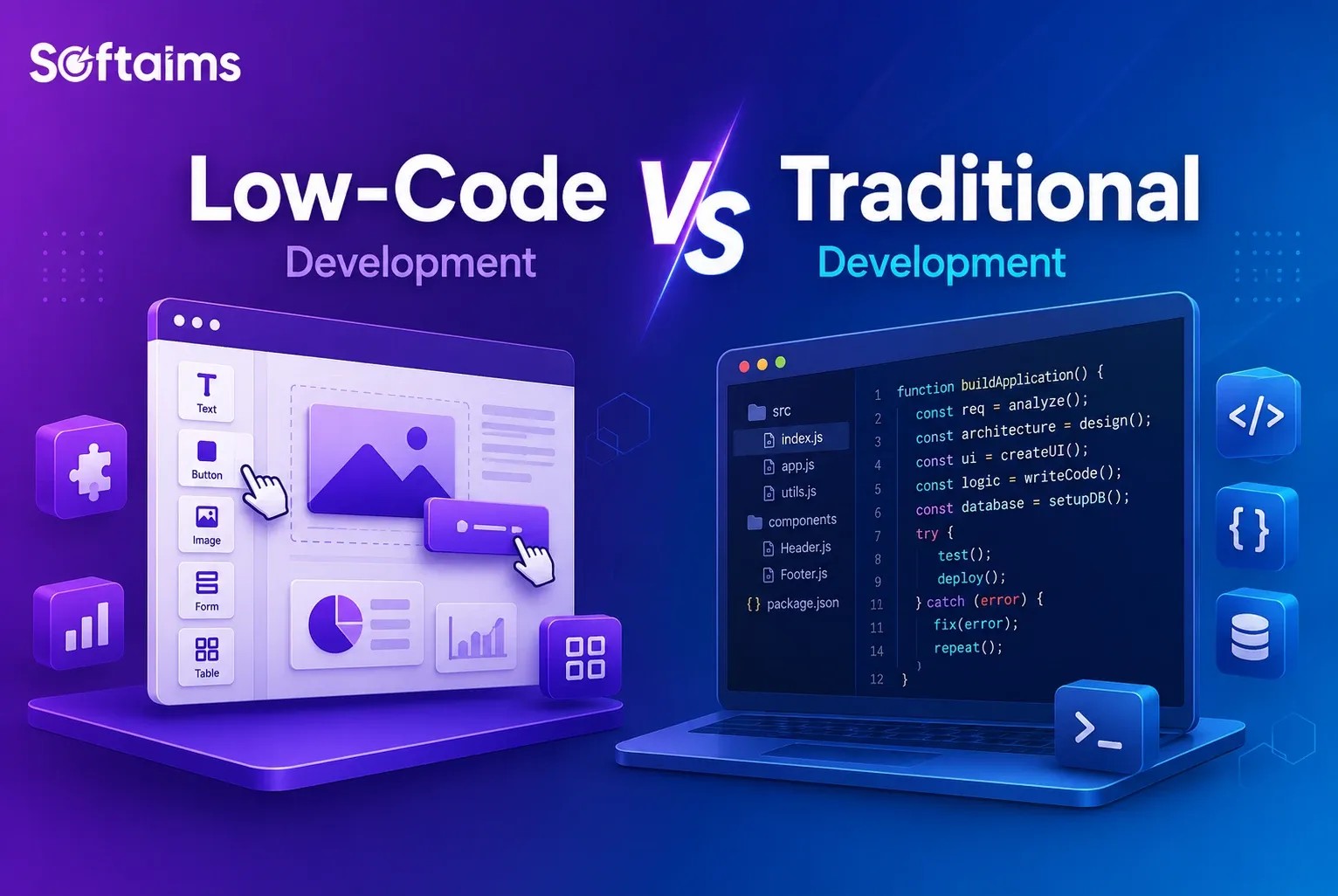
Table of contents
Key Takeaways
- The decision is really about talent. Developer demand is outpacing supply, which drives low-code.
- Low-code has a rebuild wall. Outgrowing a platform can cost £50,000 to £250,000.
- Lock-in is the hidden risk. 83% of enterprise data migrations fail or overrun budgets.
- Own your code. Traditional and Softaims-built apps keep full source-code ownership.
- Hybrids often win. Use low-code for standard parts, custom code for critical logic.
- Softaims removes the barrier. Vetted developers make custom and hybrid builds fast and affordable.
Most businesses turn to low-code for one simple reason: they cannot find developers fast enough. In 2026, the software development talent gap is still pushing teams to look for faster ways to build and launch products. That makes the low-code vs traditional development debate less about technology and more about speed, talent, cost, and control.
The appeal of low-code is obvious. You can build applications faster, reduce the amount of coding required, and get internal teams involved without hiring a large engineering team. But that speed can come with trade-offs. As applications become more complex, teams can run into limited customization, scaling challenges, security concerns, and vendor lock-in.
The cost can also change dramatically over time. A platform that looks inexpensive during the first few months may become costly when your business needs features, integrations, or infrastructure the platform was not designed to handle. Gartner research has also highlighted the broader risks around complex enterprise technology projects, including cost overruns and implementation failures.
That is why choosing between low-code development and traditional software development should not come down to which option is cheaper on day one. The better question is which approach gives your business the right balance of speed, flexibility, scalability, security, and long-term ownership.
This guide breaks down low-code vs traditional development in 2026, comparing both approaches across development cost, time to market, scalability, security, customization, maintenance, and ownership. It also looks at how access to vetted developers can remove one of the biggest reasons companies turn to low-code in the first place.
If your project needs full control and room to grow, you can hire vetted developers and build with ownership from day one.
Low-Code vs Traditional Development: Quick Comparison
The low-code vs traditional development choice usually comes down to speed, budget, control, and long-term scalability. Low-code wins on speed and entry cost. Traditional wins on control, scale, and ownership. This table gives the fast answer.
Criteria | Low-code | Traditional development |
| Development speed | Days to weeks for simpler apps | Several months for most custom builds |
| Cost (UK) | About $5,000 to $50,000+ | About $15,000 to $150,000+ |
| Skills required | Basic to intermediate | Experienced software developers |
| Customisation | Good, but capped by the platform | Full control over features and architecture |
| Scalability | Good within platform and licence limits | High, with architecture built for growth |
| Vendor lock-in | Medium to high | Low, with full source-code ownership |
| Best for | MVPs, workflows, portals, internal tools | Complex, bespoke, high-scale products |
The figures above are indicative of US budgets. Complexity, integrations, and project scope can quickly change the final cost. Low-code development reduces the entry cost with pre-built components and faster implementation. Traditional development costs more upfront, but gives you greater control over architecture, customization, and future growth.
Softaims helps narrow that gap by giving businesses access to both vetted low-code engineers and senior software developers. You can bring in the specific expertise your project needs, whether you are building with a low-code platform, developing a custom application, or combining both approaches. Instead of building a large in-house team, you can hire the right engineers when you need them and scale your team as the project grows.
Why Low-Code Is Booming (and Where Softaims Fits)
The developer shortage is one of the biggest reasons businesses are turning to low-code in the low-code vs traditional development debate. Demand is outpacing supply, backlogs keep growing, and leaders feel pressure to ship. And hiring a full engineering team can take months. So teams grab visual tools to move without a full engineering hire. Visual development tools give companies another way to get applications into production without waiting for a large team to be in place.
The market is moving quickly. Gartner projects the low-code development technologies market to reach $58.2 billion by 2029. It also expects 75% of new enterprise applications to use low-code technologies by 2027.
The speed of low-code can be attractive, but platform dependency creates risks businesses should not ignore. The collapse of Builder.ai is a reminder of what can happen when critical software becomes dependent on a single provider.
One of our clients experienced the risk of platform dependency firsthand when Builder.ai shut down. Read the full post here.
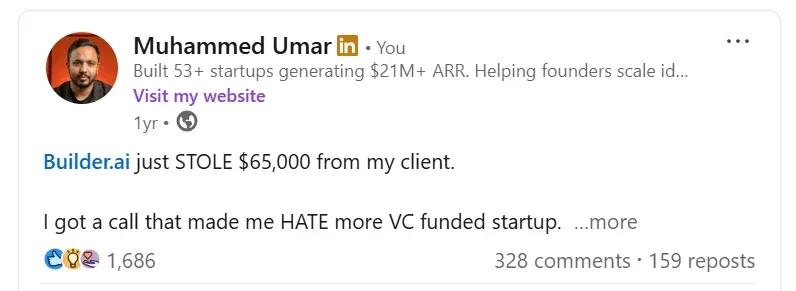
The situation raises an important question: What happens to your software if the platform you depend on disappears?
But notice the root cause. Companies do not choose low-code because they dislike owning their code. They choose it because hiring senior developers is slow and expensive. So the smart move is to fix the talent problem directly, not to trade away ownership to work around it.
That is exactly what Softaims does. Instead of a months-long hire or platform lock-in, you filter a live bench of vetted developers. You sort by skill, seniority, and rate. Then you hire in 48 hours and keep full ownership. So you get the speed that draws people to low-code, without the rebuild wall that comes later.
What Is Low-Code Development
In the low-code vs traditional development debate, low-code takes a simpler approach to building software. Teams use visual builders, pre-built components, templates, APIs, and automation tools instead of writing every feature from scratch. Developers can still add custom code where needed, but much of the repetitive work is already handled by the platform.
That makes low-code useful for internal business apps, dashboards, customer portals, workflow automation, approval systems, and MVPs. Microsoft describes low-code as a way to help both developers and non-developers build applications faster while reducing the workload on IT teams.
The speed and efficiency gains can be significant. A 2024 Forrester Total Economic Impact study commissioned by Microsoft found that a composite organization using Microsoft Power Platform achieved 216% ROI over three years, with $61.4 million in development and IT cost savings and up to 25% time savings per employee.
Microsoft also reports that 89% of CIOs and IT professionals surveyed said low-code was effective at increasing efficiency. The research covered more than 2,000 IT leaders and professionals, giving some context to how widely low-code is being adopted inside organizations.
But low-code is not automatically the right choice for every application. Microsoft points out that low-code can become limiting when projects require extensive customization, complex integrations, or greater scalability. Traditional development takes more time and resources, but gives teams more control over architecture, functionality, integrations, and future growth.
That is the important part of the low-code vs traditional development decision. Low-code can be a smart choice when speed, standard functionality, and cost matter most. Traditional development makes more sense when the product needs deep customization or has complex technical requirements. In many cases, businesses can combine both approaches and use low-code for simpler workloads while keeping custom development for the areas that need more control.
Low-Code vs No-Code: Key Differences
Before getting into low-code vs traditional development, it helps to understand how low-code differs from no-code. The biggest difference is how much technical control each approach gives you.
Low-code still leaves room for code. Developers can use visual builders and pre-built components for most of the application, then write custom code when they need more flexibility. Microsoft describes low-code as an approach that can be used by both professional developers and people with limited technical experience.
No-code goes a step further. It is designed for business users who may have little or no programming experience. Instead of writing code, users build applications through visual interfaces, templates, and preconfigured components.
The practical difference comes down to flexibility versus simplicity. No-code is a good fit for straightforward workflows, forms, internal tools, and simple business applications. Low-code makes more sense when the project needs custom logic, integrations, or developer involvement. Microsoft also notes that low-code platforms can be extended with traditional code when requirements become more complex.
| Parameter | Low-Code | No-Code |
|---|---|---|
| Coding | Some coding may be needed | No manual coding |
| Users | Developers and technical teams | Mainly non-technical users |
| Customization | More flexible through custom code | Limited to platform capabilities |
| Development speed | Fast | Very fast for simple applications |
| Best for | Business apps, workflows, integrations, and MVPs | Simple apps, forms, and automation |
| Technical control | Moderate to high | Lower |
| Complexity | Handles more complex requirements | Best for straightforward requirements |
In short, if you need to launch a simple internal app quickly, no-code may be enough. If you want faster development without giving up as much customization, low-code offers a middle ground. And when the application needs complete control over architecture and functionality, traditional development remains the stronger option.
What Is Traditional Software Development
In low-code vs traditional development, the traditional path means coding an app by hand. It uses languages like Python, Java, JavaScript, or C#. Developers work directly with the codebase. So they gain deep control over features, architecture, integrations, security, and performance.
This is the high-code end of the development spectrum. Unlike low-code platforms, which rely on pre-built components and visual tools, traditional development gives engineers much more freedom to build custom features and solve complex technical problems. That flexibility makes it better suited to products with unique requirements, complex integrations, or plans for significant growth. The trade-off is that custom development typically requires more skilled resources, time, and upfront investment.
That budget barrier is exactly what a marketplace removes. A US app built from scratch might cost $35,000 to $60,000 and take three to six months. So instead of recruiting a permanent squad, you assemble a vetted team through Softaims. Then you scale it as the roadmap changes.
This makes traditional development more accessible to startups and SMEs, not just large enterprises. You get the flexibility of custom software without committing to a large permanent team from day one.
Low-Code vs Traditional Coding: Detailed Comparison
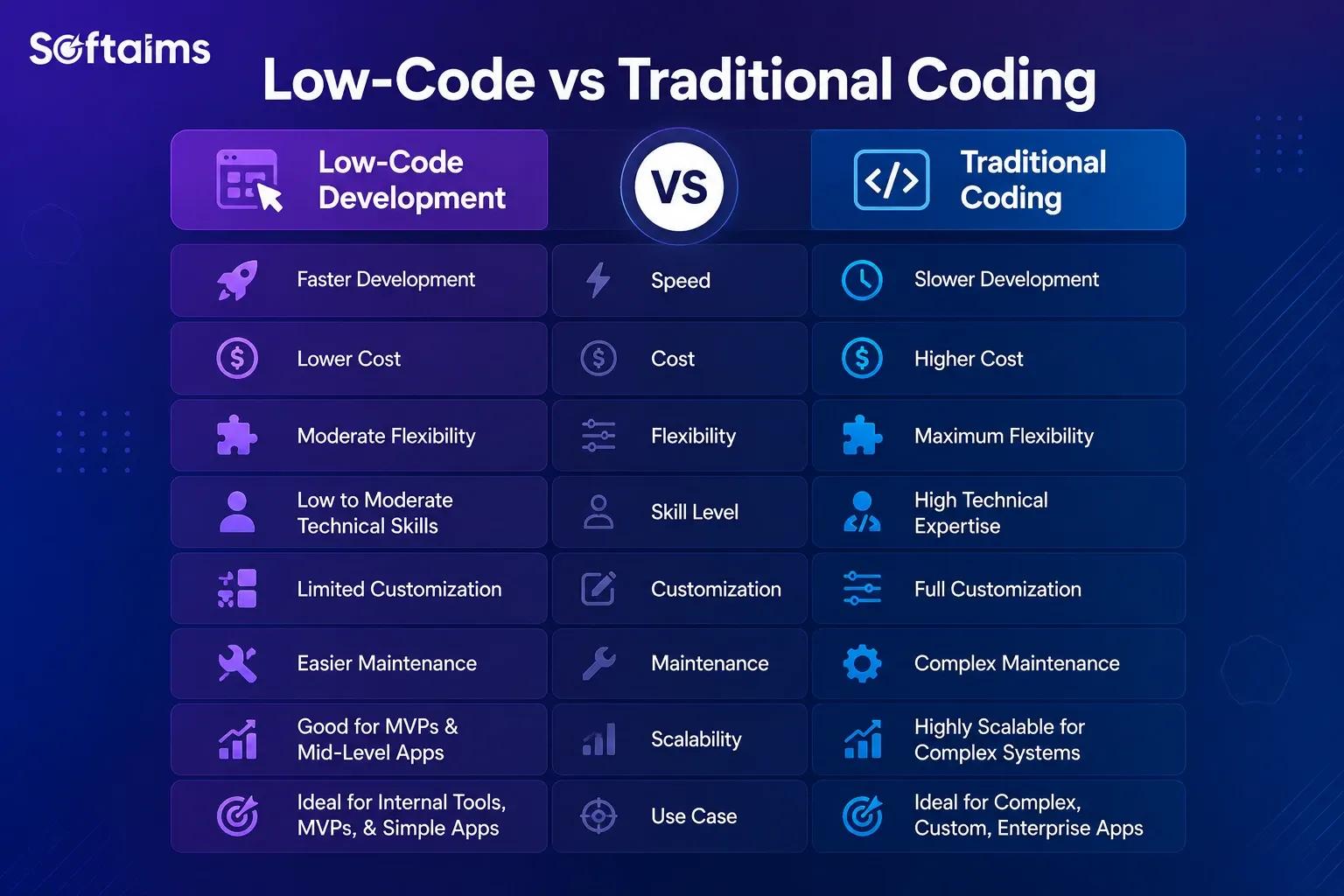
The difference between low-code vs traditional coding becomes clearer when you compare speed, cost, customization, scalability, ownership, and total cost of ownership. Each approach has its strengths, and the right choice depends on what the business needs today and where the product needs to go next.
Development Speed and Time to Market
Low-code reduces the amount of routine coding required to build an application. Teams can use pre-built components, templates, visual workflows, and drag-and-drop tools instead of creating every feature from scratch. This can shorten development cycles and help businesses launch applications faster.
That speed matters when a startup needs to validate an idea, an SME needs an internal tool, or a business needs to automate a workflow quickly. The trade-off appears when requirements become more complex. Custom features, unusual workflows, and deeper integrations can push a low-code project beyond what its platform handles efficiently.
Traditional development takes longer because engineers design and build the application around the specific requirements. However, custom development does not have to mean months of waiting before work begins. With Softaims, businesses can access vetted developers and build a team around the project in days. You can start with the skills you need, add specialists as requirements change, and keep full ownership of the codebase.
So the real comparison is not simply low-code is fast and traditional development is slow. Low-code can accelerate standard application development, while traditional development gives businesses greater control when speed alone is not the priority.
Development Cost and Price Comparison
Low-code usually requires less development work upfront because teams start with pre-built components, workflows, integrations, and infrastructure. Traditional development starts closer to the ground up, so businesses pay more for engineering time, architecture, testing, infrastructure, and ongoing maintenance. Microsoft also notes that traditional development generally requires more time, resources, and technical expertise.
The following ranges are indicative US market estimates, not fixed industry prices. Actual costs can change significantly based on features, integrations, security requirements, team location, and project complexity.
| App type | Low-code (US) | Traditional (US) |
|---|---|---|
| Simple internal tool | $3,000–$8,000 | $15,000–$40,000 |
| Mid-complexity business app | $8,000–$25,000 | $35,000–$80,000 |
| Complex enterprise system | $25,000–$60,000 | $80,000–$200,000+ |
However, the initial development price does not tell the full story. Low-code introduces platform licensing and usage costs, while custom software requires ongoing engineering, hosting, security, monitoring, and maintenance. Microsoft recommends evaluating these costs as a complete picture rather than comparing a low-code license with only the initial cost of custom development.
That makes total cost of ownership (TCO) the more useful comparison. A low-code platform can be cheaper when the application fits its capabilities and remains within its licensing model. A custom application can become more economical over time when the business needs extensive customization, multiple integrations, or freedom from recurring platform costs.
This is also where flexible hiring changes the calculation. Instead of maintaining a large permanent engineering team, businesses can build a smaller team around the project and add specialists as requirements grow. Through Softaims, companies can access developers based on the skills, seniority, and budget they need, helping reduce the staffing overhead normally associated with custom development.
Customization and Flexibility
The biggest difference in low-code vs traditional development often appears when the requirements stop being standard.
Low-code works well for familiar business processes such as dashboards, approval workflows, forms, scheduling, and internal applications. Pre-built components can handle much of the functionality, allowing teams to focus on the business logic instead of rebuilding common features.
The challenge comes when the product needs something the platform was not designed to handle. Complex business rules, unusual user journeys, proprietary algorithms, legacy integrations, or highly specialized interfaces can require workarounds or custom extensions. Those workarounds can reduce the time savings that made low-code attractive in the first place.
Traditional development takes the opposite approach. Engineers can design the architecture around the business instead of adapting the business to the platform. They can control the database structure, APIs, frontend behavior, backend services, integrations, and application logic.
That flexibility has real commercial value when the software itself is a competitive advantage. If your application depends on a unique workflow or proprietary technology, owning the implementation can matter more than getting the first version live quickly.
Scalability and Performance
Scalability is another major consideration in low-code vs traditional development. A low-code application can work extremely well for internal teams, departmental workflows, customer portals, and other business applications. But the platform's architecture, supported integrations, usage limits, and licensing model can eventually influence how the application grows. Microsoft specifically identifies scalability and complex integrations as areas where low-code can become limiting.
The important question is not simply, “Can low-code scale?” It is “Can it scale in the way this product needs?”
For example, an internal application with a few hundred users may have very different requirements from a consumer platform handling large traffic spikes. A growing application may also need advanced caching, database optimization, custom APIs, distributed services, or specialized infrastructure.
Traditional development gives engineers direct control over those layers. They can optimize databases, redesign services, introduce caching, change infrastructure, and tune the application as usage grows. That makes custom development a stronger fit for products where performance, scale, and architectural control are core requirements.
For many businesses, the smartest answer is not choosing one approach exclusively. Low-code can handle straightforward processes while traditional code handles the parts that require deeper control. Microsoft also recommends combining low-code with traditional development when a project has both standard and highly customized requirements.
Security and US and UK Compliance
Security is an important part of the low-code vs traditional development decision. With low-code, some security responsibilities sit with the platform provider, while others remain with the business building the application. Teams should review authentication, access controls, encryption, data storage, integrations, and the provider’s security practices before choosing a platform.
For US businesses, compliance depends on the industry and the type of data being processed. The FTC’s data security guidance recommends that businesses protect sensitive customer information and build security into their applications from the start. Healthcare applications face additional requirements under HIPAA, including administrative, physical, and technical safeguards for electronic protected health information. The US Department of Health and Human Services’ HIPAA Security Rule guidance outlines these requirements.
UK businesses face similar considerations under UK GDPR. This becomes particularly important when a low-code platform stores or processes personal data outside the UK. The ICO's guidance on international transfers explains the requirements for transferring personal data internationally.
Regulated projects raise the bar further. Fintech, healthcare, NHS systems, and applications handling sensitive personal data often need tighter control over data, integrations, permissions, and infrastructure. Traditional development can provide greater architectural control, but it does not automatically make an application compliant. The same security and regulatory requirements still need to be designed, implemented, and tested.
For AI-heavy applications, the technical requirements can become even more complex. Teams may work with machine learning development companies when building custom models or advanced ML features. For connecting AI models with internal systems, data sources, and business workflows, generative AI integration companies can handle the integration layer.
The key takeaway is simple: low-code can be secure and compliant, but businesses must verify the platform against their actual requirements. Traditional development gives teams more control over the underlying architecture, while low-code can reduce development effort when the platform already supports the required security and compliance controls.
Vendor Lock-In and Ownership
Vendor lock-in is the most underestimated risk in low-code vs traditional development. Many low-code apps run on proprietary technology, and most export nothing useful. So outgrowing the platform means rebuilding, not migrating.
The numbers are sobering. Research links 83% of enterprise data migration projects to failure or budget overruns. Rebuilding a low-code app in custom code often costs $50,000 to $250,000. In contrast, traditional development gives you the source code outright. With Softaims, that ownership is the default, since every developer you hire builds code that stays yours.
Total Cost of Ownership Over Three Years
Total cost of ownership decides the honest winner in low-code vs traditional development. The monthly fee is not the real number. The migration cost when you outgrow the platform is. A single rebuild can dwarf years of licence savings. In fact, the cost of a failed large migration can run into millions.
Over three to five years, a well-built custom app can cost less than a heavily licensed low-code one. Licence fees, usage-based charges, and eventual rebuilds add up quickly. In low-code vs traditional development, this long-view maths often flips the apparent winner. So model the full period honestly, including the real risk of a forced rebuild down the line. Then weigh it against a custom build you own and can staff on demand.
When to Choose Low-Code for Your Business
In the low-code vs traditional development decision, low-code suits certain jobs. Choose it when the problem is well understood and the features are fairly standard. Speed matters most in these cases. So low-code fits several situations neatly.
- Internal tools. CRMs, HR workflows, and dashboards ship without a large engineering team.
- MVPs and prototypes. An idea reaches real users in weeks, which proves value before big spend.
- Process automation. Approvals, onboarding, and reporting move into connected digital workflows.
- SaaS integrations. Pre-built connectors link Salesforce, Microsoft 365, and HubSpot easily.
- Departmental micro-apps. Individual teams get purpose-built tools without a company-wide system.
The rule is simple. If the app has a small user base, no scaling ambition, and standard logic, low-code is the low-risk win. However, the moment scale, ownership, or product-critical features enter the picture, the calculation shifts.
When Traditional Development Is the Better Choice
In the low-code vs traditional development choice, pick traditional when software becomes a core product. It also wins for demanding technical needs. That control justifies the higher cost. So bespoke work wins in these cases.
- Complex enterprise systems. Specialised logic and unusual integrations need a tailored architecture.
- Customer-facing products. SaaS platforms and marketplaces benefit from freedom over UX and monetisation.
- Regulated industries. Fintech and healthtech may demand tight control of security and data.
- High-load systems. Purpose-built architecture handles thousands of concurrent users.
- Long-term scaling. Source-code ownership leaves room to expand or change the stack later.
With custom development, your partner becomes part of the technical equation. So ask what happens when requirements change or the original developers leave. Those answers reveal more than a polished portfolio. This is where Softaims removes the usual objection. Vetted senior developers make custom builds fast to start and simple to scale. That holds for mobile app development and full platforms alike.
Signals It Is Time to Move Off Low-Code
In low-code vs traditional development, certain signals mean a low-code app has outgrown its platform. Spotting them early saves a painful, costly rebuild. So watch for these warning signs.
- Slow performance. Page loads pass three seconds under normal traffic. Therefore, the platform is straining.
- Scaling walls. User numbers climb toward thousands and errors rise. Meanwhile, tier upgrades stop helping.
- Integration pain. A niche or legacy system will not connect cleanly. As a result, workarounds pile up.
- Rising licence bills. Usage-based charges grow faster than the business. So the savings quietly disappear.
- Custom logic fights the platform. Every new rule triggers a restriction. Consequently, delivery slows, not speeds.
When two or more appear, plan the move. Rather than a full internal hire, a Softaims team can rebuild the core in owned code. Meanwhile, your simpler tools stay on low-code.
Real-World Scenarios: How Businesses Decide
The low-code vs traditional development choice looks different across businesses. So a few real scenarios make the trade-offs concrete. Each one shows how the decision plays out in practice.
A retail SME automating approvals. Purchase approvals live in email and spreadsheets. Low-code digitises the workflow in weeks. Therefore, it is the obvious, low-risk win.
A fintech startup building its product. The core app handles payments and compliance. Traditional development gives the control the FCA expects. So bespoke code is the safer route here, and it can be staffed fast through a vetted marketplace.
A healthcare provider with mixed needs. An internal staff portal suits low-code. Meanwhile, patient-data handling needs custom security. As a result, a hybrid fits best.
A scale-up that hit the wall. The platform served 200 users, then buckled at 2,000. So the team rebuilt the core in owned code, while keeping simple admin tools on low-code. A vetted team made that rebuild fast and affordable.
The pattern is consistent. Standard, internal, and short-lived work leans low-code. Core, regulated, and long-lived work leans traditional. In between, a hybrid usually wins, and quick access to senior developers makes every route cheaper.
The Hybrid Approach: Low-Code and Traditional Together
The low-code vs traditional development question is not always either-or. A hybrid approach splits the system by what each technology does best. Visual tools handle interfaces, dashboards, and routine workflows. Custom code runs complex back-end logic and integrations. So you get speed where it is safe and control where it counts. Most successful enterprises use exactly this mix.
Picture a US eCommerce startup. Its customer portal could use low-code to launch sooner. Meanwhile, payment processing and inventory stay custom-built, since they carry critical rules. This split gets the product live faster without overloading the platform.
Three principles make the hybrid model work.
- Use low-code for standard functions. Pick it for forms, dashboards, approvals, and simple workflows.
- Keep critical logic custom. Build payments, complex calculations, and core rules in traditional code.
- Connect the layers through APIs. A reliable API integration keeps data flowing without tightly coupling the two.
A hybrid needs both skill sets under one roof. So Softaims fits perfectly, since it can supply low-code-aware engineers and senior custom developers in the same engagement.
Top Low-Code Platforms and Custom Development Options for US and UK Businesses in 2026
A low-code platform can become part of your technology stack for years. So the decision should go beyond how quickly you can launch an app. Integrations, governance, scalability, security, licensing, and long-term ownership can all affect the real cost.
Here are several established low-code platforms, along with custom development options worth considering when low-code is not enough:
| Platform / Provider | Best for | Pricing | Key consideration |
|---|---|---|---|
| Microsoft Power Apps | Microsoft 365 users and internal business apps | US: From $20/user/month; UK: From £16.90/user/month | Strong fit for businesses already using Microsoft |
| OutSystems | Enterprise and customer-facing applications | Custom quote | Powerful for complex apps, but enterprise costs can increase |
| Mendix | Enterprise applications and business workflows | Custom quote | Strong enterprise capabilities with more complex pricing |
| Appian | Process automation and case management | Custom quote | Powerful for complex processes, but may be excessive for simple apps |
| Zoho Creator | SMEs, internal tools, and automation | Tiered pricing | Better suited to straightforward business applications |
| Softaims | Custom software, SaaS, AI, and enterprise applications | Project-based / custom | Best when you need full code ownership and deeper customization |
| Devaims | Custom software and technology services | Custom quote | Now operates under Softaims following the acquisition |
Microsoft currently lists Power Apps Premium at $20 per user/month in the US and £16.90 per user/month in the UK, with annual billing and taxes excluded. Other plans, including per-app and pay-as-you-go options, can make more sense depending on usage. Microsoft Power Apps pricing
For platforms such as OutSystems, Mendix, and Appian, pricing depends more heavily on applications, users, environments, resources, and enterprise requirements. That makes a direct licence-price comparison difficult. Request a quote based on your expected usage before comparing five-year costs.
There is also an important alternative to consider. Not every business needs a low-code platform. If the application requires proprietary functionality, complex integrations, advanced AI, or complete control over the architecture, custom development may be the better investment.
Softaims provides custom software development for web, SaaS, cloud, enterprise, AI, and integration projects. Businesses can work with senior developers while retaining ownership of the code, repository, and accounts.
Devaims is now part of Softaims. Softaims states that it acquired Devaims and that its locations and service lines now operate under the Softaims brand. So businesses comparing both names should treat them as part of the same organization rather than two separate development providers.
The right choice therefore depends on what you are building. Low-code makes sense when speed, standard functionality, and lower initial development effort are priorities. Custom development makes more sense when the software itself is strategically important and you need control over its architecture, functionality, integrations, and future growth.
Before committing to any platform, check how costs change as users, data, integrations, environments, and applications increase. Also confirm your exit options. Data portability, integration migration, source-code access, and ownership can matter more than the first-year licence price.
Low-Code vs Traditional Development: Decision Framework
Use this checklist to see which route matches your project. It turns the low-code vs traditional development question into a quick scorecard. So the answer becomes clear in minutes.
- Project complexity. Simple points to low-code. Complex points to traditional.
- Budget. Under $20,000 suits low-code. $50,000 or more suits traditional.
- Launch deadline. Under one month favours low-code.
- Regulation. FCA or CQC requirements favour traditional.
- Full customisation. If required, choose traditional.
- Users. Under 500 can work on low-code. Thousands favour traditional.
- Product strategy. An MVP suits low-code. A long-term product suits traditional.
A fairly even split points toward a hybrid. So combine low-code components with custom development where each fits best. In every case, the deciding factor is talent access, which is precisely the barrier Softaims removes.
How Softaims Helps You Choose and Build the Right Way
Softaims solves the real reason the low-code vs traditional development decision is hard. That reason is getting senior, production-ready developers quickly and affordably. The low-code trap exists because hiring is slow. So a vetted developer marketplace changes the maths for every option on the table, from low-code to full custom.
You hire the exact skills, in 48 hours. Filter a live bench by stack, seniority, location, and rate. Then bring on one developer or a full pod. As a result, custom and hybrid builds start almost as fast as low-code.
You own everything, with no lock-in. Every developer builds code, contracts, and data that stay yours. Therefore, you sidestep the rebuild wall that traps low-code buyers.
You scale up and down on demand. Add a DevOps engineer, a generative AI specialist, or LLM development talent as the roadmap grows. Meanwhile, you release them when the work ends.
You can hand over the whole build. For a finished product, fully managed delivery is available too. So you are never forced to choose between owning talent and owning the outcome. Following an August 2026 acquisition, Softaims pairs its bench with a managed delivery company, Devaims. So a hybrid build, part low-code and part custom, runs under one accountable partner.
Ready to plan a route? Review the pricing or talk to our team to scope your project.
Frequently Asked Questions
Is low-code cheaper than traditional development?
Low-code is usually cheaper to start, from around £5,000. Traditional builds start higher but avoid licence fees. Over three years, low-code often wins for simple apps, while custom wins for complex or scaling ones.
What happens when I outgrow a low-code platform?
You usually face a rebuild, not a migration, since most platforms export little. That rebuild often costs $50,000 to $250,000. So plan for it, or build in owned code from the start.
Can low-code apps scale for enterprise use?
They can, within platform and licence limits. Low-code serves hundreds and even thousands of users. For very high volumes or heavy workloads, traditional architecture scales better.
Is low-code secure enough for UK regulated sectors?
It can be, but it needs careful checking. Leading platforms hold ISO 27001 or SOC 2. Even so, fintech, healthcare, and NHS work often needs the tighter control of custom development.
How does Softaims fit into this decision?
Softaims removes the talent barrier that pushes teams into low-code lock-in. You hire vetted developers fast, own the code, and scale on demand. So custom and hybrid builds become affordable and low-risk.
When should I use a hybrid approach?
Use a hybrid when part of the app is standard and part is complex. Build interfaces and workflows in low-code. Keep payments and core logic in custom code, connected by APIs.
Final Thoughts
There is no universal winner in low-code vs traditional development. The better route is the one that matches the role software will play in your business. A focused internal tool may never need a bespoke architecture. Meanwhile, a core digital product can quickly outgrow platform limits and hit the rebuild wall.
So look beyond the first release. Model the three-year cost, the scaling ceiling, and the exit. In many cases, a hybrid gives the most practical answer. And in every case, faster access to senior developers makes the smarter, more durable choice affordable. Would you like help scoping it? Then Softaims can match you with vetted developers, or manage the build end to end.


 GitHub
Mike T.

 Verified Expert in Engineering
My name is Mike T. and I have over 12 years of experience in the tech industry. I specialize in the following technologies: Gatsby.js, React Bootstrap, React, Sass, AngularJS, etc.. I hold a degree in Bachelor of Science (BS), Bachelor's degree. Some of the notable projects I've worked on include: Joyntly - Application Development, Front End Developer - Web App, Linxx - Software Development, Bitlux - Senior Software Engineer, Athletic Greens (AG1), etc.. I am based in Irving, United States. I've successfully completed 11 projects while developing at Softaims.
I employ a methodical and structured approach to solution development, prioritizing deep domain understanding before execution. I excel at systems analysis, creating precise technical specifications, and ensuring that the final solution perfectly maps to the complex business logic it is meant to serve.
My tenure at Softaims has reinforced the importance of careful planning and risk mitigation. I am skilled at breaking down massive, ambiguous problems into manageable, iterative development tasks, ensuring consistent progress and predictable delivery schedules.
I strive for clarity and simplicity in both my technical outputs and my communication. I believe that the most powerful solutions are often the simplest ones, and I am committed to finding those elegant answers for our clients.

Leave a Comment
Need help building your team? Let's discuss your project requirements.
Get matched with top-tier developers within 24 hours and start your project with no pressure of long-term commitment.