Flutter vs React Native: Complete Guide for 2026
Comparing Flutter and React Native in 2026 with real benchmark data, Glassdoor salary figures, and a hiring framework. In this guide you will learn which cross-platform framework fits your team, budget, and project requirements.
Technically reviewed by:
Georgios M.|Hiren B.
Table of contents
Key Takeaways
- Flutter holds 46% cross-platform market share vs React Native's 35%, but React Native powers apps serving 2B+ users including Instagram and Shopify
- Flutter wins on rendering performance (consistent 60-120 fps vs 52-58 fps under stress) and hot reload speed (0.4-0.8s vs 1.2-1.8s)
- React Native wins on hiring speed (2x more job openings, 35-day vs 48-day time-to-hire) and ecosystem size (2.1M npm packages vs 48K on pub.dev)
- Senior Flutter developers earn $135K-$180K vs $127K-$167K for React Native in the US (Glassdoor Q1 2026), reflecting a scarcity premium
- Three-year total cost of ownership is roughly comparable: Flutter ~$360K vs React Native ~$376K, with Flutter saving on QA and maintenance while React Native saves on initial development
- Choose React Native if your team knows JavaScript and speed to market matters most. Choose Flutter if you need custom UI, complex animations, or multi-platform reach beyond mobile
More than ~80% of new app projects are now cross-platform mobile development, and two frameworks are at the center of the conversation. Flutter has about 46% of the market among mobile developers, and React Native powers 10-15% of the top 500 apps in the US. Together, they make up the vast majority of cross-platform work shipped in production today.
The question is no longer whether these frameworks are production-ready. They are. Google Pay, BMW, and Alibaba run on Flutter. Instagram, Shopify, and Discord run on React Native. I have shipped production apps with both frameworks. React Native for three different client projects and Flutter for two. Each time, the choice came down to the team's skills, the project requirements, and long-term maintenance plans. If you’re looking to hire mobile app developers for a new project, this guide will help you make a confident, informed decision.
Let’s get into it.
Flutter vs React Native Quick Comparison Table
Before diving into the details, here is a side-by-side overview of where each framework stands in 2026.
| Feature | Flutter | React Native |
| Created by | Meta (Facebook) | |
| Language | Dart | JavaScript / TypeScript |
| Rendering | Custom engine (Skia) | Native components |
| Hot Reload | Yes (very fast) | Yes (Fast Refresh) |
| UI Approach | Own widget system | Maps to native UI |
| App Size (empty) | ~7 MB | ~4 MB |
| Web Support | Yes (stable) | Limited (React Native Web) |
| Desktop Support | Yes (stable) | Community-driven |
| Community Size | Large, growing fast | Very large, mature |
The numbers tell a complicated story. Flutter excels in rendering speed, hot reload speed, and code reuse across platforms. React Native is the best pick for app binary size, memory efficiency, ecosystem breadth, and developer onboarding speed. Everything after this table depends on the details of your project.
How Do Flutter and React Native Differ in Architecture
This is the most important part for figuring out why each framework acts the way it does. A fundamental architectural difference drives performance, UI fidelity, hiring requirements, and long-term maintenance.
Flutter: Drawing Every Pixel from Scratch
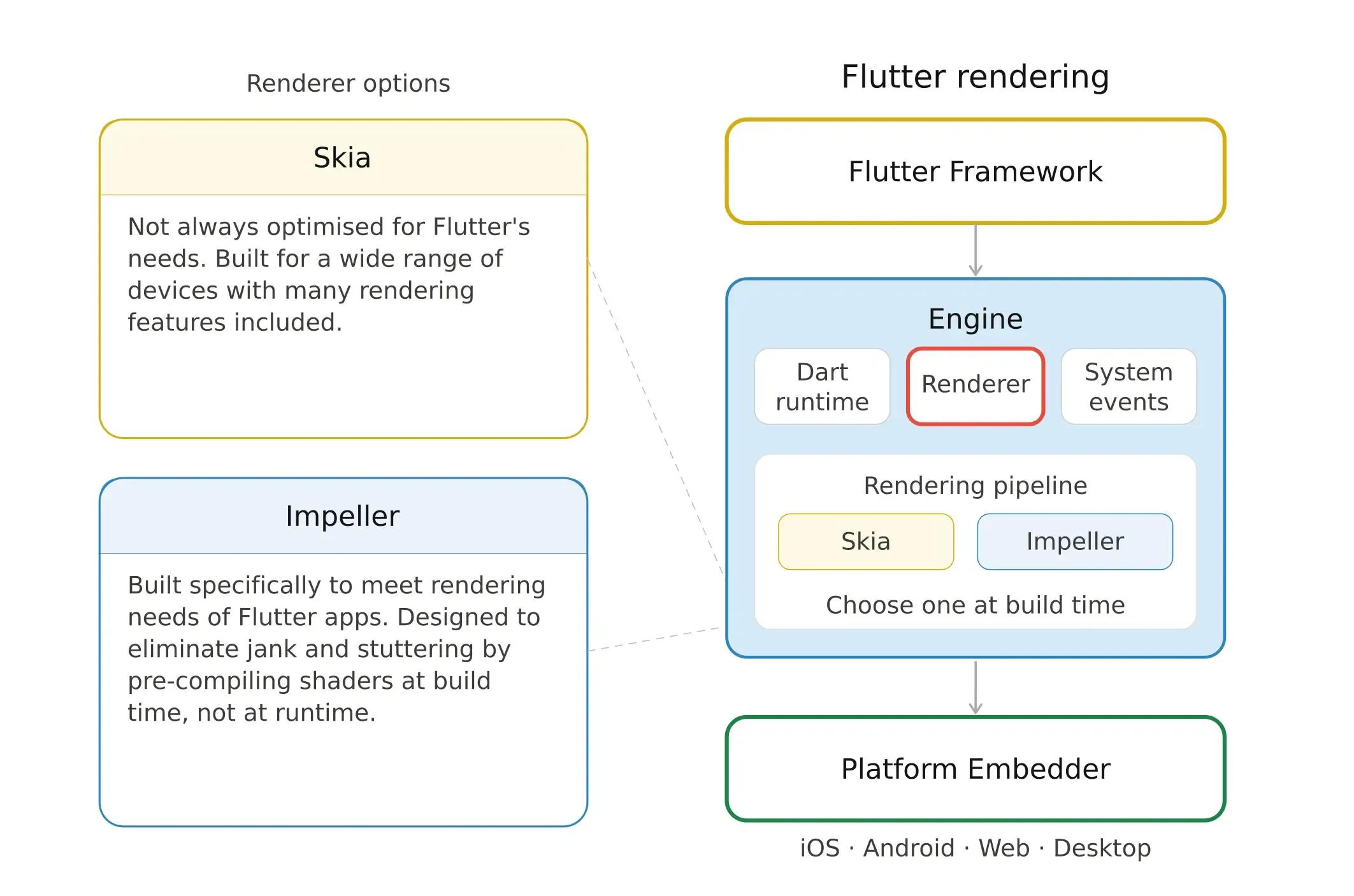
Flutter does not use any native UI components from iOS or Android. Instead, it uses its own rendering engine called Impeller (which replaced the older Skia engine in Flutter 3.27+). Impeller draws every single pixel on a GPU-accelerated canvas, completely bypassing the platform's native UI layer.
Think of it like this: Flutter is an architect who brings their own building materials to every site. It does not rely on what the platform provides. It builds everything from the ground up.
What Impeller changed in 2026: Earlier versions of Flutter had a known problem called "shader jank," where complex animations would stutter on their first run because shader programs were compiled at runtime. Impeller solved this by pre-compiling all shaders at build time. It also renders directly via Metal on iOS and Vulkan on Android, resulting in unpredictable frame times even under heavy load. Independent benchmarks show that Impeller reduced average frame rasterization time by nearly 50% in complex scenes compared to the old Skia engine.
The result: Pixel-perfect consistency across every platform. An animation that runs at 120 fps on iOS will look identical on Android, the web, and desktop. Flutter gives you total control over every visual element.
React Native: Orchestrating Native Components
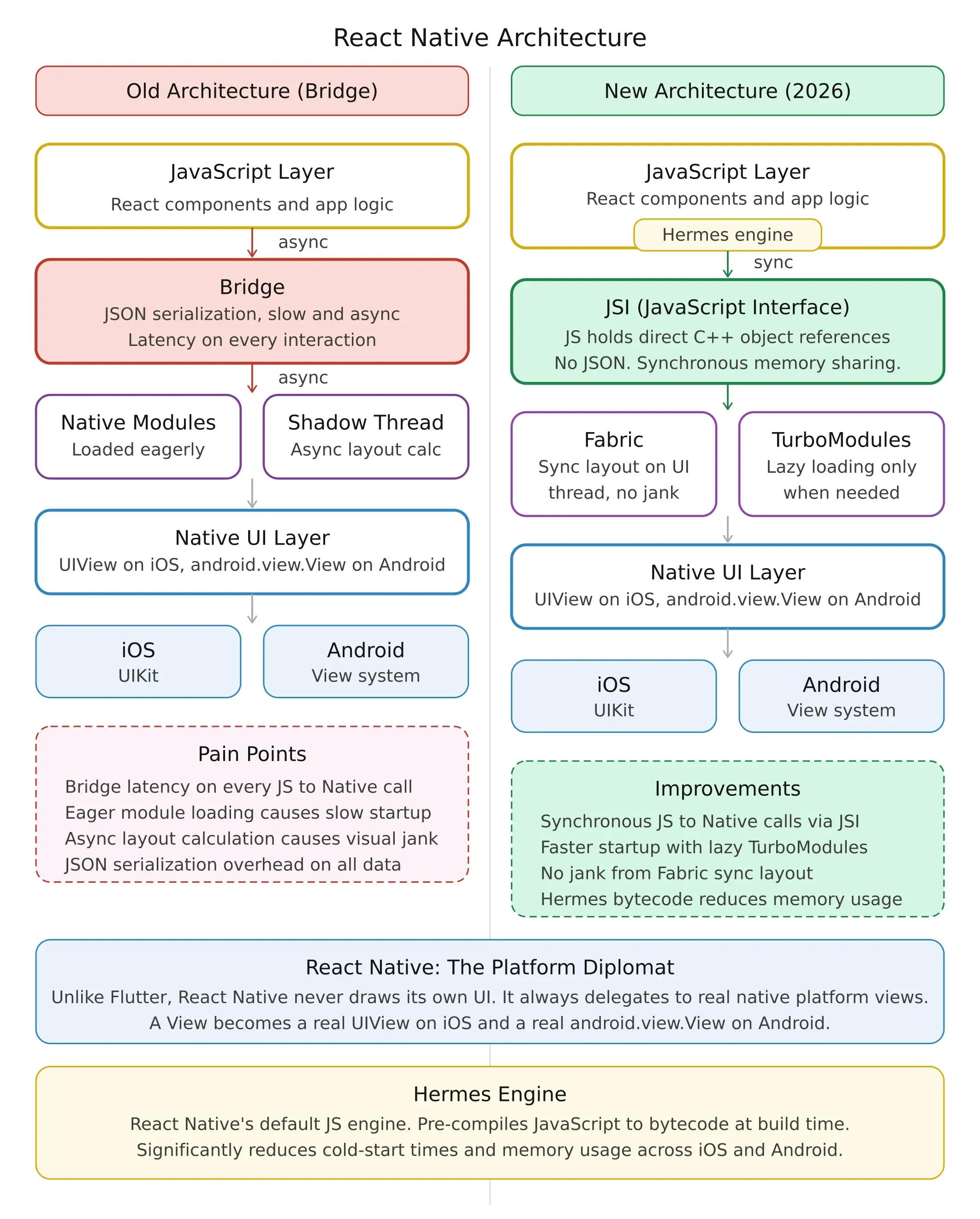
React Native takes the opposite approach. It does not draw anything itself. Instead, it tells the platform's native UI layer what to render. A <View> in React Native becomes a real UIView on iOS and a real android.view.View on Android.
Think of it like this: React Native is a diplomat who coordinates the existing systems across platforms. It speaks each platform's language natively.
What the New Architecture changed in 2026: React Native's biggest historical weakness was its "bridge," an asynchronous communication layer between JavaScript and native code that introduced latency on every interaction. The New Architecture, now the default in all new React Native projects, eliminated this bridge. It replaced it with three components:
- JSI (JavaScript Interface): Allows JavaScript to directly hold references to C++ objects, enabling synchronous data sharing via memory references rather than expensive JSON serialization.
- Fabric renderer: Performs layout calculations synchronously on the UI thread, eliminating the visual jank that plagued the old architecture.
- TurboModules: Native modules are loaded lazily and only when needed, reducing memory consumption and improving startup time.
- Hermes engine: React Native's default JavaScript engine precompiles JavaScript into bytecode, significantly reducing cold-start times and memory usage.
The result: Apps feel like they belong on each platform because they use native parts. Without any extra work, iOS bounce physics, Android ripple effects, and system accessibility features all work.
Why This Architectural Difference Matters for Your Decision
The architecture defines everything that follows:
- If your app needs a lot of custom UI, complicated animations, or consistent branding across platforms, Flutter's rendering engine lets you control every frame directly.
- If you want your app to feel naive on each platform, React Native's native component model does that for you by using platform-specific behaviors and system-level accessibility.
- React Native's JavaScript base makes it easy to share code with an existing React web app. Flutter's web output works, but it makes bigger bundles and doesn't feel as native on the web.
Performance: Which Framework is Faster
The first question everyone asks is about performance. The honest answer is that both frameworks can make smooth, 60 fps apps with end-user experiences similar to those of most business applications. The performance gap that defined this debate for years has mostly closed.
That being said, there are still measurable differences in some cases, and they matter if your app fits into one of those categories.
Animation and Rendering Performance
Flutter is strong in animation-heavy interfaces. It uses its own GPU-based rendering engine (Impeller), which allows full control over every pixel. This helps it maintain stable performance even with complex animations, transitions, and custom UI. In benchmarks, Flutter handles large UI lists and heavy layouts with minimal frame drops.
React Native uses native UI components to render through JSI and the New Architecture (Fabric + TurboModules). This makes things more responsive and eliminates many old delays caused by bridges. It works great for regular apps like forms, feeds, and navigation. In complex first-time animations, minor frame drops may still occur, but they are uncommon in business apps.
Where Flutter wins: custom UI, heavy animations, and consistent cross-platform visuals.
Where React Native wins: native look-and-feel and platform-specific behavior.
Startup Time
On real devices, Flutter usually starts up a little faster, taking about 2.1 seconds instead of 2.8 seconds for similar apps. Flutter's AOT (Ahead-of-Time) compilation means the app is compiled to native ARM code before it reaches the device. This makes it run faster the first time.
React Native's Hermes engine has closed this gap a lot by precompiling JavaScript into bytecode, but Flutter still has a small edge when starting up cold.
Memory Usage
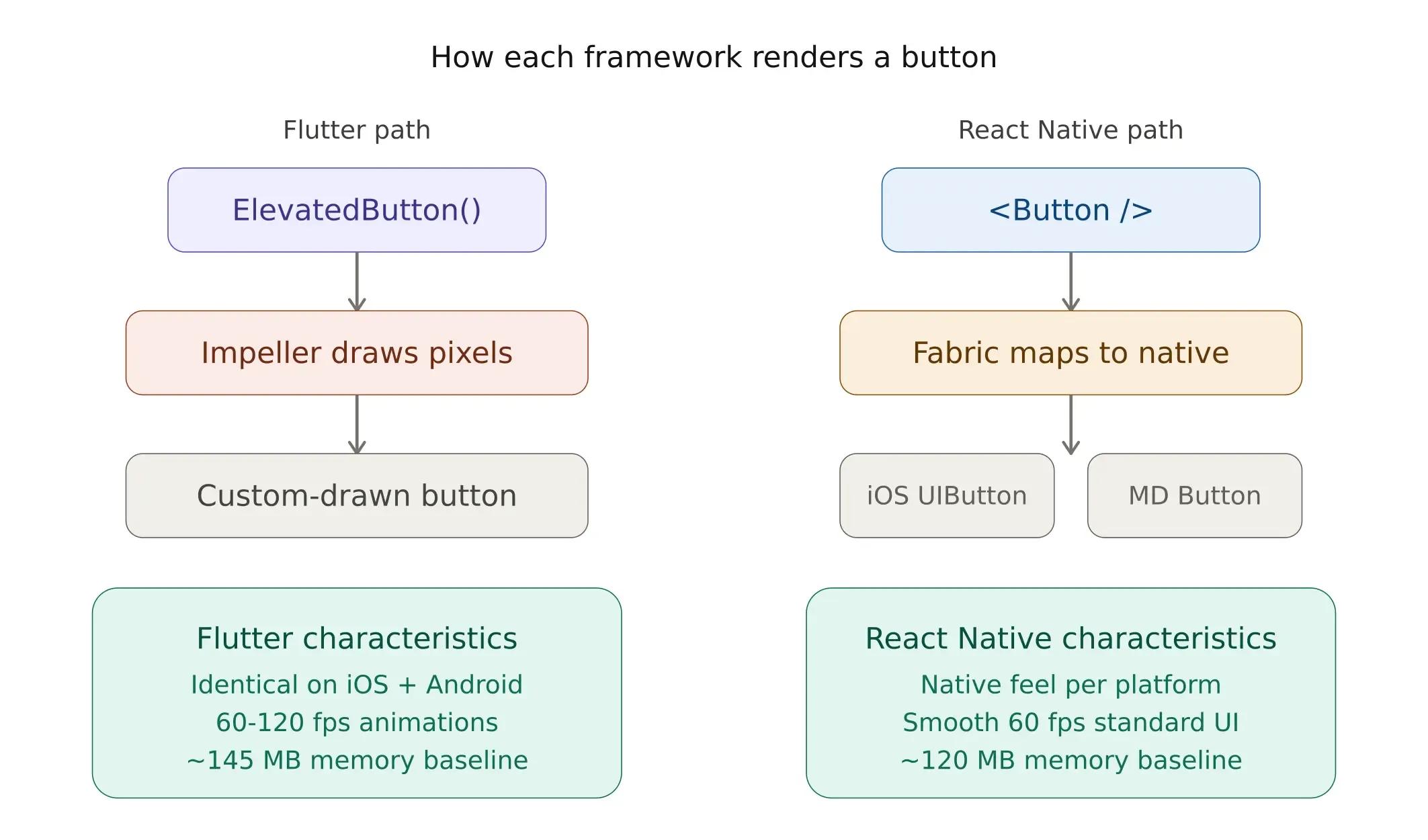
In most apps, they are the same. React Native usually uses less memory (about 120 MB baseline vs. 145 MB for Flutter) because it uses the platform's UI components rather than its own rendering engine. This 25 MB difference doesn't matter much on modern flagship devices, but it could matter for apps designed for low-end Android devices in new markets.
2026 Performance Benchmarks
The benchmarks below show tests conducted on the iPhone 15 Pro (iOS 18) and Google Pixel 9 (Android 15) using release builds. Data is compiled from independent benchmark sources, including the Niclas Fischer Mobile Framework Benchmark Suite and the community-driven CrossPlatformBench project.
| Performance metric | Flutter 3.24 (Impeller) | React Native 0.76 (Fabric + Hermes) | Advantage |
| Cold start (Android) | ~248 ms | ~341 ms | Flutter |
| Cold start (iOS) | ~189 ms | ~267 ms | Flutter |
| 60fps animation consistency | 60 fps locked | 56-58 fps avg | Flutter |
| Complex animation (60 transitions) | 59.4 fps | 51.3 fps | Flutter |
| List scroll (10K items) | 59.7 fps | 56.2 fps | Flutter |
| Idle memory usage | ~145 MB | ~120 MB | React Native |
| App binary size (minimal) | 14-20 MB | 9-15 MB | React Native |
| Hot reload speed | 0.4-0.8 s | 1.2-1.8 s | Flutter |
| JSON parse (1 MB payload) | 38 ms | 45 ms | Flutter |
| SQLite write (10K rows) | 312 ms | 298 ms | React Native |
| Network request overhead | 12 ms | 9 ms | React Native |
| Clean build time (Android) | ~47 s | ~62 s | Flutter |
Flutter is the best when it comes to rendering speed, startup time, and build times. React Native is better than other frameworks in terms of memory usage, binary size, and native I/O operations. Both frameworks perform much better than hybrid options like Ionic or Cordova, which typically achieve only 30–40 fps in the same animation tests.
When Performance Differences Actually Matter
Both frameworks work well enough for 90% of mobile apps that users wouldn't notice a difference. In these specific situations, the performance decision is very important:
- Media-heavy apps with lots of scrolling and animations work better in Flutter.
- Apps for low-end phones work better in React Native because it uses less memory.
- Media-heavy apps with lots of scrolling and animations work better in Flutter.
- For e-commerce apps, Flutter remains smooth even with big product grids. React Native is fine for normal lists, but it can slow down when items have many animations.
Developer Experience: Dart vs JavaScript
Flutter and Dart
Dart is a language created by Google specifically for client-side development. If you know Java, C#, or TypeScript, Dart will feel familiar. It is a typed language with sound null safety, meaning the compiler catches null reference errors at build time rather than at runtime. This becomes more valuable as projects grow in complexity.
Dart supports both JIT (Just-in-Time) compilation during development for fast hot reload cycles and AOT (Ahead-of-Time) compilation for production, delivering optimized native ARM code.
Here is a simple Flutter widget that demonstrates the framework's declarative UI approach:
import 'package:flutter/material.dart';
class CounterWidget extends StatefulWidget {
  @override
  _CounterWidgetState createState() => _CounterWidgetState();
}
class _CounterWidgetState extends State<CounterWidget> {
  int count = 0;
  @override
  Widget build(BuildContext context) {
    return Column(
      mainAxisAlignment: MainAxisAlignment.center,
      children: [
        Text('Count: $count', style: TextStyle(fontSize: 24)),
        SizedBox(height: 16),
        ElevatedButton(
          onPressed: () => setState(() => count++),
          child: Text('Tap me'),
        ),
      ],
    );
  }
}
Flutter's widget tree design treats everything as a widget, including layout containers, text styling, and gesture detectors. This gives you a lot of control over every visual element, but it also means that UI code can get very complicated on very large screens.
React Native and JavaScript/TypeScript
React Native uses JavaScript or TypeScript, the same languages that power web development. If your team already works with React on the web, the transition to React Native is relatively simple. The component model, state management patterns, and even many npm packages carry over directly.
The same counter in React Native:
import { useState } from 'react';
import { View, Text, Button, StyleSheet } from 'react-native';
export default function Counter() {
  const [count, setCount] = useState(0);
  return (
    <View style={styles.container}>
      <Text style={styles.text}>Count: {count}</Text>
      <Button title='Tap me' onPress={() => setCount(count + 1)} />
    </View>
  );
}
const styles = StyleSheet.create({
  container: { flex: 1, justifyContent: 'center', alignItems: 'center' },
  text: { fontSize: 24, marginBottom: 16 },
});
The React Native version is shorter and arguably more readable. The JavaScript ecosystem also provides access to the largest package registry in software development, with mature solutions for authentication, analytics, payments, maps, and virtually every other common requirement. But Flutter's approach gives you more control over the UI out of the box.
The Practical Difference for Teams
Many people think that Flutter's hot reload is faster and more reliable, and that it keeps the application's state almost instantly during iterative UI development. Fast Refresh in React Native has gotten a lot better, but it may still require a full reload when the state changes in a complicated way.
The main difference is how long it takes to get started. A React web developer can get the hang of React Native in just a few weeks. Even if a developer is familiar with similar typed languages, they will need more time to learn Flutter if they have never used Dart before. For companies whose engineering teams already know a lot about JavaScript, React Native makes it much cheaper to share knowledge and work together across teams.
UI/UX: Native Look and Feel
This is where the two frameworks take fundamentally different positions, and understanding the trade-off is essential for making the right choice.
React Native: Platform Authenticity
React Native uses real native components. A button in your React Native app is the same as the button on your iOS or Android device. The platform's real scrolling physics are used by a scroll view. This means that your app will automatically look and feel like it belongs on each platform without any extra work.
One thing to keep in mind is that your app will look a little different on iOS and Android. If your brand requires pixel-perfect visual consistency across platforms, you will need to invest additional effort in custom styling. React Native also recently added support for Apple's Liquid Glass design system via native modules, which is only possible because it renders native platform components.
Flutter: Visual Consistency
Flutter draws its own components using the Impeller engine. It includes Material Design widgets (Android style) and Cupertino widgets (iOS style), but these are Flutter's recreations of native components, not the actual native components themselves.
The benefit is that your app looks identical on every platform. A screen designed in Flutter renders consistently across iOS, Android, web, and desktop. For brand-heavy consumer apps where visual consistency is the product (think banking apps, media players, or custom design systems), this is a significant advantage.
The downside is that Flutter widgets don't always behave exactly like native widgets on the platform. There may be small differences in the physics of scrolling, how text is selected, or how system dialogs work.
Choosing Based on Your Product
Flutter is the best choice if you need pixel-perfect consistency across iOS and Android, such as for a branded consumer app. React Native wins when platform-specific native behavior is more important, such as in an enterprise tool or utility app where users expect standard OS patterns.
Community, Ecosystem, and Long-Term Support
Package Ecosystem
React Native has been around since 2015 and has a massive ecosystem. React Native's access to the npm registry gives it the broadest third-party ecosystem of any cross-platform solution. Hundreds of thousands of JavaScript packages are available, including thousands specifically built for React Native. The community is mature, and you can find answers to almost any question on Stack Overflow or GitHub. Mature, well-maintained solutions exist for virtually every common mobile requirement: authentication (Auth0, Firebase), analytics (Segment, Amplitude), payments (Stripe), and maps (react-native-maps).
Flutter started in 2018 and has been growing quickly since then. Flutter's pub.dev registry now has more than 45,000 packages and covers many important use cases. The ecosystem has grown quickly, and most common needs now have reliable packages. But you might still have to write custom platform code more often than with React Native for certain specialized or niche use cases. But the Flutter documentation is very good. Many developers say that the official Flutter docs are better organized than React Native's.
Framework Investment and Roadmap
Google has invested heavily in Flutter, including a team of more than 50 full-time engineers. Flutter's roadmap focuses on improving Impeller for web targets, making it work better with Google's AI services (on-device Gemini Nano inference through Flutter plugins), and adding support for more IoT and automotive devices. Flutter is the main UI framework for Google's Fuchsia OS, which shows that the company is committed to it for the long term.
Meta's investment in React Native includes over 100 engineers contributing to the core framework. The Expo team, which provides the most popular React Native development toolkit, raised a $37 million Series B in 2025. React Native's roadmap centers on completing the New Architecture migration across the broader ecosystem and enhancing integration with React Server Components for mobile.
Both frameworks have strong institutional backing and are actively developed. Neither is at risk of abandonment.
What Does the Hiring Market Look Like for Flutter and React Native Developers
For companies building mobile products, the hiring dimension of this decision is often more consequential than any technical benchmark. The framework you choose determines the size of your candidate pool, your salary expectations, the competition for talent, and the ramp-up time for new hires.
Talent Pool Size
React Native developers are significantly easier to find. The pool includes every JavaScript developer who has learned React, which is the largest programming community in the world. In North American markets, there are roughly 2x as many React Native job openings and a 3-4x larger pool of JavaScript developers who can be trained in React Native. Any experienced React web developer can transition to React Native relatively quickly, further expanding the effective talent pool.
Flutter developers are a smaller, more specialized group because Dart is rarely used outside the Flutter ecosystem. Finding qualified senior Dart developers takes 2-3x longer than finding equivalent React Native developers. However, the Flutter talent pool is growing fast, particularly in South and Southeast Asian markets where Flutter adoption has been strong.
Salary Expectations (2026 Data)
There aren't enough Flutter developers to meet demand, so in most US markets, experienced Flutter developers make 10 to 15% more than experienced React Native developers. This premium is based on how rare something is, not how skilled someone is. As more people use Flutter, there aren't enough skilled Flutter developers to meet demand, especially among senior engineers with production experience with Impeller.
The following salary data is compiled from Glassdoor (Q1 2026) and LinkedIn Salary Insights for US-based positions:
| Experience level | Flutter developer (US annual) | React Native developer (US annual) | Notes |
| Junior (0-2 years) | $80,000 - $110,000 | $80,000 - $105,000 | Similar range; JS onboarding is faster |
| Mid-level (3-5 years) | $110,000 - $140,000 | $105,000 - $133,000 | Flutter premium starts to appear |
| Senior (5+ years) | $135,000 - $180,000 | $127,000 - $167,000 | Glassdoor median: $138K Flutter vs $127K RN |
| Tech hubs (SF, NYC, LA) | $150,000 - $200,000+ | $130,000 - $175,000+ | Location-driven premium on top of framework |
| Remote (US-based) | $110,000 - $160,000 | $99,000 - $150,000 | Remote roles trend 10-13% lower |
Sources: Glassdoor React Native Developer (avg $112,865/yr US, based on 176 salaries), Glassdoor Senior React Native Developer (avg $127,334/yr US).
Key hiring metrics to consider:
| Hiring factor | React Native | Flutter |
| Job postings (US, Q1 2026) | ~6,800 | ~3,200 |
| Avg. time to hire | 35 days | 48 days |
| LinkedIn activity (30-day posts) | ~11,200 | ~6,800 |
| Transferable talent pool | Any JS/React developer | Dart-specific only |
If you choose Flutter, you should expect to spend about 37% more time looking for qualified developers in North America. There are more people who know JavaScript, and many front-end web developers can switch to React Native in one to two weeks. Dart, on the other hand, needs a dedicated ramp-up of three to four weeks.
For companies working with distributed teams or freelance developer rates, the cost differential narrows. Hourly rates for contract developers in either framework typically range from $30 to $60/hour (junior), $60 to $100/hour (mid-level), and $100 to $150+/hour (senior), depending on location. Flutter dominates the developer market in India, Brazil, Nigeria, and Indonesia, where Google's community investment through GDG chapters and university programs has created large developer populations. React Native dominates in the United States, the United Kingdom, and Germany, where React web development is already entrenched in enterprise environments.
The Backend Stack Factor
When developing a mobile app, sometimes you need a backend. It needs a database layer, APIs, a backend, and sometimes real-time infrastructure. This is where the decision to hire goes beyond the mobile framework.
React Native teams benefit from having a single JavaScript stack. A Node.js developer who works on your backend API can easily read, review, and add to your React Native mobile codebase. Your MongoDB specialists and backend developers speak the same language and think in the same way. This reduces task-switching, makes code reviews easier, and lets smaller teams work on the whole stack.
Flutter teams usually need to maintain separate backend expertise. Dart is not commonly used for backend development (though Dart server frameworks exist). Most Flutter projects pair with a Node.js, Python, or Go backend, which means the team needs to work across two distinct language ecosystems.
For companies building full-stack teams where mobile developers also contribute to backend work, React Native's JavaScript foundation offers a practical advantage.
Total Cost of Hiring: Flutter vs React Native Over Three Years
Framework cost extends beyond the initial build sprint. Three factors drive the real number: ramp-up time, ongoing maintenance burden, and operational agility.
| Cost category | Flutter (3-year estimate) | React Native (3-year estimate) |
| Initial development (6 months, 3 devs) | ~$180,000 | ~$162,000 |
| QA and testing | ~$30,000 | ~$45,000 |
| Annual maintenance (x3 years) | ~$90,000 | ~$120,000 |
| OS update compatibility | ~$15,000 | ~$24,000 |
| Hiring premium / ramp-up | ~$25,000 | ~$10,000 |
| Third-party integrations | ~$20,000 | ~$15,000 |
| Three-year total | ~$360,000 | ~$376,000 |
Source: Industry data from Deloitte's 2025 Mobile Development Cost Report and aggregated freelance rates from Toptal and Upwork.
There are two reasons why Flutter's total cost over three years is lower: first, QA costs are lower because the single rendering engine produces the same output on all platforms, which lowers the number of platform-specific bugs; and second, maintenance is easier because Dart's compilation model catches breaking changes at build time instead of runtime.
React Native's lower initial development cost stems from greater developer availability and from teams that already know React being able to get started faster. React Native also has a useful feature: it can get over-the-air (OTA) updates through Expo's EAS Update. This lets teams send hotfixes to the JavaScript bundle without going through the app store review process. Flutter doesn't have an OTA feature that works the same way.
For startups with a short runway, getting to market faster may be more important than saving a little money over three years. Flutter's compounding maintenance benefits become more important for businesses with a five-year plan and dedicated mobile teams.
Testing and Quality Assurance: How Do They Compare?
Testing strategy directly impacts development velocity, bug rates, and confidence in releases. Both frameworks have mature testing ecosystems in 2026, but they approach the problem differently.
Flutter has a built-in testing framework with three levels: unit tests, widget tests, and integration tests. Flutter's best feature is its widget tests. They make widgets work in a headless environment without a device or emulator, and do so in milliseconds rather than seconds. A standard Flutter widget test suite consisting of 500 tests finishes in less than 30 seconds. Flutter also has a feature called "golden image testing" that takes screenshots and compares them pixel by pixel to detect unintended visual regressions. Tests are always the same because Flutter controls the whole rendering pipeline.
React Native relies on Jest for unit testing, React Native Testing Library for component testing, and Detox or Maestro for end-to-end testing. Jest is one of the most widely used testing frameworks in the JavaScript ecosystem, with excellent mocking capabilities and parallel test execution. For end-to-end testing, Maestro has emerged as a popular choice due to its declarative YAML syntax and reliable device interaction. Sometimes, React Native tests that use native modules can be flaky because the JavaScript and native threads don't always run concurrently. However, the Fabric architecture has made this much less of a problem.
In enterprise Flutter projects, achieving 80% or more code coverage is possible because widget tests cover UI logic and run with minimal overhead. React Native projects usually require more work to achieve the same level of coverage because component tests are longer and end-to-end tests take longer to run.
Real Apps Built with Flutter and React Native
Both frameworks power applications used by hundreds of millions of people. The types of companies and use cases differ in revealing ways.
React Native in Production
- Instagram, Facebook, and Facebook Ads (Meta's own apps, processing billions of daily interactions, 3 billion+ monthly active users combined)
- Shopify (shop app managing $5 billion+ annual GMV)
- Coinbase (110 million+ verified users, high security trading)
- Discord (200 million+ MAU, rebuilt mobile app with Fabric architecture)
- Pinterest (480M+ MAU, image-heavy infinite scroll)
- Microsoft (Teams mobile 320M+ MAU, Office mobile suite, Xbox Game Pass)
- Bloomberg (real-time market data with complex charting)
Most businesses that use React Native already use JavaScript on the web and want to add mobile capabilities to their web teams. It is the best in apps for social media, communication, and enterprise productivity apps.
Flutter in Production
- Google Pay, Google Ads, Google Classroom, Google Earth (Google's own production apps, 150M+ users on Google Pay alone)
- BMW (My BMW app, where UI consistency across platforms is critical for the brand, 10M+ downloads)
- Alibaba is the largest Flutter app by traffic, with more than 200 million users.
- Toyota (car infotainment systems, making Flutter work on embedded devices)
- eBay Motors is a full automotive marketplace with advanced filtering.
- Nubank (Latin America's largest digital bank, 90M+ customers)
- Philips Hue (IoT device control)
- LG webOS TV (deploying Flutter across the entire webOS TV platform)
Companies that value a consistent branded UI, cross-platform reach, and interfaces with extensive animation are more likely to adopt Flutter. It is especially strong in the automotive and fintech industries.
Neither framework is a risky choice. Both have been proven at scale in production environments serving billions of users.
Future Outlook: Long-Term Prospects
Meta support for React Native is still going strong, and the New Architecture rollout has made things a lot better. The ecosystem is stable and has grown up. React Server Components and React 19 patterns might also affect how React Native changes over time.
Google backs Flutter, which is growing beyond mobile to include web, desktop, and embedded devices. Flutter is the main UI framework for Google's Fuchsia OS. The goal of multi-platform is more ambitious than that of React Native.
Both frameworks have strong futures. Neither is going anywhere anytime soon.
Can You Use Both Flutter and React Native Together?
This is a question that most comparison articles skip, but it reflects how many organizations actually operate in 2026.
Some businesses use both frameworks simultaneously, choosing the one that works best for them. Typically, the pattern is this: Flutter for apps that customers use, where visual polish and animation quality are very important. And React Native for internal tools, where development speed, reuse of existing JavaScript teams, and rapid iteration are more important.
ByteDance (TikTok's parent company) is one organization that uses both frameworks in production. The reasoning is pragmatic: different products have different constraints, and imposing a single framework across all use cases leads to unnecessary trade-offs.
A growing number of engineering teams are also adopting hybrid approaches that combine cross-platform frameworks with shared business logic layers. The key principle is to abstract business logic from the UI framework so you can maintain flexibility to adjust your technology choices as product requirements evolve.
For most organizations, starting with a single framework is still the best option. However, if your product portfolio includes both consumer-facing apps and internal tools, the hybrid strategy is worth considering.
Decision Framework: When to Choose Flutter vs React Native
The decision comes down to aligning framework strengths with your specific requirements. Here's a practical framework organized around the most important factors:
Choose React Native if:
- Your team already knows JavaScript, TypeScript, or React.
- You want to share code between a React web app and a mobile app.
- You need the largest possible hiring pool and the shortest recruiting timelines.
- Native platform look and feel is a priority (your app should feel like a "real" iOS or Android app).
- You are building a product that requires a unified JavaScript stack across frontend, mobile, and backend (Node.js, MongoDB, React).
- Speed to market is the primary constraint, and you want to leverage the Expo ecosystem for rapid iteration and OTA updates.
Read this article to learn how you can make your Reat app perform better.
Choose Flutter if:
- You are starting from scratch with no existing JavaScript codebase.
- You need highly custom, branded UI with complex animations where visual consistency across platforms is the product.
- You want to target mobile, web, and desktop from a single codebase with stable support across all three.
- Your project involves media-rich or animation-heavy experiences where rendering performance is non-negotiable.
- You are building for embedded devices, automotive interfaces, or IoT, where Flutter's multi-platform ambition extends further than React Native's.
Need Cross-Platform Developers?
Building separate native iOS and Android apps costs 30% to 60% more than using either framework. There isn't much of a performance gap for standard business apps. The gap in developer rates isn't big enough to make a big difference. Instead, factors such as the team's existing skills, the job market, and the long-term platform strategy should be more important than technical comparisons.
For startups with little time to spare, getting to market two months sooner may be more important than any framework-level optimization. For businesses that want to grow over the next five years and have dedicated mobile teams, long-term maintainability and team scalability become the most important factors.
If you are evaluating frameworks for an upcoming project and want guidance specific to your situation, Softaims can help. We work with both Flutter and React Native daily, and our pre-vetted mobile developers have shipped real apps across both frameworks.
- Hire React Native developers
- Hire Flutter developers
- Hire React developers for web + mobile teams
- Browse all available developers
Frequently Asked Questions (FAQs)
Is Flutter actually faster than React Native in 2026?
Yes, in raw tests. In complicated situations, Flutter always hits 60 fps, while React Native sometimes drops to 52–58 fps. But for most business apps that have standard forms, lists, and navigation, users won't notice the difference. The old bridge was the problem with React Native, but the new architecture has fixed that.
Is it easier to hire React Native developers in the US?
A lot easier. There are about twice as many React Native job openings and three to four times as many JavaScript developers looking for work. This lack of Flutter developers is reflected in the higher pay for these jobs. In North America, it takes an average of 35 days to hire a React Native developer and 48 days to hire a Flutter developer.
Can you switch from React Native to Flutter later (or vice versa)?
Technically, yes, but it is a full rewrite. You are changing the language, architecture, and UI paradigm. Business logic written in pure JavaScript or Dart can sometimes be ported with minimal changes, but the UI layer must be rebuilt entirely. Plan for a timeline comparable to building a new app (3 to 6 months for a mid-complexity project).
Which framework has better testing tools?
Flutter has the edge. Its built-in testing framework, with widget tests, integration tests, and golden image testing (visual regression), runs faster and yields more deterministic results than React Native's equivalent setup with Jest and Detox. However, React Native's testing ecosystem has matured significantly and is more than adequate for production use.
What is the average cost difference for development?
React Native projects usually cost 10% to 15% less at first because it's easier to find JavaScript contractors and hire them quickly. But, Flutter projects usually cost less to maintain over time because the single rendering engine cuts down on platform-specific bugs. The difference in total cost between the two is not very big over three years (about $16,000 on a project of medium complexity).
Is React Native dying?
No. React Native has more than 2 billion active users across Meta's apps. And Meta and the Expo team are still investing in it (100+ engineers and $37 million in Series B funding in 2025). Both frameworks will work together, but they will have different optimization goals.
Which framework is better for startups building an MVP?
React Native for most startups. You can hire JavaScript developers faster, build features more quickly using npm packages, and ship sooner. However, if your MVP's main selling point is a great UI or animation experience, like a gaming app or design tool, then Flutter's performance edge is important from the start.
Looking to build with this stack?
Hire Mobile App Developers →

 GitHub
 Stackoverflow
Francisco B.

 Verified Expert in Engineering
My name is Francisco B. and I have over 8 years of experience in the tech industry. I specialize in the following technologies: iOS, Android, Flutter, Dart, Objective-C, etc.. I hold a degree in Bachelor of Engineering (BEng), Bachelor's degree. Some of the notable projects I’ve worked on include: AVA Breathe, MagikFlame, Viewfinder3D, Khammash Scale, Sign Control, etc.. I am based in Clovis, United States. I've successfully completed 7 projects while developing at Softaims.
I approach every technical challenge with a mindset geared toward engineering excellence and robust solution architecture. I thrive on translating complex business requirements into elegant, efficient, and maintainable outputs. My expertise lies in diagnosing and optimizing system performance, ensuring that the deliverables are fast, reliable, and future-proof.
The core of my work involves adopting best practices and a disciplined methodology, focusing on meticulous planning and thorough verification. I believe that sustainable solution development requires discipline and a deep commitment to quality from inception to deployment. At Softaims, I leverage these skills daily to build resilient systems that stand the test of time.
I am dedicated to making a tangible difference in client success. I prioritize clear communication and transparency throughout the development lifecycle to ensure every deliverable exceeds expectations.

Leave a Comment
Need help building your team? Let's discuss your project requirements.
Get matched with top-tier developers within 24 hours and start your project with no pressure of long-term commitment.