Python vs JavaScript: Which Programming Language Should You Learn First
Both Python and JavaScript pay six figures and have massive job markets. But they lead to very different careers. This guide compares syntax, salaries, job demand, and career paths so you can pick the right one and stop going in circles.
Technically reviewed by:
Chileap C.|Siddharth M.
Table of contents
Key Takeaways
- Python is easier to learn; JavaScript is easier to see. Python's English-like syntax makes it the gentler first language. JavaScript gives instant visual feedback in the browser, which keeps many beginners motivated.
- They lead to different careers. Python opens doors to AI/ML, data science, backend, cybersecurity, and cloud engineering. JavaScript opens doors to frontend, full-stack, mobile apps, desktop apps, and game development.
- Python pays slightly more on average ($128K vs $119K), but specialization matters more. AI/LLM engineers using Python can earn $160K to $300K+. Senior React/TypeScript engineers can clear $250K+ at top companies.
- JavaScript is the only truly full-stack language. It runs in browsers, servers (Node.js), mobile (React Native), and desktop (Electron). No other language covers all four platforms.
- Most production apps use both languages together. React or Next.js frontend + Python backend (Django/FastAPI) is one of the most common architectures in 2026. Learning both over time makes you significantly more valuable.
This is the question that developers ask me most often. You want to learn programming, and no matter where you look, the advice circles back to two languages: Python vs JavaScript. Both Python and JavaScript rank among the top four most-used programming languages globally. Python now holds a 20.97% rating on the TIOBE Index, the highest score any single language has ever achieved, driven largely by the AI and machine learning boom. JavaScript is used by roughly 66% of professional developers worldwide and powers nearly every interactive website you visit. Both languages have massive ecosystems, strong job markets, and the ability to build real, production-grade applications.
So the question is not which language is "better." The question is which language aligns with what you want to build and where you want your career to go. I learned JavaScript first, then Python about two years later. Looking back, I think either order works fine, and the “right” answer depends entirely on what you want to build.
Let me break it down honestly.
Python vs JavaScript: Quick Comparison
Before we get into more detail, here's a comparison of the two languages. This table summarizes the fundamentals. The following sections will go into more detail.
| Feature | Python | JavaScript |
| Created | 1991 (Guido van Rossum) | 1995 (Brendan Eich) |
| Primary Use | Backend, data, AI/ML | Web (frontend + backend) |
| Runs In | Server, scripts, notebooks | Browser + server (Node.js) |
| Syntax | Clean, readable, indentation-based | C-style, curly braces, semicolons |
| Type System | Dynamic (type hints optional) | Dynamic (TypeScript optional) |
| Package Manager | pip (400K+ packages) | npm (2M+ packages) |
| Learning Curve | Very easy | Easy to moderate |
| Mobile | Limited (Kivy) | React Native |
| AI/ML | Dominant | Limited (TensorFlow.js) |
Two things stand out right away. Firstly, Python and JavaScript operate in different environments. Python is used on the server, in the data pipeline, and in the machine learning model. In contrast, JavaScript is used in the browser and, increasingly, across the entire web application stack. Second, both languages have grown a lot since they were first created. Python now powers web frameworks like FastAPI and Django. JavaScript can run servers with Node.js and mobile apps with React Native. There is some overlap, but the specializations are still separate.
A quick historical note: Python was not named after the snake. Its creator, Guido van Rossum, named it after the BBC comedy show Monty Python's Flying Circus. He was reading their scripts while developing the language and thought "Python" sounded short, unique, and slightly mysterious. JavaScript, on the other hand, was created in just 10 days at Netscape and originally called Mocha, then LiveScript, before being renamed to JavaScript to capitalize on Java's popularity at the time. The two share almost nothing in common beyond the name.
Developer Satisfaction: Both Languages Score High
This isn't something people talk about much when picking their first language, but it is important. You will be writing and debugging code for hours, so the experience needs to feel productive, not frustrating.
The good news: both Python and JavaScript perform well on this front. According to the Stack Overflow 2025 Developer Survey, Python continues to be one of the fastest-growing languages in terms of adoption, while JavaScript remains the most widely used language globally. Both consistently appear among the top languages developers want to learn next.
This combination of high use, steady growth, and ongoing interest shows that developers are satisfied. Hard or strict languages rarely maintain this level of momentum. This is more important in practice than any rankings. If you enjoy working with a language, you are more likely to stick with it, get through the difficult parts early on, and learn real skills. At first, consistency is what helps you make progress over time.
Getting Started Is Simple for Both
You don't need to do anything complicated to set up Python or JavaScript before you can write your first line of code, unlike languages like Java or C++. You don't have to install anything to run JavaScript in any web browser. Just open your browser's developer console and start typing JavaScript code. You can easily download and install Python from python.org. There are no classpath problems, no complicated IDE settings, and no steps to compile it. Beginners can learn both languages and write working code in just a few minutes.
Syntax and Ease of Learning
Syntax is often the first thing beginners notice, and it affects how quickly you feel confident. Let's look at the same program in both languages. It's easy: find the average of a list of numbers, then assign it a letter grade.
Python
Python is generally considered easier to read and write for beginners.
# Calculate average of a list
numbers = [85, 92, 78, 90, 88]
average = sum(numbers) / len(numbers)
if average >= 90:
    grade = 'A'
elif average >= 80:
    grade = 'B'
elif average >= 70:
    grade = 'C'
else:
    grade = 'F'
print(f'Average: {average}, Grade: {grade}')
JavaScript
// Calculate average of an array
const numbers = [85, 92, 78, 90, 88];
const average = numbers.reduce((a, b) => a + b) / numbers.length;
let grade;
if (average >= 90) {
  grade = 'A';
} else if (average >= 80) {
  grade = 'B';
} else if (average >= 70) {
  grade = 'C';
} else {
  grade = 'F';
}
console.log(`Average: ${average}, Grade: ${grade}`);
Read both versions out loud. The Python version flows almost like English. There are no curly braces, no semicolons, and the built-in sum() function does exactly what its name suggests. JavaScript, by contrast, requires curly braces to define code blocks, semicolons to end statements, and the reduce() method to sum an array, which is a concept that trips up many beginners the first time they encounter it.
Why the Syntax Difference Matters
This is not just about aesthetics. The syntax defines your entire early experience with programming. Python provides many of its logical operations as plain English words: not, and, or. In JavaScript, these become symbols: !, &&, ||. When you're learning programming concepts and syntax at the same time, having the language read more like natural language reduces cognitive load. Python also uses indentation and colons to control code structure, which makes code clean and easy to read by default. You can't write messy Python because the language won't let you.
However, JavaScript uses curly braces {} and semicolons to separate code blocks. You can technically write an entire if statement on one line with no indentation, and it will still run. This flexibility is great for experienced developers, but for beginners, it means they have to learn how to format code separately from writing it.
There is a useful side to JavaScript's syntax, though. It follows the C-style rules used by Java, C#, C++, Go, and many other popular languages. If you learn how to use curly braces in JavaScript first, you'll find it easy to switch to any of those languages later. The way Python uses indentation is quite different from how most other popular languages do. JavaScript's syntax is more widely used in industry, but Python is easier to learn.
Most comparisons from 2026 agree that Python is easier for people who have never programmed before. JavaScript is a little harder, but it gives you syntax patterns that are useful in many situations.
Variables: A Small Difference That Adds Up
Even something as basic as creating a variable highlights the difference. In Python, you simply write:
best_number = 29No keywords needed. In JavaScript, every variable must be declared with a keyword: let, const, or the older var (which is now considered outdated by modern JavaScript standards):
let bestNumber = 29;
const worstNumber = 27;
The const keyword means the variable cannot be reassigned, which introduces the concept of immutability early on. This is useful for building reliable code, but it is one more thing a beginner needs to understand before they can do something simple.
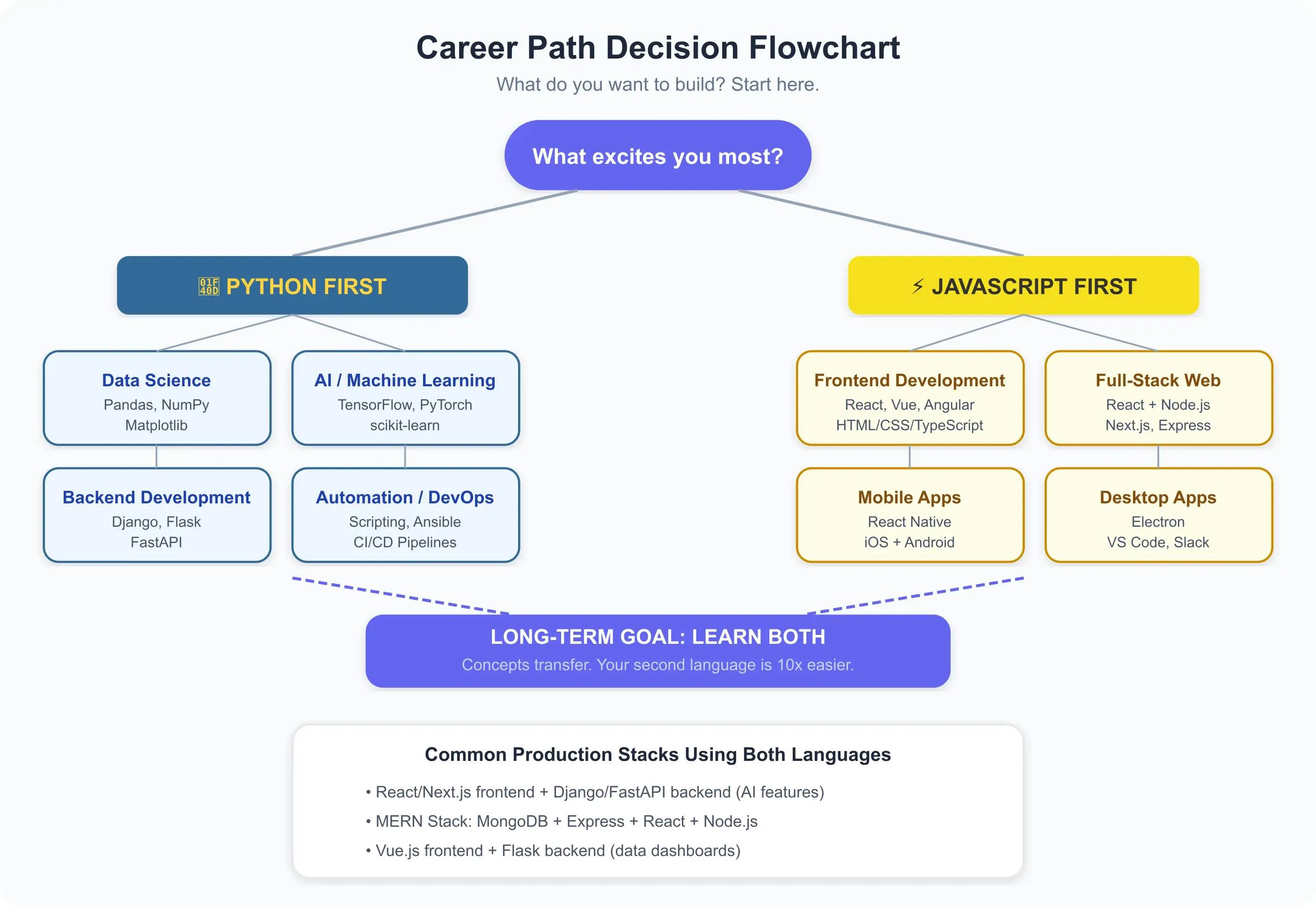
What Career Paths Does Each Language Open
Python Career Paths
Backend web development. Frameworks like Django, Flask, and FastAPI use Python to power web apps and APIs. Django's "batteries-included" approach means it comes with built-in features like an ORM, authentication, and an admin panel. This speeds up development for complicated projects. Many big companies, like Instagram, Pinterest, and Spotify, use Python. If you are building backend systems that handle business logic, data processing, and API endpoints, Python gives you a mature and well-documented toolkit.
Data science and analytics. Data professionals use Python as their main language. Pandas and NumPy help you work with data, while Matplotlib and Seaborn help you make graphs and charts. If you want to be a data scientist or analyst, proficiency in Python is required, not optional.
Machine learning and AI. This is the career path with the highest demand in 2026. Modern machine learning pipelines are built on frameworks like TensorFlow, PyTorch, and scikit-learn. AI/LLM engineering roles now pay some of the highest salaries in the industry. Python's dominance in this area is not a trend. It is structural, resulting from years of library development, research tooling, and community investment. A lot of these Python libraries are fast because they run optimized C and Fortran code underneath. This combines the ease of use of Python with the performance of lower-level languages.
Automation and scripting. Python excels at quick scripts: file processing, web scraping, PDF merging, image editing, task automation, and system administration. If a task is repetitive and rule-based, Python can likely automate it in fewer lines of code than any alternative. This is one of the reasons why Python has always attracted people from non-programming backgrounds. Scientists, researchers, and financial analysts adopted Python because it lets them solve problems without first becoming software engineers.
DevOps. Infrastructure automation, CI/CD pipelines, and cloud management scripts frequently rely on Python. Tools like Ansible are written in Python, and most cloud platforms (AWS, GCP, Azure) offer Python SDKs as first-class citizens.
Cybersecurity. Python is one of the key languages used by cybersecurity specialists and ethical hackers. People use it for security automation scripts, vulnerability scanners, and penetration testing tools. If you know Linux and Bash as well as Python, you can work as a security analyst or cybersecurity engineer in the US, where the average salary is about $127,000 a year.
Cloud engineering. If you want to become an AWS, GCP, or Azure cloud engineer, Python is one of the main languages you will use. You can use Python to automate tasks, manage servers, and work with tools like AWS Lambda and Terraform. If you learn Python first and then move into cloud platforms, you can build a strong, high-demand career with good pay.
JavaScript Career Paths
Frontend web development. This is JavaScript's territory, and no other language can compete with it. Every interactive element you see on the web, from dropdown menus to real-time dashboards, runs on JS. JavaScript is one of the three core web technologies, along with HTML and CSS. React, Vue, and Angular are the most popular frameworks for the frontend. React alone holds 44.7% market share among frontend frameworks. If you want to build what users see and interact with, JavaScript is the only option.
Backend development. With Node.js and Express, JavaScript moved to the server. This was a turning point for the language. A Node.js developer can write both the frontend and backend of a web app, so they don't have to switch between languages for different parts of the same project. Node.js is great for real-time apps like chat systems, collaborative tools, and streaming services because it has an event-driven, non-blocking architecture that handles multiple requests concurrently.
Full-stack development. The combination of React (or Next.js) on the frontend and Node.js on the backend is one of the most common stacks at startups and mid-size companies in 2026. Hiring managers frequently look for full-stack developers who can own an entire feature from database to user interface. JavaScript makes that possible with a single language. With Next.js, server-side rendering and edge computing have become standard, further expanding what a JavaScript developer can build.
Mobile app development. React Native allows JavaScript developers to build native iOS and Android applications from a centralized codebase. Companies that need cross-platform mobile apps without maintaining separate Swift and Kotlin teams often choose React Native as their primary mobile framework.
Desktop applications. Electron lets you build desktop apps using web technologies. VS Code, Slack, and Discord are all built on Electron. While this is a smaller niche, it highlights JavaScript's reach beyond the browser.
Game development and 3D web. JavaScript frameworks like Phaser.js allow developers to create 2D browser games, and libraries like Three.js and A-Frame power 3D web experiences and virtual reality applications. Developers with Three.js skills are seeing a roughly 20% salary premium in 2026 as WebGPU-based 3D web experiences become more common.
Python vs JavaScript: Job Market and Salary in 2026
Let's talk numbers. Both languages are in high demand, but they dominate different segments of the hiring market.
Job Posting Volume
Python has the most overall job postings thanks to the AI boom. Every business wants AI features, and Python is the language that powers most of the AI ecosystem. Data science, ML engineering, and AI research roles almost universally require Python. Backend web development jobs with Django are also strong.
JavaScript dominates web development jobs. The most common type of programming jobs around the world are frontend roles like React, Vue, and Angular. The most common stack at startups and mid-sized businesses is full-stack JavaScript (React + Node.js).
In raw numbers, JavaScript has more job openings than any other language because every website needs it. But the demand for Python is growing faster, thanks to AI.
Salary Comparison
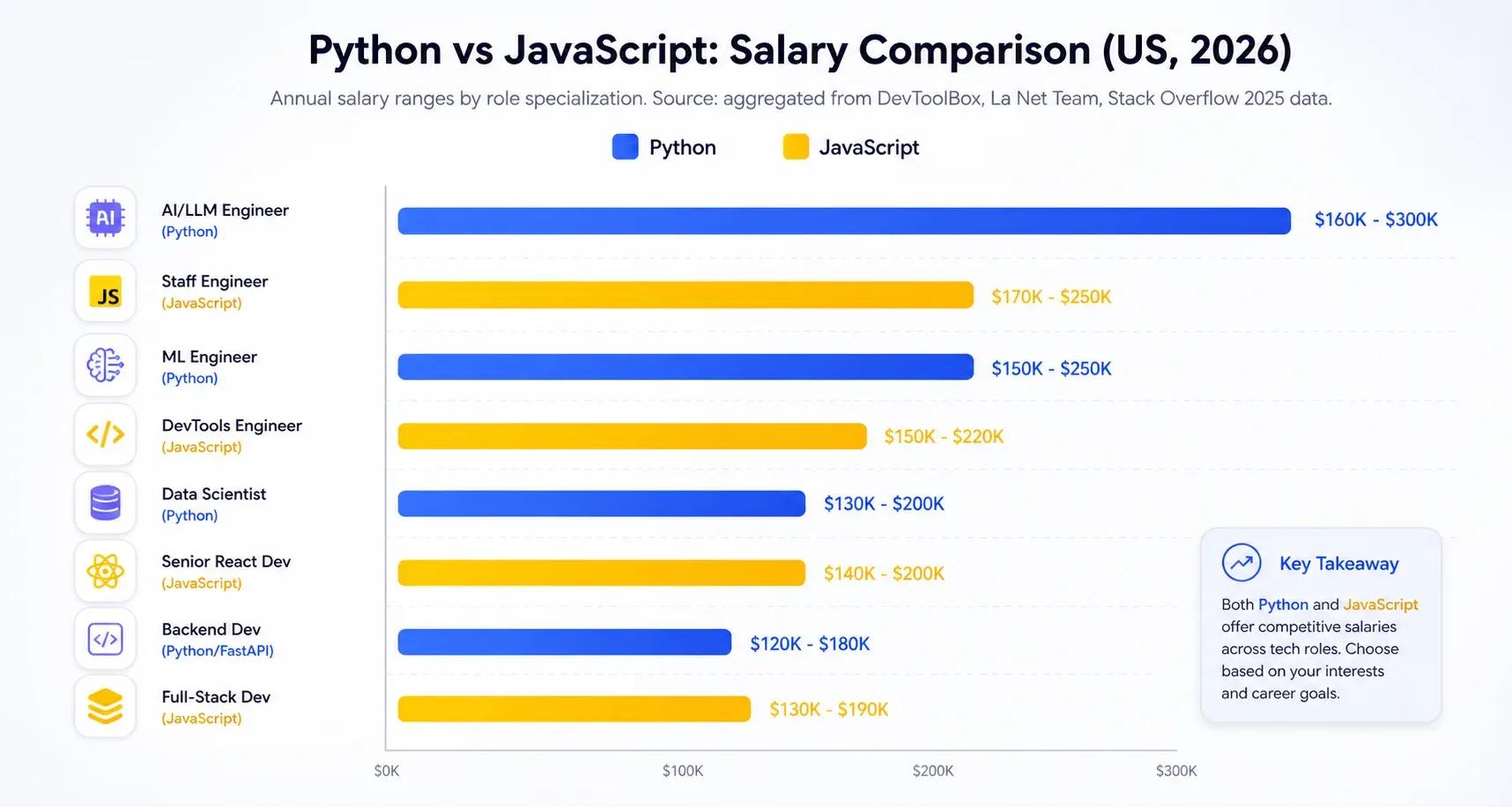
Salaries for both languages are competitive, but the spread depends heavily on specialization.
| Role | Language | Salary Range (USD/year) |
| AI/LLM Engineer | Python | $160,000 - $300,000+ |
| ML Engineer | Python | $150,000 - $250,000 |
| Staff Engineer | JavaScript/TypeScript | $170,000 - $250,000 |
| DevTools Engineer | JavaScript | $150,000 - $220,000 |
| Data Scientist | Python | $130,000 - $200,000 |
| Senior React Developer | JavaScript | $140,000 - $200,000 |
| Full-Stack Developer | JavaScript | $130,000 - $190,000 |
| Backend Developer (Django/FastAPI) | Python | $120,000 - $180,000 |
| General Python Developer (avg.) | Python | ~$128,000 |
| General JavaScript Developer (avg.) | JavaScript | ~$119,000 |
Sources: Glassdoor, KORE1 AI Salary Guide 2026, Levels.fyi, Coursera AI Engineer Salary Guide, Stack Overflow Developer Survey 2025. Ranges reflect base salary; total compensation, including equity and bonuses, can be significantly higher at large tech companies.
The pattern is clear. Python commands a slight premium on average because AI/ML roles sit at the top of the salary curve. But senior JavaScript and TypeScript roles at major tech companies pay equally well. A Staff Engineer working in TypeScript at a large tech firm can earn $250,000 or more.
The main point is that the language you choose isn't as important as the specialization you build on top of it. A junior JavaScript developer will earn less than an ML engineer with 3 years of Python experience. A senior React architect will make more money than a junior Python developer. The depth of your knowledge, not the language you speak, decides how much money you can make.
In this article, we break down the real costs of hiring developers with different levels of experience and skills in different technologies. Read it if you need more in-depth information.
How Do the Programming Paradigms Compare
This is an area that most "Python vs JavaScript" comparisons skip, but it matters once you move past the basics. A programming paradigm is a style of writing code. Both Python and JavaScript are multi-paradigm languages, meaning they support multiple approaches: imperative, object-oriented, functional, and scripting.
Imperative programming (writing code as a series of step-by-step instructions) works almost identically in both languages. This is how most beginners start, and both Python and JavaScript handle it well.
Object-oriented programming (OOP) is where Python has an advantage. Python's class syntax is clean and closely follows the formal theoretical definitions of objects, properties, and methods. In Python, almost everything is an object, even if you do not notice it. JavaScript's OOP syntax has improved significantly with ES6 classes, but it uses prototype-based inheritance under the hood, which can feel less intuitive for beginners.
Functional programming favors JavaScript. The introduction of const (for immutable bindings) and arrow functions in ES6 made functional patterns significantly easier to express in JavaScript. You can chain map, filter, and reduce operations on arrays in a way that reads naturally.
Event-based scripting is JavaScript's strongest paradigm. The Document Object Model (DOM) makes event handling (clicks, scrolls, form submissions) natural and straightforward. This is what powers the interactivity of every website. Python does not have an equivalent browser-level event model, making it less suited for this style of programming.
For early learning and experimenting with different paradigms, both languages work well. But if you plan to specialize in interactive web applications, JavaScript's event-driven model is essential. If you want to explore OOP in a cleaner syntax, Python is a better starting point.
Which Language Is More Versatile?
This is where the comparison gets interesting, because "versatility" means different things depending on what you are measuring.
JavaScript is technically more versatile across platforms. It runs in browsers (which Python cannot), on servers (Node.js), on mobile (React Native), and on desktops (Electron). It is the only language that can build everything from a website to a phone app to a desktop application.
Python is more versatile across domains. It is the go-to language for web development, data science, AI, automation, scientific computing, and education. You cannot build a website frontend with Python, but you can do things that JavaScript simply cannot do well (like training neural networks).
The Common Pattern: Using Both Together
Many production applications use both languages together. A common architecture in 2026 pairs a React or Next.js frontend with a Python backend (Django or FastAPI) that handles ML-powered features. Companies like Netflix, YouTube, Quora, and Spotify run hybrid stacks where JavaScript powers the user interface and Python powers the data and intelligence layers.
The MERN stack (MongoDB, Express.js, React, Node.js) is still one of the most popular full-stack JavaScript stacks. If your project requires a MongoDB database layer with a JavaScript-only stack, MERN provides a unified development experience. But when you need AI features, Python typically joins the architecture. This Python + JavaScript full-stack combination is one of the most in-demand skill sets in the 2026 job market.
Can You Learn Both? (Yes. Here is the Recommended Path)
The best developers know multiple languages. Learning your 2nd language is much easier than learning your first, because programming concepts transfer. And the best developers in 2026 are not "Python developers" or "JavaScript developers." They are engineers who use the right tool for the task.
Here are two recommended paths:
Path A: Start with Python. If your interests lean toward data science, AI, machine learning, automation, or backend development.
Recommended sequence:
- Learn Python basics (variables, data types, control flow, functions, classes)
- Build small projects (a CLI tool, a web scraper, a simple API)
- Pick a specialization (data science with Pandas/NumPy, or backend with Django/FastAPI)
- Build portfolio projects in your specialization
- Add JavaScript when you need to build web interfaces for your Python backends
Path B: Start with JavaScript. If you want to build websites, web applications, or mobile apps. One of JavaScript's biggest strengths for beginners is the immediate feedback loop: you write code, and you see it change a web page in real time. That visual feedback is highly motivating. You can draw a box on screen, move it around, animate it, and feel like you are building something tangible from day one.
Recommended sequence:
- HTML and CSS basics (the building blocks of every web page)
- JavaScript fundamentals (variables, DOM manipulation, events, async/await)
- Build frontend projects with React
- Learn Node.js for backend development
- Add Python later when you need data science, ML, or automation capabilities
Both paths lead to a strong developer career. The key is to pick one and stick with it for at least 3-6 months before adding a second language. Switching back and forth too early leads to confusion. Softaims.com maintains technology roadmaps for popular technologies, including React, Node.js, Python, and more. These step-by-step learning paths can help you structure your journey regardless of which path you choose.
Decision Framework: Which Should YOU Learn First
Choose Python if:
- You are interested in data science, AI, or machine learning.
- You have never programmed before and want the gentlest learning curve.
- You want to automate tasks and write scripts.
- You are more interested in backend logic than visual interfaces.
Choose JavaScript if:
- You want to develop websites and web applications.
- You want to see visual results quickly (things on screen).
- You want to be a full-stack web developer.
- You want to build mobile apps (React Native).
Still cannot decide? Go with Python. The learning curve is easier, the syntax is cleaner, and you can always add JavaScript in a few months. Python gets you writing functional code faster, and momentum matters a lot when you are just starting out.
One additional note for 2026: if you choose the JavaScript path, plan to learn TypeScript soon after. TypeScript is a superset of JS that uses static typing. It is now the standard for developing JavaScript apps that are ready for production. TypeScript is built into most modern React and Node.js projects. It is best to learn the basics of JavaScript first, then move on to TypeScript.
Best Resources to learn Python and JavaScript in 2026
Python Learning
- Python Official Tutorial
- Python for Everybody
- Real Python
- Python Fundamentals on Pluralsight
- freeCodeCamp Python Course
JavaScript Learning
Need Python or JavaScript Developers?
Whether you need a Python backend, a React frontend, or a full-stack team, Softaims can match you with experienced developers who have been building production applications for years. Our engineers are pre-vetted through a rigorous technical assessment and available to join your team within 48 hours.
- Hire Python developers
- Hire React developers
- Hire Node.js developers
- Hire full-stack developers
- Hire mobile app developers
- Hire backend developers
- Hire MongoDB developers
- Hire data scientists
Frequently Asked Questions
Is Python or JavaScript better for beginners?
Python is easier for absolute beginners. Its syntax reads like English, uses indentation instead of curly braces, and has fewer quirks. JavaScript is slightly harder to start with, but it lets you see visual results instantly in a browser, which keeps many learners motivated.
Can I learn Python and JavaScript at the same time?
You can, but focus on one for at least three to six months first. Switching too early mixes up syntax (Python uses elif, JavaScript uses else if) and slows down your progress. Once fundamentals click in one language, picking up the second takes weeks, not months.
Which pays more: Python or JavaScript?
Python averages about $128,000/year in the US; JavaScript averages about $119,000. The gap comes from AI/ML roles topping the salary curve. However, a senior React or TypeScript engineer at a major company can earn as much as or more than a senior Python engineer. Specialization matters more than language.
Is Python slower than JavaScript?
In simple terms, yes. JavaScript's V8 engine is heavily optimized. But for most real-world work, this rarely matters. Python's heavy-lifting libraries (NumPy, TensorFlow) run optimized C code underneath, and web app bottlenecks are almost always database queries or network latency, not language speed.
Can Python be used for frontend web development?
No. Python cannot run natively in web browsers. It handles backend logic, APIs, data processing, and machine learning. For the frontend (what users see and click), you need JavaScript. Many production apps pair a Python backend (Django/FastAPI) with a JavaScript frontend (React/Next.js).
Should I learn TypeScript or JavaScript first?
Learn JavaScript first. TypeScript is a superset of JS that adds static typing, and it has become the industry standard for production apps in 2026. But TypeScript builds directly on JavaScript fundamentals, so learning JS first makes the transition smooth and logical.
Do I need to know both Python and JavaScript to get a job?
No. Most roles require one or the other, not both. Frontend and full-stack web jobs require JavaScript. Data science, AI, and backend roles often require Python. That said, knowing both makes you significantly more versatile and opens up hybrid roles, especially at startups where one person may own the full stack.


 Stackoverflow
Joseph R.

 Verified Expert in Engineering
My name is Joseph R. and I have over 10 years of experience in the tech industry. I specialize in the following technologies: C#, SQL, Python, Magento, Golang, etc.. I hold a degree in Associate in Computer Science, Bachler of Science in Computer Science. Some of the notable projects I’ve worked on include: E-Commerce Product Page, Homepage. I am based in Duxbury, United States. I've successfully completed 2 projects while developing at Softaims.
I employ a methodical and structured approach to solution development, prioritizing deep domain understanding before execution. I excel at systems analysis, creating precise technical specifications, and ensuring that the final solution perfectly maps to the complex business logic it is meant to serve.
My tenure at Softaims has reinforced the importance of careful planning and risk mitigation. I am skilled at breaking down massive, ambiguous problems into manageable, iterative development tasks, ensuring consistent progress and predictable delivery schedules.
I strive for clarity and simplicity in both my technical outputs and my communication. I believe that the most powerful solutions are often the simplest ones, and I am committed to finding those elegant answers for our clients.

Leave a Comment
Need help building your team? Let's discuss your project requirements.
Get matched with top-tier developers within 24 hours and start your project with no pressure of long-term commitment.