


The AI Chatbot Developer as a Conversational Experience Architect
An AI Chatbot Developer is a specialized engineer who designs, builds, and deploys intelligent conversational agents powered by Large Language Models (LLMs). Going far beyond simple, rule-based bots, they create sophisticated virtual assistants that can understand user intent, maintain context over a conversation, and provide accurate, human-like responses. They are architects of the entire conversational experience, from the underlying AI logic to the final user interaction.
This role is mission-critical for companies aiming to revolutionize customer service, automate internal workflows, and create new forms of user engagement. An AI Chatbot Developer leverages frameworks like LangChain or builds custom orchestrations to connect powerful LLMs from providers like OpenAI or Google to a company’s unique data and systems, transforming a generic model into a specialized, expert conversational partner.
Essential Skills for an AI Chatbot Developer
A proficient AI Chatbot Developer has an expert-level command of Python and a deep understanding of the LLM ecosystem. They must be skilled in interacting with LLM APIs, managing API keys securely, and handling the nuances of different models. A strong foundation in Natural Language Processing (NLP) concepts is crucial for tasks like intent recognition and entity extraction.
The most vital skill is expertise in prompt engineering—the art and science of crafting instructions that guide the chatbot's behavior, tone, and accuracy. They must be adept at building complex, data-grounded systems, typically using Retrieval-Augmented Generation (RAG) techniques. Proficiency with vector databases, data preprocessing, and API development with frameworks like FastAPI are also core competencies.

The AI Chatbot Developer's Core Technology Stack

The core of an AI Chatbot Developer's stack is Python, along with AI orchestration frameworks like LangChain or its more advanced counterpart, LangGraph. They are experts in using the libraries of major LLM providers. For building knowledge-aware chatbots, their stack is heavily reliant on vector databases such as Pinecone, Chroma, or Weaviate to store and retrieve information.
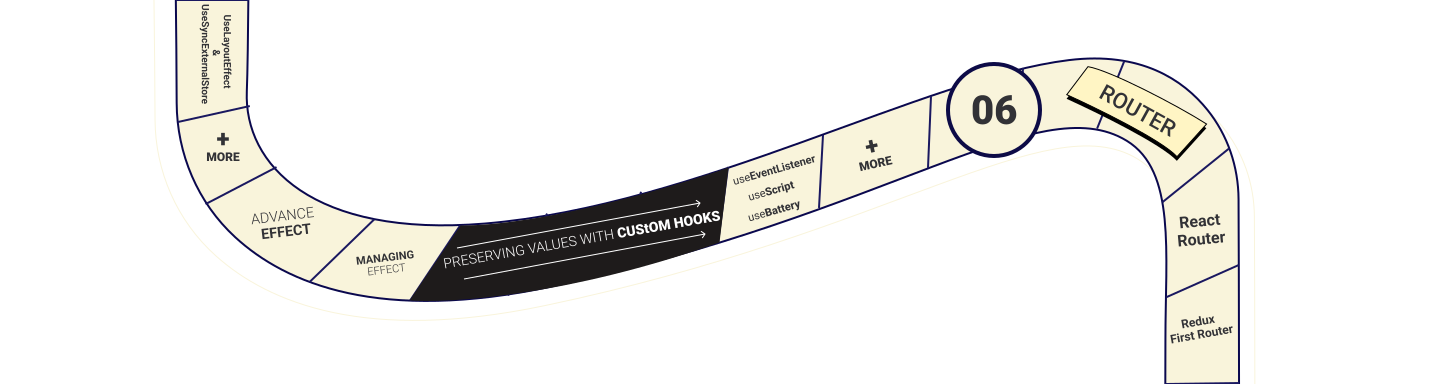
To expose the chatbot to users, they build backend services using web frameworks and deploy them in containerized environments with Docker. A crucial component of their modern toolkit is an observability platform like LangSmith, which is essential for tracing the complex reasoning steps of the chatbot, debugging issues, and evaluating the quality of its responses.
Mastering Conversational Flow and Dialogue Management
A key responsibility of an AI Chatbot Developer is designing and managing the conversation's flow and state. Since LLMs are inherently stateless, the developer must implement a "memory" system that allows the chatbot to remember previous parts of the conversation. This is essential for handling follow-up questions and creating a coherent, natural-feeling dialogue rather than a series of disconnected exchanges.
This involves more than just storing history; it requires sophisticated dialogue management. The developer must design the logic that helps the chatbot understand user intent, extract key pieces of information (entities), and decide on the next best action—whether that’s answering a question, asking for clarification, or handing the conversation over to a human agent. This skill turns a simple Q&A bot into a true conversational assistant.
Implementing Retrieval-Augmented Generation (RAG)
The single most valuable skill for a modern AI Chatbot Developer is the implementation of Retrieval-Augmented Generation (RAG) systems. This is the technique used to connect a chatbot to a company’s private knowledge base, allowing it to answer specific questions about products, services, or internal documents. This grounds the chatbot in factual data, drastically reducing "hallucinations" and making it genuinely useful for business.
The developer is responsible for building the entire RAG pipeline: ingesting documents, splitting them into chunks, creating vector embeddings, and setting up a retrieval system that can find the most relevant information for a given question. They then masterfully engineer the prompt to instruct the LLM to synthesize an answer based *only* on the retrieved context, creating an accurate and trustworthy AI assistant.
Integrating with Business Systems and APIs
A chatbot's true power is unlocked when it can do more than just talk—it needs to be able to take action. An AI Chatbot Developer is responsible for integrating the chatbot with other business systems by giving it "tools." These tools are essentially functions that allow the chatbot to interact with external APIs to perform tasks like checking an order status, booking a meeting, or creating a support ticket in a CRM.
This requires strong software integration and API development skills. The developer must build secure and reliable connections to these external systems and then instruct the chatbot's reasoning engine (the LLM) on when and how to use these tools. This is what elevates a chatbot from a simple information source to a powerful automation engine and a proactive digital employee.
Prompt Engineering for Persona and Accuracy
The chatbot’s personality, tone of voice, and safety guardrails are all defined by the prompts created by the developer. They are expert prompt engineers who craft the master "system prompt" that dictates the chatbot's character, ensuring it aligns perfectly with the company's brand. Whether the desired persona is professional and concise or friendly and empathetic, the developer encodes these traits into the chatbot’s core instructions.
This process is also critical for ensuring accuracy and reliability. The developer writes detailed instructions that guide the chatbot on how to reason, what sources to trust, and how to handle questions it cannot answer. They meticulously design prompts to minimize incorrect responses and compel the chatbot to admit when it doesn't know something, which is a cornerstone of building a trustworthy and responsible AI.
Deployment and Scalability of Chatbot Infrastructure
Building a chatbot proof-of-concept is one thing; deploying a production-grade service that can handle thousands of concurrent users is another. An AI Chatbot Developer must have strong MLOps and backend engineering skills to build a scalable and reliable infrastructure. This includes containerizing the application and deploying it on cloud platforms like AWS or GCP.
They must architect the system to handle the high latency often associated with LLM API calls, perhaps using streaming to provide a better user experience. They also implement robust logging, monitoring, and alerting to ensure the chatbot service is highly available and performant. This operational excellence is key to delivering a professional-quality AI product.
Evaluation and Continuous Improvement
Unlike traditional software, the performance of an AI chatbot can be subjective and hard to measure. A key role for the developer is to establish a rigorous evaluation framework to objectively assess the chatbot's quality. This involves creating test datasets of user questions and ideal answers to score the bot's accuracy and helpfulness.
This is a continuous, iterative process. The developer uses tools like LangSmith to trace and analyze conversation logs, identifying common failure points or areas where the chatbot is underperforming. Based on this data, they will refine the prompts, improve the knowledge base, or even fine-tune a model to continuously improve the user experience and the chatbot’s overall effectiveness.
Ensuring Security and Data Privacy
AI chatbots can be a major target for malicious actors, and they often handle sensitive user information. The developer is the primary defender of the system, responsible for implementing robust security measures. This includes preventing prompt injection attacks, where a user tries to override the bot's instructions, and ensuring that all user data is handled securely and in compliance with privacy regulations like GDPR.
They are responsible for designing the system to avoid leaking confidential information from its knowledge base and ensuring that personally identifiable information (PII) is properly redacted or anonymized where necessary. Building a secure and privacy-conscious chatbot is a non-negotiable part of the role and is critical for earning and maintaining user trust.
How Much Does It Cost to Hire an AI Chatbot Developer
An AI Chatbot Developer is a highly specialized and in-demand role at the intersection of AI, NLP, and software engineering. Their ability to build tangible, value-driving AI products commands a premium salary, comparable to that of a senior machine learning engineer or an AI application architect. The compensation reflects the scarcity of talent with a proven ability to productionize LLM applications.
Investing in a skilled chatbot developer is a direct investment in customer satisfaction, operational efficiency, and innovation. Salaries are highest in major technology hubs where the race to deploy generative AI is most competitive. The table below provides an estimated annual salary range for an experienced, full-time AI Chatbot Developer.
| Country |
Average Annual Salary (USD) |
| United States |
$145,000 - $210,000+ |
| United Kingdom |
$110,000 - $170,000+ |
| Canada |
$130,000 - $190,000+ |
| Australia |
$135,000 - $200,000+ |
| Germany |
$120,000 - $180,000+ |
| Switzerland |
$170,000 - $250,000+ |
| India |
$50,000 - $100,000+ |
| Singapore |
$130,000 - $200,000+ |
| Israel |
$150,000 - $220,000+ |
| Japan |
$120,000 - $180,000+ |
When to Hire Dedicated AI Chatbot Developers Versus Freelance AI Chatbot Developers
Hiring a dedicated, full-time AI Chatbot Developer is crucial when the chatbot is a core part of your product or customer experience strategy. If you plan to build a sophisticated virtual assistant, automate a significant portion of your customer support, and require continuous improvement, security monitoring, and integration with your business systems, a dedicated developer is essential for long-term success.
A freelance AI Chatbot Developer is an excellent choice for well-defined, project-based needs. This is ideal for building a proof-of-concept to test the viability of a chatbot for a specific use case, creating a simple Q&A bot for an internal knowledge base, or providing a burst of expertise to get an existing project over the finish line. Freelancers offer a fast and flexible way to leverage elite AI skills for a specific objective.
Why Do Companies Hire AI Chatbot Developers
Companies hire AI Chatbot Developers to create a massive operational lever and a vastly improved customer experience. The most immediate ROI comes from automating repetitive queries in customer support, freeing up human agents to handle more complex issues. This provides 24/7, instant support to customers, dramatically increasing satisfaction and reducing operational costs.
Beyond support, they are hired to build a significant competitive advantage. A sophisticated AI chatbot can serve as a personalized shopping assistant, an interactive onboarding guide, or a powerful internal tool that gives employees instant access to company knowledge. By investing in an AI Chatbot Developer, companies are building intelligent, scalable communication channels that will define the future of digital interaction.
In conclusion, the AI Chatbot Developer is a key architect of the modern, conversational user interface. They blend expertise in language models, data engineering, and software development to build intelligent assistants that are not just functional but also helpful, reliable, and trustworthy. In an era where instant, personalized interaction is paramount, this role is central to building the next generation of customer-facing applications.